Mona Vale Cottage
21st August 2021
To tie up the research into James Colbeck, though with a loose knot as there are undiscovered facts and legends out there to be tied in, I travelled to Lochiel, Ross, the home of Valerie and Roger Lemaitre.
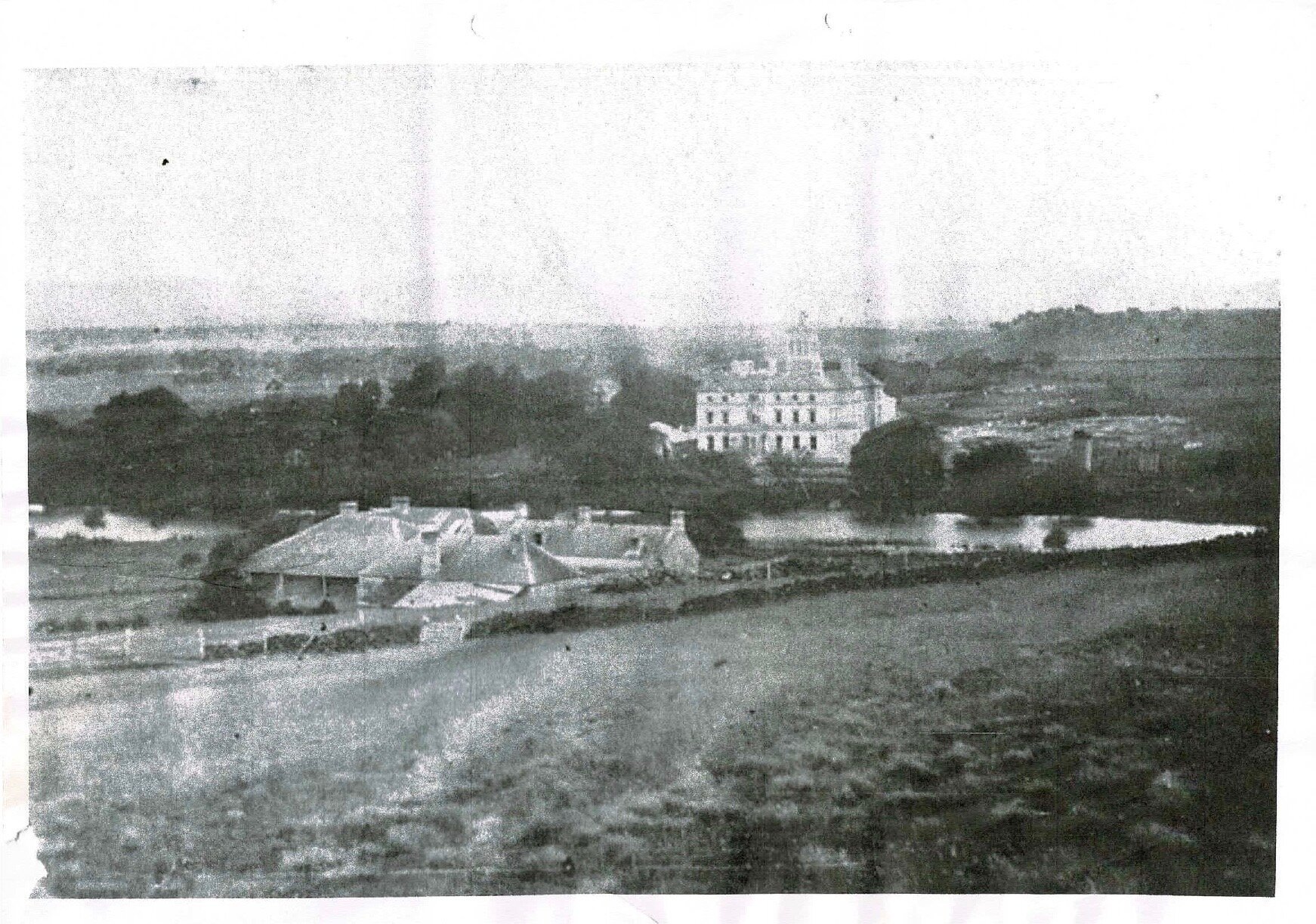
Mona Vale Cottage, in the foreground, the “new” Mona Vale mansion across the Blackman River c1868
Valerie’s maiden name was Cameron. Her family owned the Mona Vale estate after the death of the last of the pastoralist Kermodes.

On the death of his father, Robert Quayle Kermode, Robert Crellin Kermode received the third of the estate that included Mona Vale Cottage. This part of the property had been granted to Thomas Midwood but was purchased from his widow by William Kermode in 1824 .

Survey of Midwood’s Grant by Seymour, marking Kermode’s house on the south side of the Blackman River Tasmanian Archives AF396 - 946
In 1822, William Kermode was granted 2000 acres of land on the Salt Pan Plains south of Ross and in 1824 received an adjoining 1000 acres as well as purchasing the 2000 acres from Mrs. Midwood. Thus he secured an extensive frontage onto the Blackman River and the old Ross Road.

Detail of Plan of the South Esk, Macquarie and Elizabeth Rivers, 1829, Wedge & Darke Tasmanian Archives AF395-1-14
Valerie had ready the few notes she owns about Lochiel. Eustace John Cameron was her father. He had written only two pages on the history of the estate.
It should firstly be remembered that few records of a personal or family nature are available on any Kermode activities. No diaries, letter or comments […] It is believed that after the death of R. C. Kermode they were all burnt on his instructions.
She told me the legend: the son of R. C.’s gardener told her father that he had helped his father burn hundreds of books and papers as the old master had ordered.
As a consequence, these notes on “Lochiel” are in major part guesswork based on cross references elsewhere.
Some kind of dwelling and improvement on the new property (Midwood’s) was essential to fulfil the regulations covering early grants. A brick cottage, its north wall faced with sandstone, was built to house the twenty or so convicts who had been assigned to William Kermode. Valerie said that when the Blackman River was flooded and he could not get across to his own wattle and daub house, Kermode stayed with the convicts. He was known to treat his assigned men well. The cottage was two storeyed; perhaps he slept upstairs while the assigned men were below.
It was known as Mona Vale Cottage until 1927. E. N. Cameron renamed the property Lochiel, paying tribute to Clan Cameron, the head of which is known as ‘Cameron of Lochiel’.
Continuing E. J. Cameron’s notes:
There are no firm dates available so they can only be approximate but it seems as though the house was built in 4 stages in response to demands. The type of architecture, roof variations and type and quality of stone and masonry leads one to this conclusion.
The stages were:-
1 The north west section (kitchen and laundry)
2 The eastern and southern section (living)
3 The south west section (further living)
4 The north east section (sunroom and reception)
I was privileged to be shown the whole lovely house in which Valerie was raised, but only the first two sections are pertinent to the life of the Ross masons.
Stage 1.
This area was built quite early (perhaps 1826 - 1830) as a large stone living area of a communal nature with several attic rooms reached by small spiral staircases. The wall on the northern side was once over five feet thick with a brick oven and a large open fireplace nearly nine feet long. […] This could have been the original Mona Vale Cottage.
Stage 2
This area with its good stone and its well built verandah and front door was almost certainly built by William Kermode for his only son Robert Quayle and his first wife. R. Q. Kermode was married in November 1839 aged 27 to Martha Archer of “Woolmers”, Longford and this was their home.
I knew about kilns built to bake the bricks that were to form the arches of the repaired old bridge. One was on Kermode’s land; there is a paddock called the Brick-kiln. Perhaps, it was built and working before the first bridge gang arrived in 1829 and had provided the bricks for the 1st stage of the cottage. The problem of working with brick is the need for so much limestone for mortar and the outcrops at Mona Vale are of poor quality, according to Valerie. Yet the original brick part of the house still stands. She and I entered it through stage 1, the present brick-walled laundry. We had lunch in stage 2, the kitchen, a room built directly on the earth with thick walls of sandstone.
About 1830, William Kermode’s first house was being replaced with a more substantial brick homestead not unlike an English country inn. Outhouses were being built on the estate as well as the enlargement of the cottage, so there was plenty of work for Kermode’s men and the bridge convicts during their free hours. Also, it is contended, they spent many government hours at paid work beyond the riverbank and arranged to sell government stone, timber, iron, lime and charcoal at good rates to the settlers, there sometime employers and clients. Their lives at the Ross Station were known to be cashed up and comfortable and envied by convicts at other sites, infuriating and exasperating Lieutenant Governor Arthur.
The reason I wanted to visit Lochiel is that James Colbeck, convict stonemason and overseer of the building of the Ross Bridge, had worked for the Kermodes between May 1831, perhaps, and December 1834. This is known from two documents: Charles Atkinson’s and Joseph Boden’s testimonies written in December 1834 and January 1835 in the aftermath of a Christmas Day brawl in a pub between some of the convicts of the bridge gang and the military.
Boden stated that, in payment for their private work, the convicts received money, orders on Mr. Hope’s store, flour, sugar, tobacco and shirts. Some of Colbeck’s money, at least £50, was kept by Robert Quayle to pay for his wife and son’s passage to Van Diemen’s Land. This was to be arranged by Mr. Kermode when he went “home”. Why Nancy and Henry did not travel out to join James is not known. He must have been sorely disappointed; he had been exiled for six and a half years, flogged, tramped the treadwheel and chained in a road gang.
The following statement from Joseph Boden copies the erratic and contemporary punctuation and use of capital letters:
This is all that I know of Government Property going to Mr. Kermode’s since I have been in the Gang but I have seen in Colback’s possession a Bill for £25 for work done for Mr. Kermode. It was certified at the bottom by Mr. Robert Kermode as correct. Colback told me he left the money as well as the last job, I mean by the last job, the Staircase and the Flagging amounting to £25 at least more making £50 in all, speaking as low as possible in Kermode’s hands for the purpose of his (Colback’s ) wife and son coming out from England. Mr. Robert Kermode was to arrange for their passage when he got home.

Extract of Charles Atkinson’s defence
I walk and drive through this midland country to understand the topography of the places I write about, to absorb something of the experience of the characters I want to bring to life. So Valerie took me in her work-a-day ute across her domain: the Parramore graves, the mudstone outcrops, the hill behind Wetmore from which I could see Somercotes, Beaufront and Mona Vale, the lines of the Macquarie and Blackman Rivers, Grimes Sugarloaf and the legendary low mound of Don’s Battery; the waterholes and dams which give her a few month’s grace during this “green drought”, the merino and “chop” sheep and the Hereford cattle; the way the highway cuts off the south-west corner as it did in Kermode’s time; the swelling in the Blackman River that separates Lochiel from Mona Vale, its facade and courtyard visible through wintry, bare branches.
In 1866, before he died of “bronchitis”, which would have been silicosis and emphysema, Daniel Herbert worked there, picked up in Mr. Kermode’s carriage and driven home. I fancy he carved details over the door or perhaps the fountain or the gateposts, work that did not require too much breath.
I still can only surmise that James Colbeck helped to build Robert’s house, Mona Vale Cottage; whether he had flagged the courtyard I walked across or dressed the stone for the sills I could see from the kitchen table. But I do know he was there.