Three jobs to be done at Ross last Sunday
Whether it rained or not, my mind was made up to do three things:
1. To dig around the bases of headstones in the burial ground, looking for the stonemason’s signature, particularly Dan Herbert’s.
2. To site the first St John’s Church, using a photograph in Hawley Stancombe’s booklet on the Parish of Ross.
3. Knock on the door of the cottage that is purported to have belonged to Dan Herbert at 2 Badajos St, to determine if my memory of the back yard with sheds was correct.
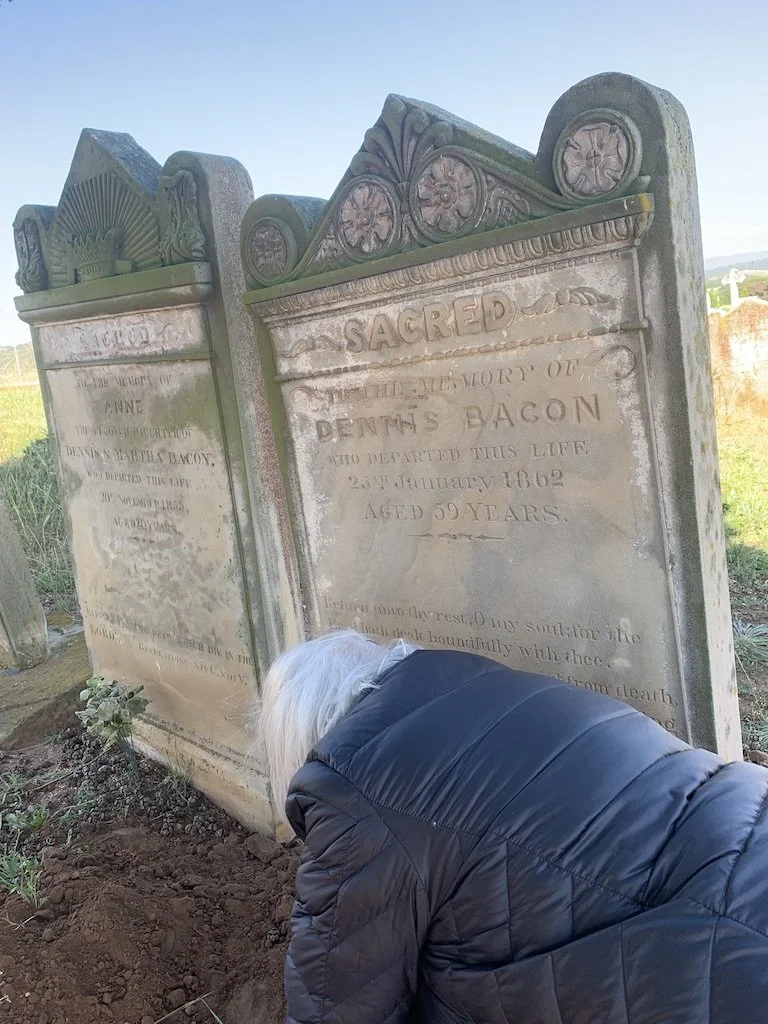
My archivist friend, Kathy, is a willing companion on these exploratory days. Eventually we devised a system so no stone would be unturned, so to speak, and walked along the lines of gravestones, looking for dates before 1866; this, I think, would have been the last year in which Herbert would have carved headstones. Using our trowels with great care so as not to destroy any remnant signature which might have been painted on rather than carved into the stone, we scraped away the soil that had built over many years until the bottom edge of the prepared face had been revealed. Below this line was rough stone. Interestingly, the only possibility was on Dennis Bacon’s stone. He was one of two Irish brothers, stonemasons, who arrived in Ross in 1833, free men with their families. The carving on the top of this headstone matches the gravestone of Edward Barwick in the Oatlands Anglican Cemetery, known to be Daniel Herbert’s work as the signature is prominent. It was carved in 1859, three years before Bacon’s.
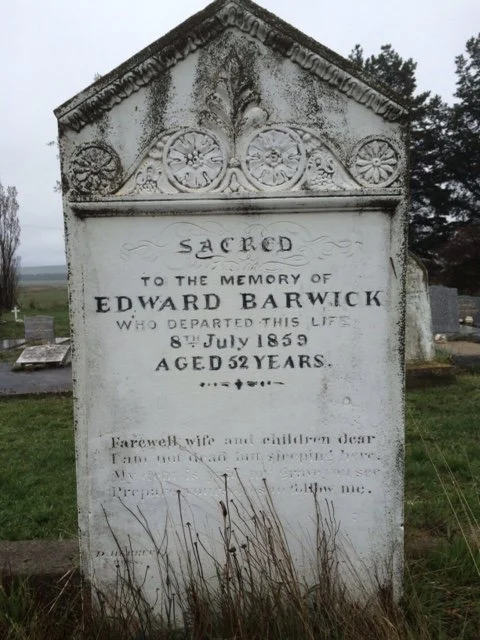
Edward Barwick’s headstone, Oatlands.

There was not a distinctive incised signature on Bacon’s stone. However, marks were present under the soil level. To the hopeful eye, they might read a part of HERBERT. The straight line, their height of 4 - 5 cm, the position on the left indicate the likelihood of a signature - but whose? The decoration is a standard style from a monumental mason’s manual.
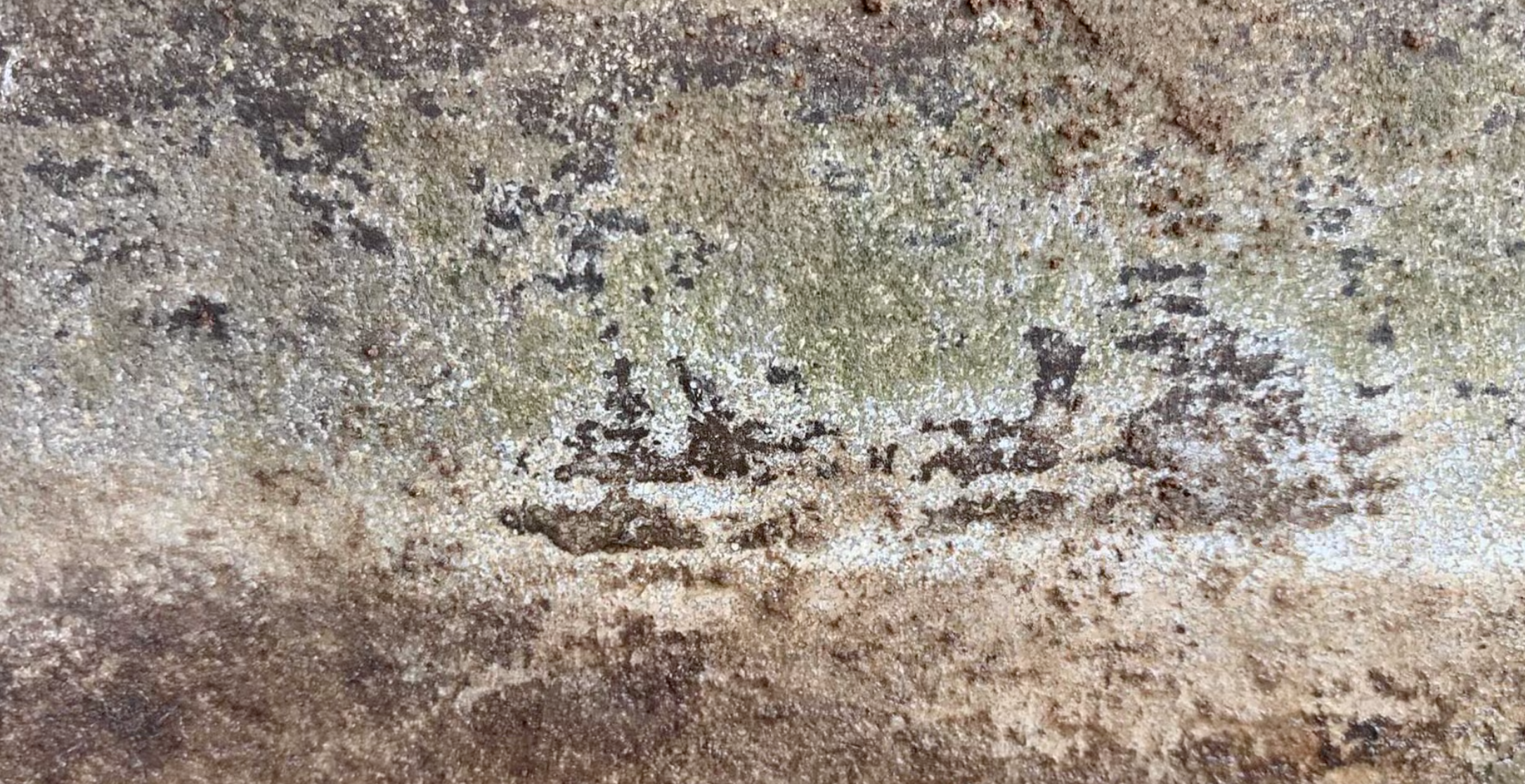
Marks on Denis Bacon’s gravestone, Ross, possibly the remnant of a signature.
Our archeological pursuit being daunted, we bought our eccles cakes and coffee and walked down to the river end of Badajos Street to the cottage which I remembered from the day, years ago, when I had visited the woman who had lived there. Nobody was at home. The nextdoor neighbour was coming out of his gate with his border collie and we asked him if he knew if there had been sheds in the backyard. We were able to look over the dividing fence; indeed there had been open, leaning sheds, recently taken down except for one on the end. What is more, there had been a lot of sandstone rubble which he showed us was still in piles. There were some that looked like broken flags but some as thick as a gravestone. He told us the cottage was built of sandstone, each block being the size of a brick - as if the offcuts of gravestones had been used. Painted white, it was difficult to tell that it was stone. He told us that Daniel Herbert had built the cottage, according to the old woman who had died recently.
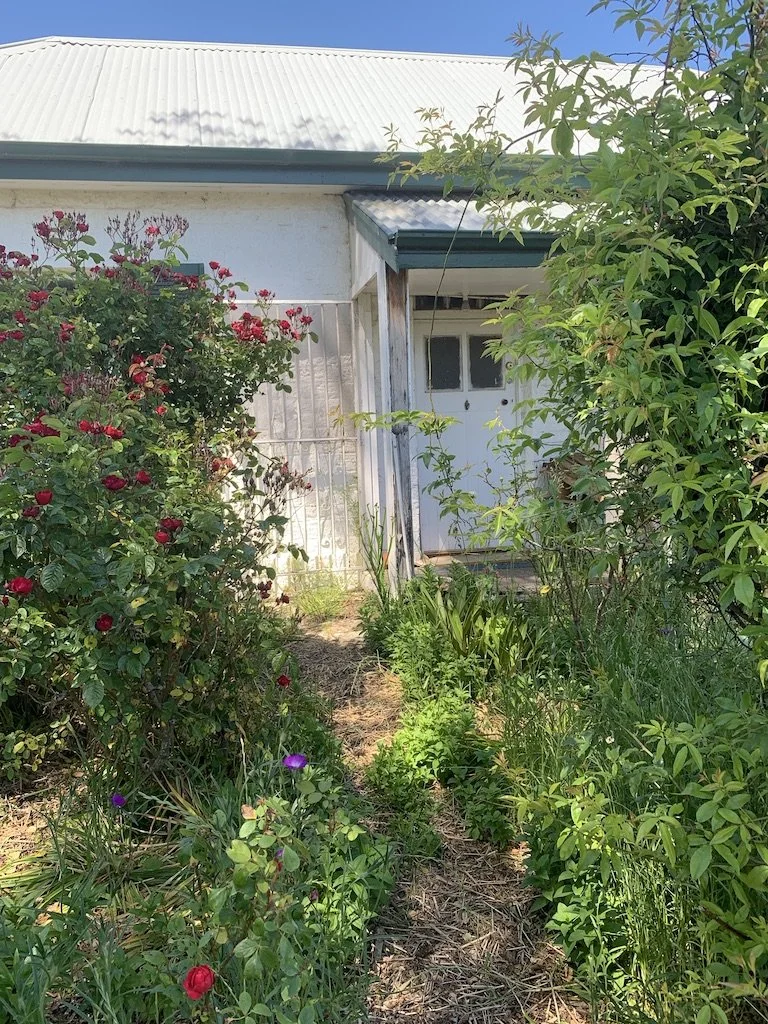
No 2 Badajos Street Ross, according to legend, built by Daniel Herbert.
Over the road, a couple in their garden stopped their work to answer our questions with true village friendliness. They had known and cared for the woman who had lived in the house, Poppy Passmore. She had lived her life-long in Ross, nursing at the local hospitals for over forty years until her retirement. A down to earth, straight talker, with a wry sense of humour, she was a part of the town. They confirmed the belief that Dan Herbert had built the cottage.
On the hill again, we lined up Ben Horne’s obelisk and the Kermode family’s rails in a frame corresponding with the photograph in the booklet A History of the Parish of Ross 1833 - 1969 by Hawley Stancombe.
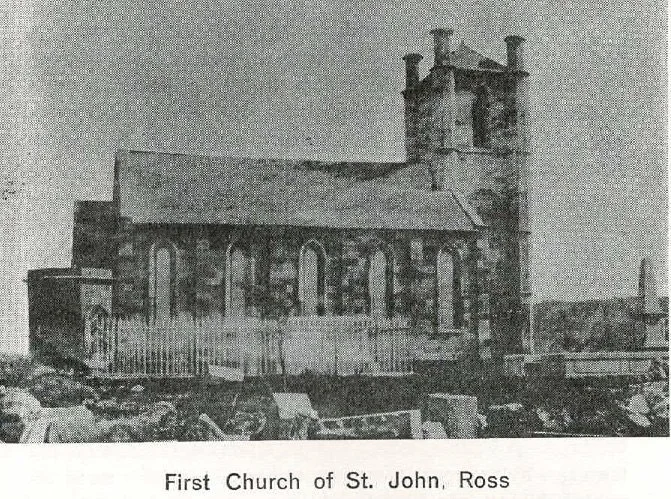

Ross Burial Ground. The graves on the left: The Kermode Family and Louisa Ann Ruffy; on the right: Benjamin Horne.
Having decided the now-demolished church was about where the little tree is, we cleaned the inscription on the table grave of Louisa Ann Ruffy. She died at Mount Moriston in February 1859 at the age of 79 years.
She was the widow of William Joseph Ruffy, Esq. who had died in 1836 at the property of his son, Fernhill, on the West Tamar. Their daughter, Louisa Mary, had married George Scott of Mt. Moriston in October 1837 ( Launceston Advertiser, Thursday 12th October 1837 p3). The intrigue was that the only other grave of that design at Ross is Ernest Herbert’s, Dan Herbert’s infant son. He died in June 1846. Dan was buried with him in February 1868.

Louisa Ann Ruffy, tabletop grave Ross.
The Ruffy grave is plainer than the Herbert’s. The urn that Dan carved for his son is an unusual ornament for a tabletop grave of the early nineteenth century. Sometimes they had a frieze but generally they were elegant and simple. A signature does not remain on Louisa Ann’s stone, if it was ever there …
Three jobs done as well as could be in one day; as well as a mystery about grave belonging to Louisa Ann Ruffy, widow of William Joseph Ruffy, gentleman.