The Eye of Providence
or the Third Eye, or the All-seeing Eye.
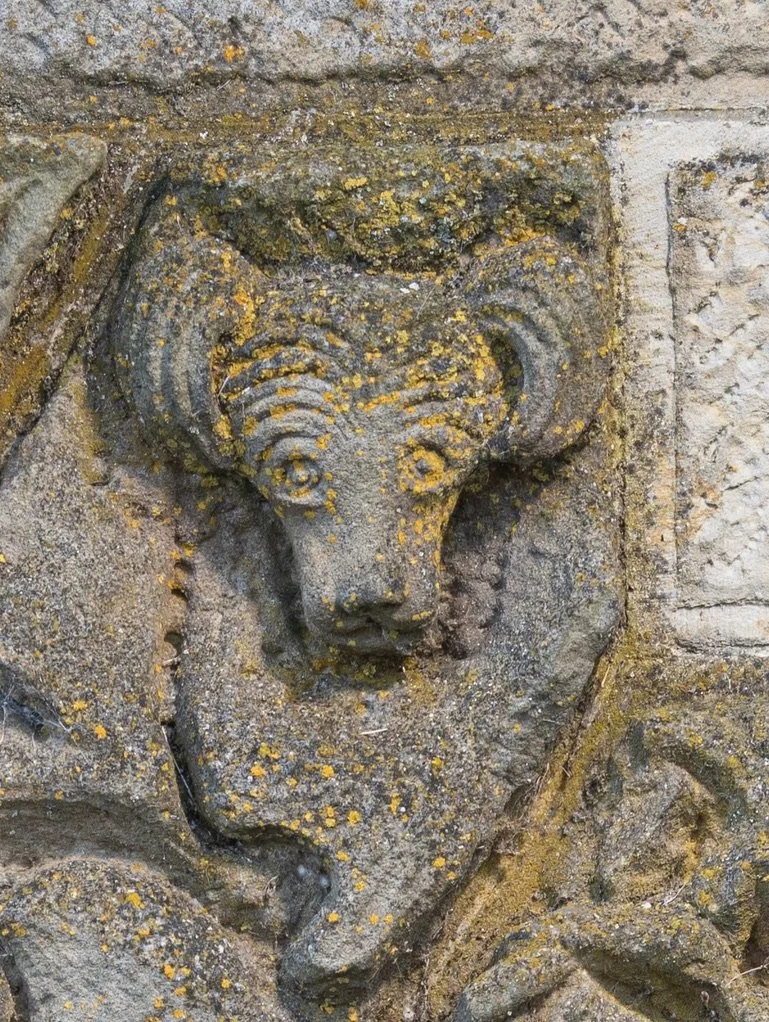
7th arch stone, right side of, the eastern arch, south face. 2025
The photo of the apparently worried dog taken by Norman Laird in 1968, has a distinct rounded disc between the furrows that crease his brow. Only its remnant remains. (Ross Bridge and the sculpture of Daniel Herbert 1970)
I have thought it had a link with freemasonry; perhaps it does though it is not found in the oldest freemasonry rites. It was not a symbol recognised in Freemasonry until the late 18th century.
The notion of a third eye is ancient and ubiquitous, associated with religions. It represents an entry into the soul, symbolising enlightenment through meditation.
The All-seeing Eye or the Eye of Providence is known to be esoteric and prone to misinterpretation. In Christian art of the renaissance, it represented God., the personification of Divine Providence, the benevolence of God, His compassionate watchfulness over humanity. The rays of light that are often shown emanating from the symbol represent the Divinity’s radiance.
Jeremy Bentham was regarded as a leading advocate of the separation of church and state, freedom of expression and individual legal rights. He proposed the Panopticon, a prison allowing a watchman to observe occupants in their single cells from a central station, without them knowing whether or not they were being watched. The Separate or Model prison was not build at Port Arthur until 1857 - 62, long after this sculpture of the watching dog. The Pentonville architectural model upon which it was based, with its radial prison wings, was not designed to facilitate constant surveillance of individual prisoners. Guards had to walk from the hall along the radial corridors and could only observe prisoners in their cells by looking through the cell door's peephole.
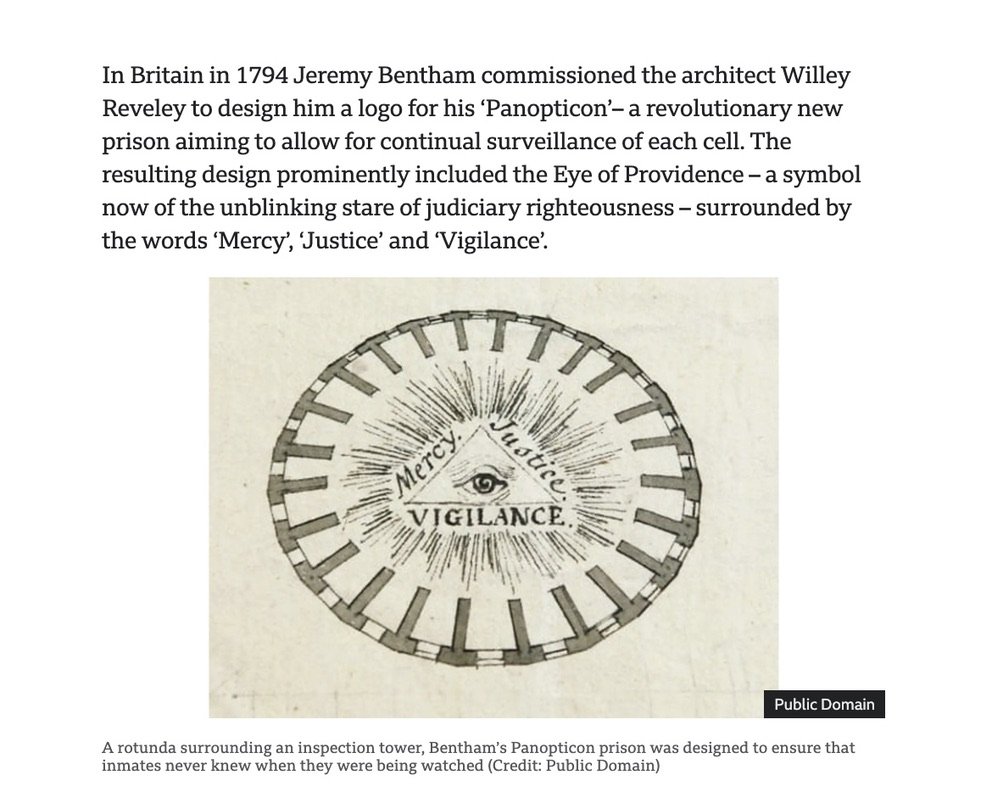
One supposes that crime, punishment and prisons were common topics of conversation amongst the transported criminals. Colbeck and Herbert would have known about prison reform in Britain because York Castle was undergoing renovations when they were incarcerated there though Bentham’s proposals had not been embraced by the government. The Quakers were advocates of reform and the treatment of prisoners as human beings … James Backhouse and George Washington Walker, Quaker missionaries, were in Van Diemen’s Land between 1832 and 1834. It is possible that Herbert and Colbeck were among convicts who spoke with them.
Is it not intriguing, that during this time of agitation for prison reform, a convict carved an observing eye among rays of light on the brow of a dog?
The Port Arthur Historic Site Management Authority by Design 5 - Architects Pty Ltd 5 Queen Street, Chippendale, NSW 2008 Phone: (02) 9319 1855 FINAL REPORT Issued June 2003