The mantelpiece at 31, Church Street, Ross
There is a mantelpiece in a room through the shop and dining room of Bakery 31 that I had heard was carved by Dan Herbert. But was it?
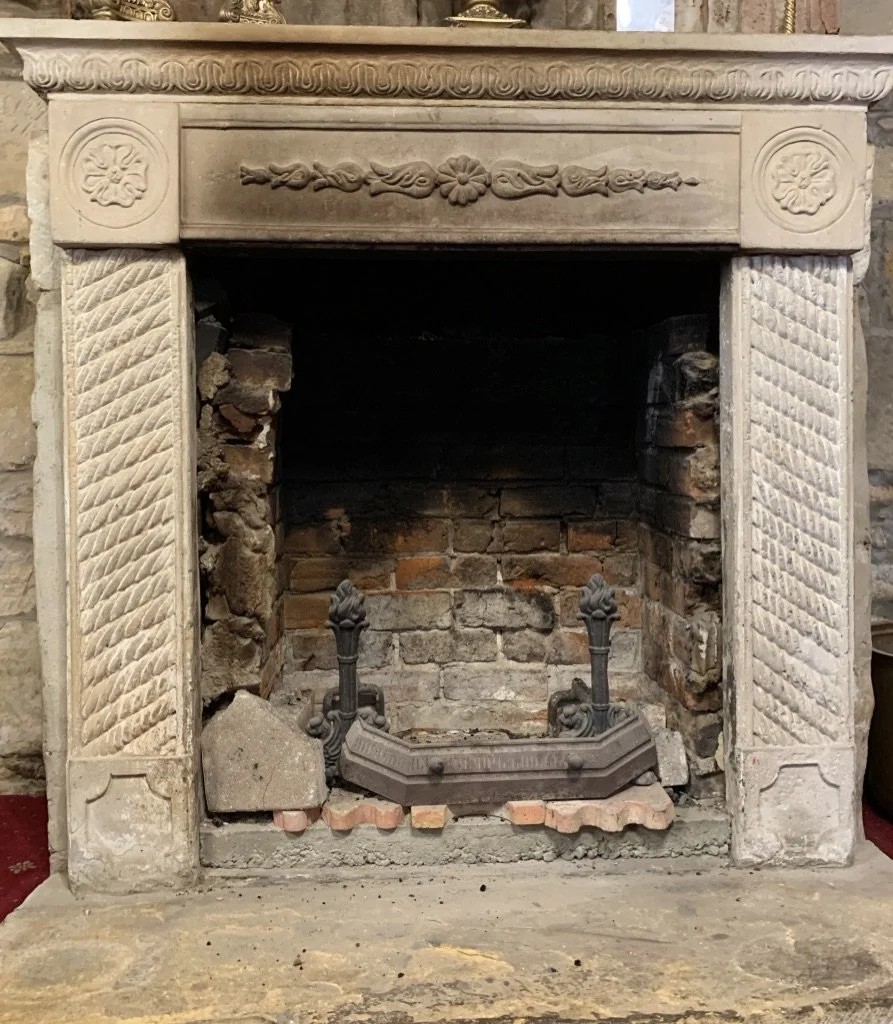
The mantelpiece at Bakery 31, Ross.
I scrabbled around its base and under the shelf hoping for a signature but could not find one.
In the Ross village interactive map, it is stated that the house originally belonged to Robert Standaloft.

24. Bakery 31 and Tasmanian Scallop Pie Company. Originally the home of the Standaloft family, it was converted to a shop in 1880.
Robert Standaloft was born in Somercotes, Lincolnshire in 1834. He arrived in Tasmania in the ship ‘Alice Watson’, a literate, Church of England gardener among 294 immigrants. They had departed Liverpool on September 30th and arrived in Launceston on 30th December, 1856, a trip of only 90 days. Captain Samuel Horton of Somercotes, Ross, had applied for his passage out. He married Elizabeth Cawthorn(e) in 1863 and moved into the town some time afterwards. They both died in 1912. (Tasmanian Names Index; Robert Standaloft)
It seems the land upon which the cottage was built was granted to WIlliam Rogers and purchased by Dennis Bacon by 1845 from the then owners, perhaps William Hill and James Hope. In his will, Bacon bequeathed to his son Charles the land he had purchased from James Hope who owned the block on the western boundary of No. 31. (He bequeathed a second block of land and cottage to James, his son, probably the one over the road by the Roman Catholic Church.)

Detail of Map of Ross, 24/4/1845 Robert Power, Surveyor General AOT AF721-1-584.
Bacon was a stonemason who had arrived with his brother, John, in the ‘Strathfieldsay’ from Ireland in 1833. He and John built elegant Beaufront; Dennis was still living there in 1843. The brothers extended Lochiel Cottage at Mona Vale and John was there with his family in 1843. (Tasmanian Names Index; Dennis Bacon, John Bacon)Although the 1845 map indicates the land was owned by Dennis Bacon, the title was officially granted in 1856. (Tasmanian Names Index, Denis Bacon). (In 1858, he purchased 5 acres on the corner of Nivelle and Vittoria Roads.)

Barbed Quatrefoil with a variation of an egg and anchor moulding. Detail of the mantelpiece, 31 Church Street

Barbed Quatrefoil with egg and dart moulding; Detail Headstone of Dennis Bacon’s grave, Anglican Cemetery Ross
The questions are: Did Dennis Bacon build the original house that is the centre of the present bakery and therefore, was likely to have carved the mantelpiece? The Bacon brothers went to Antill Ponds in 1848 where Dennis became a publican, returning to Ross by 1856. He owned a store at his residence until he died in 1862. (Launceston Examiner 1st April 1862 p6) Did he carve his own gravestone? Daniel Herbert is buried under the stone he carved for Ernest Henry, his infant son. Or did John carve it? He died in 1864 of consumption. Or would Martha Bacon, Dennis’s wife, have asked Dan Herbert to do it?

These marks in such a straight line may be the remains of a signature at the base of the headstone of Dennis Bacon’s grave - but they are indecipherable.

Barbed Quatrefoil; Eastern Arch North Face Ross Bridge
These quatrefoils (four leaves) or four petalled rosettes are on the 8th voussoir on the north-facing eastern arch of the bridge. They are more likely to be the work of Herbert than the Bacons. It has never been suggested that the brothers had a turn at carving an arch stone or two, though I have wondered. A quatrefoil is made of four overlapping circles of the same radius; with an inscribed square, it becomes a barbed quatrefoil, the corners of the square resembling rose thorns placed between the petals. They are ancient forms and were absorbed into Christian art and decoration in the Gothic period. The number four is said to represent the evangelists. In other cultures, four symbolises the cardinal points, the seasons, the elements, the humours ….
The bridge motifs are more complex than the quatrefoils on the mantelpiece and probably indicate the bridge artist’s intent to use symbols in his great work. There were three before the stone was cut down to fit; and there are three veins in each petal or leaf referring to the Trinity. There are four barbs and four ridges at the tip of each. There are the two crosses, the Greek and Saltire within octagrammic stars formed by two squares overlapping . The eight-pointed star has symbolic significance in freemasonry as does ‘squaring the circle’.
The rope design on the pillars is a standard enrichment of a bead moulding and the central decoration is typical of a simple oblong panel. (F. S. Meyer Handbook of Ornament 1888). There is no specific symbolism in the carvings on the mantelpiece.
The more I research the bridge sculptures in parallel with Daniel Herbert’s life, the more I think he was brought up amongst people who questioned the circumstances that had brought British folk to their knees, all except for the traditionally and newly wealthy. I think they belonged to the dissident sects or religions: the Quakers, the Independents (Congregationalists), perhaps the Methodists and the Bible Christians; the latter based their religious practice and philosophy on the works of Emmanuel Swedenborg. The Freemasons in London embraced Swedenborg, as did William BLake for a time. It is fascinating to me, that while interpreting the contents of the sculptures on the bridge, I have come to these institutions of which I knew very little or nothing before I began - not the other way round.
But does that help determine who carved the mantelpiece? I dare not say.