Was Daniel Herbert a good lad, a reader, a student?

For years I have pondered the childhoods of Daniel Herbert and James Colbeck. The gallery of sculptures on the Ross Bridge must relate to their experiences, as a novel might allude to events in a writer’s life. James Colbeck was illiterate, yet he was a master mason and stone carver capable of irony. Daniel Herbert could read and write and was also a sculptor of subversive works.
Charles Knight was the editor of the weekly magazine in which Thomas Carter’s autobiography was published in 1845, Memoirs of a Working Man. Knight asks the reader: “Shall we feel an equal interest in the “personal memorials” of a man of humble station, unknown to the world - who may, indeed, have had as strong aspirations after knowledge as the most illustrious author of his age, (he is referring to Edward Gibbon), as much satisfaction in its acquirement, but who has walked through life humbly and obscurely - who has laboured with his own hands to earn his daily bread - who has endured the bitterness of poverty - who has been prostrated for years by chronic sickness - whose earliest lot was toil and indigence - whose accumulation for the day when the small rewards of toil shall be no more than are of the scantiest amount? Such a man is the Working Man whose memoirs are now presented to the reader”.
He goes on to say that the public is always curious to know the men who have left behind them any image of their minds ….
The Memoirs of a Working Man is accessible for free on Google Books. Within are answers to questions about the books available in a poor man’s home and, as interesting, is the passage about children who play in the streets as opposed to those who are kept inside. (p22)
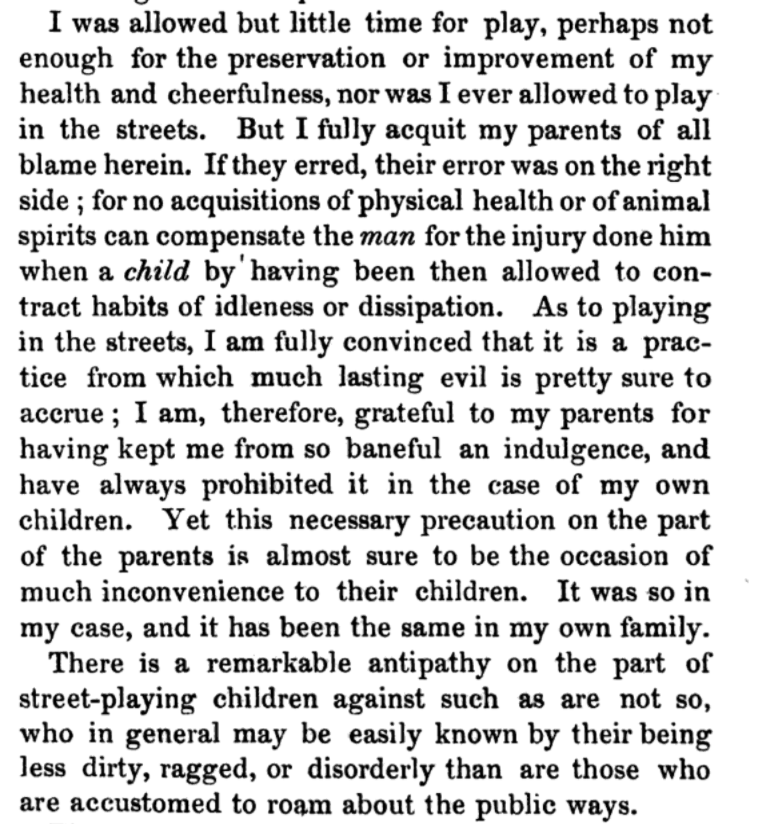
He attributes this antipathy to Envy with a capital E. He says there is a dog-in-the-manger attitude among “the indolent, the dirty, and the dissolute poor”. The street kids call the better dressed and clean children by “opprobrious names; charge them with being imitators of the dress or the manners of the rich”; and will go out of their way to insult or injure them. Whether he is right of wrong, he says he knows not …

So, he describes two classes of poor people; do they equate with the deserving and undeserving poor? Where did Dan Herbert belong when he returned to Eccles with his widowed mother in 1803?
I have to say, I had come to the conclusion that Dan was an unruly child. His father died when he was a toddler; a corporal in the Inniskilling Dragoons when Dan, his youngest, was born in February, 1802. Why he died in Birmingham in 1803 is not known. It is clear that Mary, Dan’s mother, was a camp follower which means she and the children travelled with the regiment in its peripatetic existence around England. The births of her other children were in garrison towns when the regiment was stationed in them. Daniel, the father, was a member of the freemason’s lodge attached to the 6th or Inniskilling Dragoons, so Mary might have received a small handout from them when she was widowed. The British Government did not provide pensions for soldiers’ widows but a collection from the ordinary ranks was often taken up. We know from baby Daniel’s baptism record that the family was of Manchester; it seems impossible that the mother and children walked the 85 miles home. Perhaps most of the money was used up in coach and inn fees.
I think Mary had been Mary Rogers before her marriage and she belonged to a large family in the Eccles district to which she is likely to have returned. One of the families was Quaker; others attended the local Church of England. In those days, dissenters might also be faithful adherents to the established church and able to use those facilities for their celebrations. The Reverend John Clowes was such a man, a follower of the writings of Emanuel Swedenborg but disavowing separation from the Church of England into which he had been ordained. It was he who married the widow Mary Herbert, aged 46, with Thomas Bulmer, aged 54, on November 25ht, 1817, the Quaker Mary’s birthday.
Thomas Bulmer was one of the Bible Christians, a sect led away from the established church and the Manchester Swedenborgians of the New Jerusalem Church, by Clowes’s erratic curate, William Cowherd, in 1793. He had built his own chapel, Christ Church, in Salford by 1809 and it was there that Thomas and Mary were buried, in 1827 and 1834 respectively. Clowes set up an academy with an emphasis on scientific inquiry and perhaps this is where Dan was educated. But Cowherd was notorious for his methods of dispensing severe discipline and maybe this, on top of a straight-laced step-father ,caused Dan Herbert to rebel.
When or whether Thomas assumed the role of step-father before he married Dan’s mother, we cannot know. He was gaoled for three years for a misdemeanour, probably relating to insolvency, in 1814. Perhaps Dan did not regard him with respect, yet learned something about endurance during imprisonment from this criminally charged interloper. A condition upon entering the Bible Christians was the acceptance of a vegetarian diet and abstinence from alcohol; so such demands on an adolescent might have compounded the adverse aspects of their relationship.
Thomas and Mary lived in Pollard St., Ancoats. A once pleasant grassy part of Manchester, Ancoats was a slum by 1817. Two rivers crossed it and, at first, their waters were used for many water-powered mills. Later, they sucked up the waters for steam that depended on coal to power new-fangled machines in even more and larger factories. The atmosphere became thick and low with smog; rapacious investors provided inadequate housing for the factory hands; alleys between factory walls and apartment blocks lost their light and became fouled with excrement; homeless people lived in squalor; sickness and poverty heralded death. Perhaps, Thomas, Mary and the children lived there because it was cheap. It was from Ancoats that Dan committed his crimes. They occupied rooms in The Hampson’s Building, which belonged to a family who were cotton merchants. Bulmer was a chapman and dealer; that is one who invested in the raw materials of the textile trade. He bought raw cotton and yarns and ‘put out’ to the domestic spinners and weavers; then he passed on the spun or woven product for a profit. But the once dignified domestic artisans were suffering from the ravages of industrialisation; hence his own insolvency. One wonders whether the Hampsons had known him in prosperous times and offered him a home in his misfortune.
A stonemason, John Rogers, lived and worked in Coates St. off Jersey St. in Ancoats. Perhaps he was a relative and offered Dan an apprenticeship, although there is no record. (In 1827, in the Orders for Transportation (indents) of the convict ship Asia 3, it is recorded that Daniel Herbert had been a stonemason for three years. But he committed his first burglary when he was seventeen, was gaoled for two years; immediately committed his second burglary and was in a hulk for four years; within weeks of his release in August 1826, he embarked on a series of highway robberies for which he was transported. Therefore, the only three year period in which he could have been a ‘stonemason’, was from the age of fourteen when he was likely to have been apprenticed. The Elizabethan Acts that protected apprentices were unenforceable by the turn of the century because unskilled cheap labour was superseding that of the apprentices and journeymen. The laws were repealed in 1813. Elizabeth Gaskell describes apprenticeships and the slums of 1840s Manchester in her book, Mary Barton.)
Returning to the recollections of Carter, we can imagine books in an “entertaining library” for children …. isaac Watts’ Divine Songs for the use of Children was reprinted in cheap editions for years and read amongst dissenters as well as anyone of any denomination; coverless farthing copies of Tom Thumb, Red Riding Hood, Jack the Giant KIller, Robinson Crusoe, all in abridged form; Agnes Bulmer’s Scripture Histories and the Methodists’ Arminian magazine, as well as some scrounged copies of the Gentleman’s Magazine. But most tantalising is the possibility that Daniel Herbert was introduced to Songs of Innocence and of Experience written, illustrated, printed and illuminated by William Blake (1790 & 1794). They evoked the poor and oppressed, injustice and the sorrows of black children. The best known, The Tyger is about good and evil and asks how could God have made them both.
Tyger, Tyger burning bright,
In the forests of the night;
What immortal hand or eye
Could frame thy fearful symmetry?
[…] Did he who made the Lamb make thee?
This dilemma about good and evil was addressed by Swedenborg but his theosophical conclusion was rejected by Blake in his own vision of the cosmos: The Marriage of Heaven and Hell, also published in 1794. In it he expressed his belief that the material and physical world was equal with the Divine. Hell was not a place of punishment but of unrepressed energy; Heaven was ordered, authoritarian and regulated where conventional morality and institutionalised religion was repressive. Good was Heaven: passive, obeyed reason, and was organised. Evil was Hell, but was active, energetic and creative. The marriage between these contraries was necessary to human existence.
The Reverend Clowes was a disciple and translator of Swedenborg; he broadcast the scientific and mystical ideas in his sermons. Thus the Rogers of Eccles would have heard them; the children who attended Clowes schools would have learned them; there would have been a library which would have had his books and perhaps those of Blake. Dan’s mother probably joined the congregation of the deserting William Cowherd where she met Thomas Bulmer; she may have enrolled her boy in the Cowherd Academy where he would have been encouraged to read.
I wonder if, in the misery of his exile, Dan Herbert thought about the Divine Songs and Songs of Innocence and of Experience; if, by contrast in his wrath, he brought to the bridge the irony of Blake’s libidinous Hell in which his creations were forged. I have no doubt that Dan’s maturing from a thug to a rebellious artist and then to an emancipist was grounded in unusual influences as a child.
Thomas Carter wrote that the surprising tenacity with which the memory retains whatever has been learned in childhood , naturally suggests the necessity of taking care that what is then acquired should be worthy of remembrance . For myself , I have now after an interval of more than forty - five years — a clear recollection of the little books which I read when a child , and which then formed the principal part of a poor child's “ Entertaining Library . ”