The symbols of Freemasonry’s mysteries are not to be found in the Ross Bridge carvings

A stonemason’s compass is carved in Daniel Herbert’s beard.
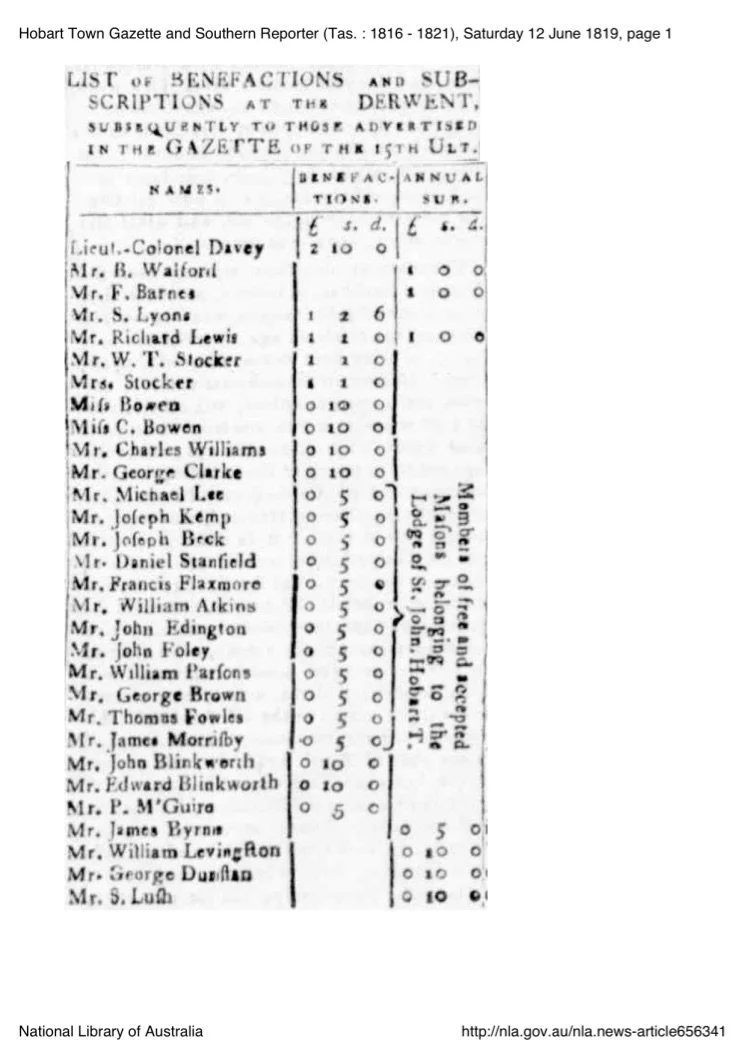
This morning, I spent an interesting hour with the librarian of the Grand Lodge of Tasmania. I had years of questions to distil into time available, having formed the opinion that many of the symbols in the sculptures were derived from the mysteries of freemasonry. He was well prepared and pleased to help me; first he showed me a book compiled by his predecessor on the history of Freemasonry in Tasmania. In this volume was a reference to a list of members of “free and accepted Masons belonging to the Lodge of St. John, Hobart”, which had originated on Norfolk Island. (Hobart Town Gazette, 12th June 1819). My question whether convicts could be freemasons was partly answered, because Francis Flexmore, William Atkins, Williams Parsons, George Brown were “second fleeters” and Thomas Fowles arrived in 1796, all convicts. However, it seems from the lists of membership in other early Hobart Town lodges, this indulgence was not permitted. (Norfolk Island 1788 - 1813 The People and their Families James Hugh Donohoe)
There is no evidence of Daniel Herbert being a member of a lodge. According to the librarian, the inverted V in his beard is likely to be a pair of compasses, a sign that he was an operative stonemason but not a freemason who had lost his square.

6th voussoir central arch, north face L.
I was sure this stone of seven falling faces was from the masonic mysteries but the response was adamantly negative. In Freemasonry’s symbols, there are no references to falling, or descent. I had thought this may symbolise the soul falling to earth to be enclosed in a fleshy mantle, only to have to undergo the task of rising again to a state of purity, freeing itself of its material dross. References to this work of the freemason are about ascent, not descent. I was shown a picture of a ladder rising into a cloud of glory which is Heaven.
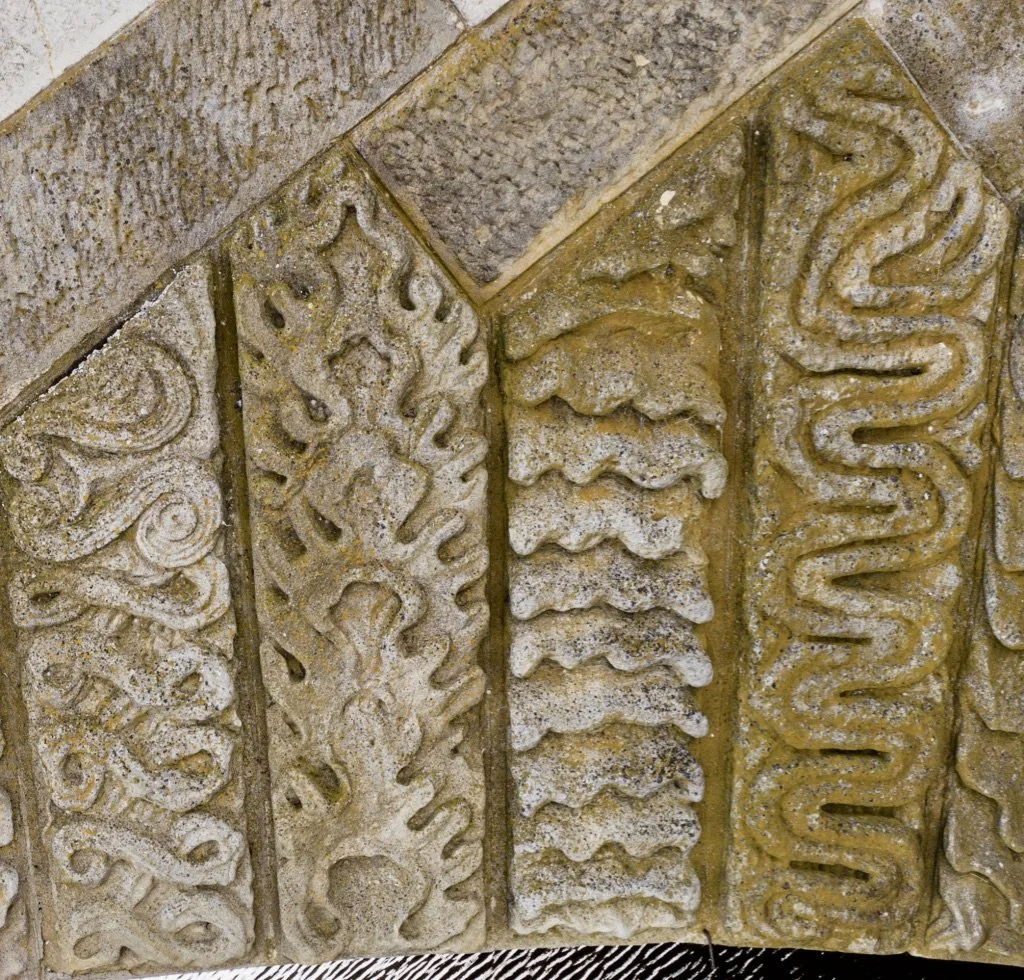
Voussoirs 3, 4, 5, 6, central arch, south face, associated with Daniel Herbert’s portrait.
This quartet of stones represents air, fire, water and earth. The elements are contained within some masonic rituals and symbols. In particular, I thought I was close with the detail at the top of the air stone, on the left.

Again, the response was ambivalent. The reflected spirals, the point within the circle, the triadic figure in the centre did not evoke a strong positive. And, the librarian was keenly anticipating an association between the Craft and the bridge carvings!

Voussoirs 2, 3, 4, 5, 6 central arch north face.
The numbers 3, 5, 7, and 9 are special in freemasonry as is the sequence 3:4:5. Both series pertain to squares - squaring one’s square. They appear in the set of 5 stones above.
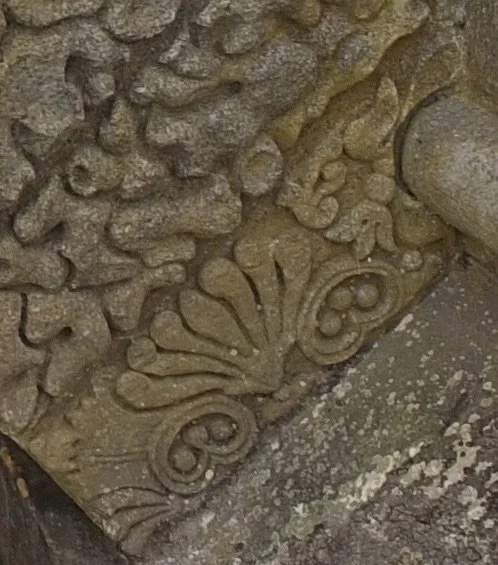
1st voussoir west arch north face R.
The numbers 3, and 7 appear again in this lovely carving tucked away at the base of its half-arch. There could be a little lily and two pomegranates, though there is not much plenty with only 3 seeds. In Freemasonry, the lily represents peace and the pomegranate plenty.

I suggested this stone was about the equilateral triangle and the notion of reflection ….

… and the idea of metamorphosis or transition from a lowly fleshly creature into a butterfly spirit. But no, these could be metaphors from any philosophy and there is nothing about larvae and butterflies in masonry.
So we were both disappointed but I was relieved that I had not published a book claiming the bridge was immersed in freemasonry’s mysteries. A few people would have come crashing down upon me, he said.
However, when fresh eyes are brought to this project, they always shake it up -

Keystone eastern arch north face.
I had never thought of this figure being a dachshund and well she might be because Caroline of Brunswick, the disappointed wife of the Prince Regent, was the daughter of a duke of a princely state of the German speaking people, though their unification did not occur till 1871. I always thought she was a rat; actually, I think she does have rat paws.

Keystone central arch north face.
And the four spikes on this parody of a regimental crest would be pikes or half-pikes; the cords probably were attached to banners, the cloths of which form the background to the sculpture. I was glad of the explanation.
Although my theory about John Lee Archer, Worshipful Master of the Tasmanian Lodge 313 in 1836, exhorting Dan Herbert to redeem himself as a masonic initiate might, plying him with tracts, I do not feel I have completely failed in the quest; I have read many essays about the Freemasons, their history and symbols which are accessible to the non-member world; and enjoyed returning to Euclidian geometry and biblical texts that I learned at school.
There is much revision to be done - duffer to have dared to think the work for the books was nearly finished.