The Judge, No-name, the French bulldog, the Thespian, the bearded man and the poodle.
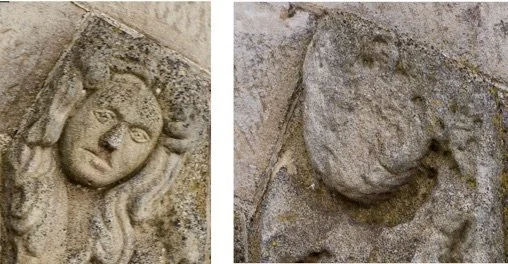
The Judge No-name

The Thespian French Bulldog

The Poodle The bearded man, perhaps a Dissident Preacher
Just when I think I have finished this work on the enigmas of the Ross Bridge; just when I think I am progressing, editing the second draft, I doubt myself and become stuck. I have a little wallow in the bog, recalling Professor Vic. Gatrell’s warning in the beginning, that I should not expect too much from the stones. But, if I broadcast my thoughts, perhaps someone’s brilliance will shine upon them; my appeal to the reader: agree, consider, disagree and wonder … and most of all imagine.
It has been the thespian who has been stalling me for a few days … the 7th voussoir, on the right as you look at the western arch of the south face, easily seen from the bank. He is coupled with a French Bulldog - I am sure that is the breed of dog as it has round ears and I think it reasonable to interpret the caricature, the French dog metaphor, as a Republican. The bridge contains political drama: the keystones mock the monarchy; the grotesque of George Arthur mocks the Van Diemen’s Land penal code and, by extension, the Bloody Code of Britain. i.e. her capital laws at the time of transportation of convicts, men and women, to the American and then New South Wales colonies.
On the north face, five caricatures and an ox span one and a half arches with the intervening carvings … the eastern and central arches. Probably they tell a tale of local characters of Ross.
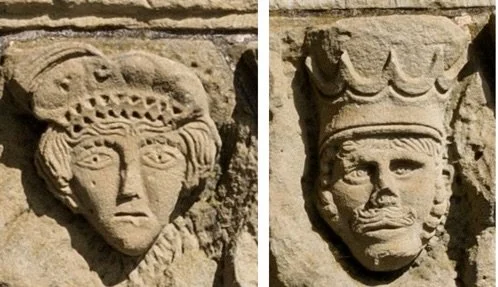
Norah Corbett (Jorgenson) Jorgen Jorgenson

Christian Cameron Rum John Conn, her husband

The farmer-scholar, probably John Headlam and his ox
Therefore, instead of considering separately the judge, No-name, the bulldog, the actor, the bearded man and the poodle, imagine them in a sort of petrified tableau vivant. Such parlour games were popular during the late Regency and the Victorian period, in which the costumed characters arranged themselves as still as statues, silent, as in a famous scene from history, the bible or literature or a well known painting. The spectator would deduce the story from their own experience, memory or imagination, guessing or knowing.
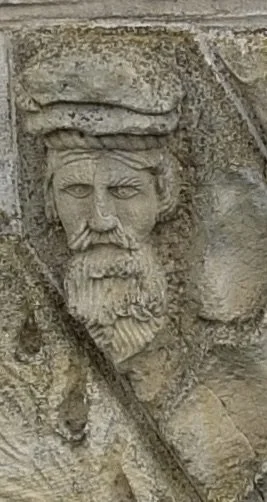
7th voussoir on the left, Central arch, south face
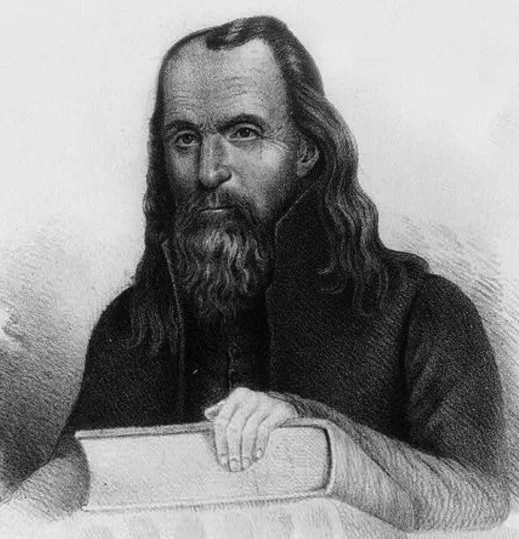
Lorenzo Dow, American Preacher, who visited England, preaching particularly to the Methodists and Primitive Methodists of Lancashire and Yorkshire.
The beard and fierce eyebrows flummoxed me. I have trawled through books, old articles and illustrations about stonemasons from the medieval time to the Regency and there is not an image of a mason with a beard. It is true, they do have moustaches but, I suppose, the stone dust in a full beard would cause an irritation of the skin. Daniel Herbert had a moustache while working on the bridge but not in later life. This is pertinent, because at first I associated the bearded man in the tradesman’s cap with Herbert, suspecting he was his master. And then by chance I found this small article while browsing through the British Newspaper Archive for anything relevant in 1827, the decisive year for both Colbeck and Herbert.

Morning Advertiser, 1st June 1827 p3
I already knew about Lorenzo Dow from researching the Primitive Methodists of the West Riding, Yorkshire, in relation to James Colbeck. So I suspect the bearded man might represent the dissenting religious men of Herbert’s or Colbeck’s childhood. How to connect him with the poodle? In England and originally in Germany, poodles were hunting dogs; more specifically, retrievers of waterfowl - ducks and swan from swamps and lakes. - creatures shot down by hunters. Could the good preacher be a hunter?! - hunter and retriever of souls? My sense is that is a long straw. Returning to the French idea - applying the same metaphor as with the bulldog, perhaps the poodle metaphorises an effeminate republican or a woman who entered Colbeck’s or Herbert’s narrative.
At this stage, let me remind you of Charles Atkinson, the young architect who superintended the Ross Bridge work party between 1833 and 1835, and who knew about architectural decoration from his years as a student in the office of George Basevi; afterwards as a designer of British churches with his partner, Thomas Witlam Atkinson; who, in 1829 in London, published a portfolio of 48 lithographs of gothic decorations in the cathedrals and churches of England. According to his biographer, Sally Hayles, he probably came from a family of Russian merchants, Russophiles. Always in the back of mind is his influence on the stone carvers.
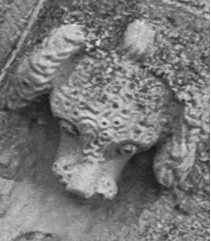
The poodle 9th voussoir central arch south face on the left.
The moustached thespian in the Shakespearean ruff and small brimmed hat has a rueful countenance. His brow is grooved in a worried frown; His hair flops to one side; his lower lip is full; perhaps he is trying to smile but it tends to down-turn. His disproportionately small left hand is lifting his hat in a gesture of reluctant farewell. Is the ruff telling us he is acting a role that is not true; that he is hiding his identity, his republican sympathies? Or, is he role-playing to mask an intimate friendship with the man he is farewelling? In this context, the French dogs, the masculine and the effeminate, may represent the public opinion that Europeans introduced to England that most grievous sin of love between men. According to George Haggerty, in his book Men in Love, the use of the French language in reference to loving male relationships in the 18th C and early 19th C, suggested the sodomitical. To be accused of sodomy was to be pilloried, publicly hated, transported or executed (the last execution in England for sodomy was 1835; in Tasmania 1867). To be a Republican might have incurred a prison sentence but not social death.. This would explain the judge and the ignominious face without features. It also explains the carving on No-name’s stone which I interpreted as the myth of Ganymede.
The tableau in the courtroom: the judge high on his bench; No-name shamed in the dock. The verdict has been decided; sentence has been passed. His friend is turning at the door to see him one last time; perhaps he is putting his hat on before he disappears into the crowd. The preacher from the village chapel has carried the letters of good character, pleading and praying that the death sentence be commuted. He will take the news of the trial back to the mother and father. The trial might have been for burglary or highway robbery and the affectionate friendship might have remained unrevealed.
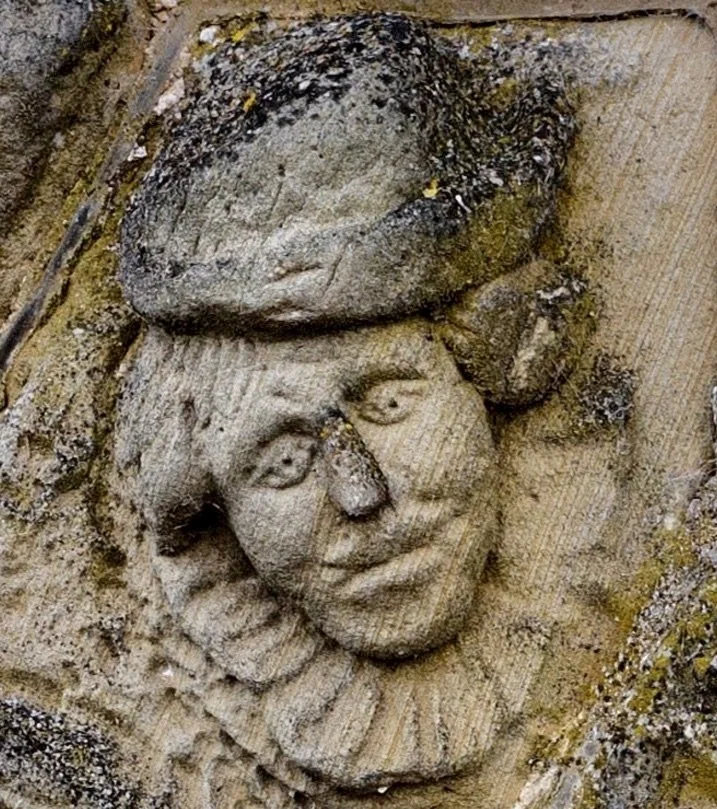
Thespian, 7th voussoir western arch south facade on the right.