Charles Atkinson’s Death.
CHARLES ATKINSON WAS THE SUPERINTENDENT OF THE ROSS BRIDGE PARTY FROM NOVEMBER 1833 UNTIL JUNE 1835, a young Londoner amongst a gang of toughened, uncontrollable convicts. Afterwards, he contracted to build two churches, his own designed St. John’s in Ross and John Lee Archer’s St. Luke’s at Campbell Town. But the Church committee’s promises of funds were not adequately fulfilled; convict mechanics and labourers were lent from local gangs begrudgingly; Atkinson had no money of his own; his tenders were too low to enable sturdy construction - and then he was terribly hurt in a chaise accident and died as a consequence on March 21st, 1837.

Possibly Charles Atkinson, superintendent of the Ross Bridge party from November 1833 till June 1835. West arch of the north face.
Young Henry Emmett was Charles Atkinson’s principal creditor in his efforts to raise money for his contracts: the building of the churches at Campbell Town and Ross. On Wednesday, !st March 1837, Charles was driving in a gig to Launceston to raise money on a security given him by Henry. He had to pay for supplies for the projects; the debts were pressing. Henry had established himself as a merchant in Campbell Town and rented Mr Jellicoe’s house, Camelford, from Mary Jellicoe and it seems his father, Henry Emmett snr. and family were living in it. Henry jnr. had recently returned from Port Phillip but had not taken up land in Victoria.(Launceston Examiner Obituary Henry J. Emmett 28 Dec 1881; AOT Census 1842 Mary Jellicoe).
Charles was thrown out of the chaise and suffered a compound fracture and dislocation of the bones of his right leg. Doctor Strang and Dr. Brock considered his life was in imminent danger. The next day, Dr. Strang sent a messenger, John Duxberry, to Launceston to request the presence of Mr. William Seccombe, surgeon, ostensibly of fine skill but of an irresponsible and uncooperative nature. (ADB) Henry Emmett snr. wrote to the Lieutenant Governor, newly arrived Sir John Franklin, asking for government money to assist with the costs of Charles’ medical and domestic care, because neither he nor his son could possibly bear the expense. Henry Jnr. had lost “full £500 by the failure of the persons to whom he parted with his business” (CSO5-1—17). Mr. Emmett brought to the Lieutenant Governor’s attention that it was generally known that the churches had ruined Charles.
On Sunday afternoon, Dr. Seccombe amputated Charles right leg, having intimated that his recovery was doubtful. By Thursday 9th, despite the unremitting attention of Dr. Strang and Mr Atkinson’s friends, his “case was considered hopeless”. The stump was washed in brandy and dressed regularly; the discharge from the wound was copious; the suffering was dreadful. He died three weeks after the injury on Tuesday 21st March. His death was inevitable although “every attention which skill could desire was assiduously bestowed by the district surgeon, Mr. Strang”, with the “assistance afforded by Mr. Surveyor Dawson with whom Mr. Atkinson was in the habit of intimacy.”
Charles had made his will a day or two after the amputation. It was not proved until 1840, Henry James Emmett, the younger, being the executor, then living at May Farm on the Tamar River. Charles bequeathed his books to Henry Emmett Snr and it is interesting to note the authors of some of them: Augustus-Charles Pugin, Augustus Welby Northmore Pugin, his son, and John Britton, all architects in London when Charles was associated with George Basevi and the government churches. Also, he gave Henry Sen. two boxes of papers, the larger containing drawings entitled “Views of Hobarton”. They were probably the original sketches from which he took the lithographs in 1833. Mr Dawson of the Survey Department was given Molton on Perspective. The wording is difficult to follow in the lines thereafter, but it seems Mr Dawson also received Brewster’s Letters on Natural Magic and Imms 1 Volume. ( I am not sure of the content of this book). A box containing colours, brushes and mathematical instruments with a roll of drawing paper went to Mr. Dawson as well as any papers not enumerated and his linen and cloths. “Such things that were stated in my former memorandum to Mr Nicholson sic. of Ross, I wish him to have. “ David Strang was the kind and attentive doctor during Charles’ illness, who replaced the disgraced Barry Cotter with whom Charles had had an antipathetic relationship; he received the pair of duelling pistols. A sum of £50 Charles had inherited on the recent death of his mother was bequeathed to Henry Emmett jnr. in part payment for money owed to him. Also any interest that might accrue from the building of the churches, so his creditors could be paid.
But there was no profit in those ecclesiastical projects. Both were partly pulled down and rebuilt. In 1846, movement in the walls of St. John’s threatened the support of the roof. The side walls were taken down to the foundations where it was found they were only two feet thick which was insufficient. (Hawley Stancombe, A History of the Parish of Ross.)
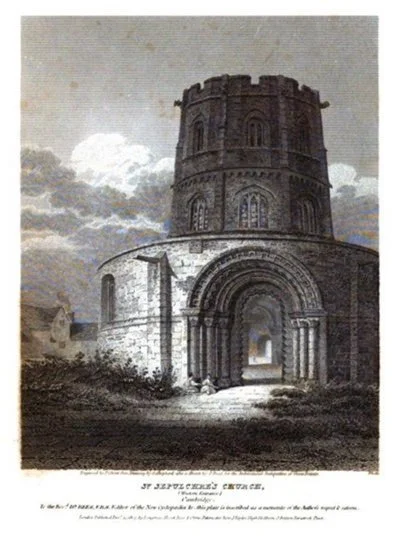
St Sepulchre’s Church where Uncle James Atkinson of 31 Russell Square was buried. In Pugin’s Examples of Gothic Architecture

This caricature is Charles Atkinson in my imagining.
It is sad he has lost his nose. His eyes appear bewildered;
his mouth slightly open in a gasp of surprise or bemusement or exasperation:
“Not again?”.
The carving is probably by James Colbeck who knew Charles well.
He must have observed the young man, beset by the men he was supposed to be commanding
but who were controlling him because he was soft and kind.
Probably, Colbeck helped him build his church at Ross after the bridge was completed
in July 1836, struggling with the stones that were rejects from the bridge,
that were the wrong dimensions to sustain the structure.
And yet, he was no ninny. The books Charles’ owned evoke an analytical intellect touched by the romantic. The greatest treasure was Thomas Malton the Elder’s Complete Treatise on Perspective in Theory and Practice (1778). Today, one may buy this book on ebay for $2,875.00 or read it for free on esmoa.org. One wonders if William Dawson received it as the bequeathed gift his friend intended or whether young Henry Emmett insisted it be sold to pay the creditors. Within, theories are made clear by various moveable schemes and diagrams: all the plates are folding except for the frontispiece and four others; another four are fitted with moveable pieces, like a magical pop-up book but a serious exegesis for a student of architecture to have on hand.
Then there were the architectural works by Auguste-Charles Pugin, John Britton and Peter Frederick Robinson. Imagine Charles during those fraught months, even years, climbing between the hangings of his bed and hiding from the world with the meticulous illustrations of Gothic ornaments and edifices published by Pugin as lithographs in Specimens of Gothic Architecture (1821 – 23) or his Examples of Gothic Architecture (1831). And he would remember Thomas Witlam Atkinson and himself preparing the plates that were published in their own portfolio in 1829; and the fine review in The Gentleman’s Magazine.
Or he might have taken into his cubby John Britton and A-C Pugin’s collaboration of 1828, Specimens of Architectural Antiquity in Normandy or Britton’s own A Chronological History and Graphic Illustrations of Christian Architecture in England.(1830). Both authors produced exquisite architectural drawings of the early Romantic period, exhorting the wonder of Gothic buildings. Peter Frederick Robinson published Designs for Ornamental Villas in 1830; perhaps the romance in the lithographs sustained Charles’ dreams during his tribulations in the constrained and cruel colony; perhaps he shared it with the settlers exhorting them to greater designs. Another volume he owned was probably Sir William Chambers’ A Treatise on Civil Architecture (1759) though it is mentioned in the will as Chambers’ Architectural Designs. Charles had lent it to Dr. Temple Pearson of Ballochmyle, south of Ross.
Brewster’s thirteen Letters on Natural Magic were written to Sir Walter Scott during 1832, examining the ‘magic’ of natural and mechanical occurrences such as optical illusions and musical and harmonic sounds. Considering the carved faces on the bridge, the paragraphs on the manner in which eyes in portraits follow the watcher are particularly intriguing, evoking my imaginings of the stone carver at the bridge being beckoned by Atkinson before he was dismissed. If the mason had been James Colbeck, the book would have been read or the phenomenon explained to him, as he was illiterate. If he had been Daniel Herbert, it would have been at a time when Charles was a mere visitor to the site and, because Dan was well educated, he may have asked to borrow it; he lived only a few houses away from Atkinson’s home.
Charles was a reader of poetry and a musician as well as an artist. He bequeathed his music to Miss Mary Elizabeth Emmett and his musical instruments to Mr. Nicholson (sic) of Ross. Mr Nicolson is likely to have been Norman Ronald Nicolson whose brother was married to a Miss Davidson whose family bought Camelford. Charles asked that the part of the double flageolet which he had borrowed be returned to John Headlam. His five volumes of the Poetical Work of Thomas Moore including his Melodies, Ballads etc may have been covered in brown calfskin, with a richly gilted spine and gilt edges, the inner book covers also bearing rich gilt ornaments, another treasure bequeathed to Henry Emmett Senr. with the architectural books. In a box given to Henry Emmett Senr. were the drawings entitled Views of Hobart Town, probably the originals of the lithographs Atkinson had published in 1833 when, though momentarily stalled, life was so full of promise.