What if the Judge, No-name, the French Bulldog, the Thespian, the Bearded Man and the Poodle enact a Tableau?
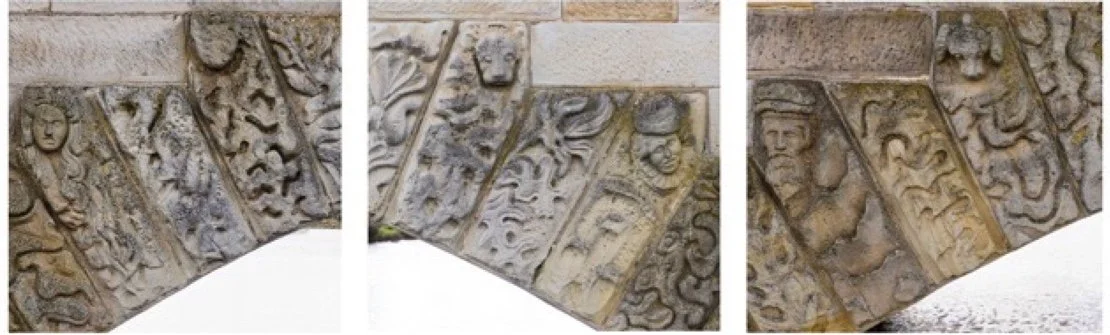
The Judge , No-name, the round-eared dog and the Thespian
First, I must admit a recent reticence about the round-eared dog being a French bulldog. The dates only allow it with a squeeze.
French bulldogs descended from English toy bulldogs during the 19th century about the time the convict stone carvers were transported. The trade blockade between Europe and Britain during the Napoleonic Wars caused the unavailability Flemish thread for the English domestic lace industry. At the same time, John Heathcoat’s lace-making machines began to impoverish the cottage lace-makers of Nottinghamshire. Treacherously, their special product was being replaced by machine-made pieces that used locally spun cotton, worked by cheap, less-skilled labourers in Heathcoat’s manufactories. Even as their livelihood was threatened, these women took a fancy to small English bulldogs with wonky ears; the reason is not known. In June 1816, Heathcoat’s mill in Loughborough was destroyed, commonly thought to be the last campaign of the Luddites. Circumstances forced the lace-makers to move to the north of France where their particular skill was still admired. Their funny little dogs went with them. The pets soon became popular, were crossed with pugs and terriers until their round ears became their signature but probably not till the 1860s. By 1835, a “Frenchie” may have been the lapdog of a settler woman familiar to the Ross masons - we do not know.

On the north face, eastern arch, a series of portraits probably forms a narrative tableau.
The judge probably represents British justice, or injustice, depending on which side of the world or court room one was sitting. He is similar to Hogarth’s men of the higher court immortalised in his illustration for his essay on portrait, caricature and grotesque, The Bench. Sir John Hullock sentenced both Herbert and Colbeck in York. Herbert had been before the courts twice before his death sentence was recorded in 1827.

The Bench William Hogarth British Library
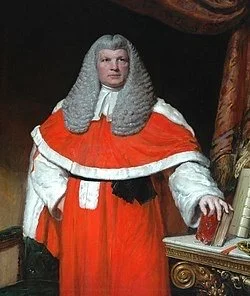
Hullock J., the judge who sentenced both Herbert and Colbeck
I imagine the visage without details was meant to be that way, representing the convict in the dock, shamed and terrified of execution or exile.
The dog associated with the man in the ruff could be a bear. I had thought of him as a reference to the republican Francophiles but as explained, that theory has wobbled. Across the spandrel is a top-knotted poodle. Englishmen did own working poodles; they retrieved downed ducks when hunted and shot. But remembering the politics and irony carved into the bridge, there must be a republican connection.
The man in the ruff has a sad expression, a frown and half-smile. His left hand is doffing his hat in farewell I suspect. Was he really an actor or a metaphor? The British theatre was censored when the convicts were leaving their apprenticeships. Shakespearean dramas were still played in the region and Leeds and Manchester. - the ‘divorce plays’, Henry VIII