THE STONE CARVERS AS CYNICS
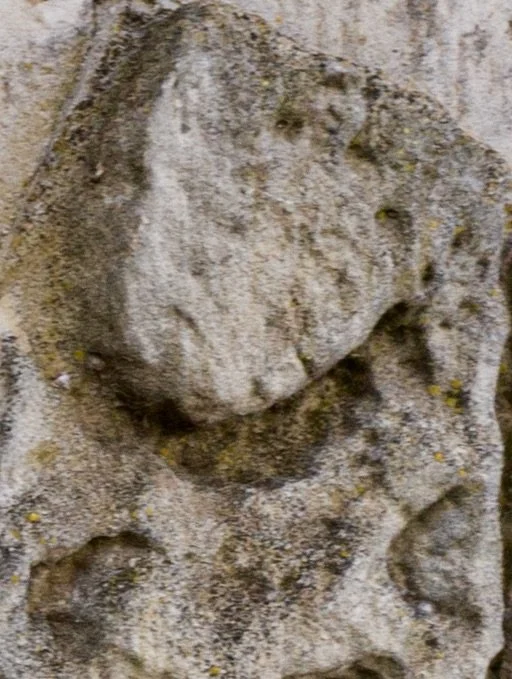
No-name 9th voussoir L western arch south face
Why then does the impartial balancer never incline to me.
Sometime between 200 BCE and 250 BCE, Cercidas, a Greek politician, wrote a piece of meliambic poetry that has reverberated throughout the ages and is still relevant today:
Why does not God choose out Xenon, that greedy cormorant of the well-lined purse,
the child of licentiousness and make him the child of poverty,
giving to us who deserve it, the silver that now runs to waste?
And indeed, the silver was running to waste in the antipodean colony of Van Diemen’s Land, between 1831 and 1835. There was a bridge to be built across the Macquarie River at Ross to connect the north and south of the island but the administration was dilatory in its decision-making and the would-be builders were wily exiles. They filled their time building houses for the settlers and business premises for the village’s publicans and shopkeepers while the planners fiddled. No doubt they repeated Cercidas’s question:
Has Justice the sight of a mole?
One of them carved a caricature of a judge, Hogarth-style, into an arch stone on the western arch of the south face. Between his lowest right sided curl and his knobbly knuckles there peeps a rabbit. Opposite there are sheep, still discernible though weather-worn.
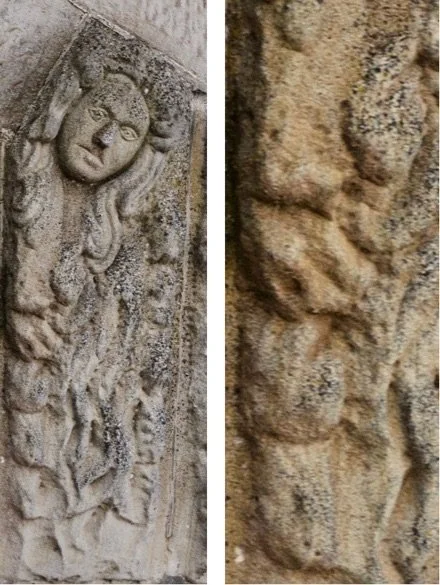
The Judge 7th voussoir L western arch south side
Cercidas was a philosopher, politician and poet of Megalopolis in the third century BCE, a disciple of the first Cynic, Diogenes, who had died in Corinth in 323 BCE. Cercidas differed from the original Cynics in his wealth and position; his predecessors were ill-mannered misanthropes who persuaded their disciples by their their ascetic way of life rather than traditional philosophic discourse. It was through their biting, humorous rhetoric and beggarly bios that Diogenes and his devotees declared their adherence to their levelling philosophical principles. A formal doctrine was not espoused; a real-time demonstration of free-speech, self-sufficiency and liberty of the spirit replaced Socratic instruction through discourse.
The nineteenth century stonemasons of the Ross Bridge were not rhetoricians; they would have been flogged for insubordination and insolence. Maybe they had lived as mendicants in England, but not by choice. Once, they had been apprenticed stonemasons and journeymen who may have participated in political protests. Probably driven to desperation by lack of work, they became criminals and exiles. They defied and defiled the authorities through their sculpting, a manual or manifesto equivalent to the spoken word. Like the Cynics, they veiled their protestations with satire and parody. They were not permitted to express opinions, yet, for the Cynic, freedom of expression was a fundamental drive.
The three tenets of the Cynic’s philosophy were free speech, liberty of the spirit though the body was restrained; self-sufficiency, a confidence in one’s own worth rather than a dependence on money.
The ancients took risks with their fearless truth-telling and political subversion, as did the convict carvers. However, the cynic of Athens had little to lose in his defiance as already he was considered the lowest of the low, a cur. It was Diogenes who had described himself so. Having turned up in Athens, exiled from his home city of Sinope for defacing the coin of its coloniser Greece, Diogenes was not granted a habitation as he had expected, so he slept in a wine barrel like a dog in a kennel. (In Greek, kuon means dog and is the etymological root of cynic.) The stone carvers, Daniel Herbert, James Colbeck and possibly Frederick Edwards, had everything to lose: the skin of their backs, their free pardons, even their lives. Their transportation to the antipodes could not be compared with a sojourn in the great cultural capital. They were not reduced to barrels though some who were secondarily punished by banishment to a road gang might have thought their movable stations were little else. (They were designed by the Colonial Architect and Civil Engineer, John Lee Archer who designed the elegant Ross Bridge.)
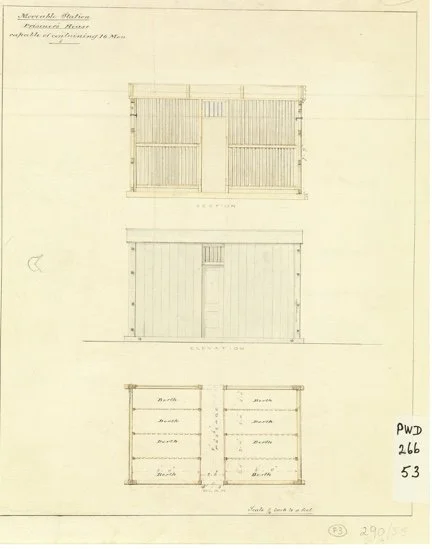
Movable Station capable of housing 16 men
Those who arrived with and after Daniel Herbert would have been crowded into uncomfortable dormitories in the ‘tench’, the penitentiary, in Campbell Street, Hobart Town, before their ‘disposal’ to private masters or public works anywhere on the island.
Very little was written by the convicts during their years of confinement, although by the 1830s about half were literate in some degree; rarely was there the luxury of paper, pen and ink. They would have been wary of punishment for exposing the truth. A few did publish their testimonies as novels or memoirs, usually on gaining their freedom. (Henry Savery’s essays and novel Quintus Servinton were published before he gained his ticket of leave in 1832.)
Thus, the sculptures on the Ross Bridge are a unique, contemporary expression of
the contempt of convicts for the monarchy and its agency in Van Diemen’s Land.
xxx
Those in charge should be drained of their swine-befouled wealth and
the money now wasted given to him that had but his daily bread
and dips his cup at the common bowl. Cercidas
A Cynic of ancient Greece asserted an ostentatious contempt for wealth and its associated ease and enjoyment, as exposed by Cercidas. They were cup-dippers who carried the constraints laid upon them to extremes in order to persuade by deed and not discourse. The deed of the convict who was given the chisels and mallet was to carve a voussoir, intending to persuade by the sculptured image. The keystones carved in high relief are parodic, sarcastic and champion practice over theory and debate. In their pragmatism, they echo the ancient cynics.

Grotesque of George 111 flanked by sheaves of corn.
It is not truly known who were the stone carvers, or their education and competence on arrival but by mid-1835, James Colbeck and Daniel Herbert were recognised as the most skilled of the government masons. Colbeck had been apprenticed to Daniel Sharp in Dewsbury and had tramped to London about 1822 as a journeyman where he worked on the new King’s palace (Buckingham Palace) for Thomas Grundy. He would have observed the city’s statues and architectural decorations. Perhaps Mr Grundy directed him to study Eliza Soane’s tomb in St Pancras’ churchyard for its symbols (which Grundy probably carved.) Perhaps he enjoyed the fuss over Richard Westmacott’s statue of Achilles monumentalising the Duke of Wellington that was erected in Hyde Park in July 1822. Being the first nude statue in England, there was much comment and the public’s response was ridiculed by the caricaturists; their prints were posted in publishers’ windows for all to laugh at. Perhaps Colbeck mingled with vagabonds and prostitutes populating the streets in their thousands. Thus he learned about satirising the great and not-so-great and parodying the works that depicted them.
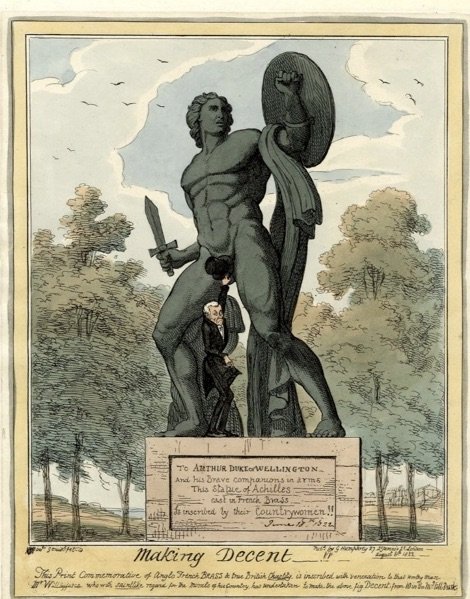
George Cruikshank Making Decent August 1822
Why the Inspector of Roads, Roderic O’Connor, and John Lee Archer cast blind eyes towards the carvings is not known. O’Connor was from Ireland and the brother of the radical Feargus O’Connor; he shared his anti-Tory views. Archer was Irish too; perhaps both men were of the same opinion of the monarchy and, being non-military, were repelled by the martinet Lieutenant Governor, Colonel George Arthur. Their correspondence with his secretary is voluminous but there is not one mention of the stone carvings.
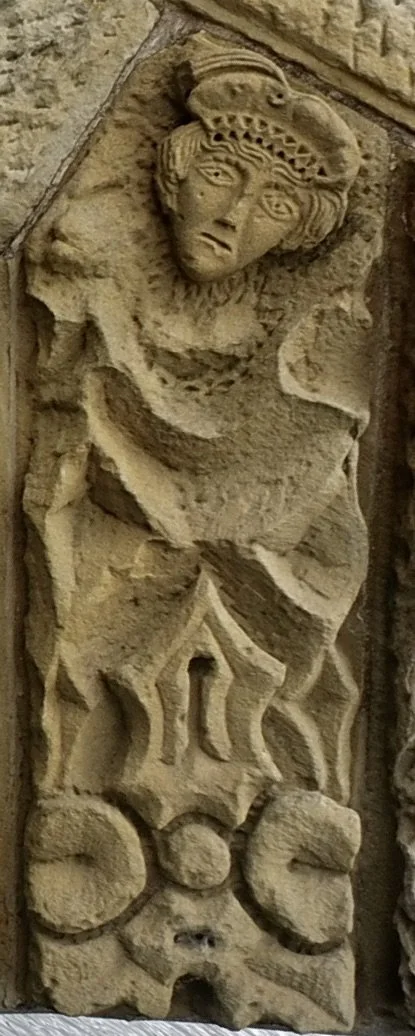
The Shaming of Norah Cobbett … 7th voussoir L eastern arch north face.
To understand the stone carvers as cynics, the observer needs to extract humour and contrariness from the carvings. The joke has been described by R. Bracht Branham as a symbol of social experience at odds with domestic social reasoning and ideology. It is embodied in satire and parody, its basis being in the violation of rules. Therein works the contrarian, asserting political beliefs in a way to invoke laughter and , therefore, the viewers’ collusion. Where there is no laughter, there is no understanding; empathising with the social situation of the joker clarifies and compounds the joke. The convicts’ opposition was to the clerical, judicial and state’s authority to dictate their behaviour. On the bridge work-site, a few men had the chance to free their thoughts and twist them into absurdities. Most philosophy is not meant to be witty but grave and uplifting, like religious friezes and statues of the mighty. On the other hand, the convict knew that hunky punks, grotesques and gargoyles poked fun at the rich and poor.
Anciently, the Cynics sought topics worthy of shame. So did the stone-carvers: the keystones of King George 111, the arch stone of poor Norah Cobbett and the grotesque of Lieutenant Governor George Arthur tell us so. If satire is the the cynical presentation of others thought to be “good” conventionally, then gaze upon the north facing keystones of the east and west arches. The caricatures represent George IV as the Prince Regent and his wife, Caroline, the Princess of Wales, whom he hated and barred from her coronation as his queen. The couple was the epitome of prodigality and infidelty.

The Royal Rat … Grotesque of Caroline, Princess of Wales flanked by pineapples, the symbol of extravagance.

The Foo Dog … Caricature of George IV, formerly the Prince of Wales.
For all their unfaithfulness in marriage and their extravagant expenditure of the country’s money during the wars with Napoleon, many Britishers continued to believe the royal family was owed loyalty. That is, unimaginative, unquestioning members of the public succumbed to the power of monarchy to control their thoughts, experiences and sensations. Others of the same ilk, equivocated but knew which side their bread was buttered. Not everyone, though. There were radicals, reformers and republicans to whom the London caricaturists catered with their ridicule of George III in the 1790s, the dukes who were his sons, and then the Prince of Wales as Regent and his estranged wife. They mercilessly satirised the hypocrisy of her behaviour in Europe with her ‘consort’, Bartolomeo Pergami. Although some lauded and magnified her on her return to England on the death of her father-in-law, the scorn did not let up. The convicts would have been aware of their flamboyance during their own poverty stricken youth and although the bridge was built after the royals’ deaths, their power persisted as a synonym for monarchy. The immediacy of the vision of the ill-fitting, puny crowns on their grotesque hair-dos forces a step backwards into the joke.
Caroline’s opulent coiffure, her bare bosom, the left elbow rejecting her rat-child and the three ostrich feathers of the Prince of Wales on her crown, identify her. Acknowledging that George behaved towards her in a most un-princely manner, Caroline’s abandonment of her subjects and daughter, Charlotte, to his household on her departure for Europe, was not queenly; more like a rat leaving a sinking ship. Her adultery is ironised in the juxtaposed letters M and V which mean Mary the Virgin. Hardly discernible now are a sheep’s head and snake’s head on either side of her crown. One wonders whether they refer to the wolf in sheep’s clothing and the serpent in the Garden of Eden. Her toenails have survived the ravages of weather and flood. They parody the claw foot of the chair in Theodore Lane’s caricature of her, published in 1820.
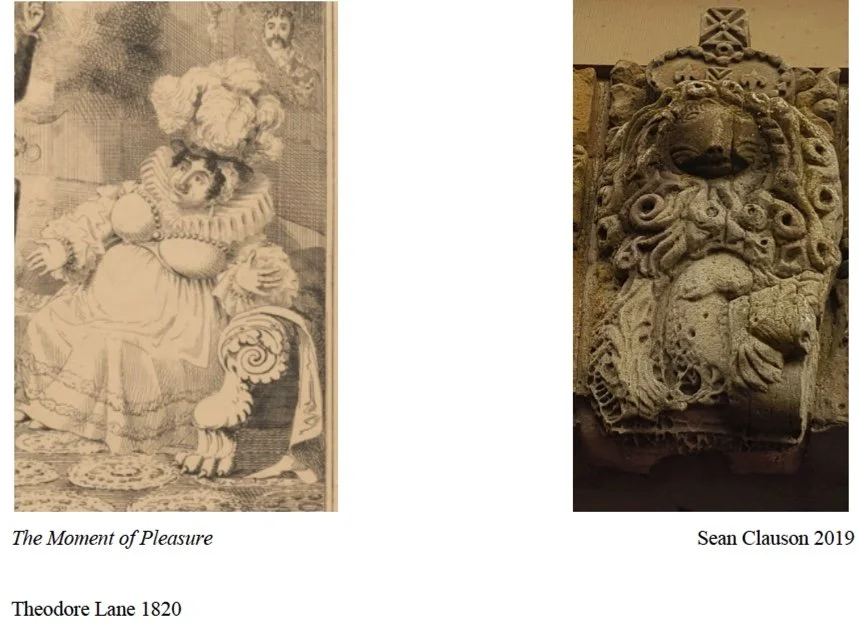
Foo dogs or lions were guardians of Chinese palaces, houses and business premises before their presence pretended to protect British doors. The male rested a paw proprietorially upon a sphere representing imperial supremacy; the female restrained a cub, said to represent the spirit. So, why did the sculptor carve a male lion with a cub? Was it to make a joke of the Prince’s power over his subjects? To make him appear womanish? The cub is puppy-like, his head pressed down, his tongue protruding like a simpleton, his tail between his legs and his eyes wide with bewilderment. It is all about the subservience of fools to a fool. A casual glance might perceive a sense of play but the joke and irony prevail.
The newly empowered stonemasons, saved their cruellest sneer for the governor. He is transformed into a grotesque anthropomorph in the style of a British monarch. His puny crown is ornamented with a cat o’ nine tails and ankle irons; his face is mean with hooded eyes and fanged teeth; his sceptre is a thigh bone and his skinny legs sit astride a two-in-one, a uterine form filled with an erect phallus carved like a screw. He is juxtaposed to a skeletal death’s head, the devil.
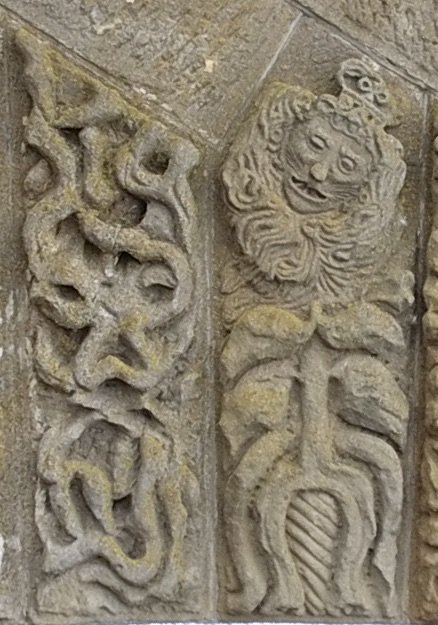
Grotesque of Lieutenant Governor Arthur and the juxtaposed death’s head resembling the devil
6th & &th Voussoirs L eastern arch south face
Theory is a set of ideas intended to explain something; it is the realm of the Socratic philosopher. The cynics were the opposite; they considered that philosophy was a “dialogue with the contingencies that shape the material conditions of existence”. (R. Bracht Branham) For the convict, material conditions were meagre and those who controlled them were harsh. In Ross, between November 1833 and June 1835, their agent was an unworldly young architect from London, Charles Atkinson. He wrote many letters on behalf of the one hundred and eleven men in his charge, requesting better conditions. But he was treated scornfully as he tried to earn the respect of both the authorities and the convicts. He had an unsubstantiated belief in his own architectural capacity and the convict stonemasons, detecting his weaknesses, carved a vacuous visage in his memory paired with a boar, an homonymous joke.
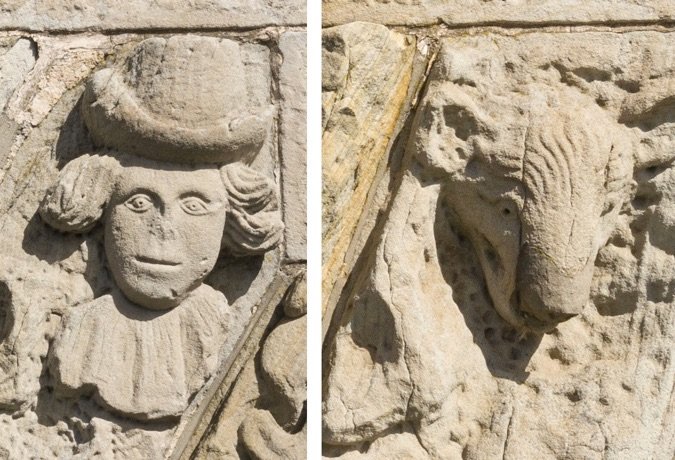
Charles Atkinson and a boar 7th & 9th voussoirs R western arch north face
Their material conditions are represented by the cat o’ nine tails juxtaposed to a spine with exposed vertebrae; it does not depict a discourse on crime and punishment but a statement. The two stones are mid-river, rising from the springer stone bearing the weight of the half-arch from which Daniel Herbert gazes.
In 1970, Norman Laird described them in his book, Ross Bridge, The Sculpture of Daniel Herbert, thus:
61SF A descending order of eight overlapping oak leaves […]”When leaves appear together as a motif, they represent people; in this sense it is closely related to the significance of herbs as symbols of human beings.” (J. E. Cirlot 1967 A Dictionary of Symbols Routledge & KeganPaul,vLndon p 173)
62SF A plant form - possibly a species of willow.
His and my interpretations together exemplify the layered meanings the carvers put into their works. Mine are not of the fashionable Celtic tendency of Laird’s day. It is undeniable that the stonemasons grew up in communities soaked in ancient folktales, but removed from all comforts of home their thought was focussed on survival. They were too hungry and cold; too close to their own floggings; too brutalised; too cynical; too much in dialogue with their material conditions. One cannot dismiss the Celtic influence on the form carved in the stone next to Daniel Herbert’s self-portrait. Its content is a cynical depiction of sodomy.


8th voussoir R central arch south face
Homosexual behaviour was regarded by the regime as deplorable, wicked, unavoidable and out of control, probably to the stone carvers antipathetic glee. Two chimera are enfolded, groin to rump. The sign of the fig is in the fist clutching the thumb; three finger tips can be seen tucked below. It seems to choke a bird with a tongue protruding between the parts of a parrot’s open beak. The motif imbues the sculpture with murderous fury.
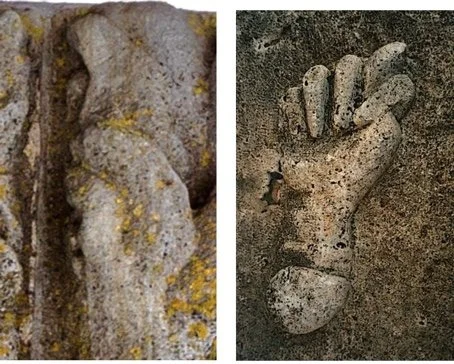
central arch south face sign of the fig - manu fica
This is not a dialogue on reparative justice; it is retribution, defiantly and cynically asserted.
Owing to experience, an exiled stonemason was likely to foresee that the impartial balancer would never incline towards him. He might give up all hope of freedom or he might resist. He knew from London caricaturists that resistance rattled by humour outwitted the audience and invoked its collusion, thereby deflecting detection and punishment. Therein lay his skill as a cynic; his peculiar way of speaking freely and casting off his metaphorical chains.
The stonemasons and their mates in the Ross Bridge party made hay while the silver ran to waste down the Macquarie River. Their defiance was ripening into designs for stone caricatures and tales of their experience until the time came to select the voussoirs and exorcise it. Aware of the consequences of speaking freely, they veiled their intent in satire and parody. Diogenes had been able to declaim; the convicts could carve. Diogenes made the most of his material conditions, living them as a demonstration of his philosophical antipathy toward the wealthy; the convicts had no choice but to endure their harsh conditions, twisting them into a wily self-sufficiency and a liberty of spirit that still survives on the bridge. It was as lewd and as anti-authoritarian as were the words of the ancient cynics.
It is the only work of architectural decoration of its type in the world.