Daniel Herbert’s Bible
On the 11th June, 1838, an Edward Butler gave Daniel Herbert a bible.
Recently, a secondhand bookseller told me he had seen the bible at a house where items were being sold and he had seen doodles in the margin.
Those scribblings might be fundamental to understanding the carvings on the bridge
but where is the bible?
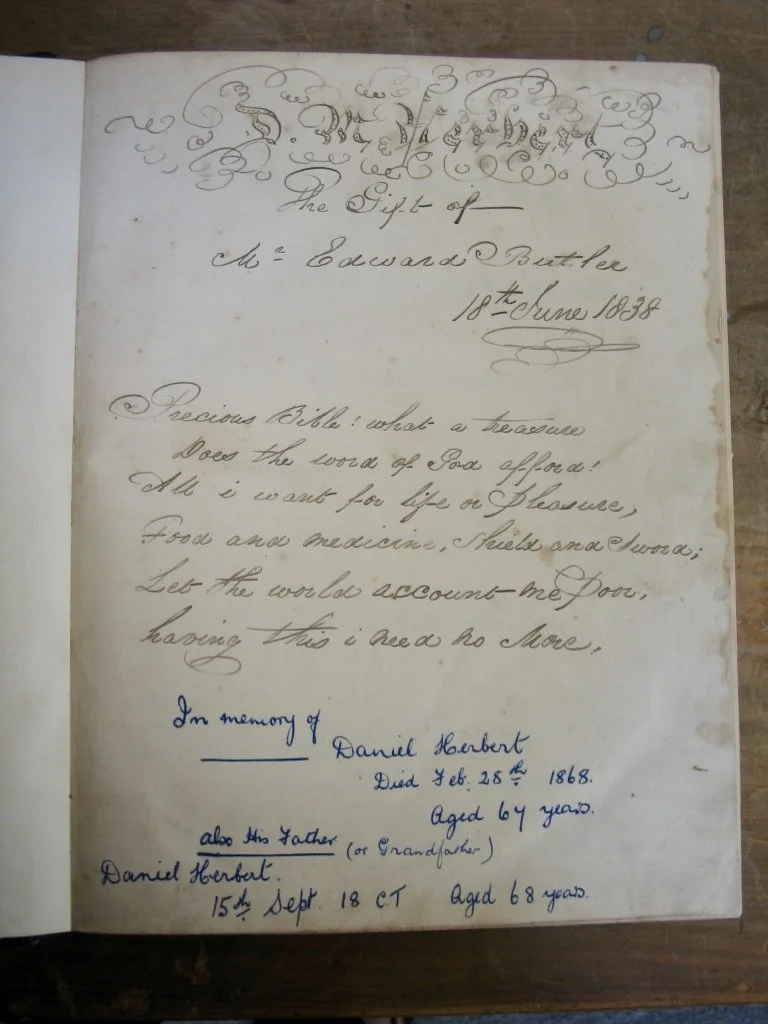
The photograph of the front page of the bible was sent to me by a descendent of Dan and Mary Herbert.
It was a gift given after their marriage in July 1835 and before the birth of their first child, Sarah Ann Sophia, in 1839. I wondered if it was in sympathy for the death of a child but there is not a record of the baptism or burial of a Herbert child in the intervening years.
The hymn, Precious Bible, was written by the turncoat John Newton, a slave trader who turned abolitionist; a Wesleyan ordained in the Church of England. He wrote many hymns, including Amazing Grace in 1799. He died in 1807.
D. M. Herbert might refer to Dan and Mary but there is no flourish to suggest an &. Therefore, it might be the only reference to Dan’s second name. Similar curlicues enhance his signature on Ann Newby’s gravestone at Oatlands so my suspicion that the inscriptions are his own is reasonable.
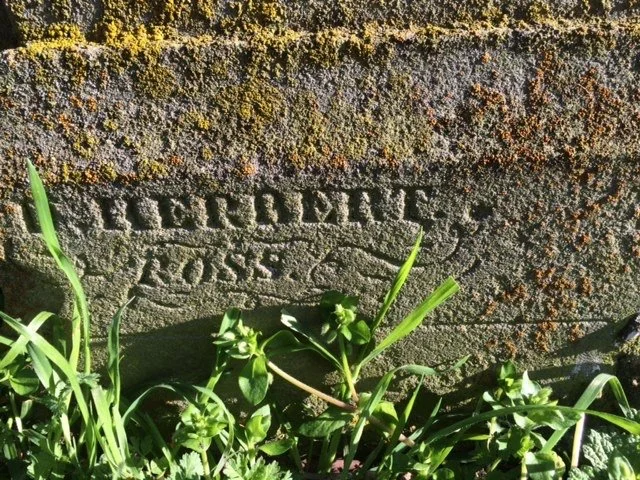
Daniel Herbert’s signature on Ann Newby’s gravestone, Oatlands 1859
Who was Mr. Edward Butler? There are three contenders: Edward Paine Butler, solicitor and neighbour of William Davidson; Edward Butler, victualler, of George Town and Battery Point; Edward Butler, carpenter, former convict and husband of Ellen Fraser.
Edward Paine Butler arrived in Hobart Town in July 1835. His property was on the corner of Antill Street and Garden Crescent. William Davidson was the first director of the Government Gardens on the Domain. His private property extended between Antill Street and Elboden Street, bounded by Garden Crescent, westward of Butler’s land. Two cottages were built facing Elboden Street between 1832 and 1833, one in brick and one in sandstone. Family legend tells that Davidson commissioned Daniel Herbert to carve a sundial as a gift for his wife. Now, it stands in front of the administration building in the Botanical Gardens which had been the director’s cottage but it was in the Elboden Street garden originally. A mantelpiece that is still in the cottage is attributed to Herbert, as well. Lieutenant Governor Arthur rashly dismissed Davidson from his position at the Gardens in September 1834. Carved into the sundial pedestal are two adults and two children, supposed to be William and his wife, Elizabeth, and their two children born in 1830 and 1832. Their third child was born in 1834. Perhaps this dates the sundial to about 1833-34. Herbert left Hobart Town in May 1835, before this Edward Butler arrived in the colony.
There is a scroll between the Edward and Butler that could be a P but I don’t think it is as it is attached to the B and is not like the capital P that begins the hymn’s first word. For these reasons, Edward Paine Butler is unlikely to be the gift-giver.

The sundial and mantelpiece, attributed to Daniel Herbert, said to be commissioned by William Davidson, the first director of the Government Gardens, now the Royal Tasmanian Botanical Gardens.
Edward Butler the victualler was an innkeeper in Georgetown at the mouth of the Tamar estuary. He bought property in Battery Point, a fraction of the acreage that had surrounded Reverend Robert Knopwood’s Cottage Green. There no connection between Herbert and this Butler in any documents.
In 1826, the third Edward Butler arrived in the colony per the convict transport Chapman. The muster roll states he was seventeen years old and a gentleman’s servant. He stated for his conduct record that he had picked pocket for a £5 note. He had been convicted before for stealing tools and spent time in Wakefield gaol. He was sentenced to seven years in exile. On October 31st, 1831, he had his ticket of leave and married the convict, Ellen Fraser, in Hobart Town.
In 1828, Ellen, an orphan and housemaid, had been tried for larceny, found guilty and transported for fourteen years to Van Diemen’s Land in the Harmony with Mary Witherington, who became Herbert’s wife in 1835. They had spent time in the Cascades Female Factory during 1830. Ellen’s daughter was born on January 1st 1830 during her assignment to the Whittaker family. Because Ellen refused to divulge the name of the father to the Principal Superintendent of Convicts, and because the baby was “unweanable” so she could not perform her duties as housemaid, Ellen was returned to the Female Factory on January 25th, with the order that she be placed in the criminal class as soon as the babe was weaned. Mary had been sent to the Female Factory three months before, on October 31st, 1829, after Magistrate Butcher in Richmond determined she was guilty of petty theft, probably words for “pregnancy beginning to show”. She had been working in the household of Valentine and Sarah Griffith at Tea Tree. Her baby Henry was born in March 1830, so Ellen and she would have been caring for their mites in the dismal, damp nursery at the same time. Henry died in May 1831. Ellen’s child was baptised Jane Mary Butler in April 1832 after her marriage with Edward. The certificate states that Edward Butler, the father, was a carpenter. (Remember, he was convicted of stealing tools before he turned pickpocket.)
This is the likeliest connection between the Herberts and the Butlers. Perhaps, Edward and Dan had met on a building site and were acquaintances before the women met in such unhappy circumstances.
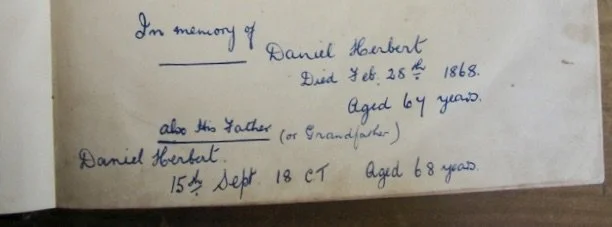
In the memory of Daniel Herbert … also his father or grandfather.
Daniel Herbert, former convict, stonemason of Ross, died of bronchitis on February 28th, 1868.
His oldest sister was Sarah, baptised in York on 25th December 1793. Her baptism record states that her mother was Mary Rogers, daughter of John Rogers, joiner, late of Liverpool; her father was Daniel Herbert, soldier, 6th Inniskilling Regiment of Dragoons, son of Stewart Herbert, Manchester, staymaker, by his wife, Sarah. Corporal Daniel Herbert had been born in Sheffield in 1770.
A tailor Stuart Herbert was buried in Sheffield, Yorkshire, on 1st March 1812. If this was Stuart, formerly a staymaker, then young Dan would have been ten when he lost his grandfather having lost his own father on 29th May, 1803, when he was sixteen months old.
But, the bible states that his father, Daniel, died 15th September 18 CT aged 68 years . Corporal Daniel Herbert died when the regiment was in Birmingham, on 29th May 1803.
Another Daniel Herbert, husband of Mary, died in West Derby in September 1848. This entry in Ancestry.com, incorrectly names his son as the Daniel who was baptised on February 17th, 1802, in the Paul Street Independent chapel, Taunton, Somerset where it was written into the records that the babe’s father was a corporal in the 6th Inniskilling Regiment of Dragoons. And we know he died in 1803.
So who ever added to the frontispiece made a mistake, it seems.
The bible is unlikely to have been inherited by the struggling Frederick Stuart, son of Dan and Mary. Sarah Ann Sophia married Francis Tucker on 20th June 1863. Their daughter, also Sarah Ann Sophia, married Frederick William Lee on the 6th May 1890. They had two sons and two daughters. Assuming the bible went with the oldest daughter, Lola, who was born in 1900 in Cressy and married Albert Gordon Thomas on 16th April, 1924, it is likely to be in southern Tasmania, now, as she died in Kingston in 1989. … where it must have been seen by the bookseller.
But if the younger sister, Myrtle, inherited it, her daughter, Nola, might have taken it to Victoria when she married William Henry Matheson. She died in Northcote in 2012. Myrtle died in Launceston in 1999. There the public record ends.
Oh, to gaze upon the doodles in the margins of Dan Herbert’s bible!