AN INTRODUCTION TO
THE ENIGMATIC ART OF THE ROSS BRIDGE
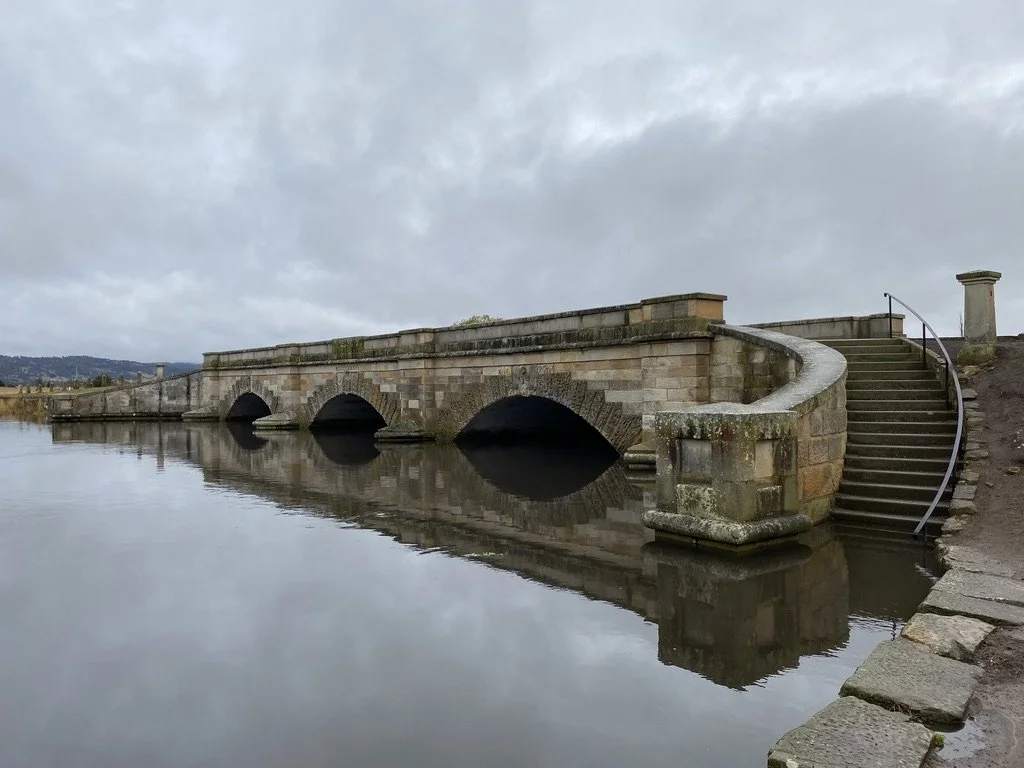
One hundred and eighty-six sculptures in relief decorate the north and south facades of the elegant arched bridge that crosses tinamarakunah/Macquarie River at the town of Ross in Tasmania’s midlands. Its low profile was conceived by the Colonial Architect and Civil Engineer, John Lee Archer. He employed Charles Atkinson to draw up the plans, a guileless young architect from London who boasted Archer needed to defer to him. The stonemasons were convicts transported from Regency England. It is a remarkable thing that the sculptures of the Ross Bridge were not mutilated by the military under orders from the Lieutenant Governor as they were being carved as they broke the rules of the inchoate penal colony. Convicts would be harshly punished if they dared to publish critical opinions of the administration and the conditions under which they laboured. And yet, these subversive and satirical sculptures are no more nor less than published comments on the monarchy, the regime in Van Diemen’s Land and the conditions that prevailed in Britain which induced the young men to commit their crimes. The plans were requested in 1831 and completed in 1833; the bridge was finished in July 1836 and opened in October, the superintendent in the final year being Captain William Turner, remembered in plaques on the four pillars.
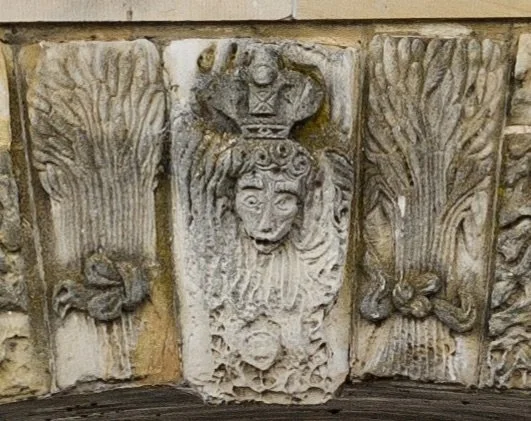

The keystones stand in proud relief, mocking the monarchy. In his angst, mad George III stares out between two sheaves of corn. The extravagance of his son, the Prince of Wales, the Prince Regent, distresses him beyond reason. Many of the convicts stole because their families were hungry because of his government’s enactment of the Corn Laws which perpetuated the high price of grain in England after the Napoleonic wars had ended. Life had been hard enough then, with industrialisation and the drain on the government’s coffers. But the ministers would not repeal the laws to ease the common man’s poverty. The satire is plain.
The Royal Rat on the opposite facade is a grotesque carving of his daughter-in-law, Caroline, the Princess of Wales, despised wife of the Regent. In her bare-bosomed state, she exudes wealth and privilege, yet her left arm curls around her rat-child, rejecting it.
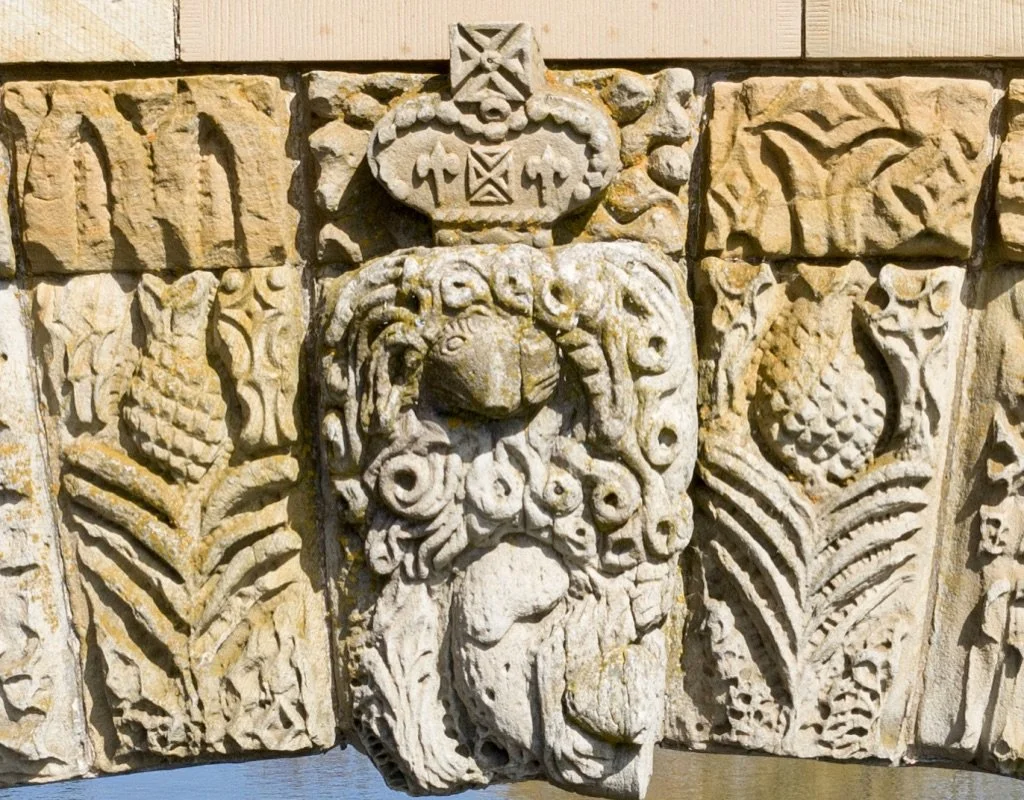
Crossing to the other bank, her husband, George, is presented as a ridiculous foo-dog, a guardian lion. His features are foolish, his crown is puny and he plays with a cub or puppy, as would the female in a pair outside a prominent establishment. Does the work represent oppression by the monarchy? Probably it does, though carved by a cynic. Absurdity is a great camouflage.
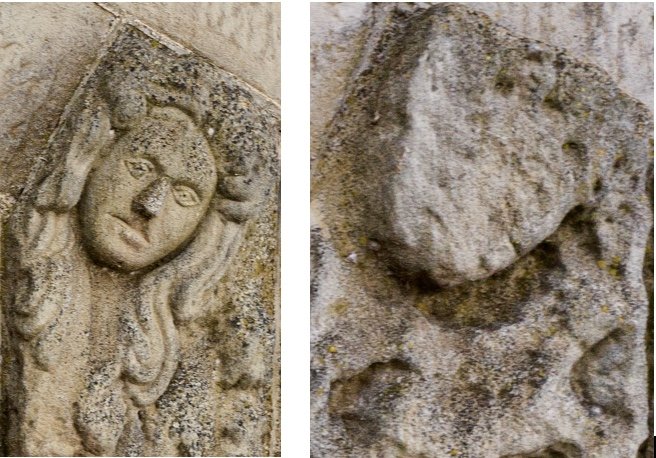
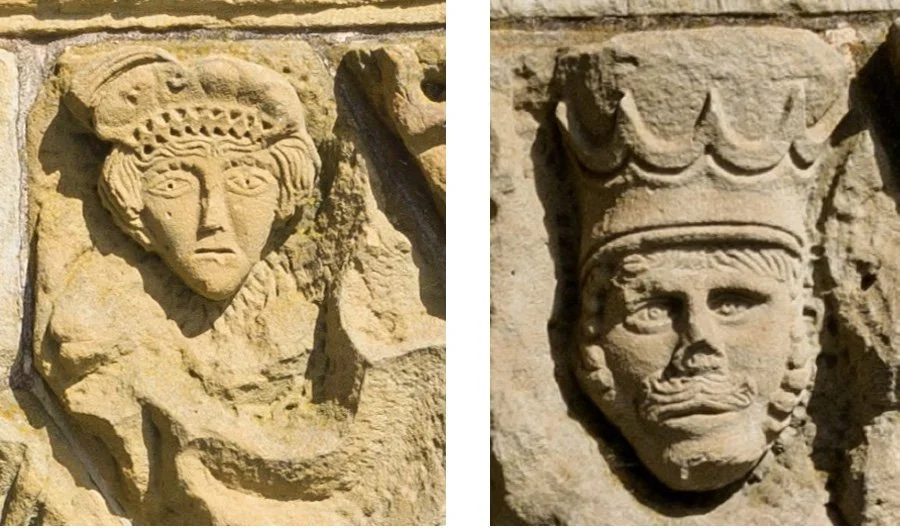
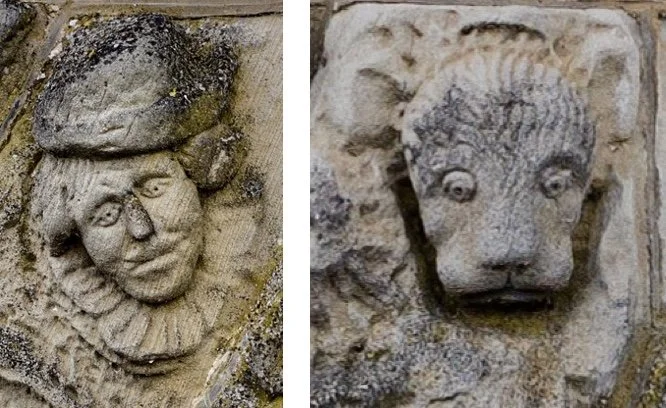
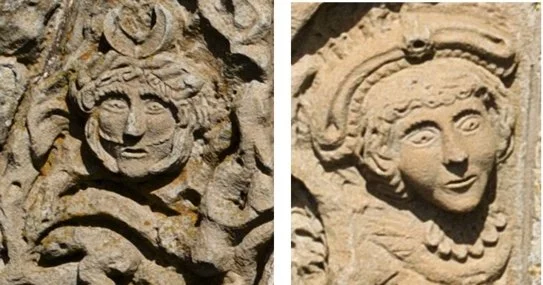

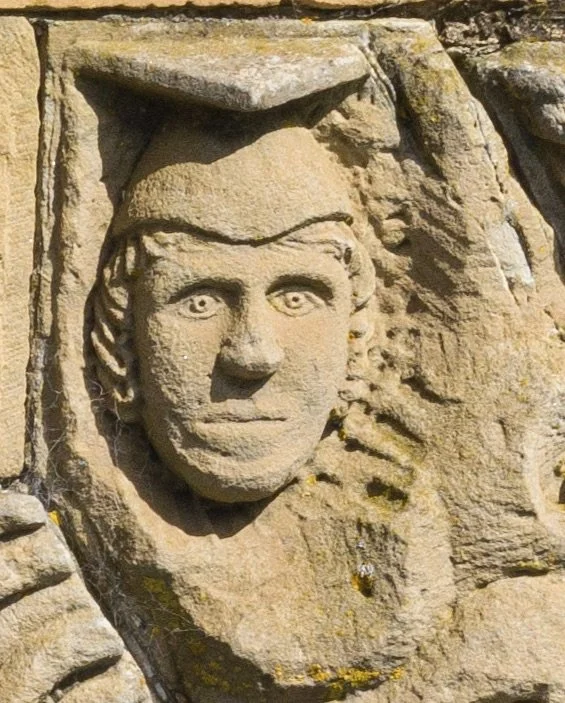
Two quintets of caricatures of English and local folk seem to be petrified in tableaux vivants.
The dog is round-eared; probably, it is a French bulldog signifying a connection
between the thespian in the ruff and the republicans
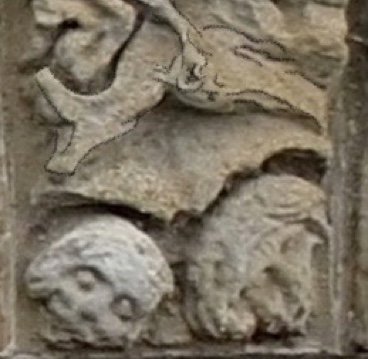
The sadness and helplessness of the stone carver is revealed in the buried mother and child.
Two floundering fish gasp for life on the ground above.
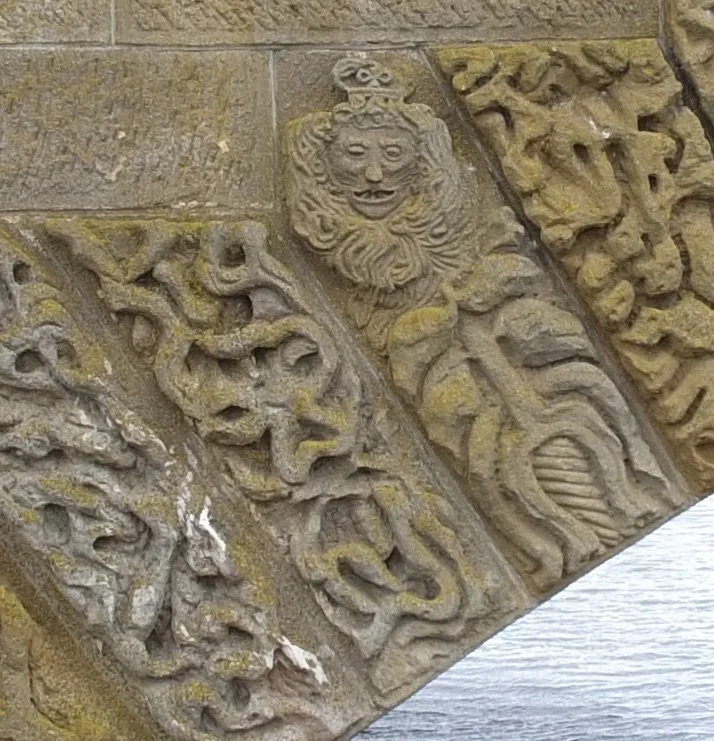
Contempt for the colony’s Lieutenant Governor, George Arthur, pervades the pair of carvings of
an anthropomorphic lion seated on an obscene throne and
a death’s head with a forked tail and horn.
With cutting irony, the lion’s crown is ornamented with a cat o’ nine tails and shackles.
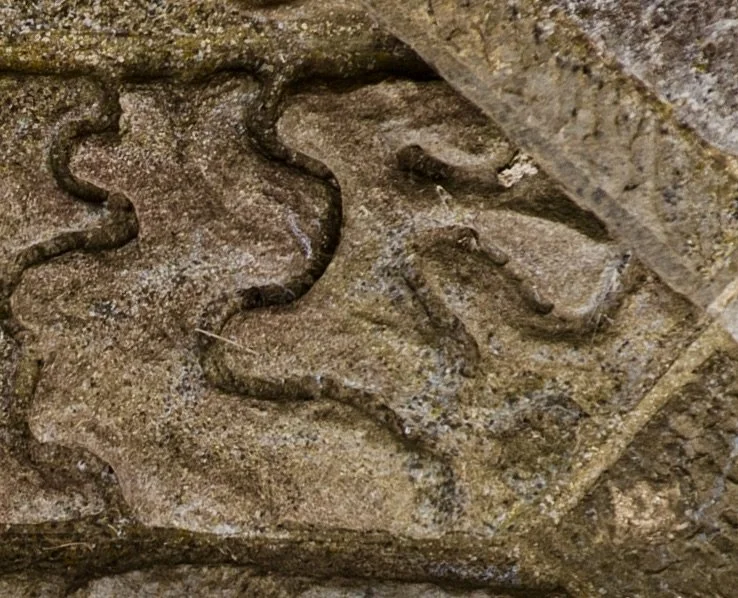

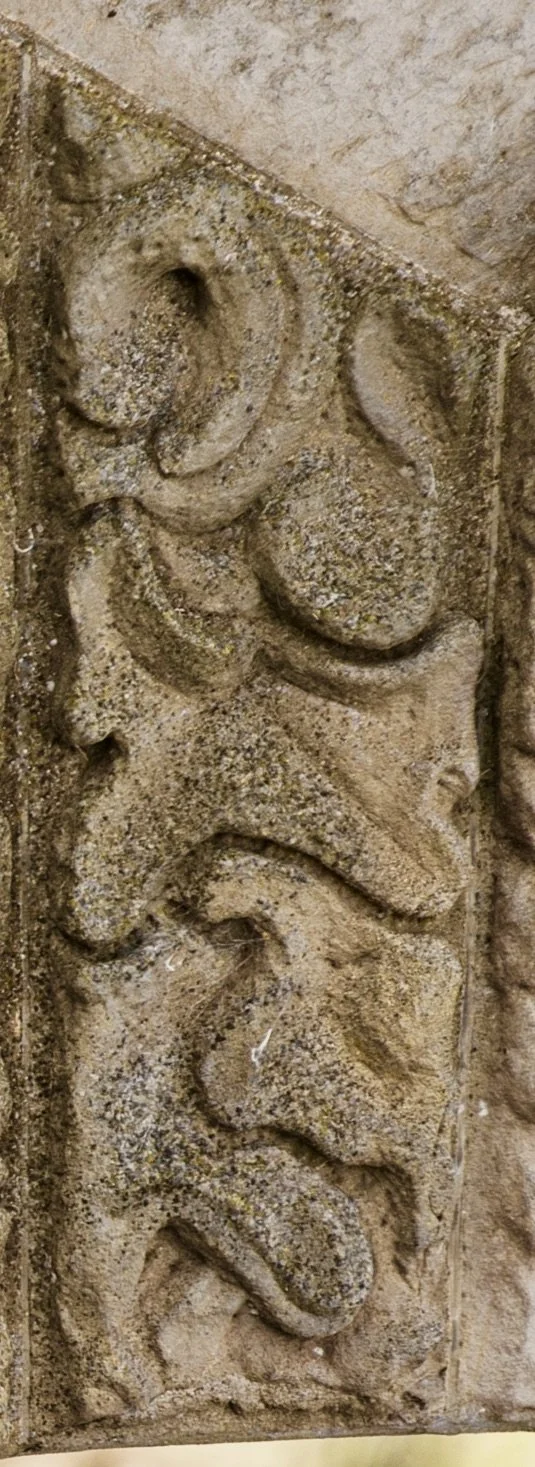
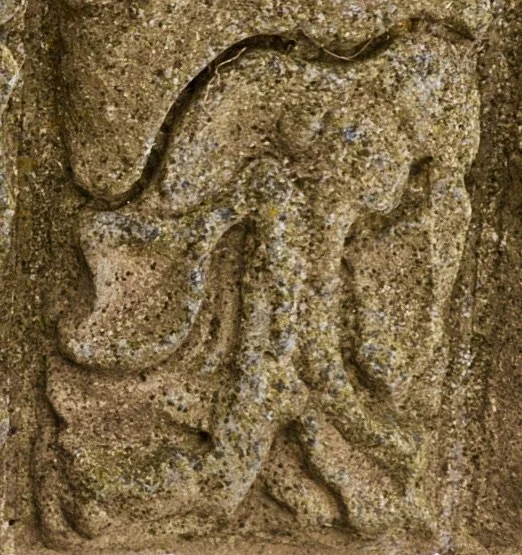
Perhaps these funny little figures are characters in Lancashire and Yorkshire folk tales:
an ithyphallic hare appears to be running; two cats, one climbing, one dying, could be Dildrum and Doldrum;
a green man watching a bull present his erect phallus to a cow or calf which seems to be in a tree;
a little man striding along may be Johny Green.

Bearing the weight of its half arch, is a cat o’ nine tails. Next to it is an exposed spine,
a diary entry to be secreted away, out of sight, out of mind.
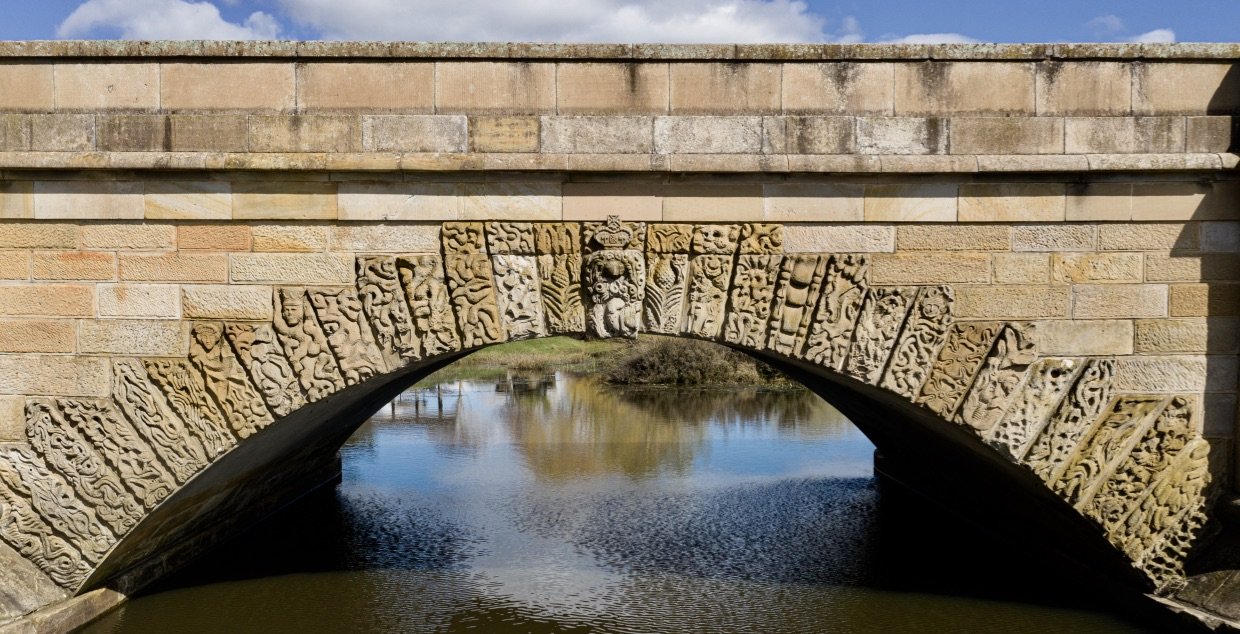
The bridge is an example of narrative architecture; there is no other like it in the world.
Usually, decorated architecture telling an important story, such as a triumphal arch,
faces a thoroughfare for the erudition of the illiterate people.
These face a waterway which has never been used as a public way. Why spend so much energy?
The convicts’ ghosts might say: “to exorcise our demons;
to make sure the stones’ meanings were obfuscated by distance as well as irony.
To tell the truth”.
The irony is that we do not know which stonemason carved which stone.
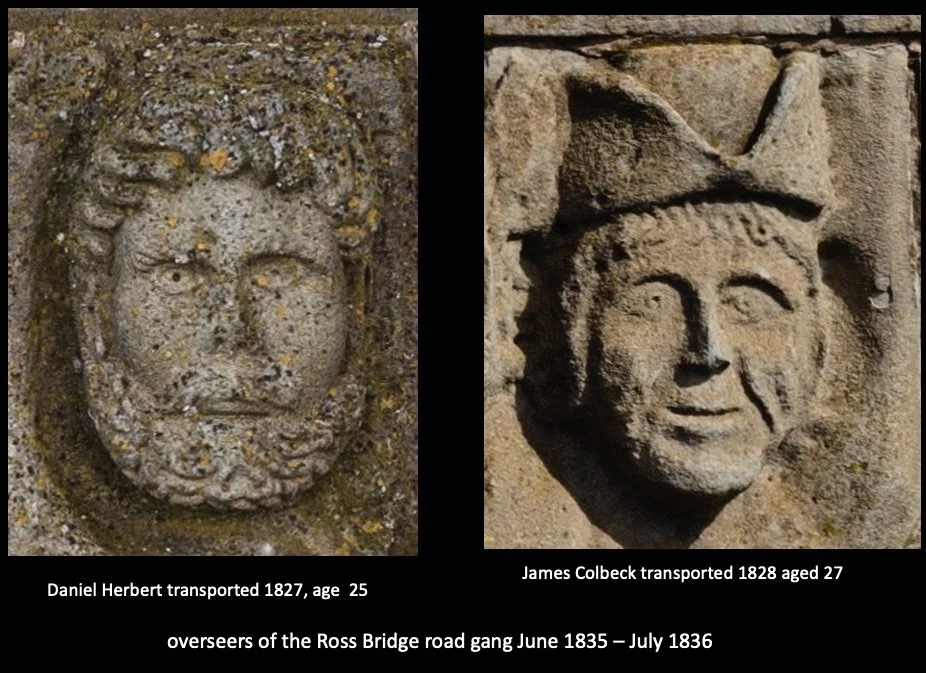
Between June 1835 and July 1836, Daniel Herbert and James Colbeck were the convict overseers of the Ross Bridge road party. Colbeck was of a Methodist family from the West Riding, Yorkshire; he was illiterate when he arrived but experienced in his trade. Herbert was literate, from Manchester, but had been incarcerated twice for burglary since he was seventeen. He would have gained experience working at Woolwich docks when he was held in a hulk for four years but not transported though that had been the sentence. He was released in 1826 and immediately committed four acts of highway robbery for which he was sentenced to death. Transportation was a commutation of the capital punishment they both had received. It is not known where they learned about the symbols that they carved into their work; perhaps they had been exposed to the mysteries of the craft of Freemasonry. Why else would Herbert have carved a mason’s square into his beard?
Colbeck returned to Dewsbury, his hometown in Yorkshire. His wife was alive but on her death he married the widow of a stonemason and died in 1852 of typhus, cabin fever, a bitter irony after he had survived dungeon, hulk and transport ship.
Herbert remained in Ross, an unacknowledged stone carver. He died insolvent, of ‘bronchitis’ … it was likely to have been silicosis from the dust given up the stones that ought to have brought him notoriety and admiration.
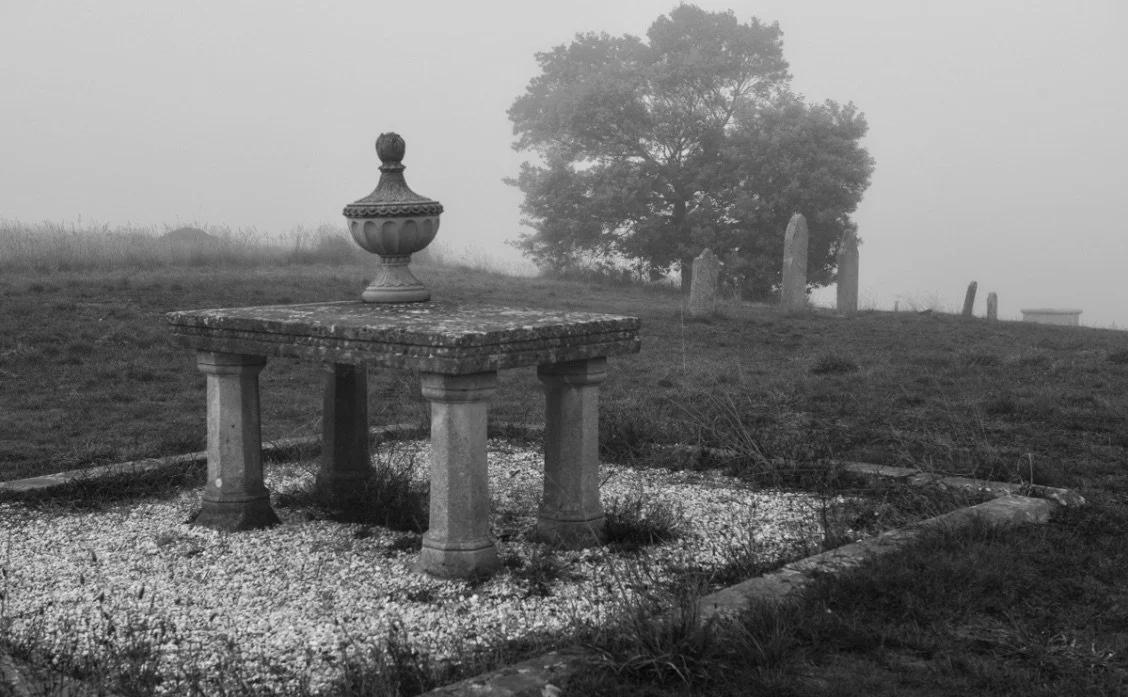
He is buried in the old Ross cemetery, in the idiosyncratic table grave he made for his baby son, Ernest.