MUCKING AROUND
IN A BOAT
It is a May midday, 2017.
I am on a barge on the Macquarie River, on the north side of the Ross Bridge. Even in the clarity of wintry light and the shadow play on the sandstone, its sculptures cling to their secrets. The coxswain is awaiting my instructions but I say:
“I reckon you can the read the bridge from left to right starting on the south face … like a book.”
I sense he wants to go home: “So can we go to the other side?”
…under the toenails of the rat queen.
The barge putts past a heathenish man-lion, cocked head on a stem,
astride an androgynous shape
like a penis-full vagina.
Sullen Dan Herbert
gazes forever upstream.

A poodle stares in contemplation
beside a bearded man in a tradesman’s cap.
We nose into rushes on the edge of Stocker’s Paddock, alongside ‘page 1’; that is, the western arch on the south face:
“See the judge and No-face, there on the left side?”
But Millenial is not listening.
Dan Herbert and James Colbeck were sentenced to death
then transportation by the same judge, Baron Hullock, at the York Assizes, in 1827 and 1828 respectively. They were the stonemasons who oversaw the sculpting of this story.
The high browed, cross-eyed judge looked down his nose at them, crowned in his Hogarthian wig.

Weathering has granted him a sneer where a chip
has fallen from his top lip.
Juxtaposed but one is a visage without nose or mouth
but two drilled holes high in his forehead, the Nobody in the dock,
the faceless criminal to be exiled and forgotten.
Therein lies the irony of the Ross Bridge,
a subversive work of art in the guise of a folktale
carved in stone by exiled men,
never to be lost
though ravaged by weather and flood.
On the right arc of this western arch as we are facing it from the boat, a man is doffing a small brimmed hat with his left hand. He has a bemused expression, a sorrowful frown, moustache and Elizabethan ruff.
One arch-stone removed from him is a dog-like animal with round ears; a bear or a French bulldog?
To say the portrait alludes to Shakespeare because he was born in Warwickshire, the flag of which bears a bear, could overstretch a metaphor.
But the bard must have symbolised all that was English to these outcasts. Considering themselves Malvolios, wretched dupes of the fortunate, they carved him farewelling them, perhaps.
More likely, the dog represents the British Republicans who lost heart when Napoleon declared himself Emperor in 1804; who scorned the monarchy as did these convict artists.
The keystones mock George III, George IV and his wife, Caroline.


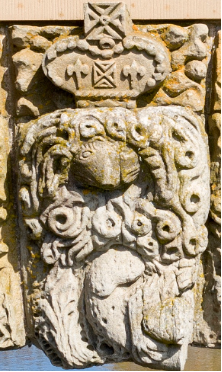
The relationships of all the characters to the animals and to each other must be deliberate. They occupy the seventh and ninth positions, counting from the bottom of each half arch. [i]
I can only guess who is the man in the master tradesman’s cap with the unfashionable beard on the central arch or what the nearby poodle signifies or why Dan Herbert is on the same arch. Maybe he is a Yorkshireman with his duck retrieving dog.


Perhaps, he is Mr Chapman who was the first superintendent to bring Dan Herbert before a magistrate in June 1828 for not performing his work, per their agreement. Dan was reprimanded and returned to finish the job. Per their agreement ... it is an odd statement regarding a convict and his master and might pertain to the work that first and second class prisoners arranged privately on Saturdays.
Imagine Dan Herbert at the Government Gardens about this time:
the cottage, warming wall and hothouse are being built;
he is chatting with William Davidson,
the first director of the gardens.
Maybe the superintendent of works is Mr. Chapman,[ii]
unhappy that Herbert is not dressing stone blocks.
Or maybe it is William Foord who was the overseer of many public works, as well as the private and clandestine, known to Colbeck but not to Dan Herbert whose arch he shares.
Norman Laird thought the dog was a dalmation and the topknot was a horn, referring to Cernunnos, Celtic horned god of fertility, life, animals and the underworld.[iii] I preferred to refer to Francis Grose’s Classical Dictionary of the Vulgar Tongue where entries including HORN are about cuckolding.
In July, ’33, Herbert was ordered to sleep in the prisoners’ barracks for taking into his lodgings the wife of a free man and that an illicit connexion formerly existed between the parties.[iv] What else was there to do at thirty-one?
He was punished many times for being absent
without leave and out all night.
A cat o’ nine tails is the lowermost carving on Dan Herbert’s half arch, obvious only from the water. Next to it is a carving of seven overlapping forms like vertebrae below a gloved hand in the shape of an oak leaf. It relates to the seventh stone on the adjacent arch, as if one had turned a page.[v]

I point to the man-lion on the left
and a worried dog on the right side of the arch.
I shout above the engine noise:
”In 1968 there was a round swelling above his eyes and the wrinkles of his frown radiated from it like sun’s rays. But it has worn away.”[vi]
The coxswain shrugs and nods his head in the direction
of the caricatured lion: “What’s with the lion?”

I have already decided it must be a grotesque
of Lieutenant-Governor Arthur.
I launch into my idea in solidarity with the convicts, envenomed by the cruel visage. Compounding my mood is a death mask beside it:
“Arthur ran the penal colony in military style. He was an evangelical Christian and thought wickedness could be flogged out of a man. But he was wrong. Over two hundred people were hanged in his twelve years here.”
“Yeah, but what’s he sitting on?”
How do I say to this young man: “a horn in a quim? A fuck? A cunt?”
“I reckon the plant is a mandrake; it was used in witchcraft. You know Harry Potter?
He nods.
“There is a legend that it grows where the urine and semen of a hanged man spills, under gallows. You know about death erections?”
He looks away.
“There is this too: a mandrake root looks like a gnomish human. Maidens used to put a seed in one; it would sprout like pubic hair. They believed it granted fertility.
What’s more; see the dog? It was believed that someone who pulled up a mandrake would be cursed and die. So, a dog was tied to the stem below the leaves and encouraged to run after his master. The plant would come out and the dog would die … sacrificed. That is why the little dog looks so worried. Let’s go back to the other side.”
I have engaged his interest. I suspect he is hungry and I have nothing to offer him but the caricatures on the eastern arch:
“See that bloke with the simple crown? He’s Jorgen Jorgenson and that poor bitter looking woman near him is his beserk wife.”
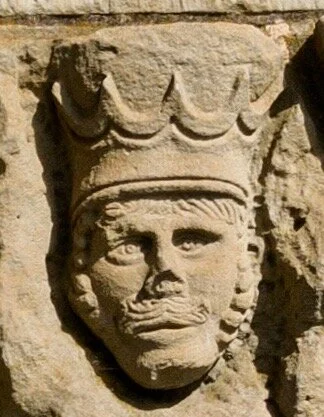
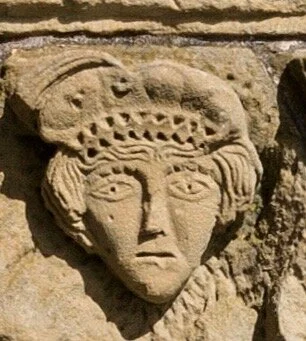
In Ross, the convict gang worked a well-organised racket trading stone, bricks, charcoal and lime, as well as their time, building houses and barns for the settlers and pubs for the publicans with government materials, instead of building the bridge. Jorgenson was appointed a Special Division Constable, with the brief to eradicate this lark. He was a tragic and brilliant man with over-inflated ideas about himself. Nowadays he would be labelled “bipolar”.
His ill-judged enthusiasm alienated everyone in the district. The thriving free economy benefitted them all, even the magistrates, despite there being only a tumbledown wooden bridge and a ford. His wretched wife, Norah Cobbett, was a scold and sot. Everyone he approached thwarted him. In his frustration, at sunrise on the 1st September 1833, he rode along the Macquarie River road with four constables to Egleston, John Headlam’s home.
He shot dead two of Headlam’s dogs, claiming it was the King’s orders; that they had been at large without their mandatory metal collars. [vii] So incensed was Headlam and his influential friends, that Jorgenson was dismissed, accused of being over zealous.
Thereafter, his life in Hobart was a tragedy, with mad Norah lugging ‘him continually downhill’. [viii] It is said he was found in a ditch in January ’41 and died soon after. Yet the writer of his obituary remembered him ‘as one of the most extraordinary men of his time’. [ix] And he was. [x]
Matching Jorgenson and Norah across the arch is the turbaned Rum John Conn and his wife, Christian Cameron. [xi] Conn lived across the river from Egleston; Christian did not arrive in the district till 1835. It is not hard to conjure the neighbours’ alarm on hearing the gunshots at Egleston reverberating throughout the valley. All settlers had been exhorted by Arthur to assist their neighbours if besieged by bushrangers and this would have been their immediate thought. Rum John Conn and the men of the eastern bank might have crossed via Black Johnny’s Ford at the bottom of his farm.
When Rum John Conn arrived in 1823 to take up his land at Emu Bottom on the Macquarie, the Taylor family had been there for ten months, settled on his northern boundary. They were cashed up, a father with three sons. Rum John Conn was a dark, solitary Moslem amongst white Protestants. He had suffered the British as a sepoy in the Bombay Marine, less worthy than the lowliest private.

His neighbours’ eyes were on the property that he struggled to develop; yet, they were respectful and included him in the district’s affairs. Conn mortgaged his land to the Taylors so he could erect buildings and eventually sold out to them in 1835 when he was probably over seventy. He remained a confessed Presbyterian, living with Christian in his red brick house above Black Johnny’s Ford until his death in 1841. [xii]
In 1794, he had embarked the Endeavour in Bombay, a privately owned ship, Captain William Wright Bampton. There follows a remarkable story:
forty-six convict stowaways out of Sydney;
knowledge of a half-built ship in its stocks on a beach;
the scuttling of Endeavour in Dusky Sound, New Zealand;
the marooning of 244 souls; the departure of all
but thirty-five castaways: lascars, sepoys,
runaways and deserting soldiers,
surviving for twenty months
on seals and birds [xiii]
until their relief and deliverance to
Norfolk Island in August 1797.
One was Rum John Conn.
The Moslem seamen were not provided with a passage home. They worked for English emancipists and when the island was evacuated, they were sent to Van Diemen’s Land. Conn turned up at Pittwater, “a poor miserable creature with not a shilling.” [xiv]
He became a stock-keeper for Bartholomew Reardon, ostensibly for £1 a week and by a strange sequence of events became a legend on the best farm in the district. [xvii]
His name is marked on the Tasmanian map:
Black Johnny’s Marsh, Johnny’s Lagoon,
on a gate entering Front Jonny’s (sic) paddock at Lemont.
Johnny’s Creek at New Norfolk,
Black Johnny’s Tier by Wood’s Lake
and Black Johnny’s Ford.
Christian is the woman of the moth, emerging into the light from a dark and chaotic place. She was a troublesome convict from Edinburgh but her crowded conduct record is free of punishments for the six years she spent with Rum John Conn.

The coxswain neutralises the motor and points to the man in the mortarboard beside a cow.
”I reckon that’s the farmer Headlam who lived across the river from Rum John Conn, whose dogs were shot by that man, Jorgenson. He wears a mortarboard because he was a teacher.
When he arrived in VDL in 1822, he couldn’t afford to establish his property, so established a school instead. Later, he taught in Launceston but his fine principles were not aligned with the prevailing protestant plan. The Inspector of Schools, Reverend Bedford, divided the girls from the boys with a curtain across the classroom, committing the girls to a life of domesticity. Headlam left, dispirited, to run his inn and farm; hence the cow.” [xviii]


“And the man with the whiskers by the cute little dog?”
“That’s a convict’s cap he’s wearing; he’s James Colbeck. He was in Ross when Jorgenson’s shenanigans were stirring things up, organising the very activities the cop was trying to stop. He was probably building Headlam’s house instead of – or as well as - the bridge.
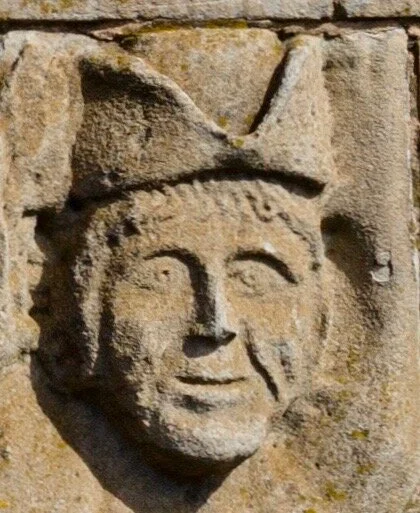

Dan Herbert is opposite him, on the central arch; they were the overseers of the works between 1835 and 1836, when the stones were being carved. Colbeck was yearning for his family; why else would he be looking northwards? He went home in 1846.”
Ross forgot him.
Except for the historian G Hawley Stancombe: [xix]
The chief mason, James Colbeck, was a troublesome fellow,
both at work on the bridge and on the church,
yet the quality of his carvings
will continue to please us
for centuries to come.
Colbeck came from a family of stonemasons in Dewsbury in Yorkshire. He was troubled but not a wicked man.
In Van Diemen’s Land he was assigned to the public works. He tried to stow away in March 1830. For that he received fifty lashes and the tread-wheel till the Governor’s pleasure was known. He was sent to the Bagdad road party from which he was sent to Mr. Foord in Bothwell to build a church. He was a good stonemason. In 1831, Roderic O’Connor, Inspector of Roads, pleaded with the Superintendent of Convicts on behalf of William Foord for his transfer to Ross.
Foord had the contract to build the new bridge but was dismissed for using government men to make bricks on his own land, Tryhard Farm. He had been managing the clandestine building projects for the settlers and Colbeck took it over until he was removed to Hobart, in January 1835. He was back in May as overseer of the gang with Dan Herbert. Their good behaviour was bought with the promise of free pardons and a shilling a day. The bridge was finished in July 1836, complete with 186 sculptures. [xxii]
On the left side of the western arch is a face so worn away it is hardly recognisable but Laird thought it was aboriginal, lest we forget the Black Line. Perhaps it represents George Van Diemen, who Kermode took to England.

But I think she is a poor woman, as John Dempsey’s contemporary portrait of the Bathing Woman of Bridlington (TMAG).
The last character is easily seen from the riverbank. He has lost his nose but his face was never distinguished. He is smooth-faced with an indecisive mouth. His hair and hat appear foolish. His collar gives the impression of clerical ribbons but may refer to his work in England as an architect of churches.
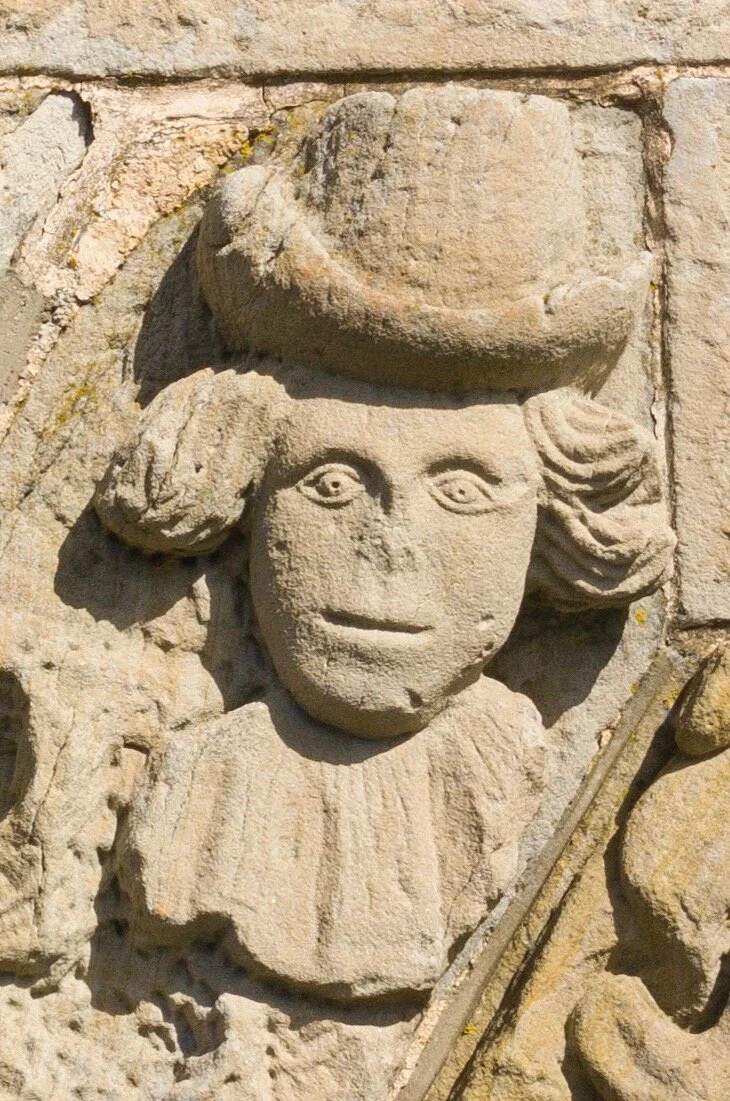
“I reckon he is Charles Atkinson,” I say to the coxswain, “who had grandiose ideas of self.”
Boring… how can I say it in pop-psychology speak?
Millenial nods, frowning, inquisitive.
“Poor bloke,” I say. “He had arrived in Hobart Town from Rio de Janeiro having been rescued in the middle of the Atlantic after the ship that was bringing him to Tasmania was wrecked by fire. Imagine it…"?
“DId he have PTSD do you reckon?”
My turn to nod.
He was one of seventy-one survivors of the wreck Hibernia, in the Atlantic in February but was publicly accused of occupying the stern sheets in the pinnace he had clambered aboard, making no room for others. He defended himself in the press, graphically describing the hopelessness of the abandoned souls. [xxii]
“What’s he got to do with the bridge?”
“He was an architect and was appointed Superintendent of the gang. He had already published a book in London on gothic stone carvings.”
He enters our story as Superintendent of Convicts at Ross Bridge as Jorgenson slinks away. Herbert did not arrive until June 1835 but Colbeck was there. He picked Atkinson for a gull and the clandestine practices restarted. But the bridge began to rise.
Atkinson must have beheld a riverbank piled with prepared freestone blocks with ornament-oriented eyes and Archer’s elegant plan in his hand. He declaimed he knew more than Archer and Colbeck, that he had vision. But he was dependent on the masons to execute it and curried favour, lobbying the administration on their behalf for improved conditions. [xxv]
He could draw.
Colbeck and his mates could carve his quatrefoils and egg and reels but they would have had their own agenda. How much was carved before Herbert arrived, if any, is not known.
Millenial seems thoughtful now. As we chug back to the east bank he gazes at the north face. I wonder if he was interested in the history he must have been offered at school; if today has breathed on a spark. I cannot tell if he is curious; he is taciturn when he drops me off and heads downstream to his launching spot.
[i] There are some other small portraits, randomly placed, as if one of the masons covertly carved a memorial to a family left behind. Five voussoirs beyond the lion-man is a child and a woman. Above them is a tiny face. Perhaps it is chief mason, Colbeck, watching over his wife and child.
[ii] Isaac Chapman built Westella for Henry Hopkins in 1835
[iii] Leslie Greener and Norman Laird Ross Bridge and the Sculpture of Daniel Herbert (Fullers Bookshop Hobart 1970)
[iv] Daniel Herbert conduct record, AOT Tasmanian Names Index
[v] I am grateful to Dr. David Bedford for recognizing the cat o’ nine tails
[vi] Greener et al Ross Bridge
[vii] The Headlam Files p325 personal communication with Ian Headlam.
[viii] Dan SprodThe Usurper (Blubberhead Press, Hobart. 2001 P. 607)
[ix] ibid p 610 and Hobart Town Advertiser 22nd January 1841
[x] Hobart Town Courier Friday 7 June 1833 Jorgen Jorgenson
[xi] I am grateful to John Taylor for recognising him.
[xii] Taylor v Reardon, Supreme Court 1837 & 1842
[xiii] David Collins Account of the English Colony in New South Wales London 1798
[xiv] ibid
[xv] ibid
[xvi] Earlier, Reardon had coerced Conn into writing a will, bequeathing all he owned to the Reardon sons. He always thought Conn held the land in trust for them. When John Taylor bought it and applied for the title, Reardon challenged him in court but his caveat was dismissed, twice. It is the transcript of this case that tells us a lot about the life of the legend, Rum John Conn.
[xvii] O,Connor R. 1826 – 1828 The Journal of the Land Commissioners.
[xviii] Australian Dictionary of Biography and Laird et al Ross Bridge
[xix] G. Hawley Stancombe A History of the Parish of Ross (The Ulverstone Press 1969)
[xx] Calendar of Felons, National Archives, United Kingdom
[xxi] Manlius 1828
[xxii] Tasmanian Archives CSO/1/1311/7501; microfilm Z1824
[xxiii] Hobart Town Chronicle May 21st 1833;

[xxiv] September 1833; TMAG Hobart
[xxv] Geoffery Stilwell. Notes on Ross compiled for the Association’s excursion to Ross September 1961 THRA Papers and Proceedings.