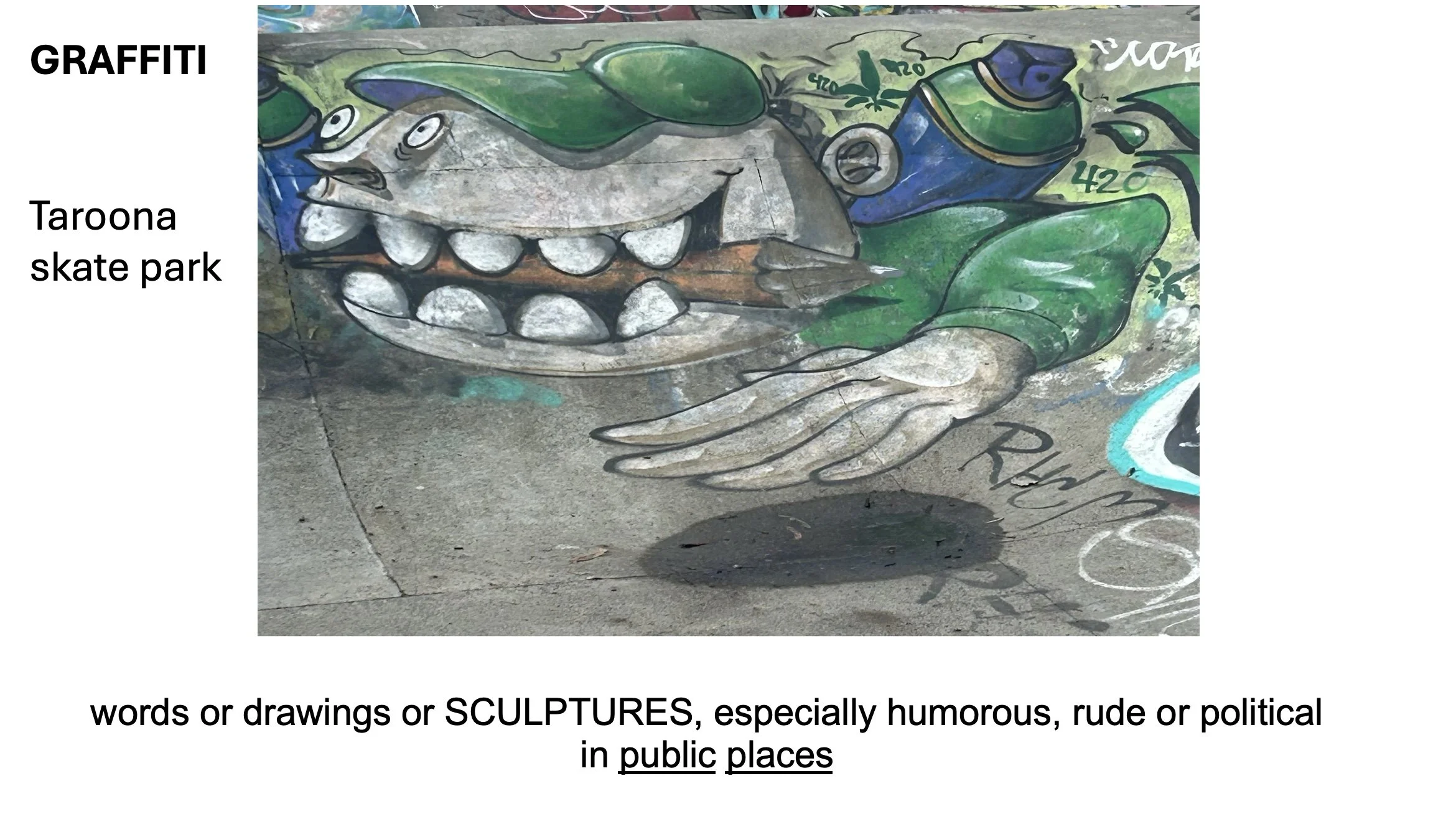
GRAFFITI, SATIRE, CYNICISM, SAUCINESS,
SYMBOLS & STORIES
A TRANSCRIPTION OF A POWERPOINT PRESENTATION I DELIVERED ON AUGUST 5TH 2025 TO PROBUS, SANDY BAY CHAPTER
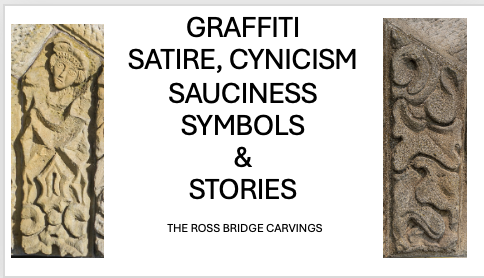
The convicts of VDL endured an unenviable lot but the men of the RB party had the extraordinary, unique chance to write their story in stone. If it had been written on paper, it would have been burned. THE BRIDGE IS PROBABLY THE EARLIEST AUSTRALIAN DOCUMENT TELLING THE LIVES OF WORKING CONVICT MEN WRITTEN BY THEMSELVES, WORKING MEN. They used the joke, satire, irony, grotesquery, caricature, symbols to subvert those in power and exorcise their own demons.
The sculptures are often lewd, obscene, absurd, but the superficial humour veils a deeper layer of social criticism.….it is the sense of humourous reportage of those pre-Victorian criminals who were crowded into dungeon, hulk, transport ship, penitentiary, and chained in demountable caravans without a whiff of the opposite sex, …. It is the cynicism of those hardened brutalised men, viewing society from the edges, that raises the carvings of the Ross Bridge to the genre of subversive satire.
I do think the bridge is an example of narrative architecture: story telling through sculpture. USUALLY NARRATIVE ARCHITECTURE FACES A THOROUGHFARE FOR THE ERUDITION OF THE ILLITERATE BUT THE ROSS BRIDGE CROSSES A RIVER WHICH HAS NEVER BEEN A THOROUGHFARE.
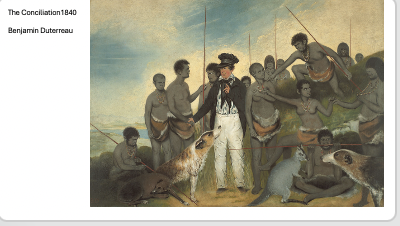
Its completion in 1836 predates Duterreau’s The Conciliation, long considered the first example history art in Australia. It is a document written in stone as is no other, a document written by working men about their lives, opinions and the conditions of their labour. The carvings are subservient, mocking the monarchy and the regime in the colony. They reveal the convicts’ experiences: flogging, witnessing hanging, the transport ship and the ubiquity of promiscuity and unnatural sexual acts of sodomy and lesbianism. The stone carvers were hardened, brutalised and resentful, the products of poverty in the age of the Industrial Revolution, resistance to change and the Napoleonic wars and post-war constraints.
They were men of their time: pre-Victorian and before the emergence of the gentrified English middle class.
.. but first let us consider the river which was known by the tyrrenotepaner people as tinamarakuna before Lachlan Macquarie renamed it in 1811 after himself.
The palawa traversed the northern midlands beside the river for thousands of years, preparing the land for their survival. It was their park-lake plains that were prized by the white settlers for their stock, so they possessed them, altered the landscape and re-named it, killed the native animals, and displaced the people, even joining the Black line. Extirpation was the word used by some.
I think it is well for us to remember in our good fortune, the tragedy of the palawa, the first peoples of Tasmania.
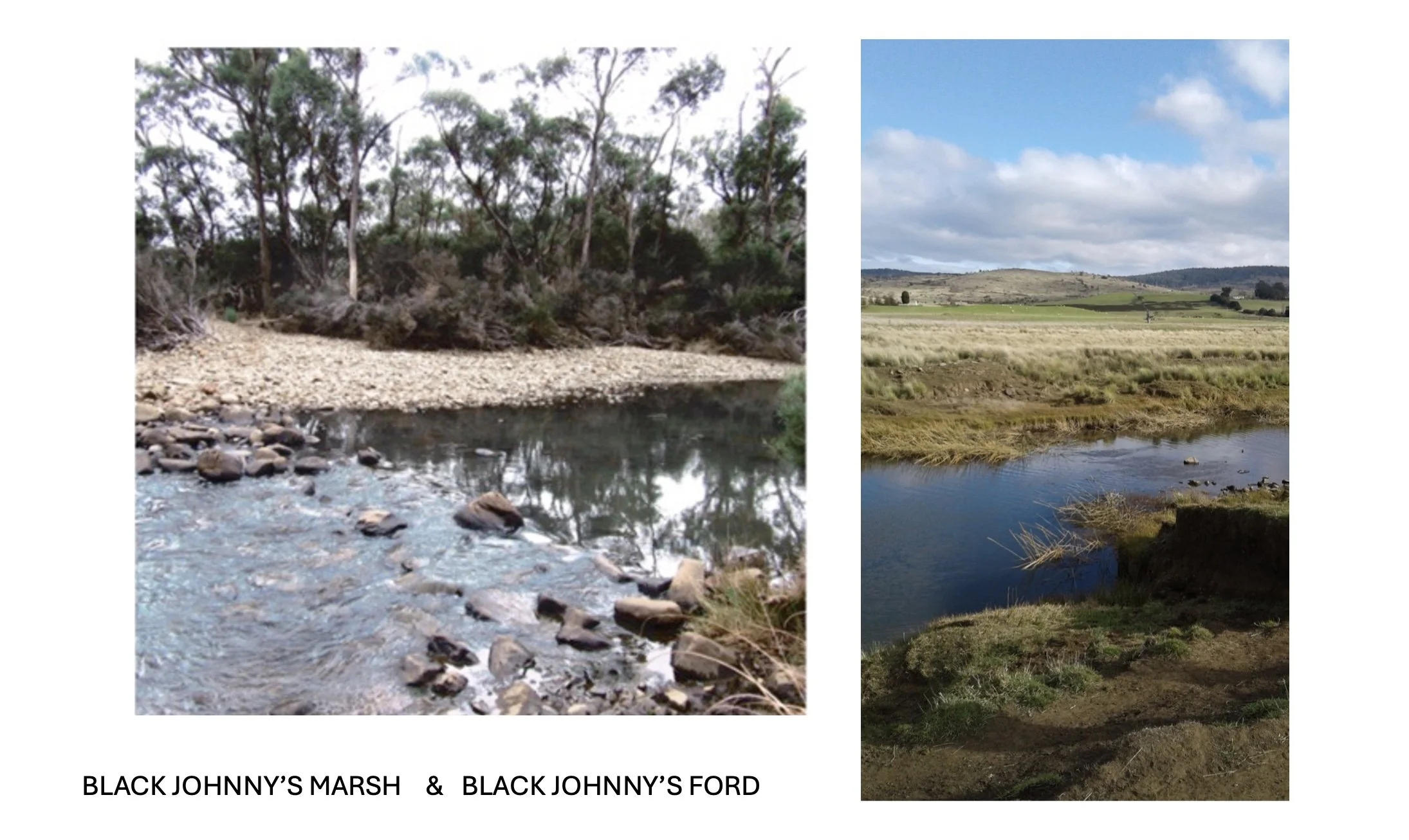
The river is 189 km long, rising at Hobgoblin, a small mountain in the Eastern Tiers 20 km east of Ross. It flows south and turns towards the north at Black Johnny’s Marsh in the Eastern Marshes. It flows north-south through Ross under the bridge, across Black Johnny’s ford beyond Campbell Town and on to its confluence with the South Esk near Longford.
Cynics viewed society from its edge, regarding wealth and power with derision, expressing their contempt publicly.
The philosophy is regarded as an experimentation with psychopathological states of mind – madness, split personality, unrestrained daydreaming, weird dreams, extreme passions, to destabilize the unity of an individual and his fate
It is characterised by significantly heightened comedy, fantastic and mystical elements combined with a crude slum naturalism: the 'testing of the idea' never avoids the degenerate or grotesque side of earthly existence. It breaches conventional behaviour and disrupts the customary course of events.
I ask you, how would you respond if your most despised politician was drawn as a grotesque with head on a two-pronged hay fork? Would you be outraged, cringe or feel a little sympathy, or laugh out loud?
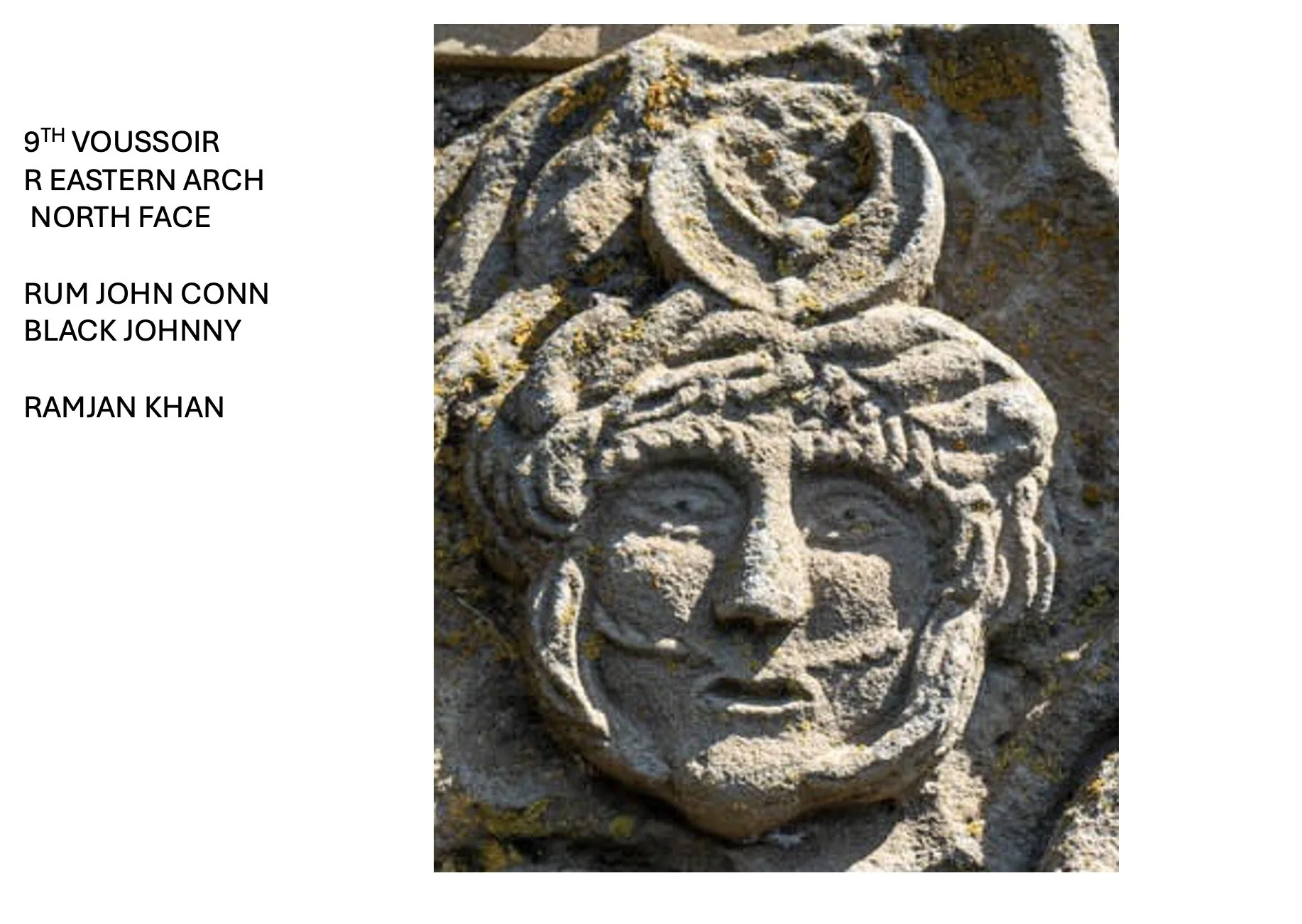
And this is Black Johnny.
John and Vera Taylor rowed me by the bridge when I began this research and when I said: But, I don’t know who that Turk is, John said without hesitation: that must be Rum John Conn..
.. Ramjan Khan owned the neighbouring farm to the Taylor’s from 1823 till his death at an advanced age in 1841. I think the Taylors both cared for him and coveted his land which he sold to them for an annuity of £200 in 1837. He remained in his own red brick house above the flood level till he died. He must have told his extraordinary stories to the convicts for them to revere him enough to preserve him in caricature on the bridge. I think they understood a man who had survived the patronising disrespect of white men ever since he had entered their world when he joined the Bombay Marine in 1775, I calculate, at the age of 15. The course of his life was remarkable and I think is marked in our landscape at New Norfolk at Johnny’s Creek; ;Johnny’s Paddock at Fonthill, Johnny’s Lagoon and Johnny’s cottage at Lemont, Black Johnny’s Marsh at the Eastern Marshes, Johnny’s Ford past Campbell Town and Black Johnny’s Tier in the Western Tiers.
…… just as the convict overseers and artists, James Colbeck and Daniel Herbert did on the bridge. Herbert is the legendary artist of the bridge. However, he did not arrive in Ross until June 1835. We know that from January 1835, the work party was depleted when 23 of its skilled tradesmen were removed to other parties because they had brawled in a pub after the church on Christmas Day.
John Lee Archer, the architect and engineer of the bridge, wrote in April 1835 a report after having surveyed the works, referring to Charles Atkinson, the dismissed superintendent: The whole of his gang which was in an efficient state at the time of my last survey was in a short time subsequently removed and dispersed to various parts of the colony and that in composing his the present gang he was under the necessity of receiving the refuse of workmen from such works as could from time to time be spared, a strength which was mostly inadequate and incompetent to the execution of such a work as the construction of a bridge within the time desirable for its completion. And that is why Dan Herbert was posted to Ross. He was Archer’s best mechanic, then acting as overseer on the Customs House site (which is now Parliament House.)
Colbeck had been one of the men removed from Ross – he went to Hobart until May 1835 when Archer relinquished him too, because the bridge work had stalled without him. He had arrived in Ross in 1831.with a gang of 40 convicts who had been in Bothwell, repairing the barracks and building St. Luke’s Church under the superintendence of William Foord, a builder contractor.
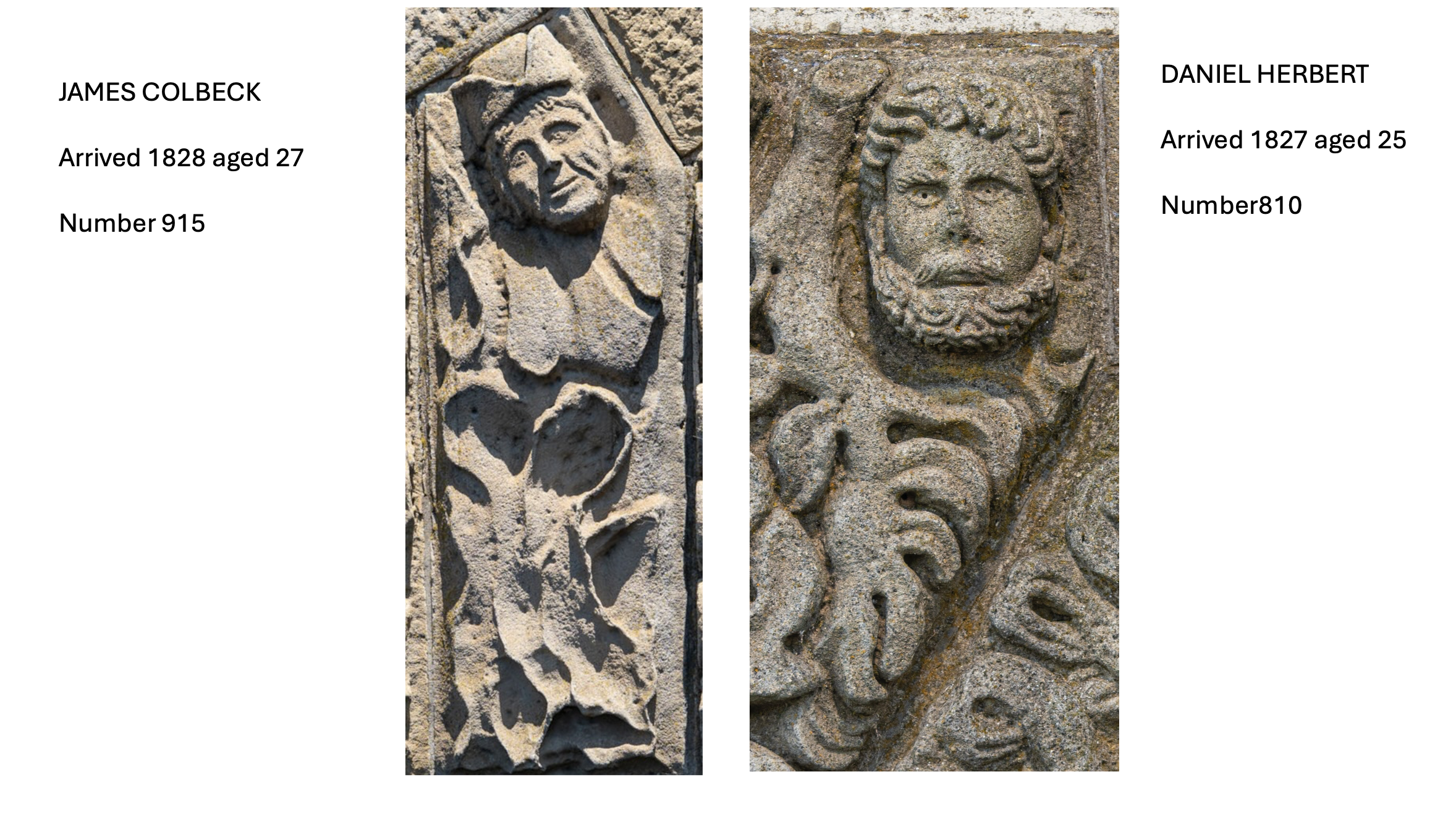
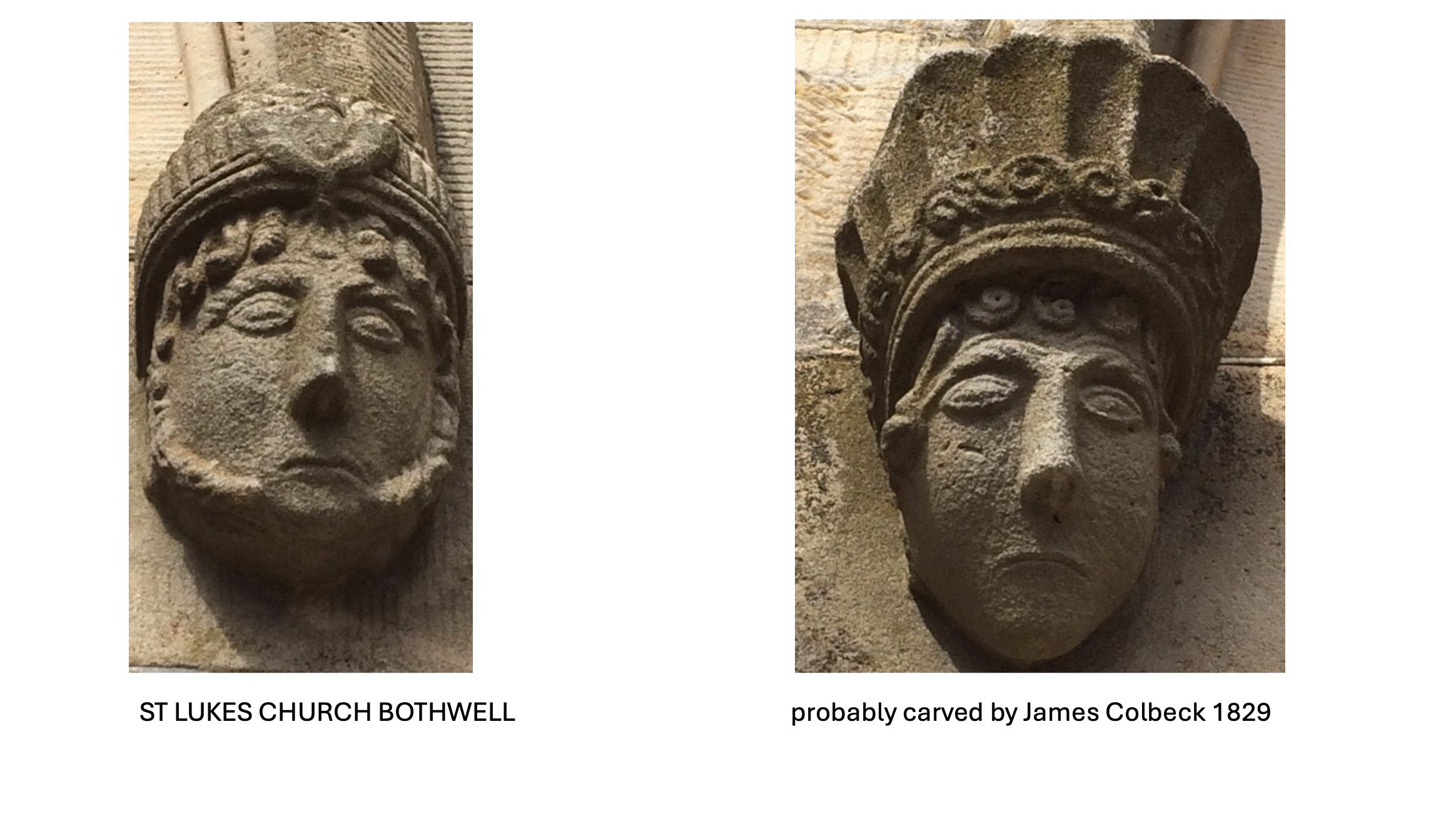
These carved heads on the portico of St Lukes church are attributed to Dan Herbert – but he was never there. James Colbeck was. My great great grandfather was there too – Thomas Herbert - who was transported for housebreaking in the same ship as Dan Herbert – convict number 811. Dan was 810 … I think that is where the mis-attribution arises. Thomas was a quarryman who went to Ross with the gang of 40 in May 1831
I think Coleck carved these with his tongue in his cheek … the Presbyterians had called Mr Garrett from Scotland to build their congregation and church at Bothwell. It seems that these heads are superficially a Celtic king and queen – but I reckon they really are James and his wife Nancy looking sad and grim because he has been transported. We know he had whiskers from his description.
Look carefully at the details of the sculptures – their almond-shaped eyes and proud outlines; the details of their curled hair, the simplicity of their faces, their thin lips and headwear, because they are like the caricatures on the bridge.
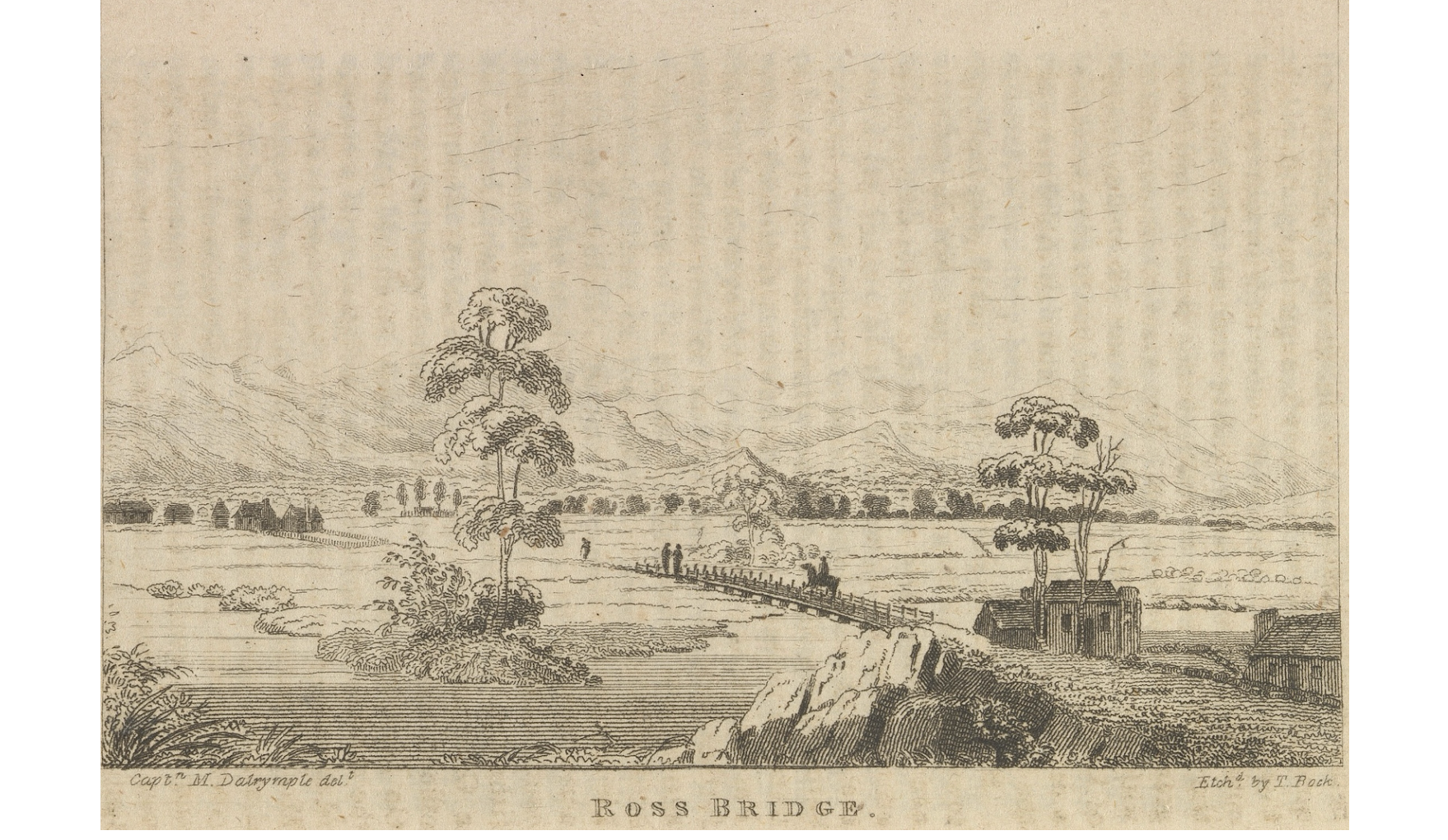
The old bridge that was to be repaired had been designed by a military engineer in 1828. It had 14 arches, merely stone piles, and a wood roadway … it was washed away repeatedly. The convicts had to build their own barracks and a house and stables for Mr Foord and prepare material for the new bridge. They had repaired the old one before they crossed the river into the village.
But the plans were not ready and the site had not been chosen – not till 1833. So the men under the organisation of Mr Foord built homesteads and outhouses for the settlers. The Lieutenant Governor did not approve and Mr Foord was dismissed in 1832.
Charles Atkinson was a young London Architect from a family of Russia merchants who arrived in Hobart Town in May 1833. He was appointed to the office of John Lee Archer, the Colonial Architect and Civil Engineer, to draw up the plans of the Ross Bridge. Then he was appointed to the position of superintendent of the gang at Ross – by then, one hundred wily, hardened criminals in the ‘habit of working for themselves’ – so wrote Roderic O’Connor in 1835 in a report on the clandestine building racket. There was no evidence that Atkinson converted the work of the men under him to his own benefit or that he had acted in any manner unbecoming to a gentleman. He was placed in a situation totally new to him, and having the progress of the work much at heart, he conceived by permitting the mechanics to earn wherewithal to procure trifling necessities that they would assist more cheerfully in completing the undertaking.
And they did at first… in December he wrote that the first cutwater was in place. But in April 1835, according to Archer, only 2 courses of the abutments had been laid - the arches had not been erected because the iron required for the centre work had not been supplied despite Mr Atkinson’s repeated requests. From their reports, O’Conor’s into the building racket and Archer’s into the progress of the work, the engineer and the inspector of roads were sympathetic towards Atkinson. But for his lenient ways and personality, and because he was the only person who could exact compliance from the convicts in the gang, he was given the opportunity to resign in April 1835.
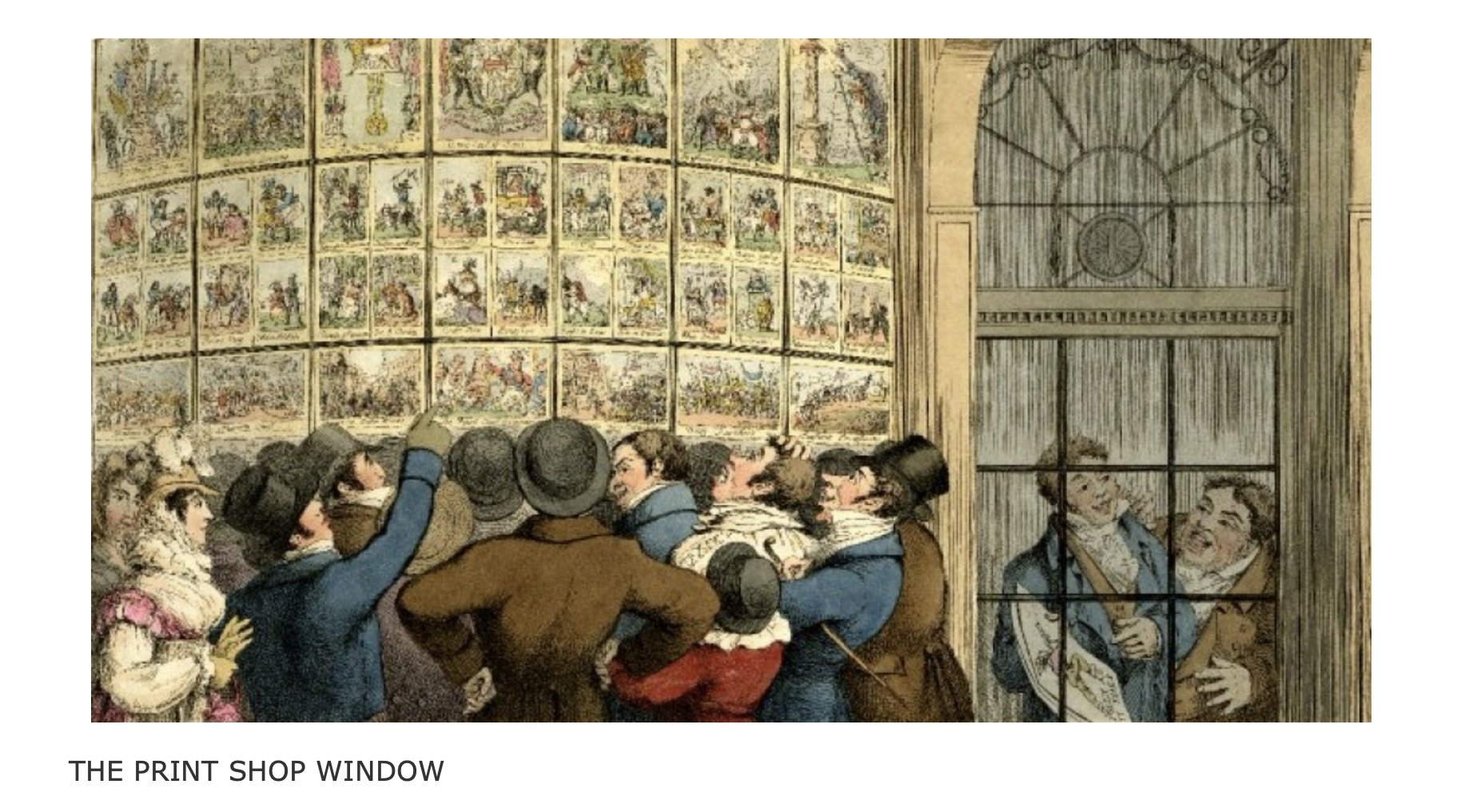
THE GOLDEN AGE OF THE SATIRICAL PRINT was 1780 - 1821, thereabouts, when George IV bought off the satirists who had lampooned him during the Regency. In London, the print shop window displayed the works of the caricaturists that were published within. James Colbeck was in London 1822 and 1826 working on Nash’s renovation of Buckingham Palace. He had a talent and Yorkshire sense of humour, no doubt returning the Londoners’ disdain for the northern bucolic interloper. I imagine him in the crowd outside a window display of prints.
The enduring appeal of the satirical print is that it works both as a piece of superficially absurd humour and as a vehicle for more subtle forms of social and political criticism. I think Colbeck brought this trait to Van Diemen’s Land.
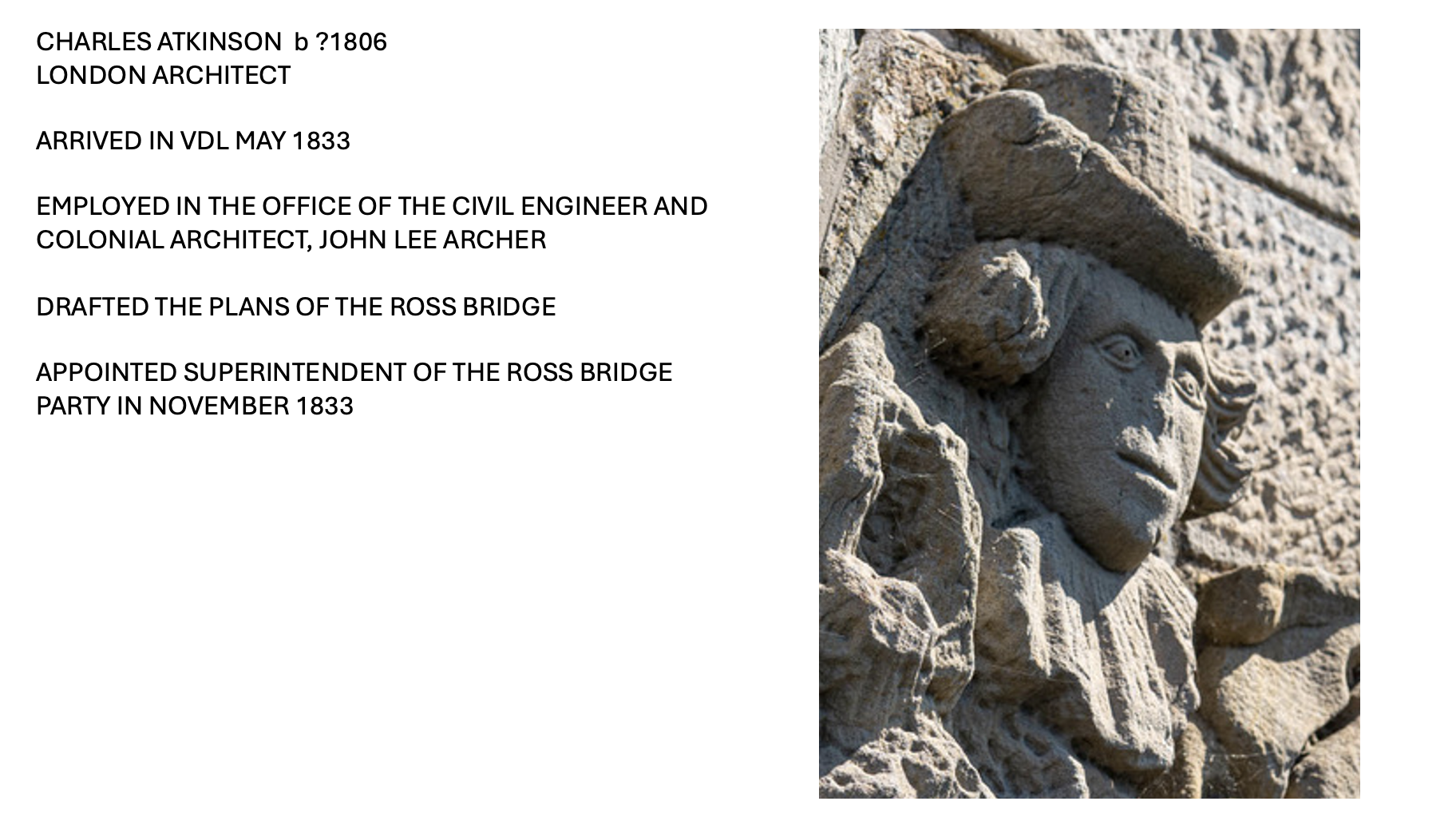
However, the carvers endowed him with a naïve fae, bewildered, rather foolish. What did they know of him? He was lenient, an egoist and an aesthete. He was soft, letting them continue earning money for themselves in the manner of orders upon the village stores, received meat, flour, tea, sugar, tobacco and clothes. When describing the plans for the C of E church at Ross 1835, he said:
“When I have finished it, I can boast that there is no such edifice in the Island – the design is strictly architectural and as yet I have not seen a building which is – it will be a monument of fame to me if I should cease further labours in my profession…” Yet, Archer had been designing elegant Georgian buildings since his arrival in 1827.
He was an aesthete – we know from his will that he played the double flageolet, had poetry books, books on architectural decoration, and he was a fine lithographer and watercolourist. I suspect he was homosexual in a gentlemanly way.
He was severely injured in a carriage accident in March 1838 which caused a lingering, dreadful death from sepsis. It was written by Henry Emmett afterwards that
The assistance afforded by Mr Surveyor Dawson with whom Mr Atkinson was in the habits of intimacy was highly gratifying to the sufferer and several other of his friends. Perhaps it was that reason that the self-appointed aristocracy of the district forced him to resign.
Why did they pair him with a boar……. I think it was for the homonym
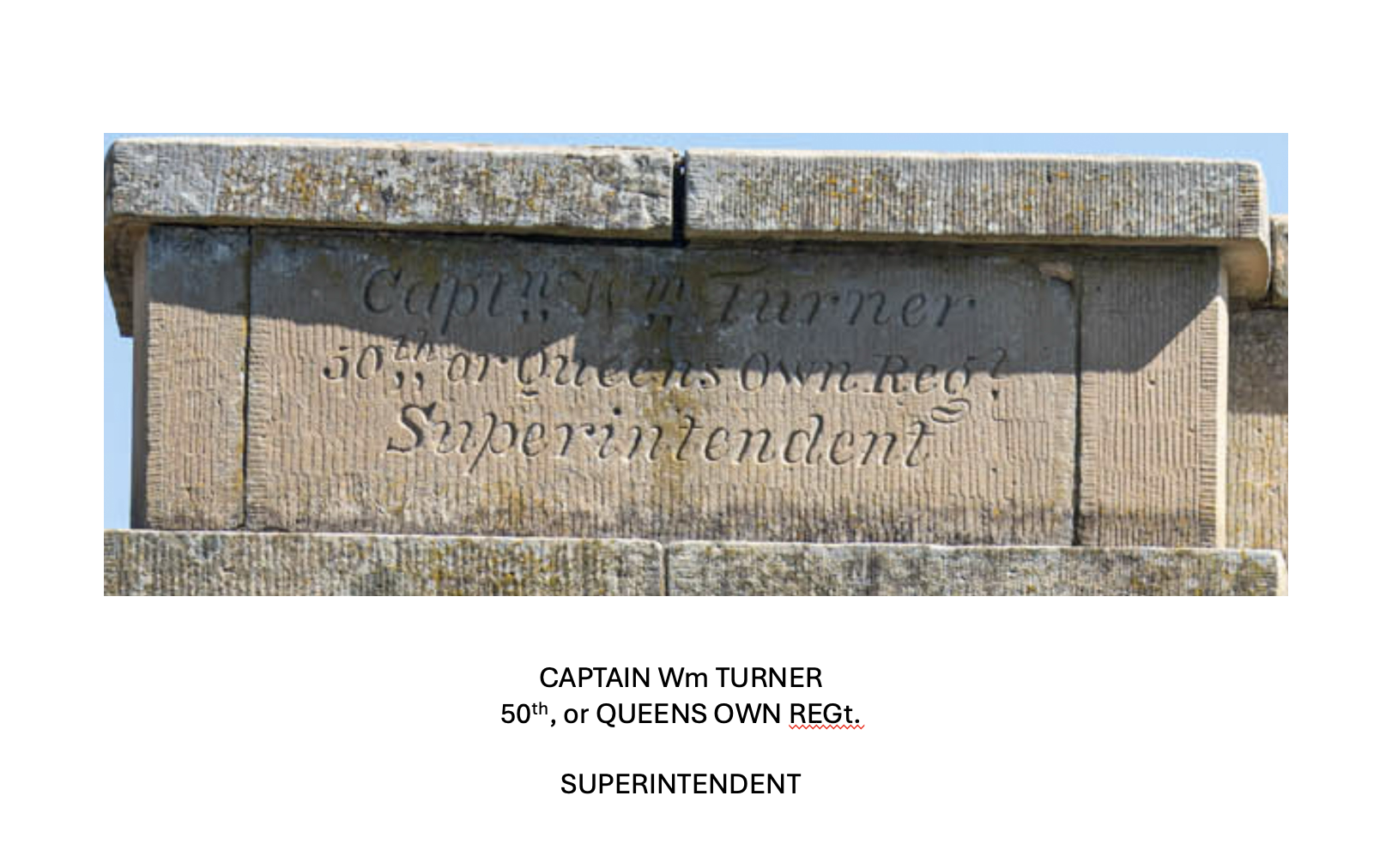
Captain WIlliam Turner replaced Atkinson as superintendent. He was a one armed officer who had been injured at the Battle of Vitorio in Spain in 1813. He admitted to knowing nothing of building a bridge, but he was an experienced manager of men. We know he was proud of his men at Ross. In the True Colonist, 7th September 1838, a correspondent wrote: A gallant and amiable officer who superintended at Ross … go where you would from sunrise to sunset, to the works at Ross, you never failed to observe Major Turner in the midst of his men; he did not hesitate to tax his own pocket to pay for a portion of the decorative work on the bridge … it was quite a hobby with him and his best energies were entirely directed to it …… What did that mean? Were other stone carvers, free men in Ross, paid to help with the carving? Or were the men of the gang paid to inscribe his name, rank and regiment into the pillars at the four corners of the bridge?
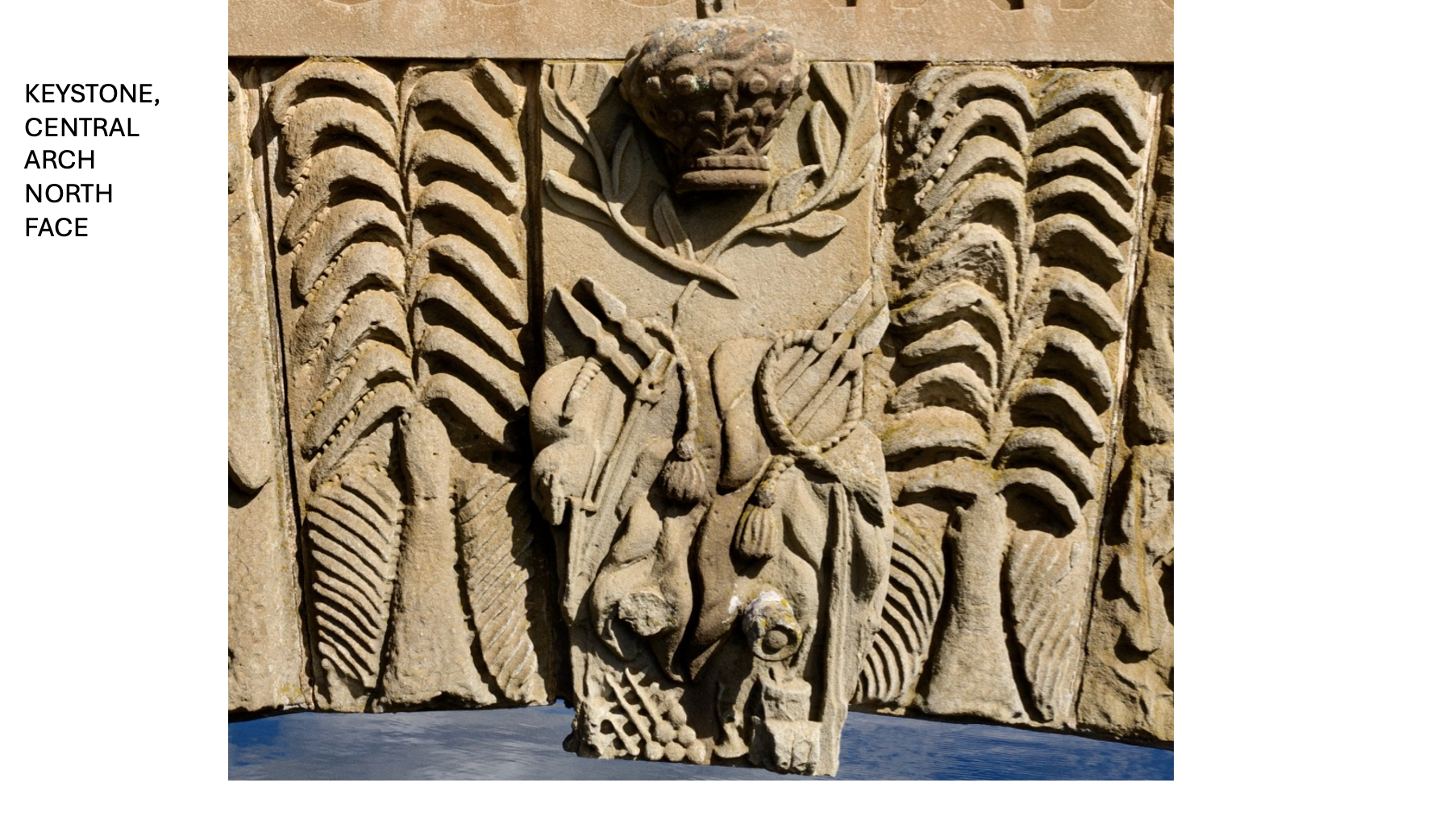
Was it he who suggested the parodies of military crests on both keystones of the central arch?
The crown is bigger than the brass monkey, keg and drum on the base of the stone with a powder measure and a bugle. There are two cannon barrels containing balls and tools for firing the cannon. A demi-gaunt – a glove used by the cannoneer - is clear on the stone’s right edge in the photos taken in 1968 by Norman Laird .
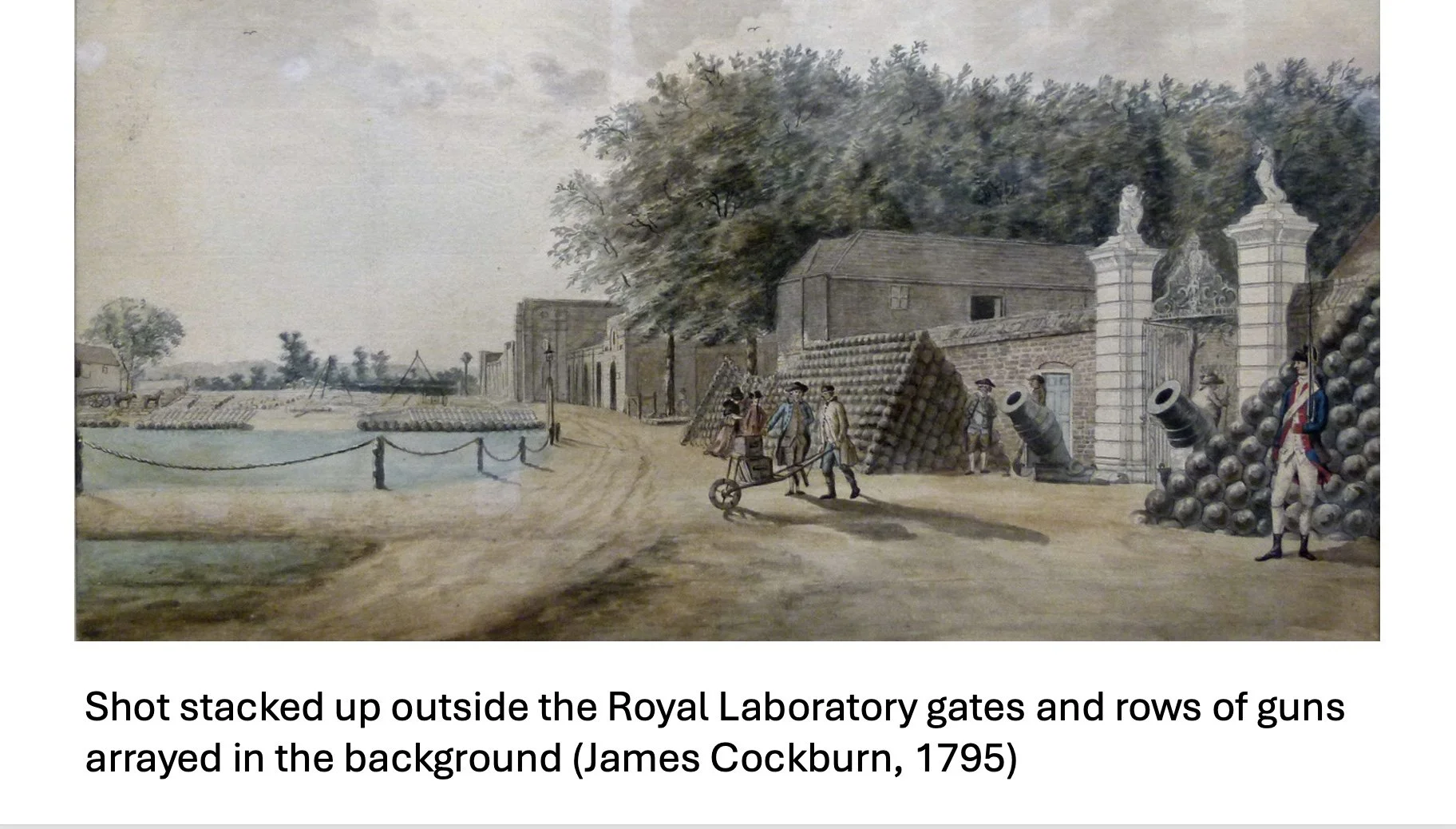
Dan Herbert was imprisoned in a hulk at Woolwich after his second crime in 1822. He would have been sent to work on the wharf attached to the arsenal; brass monkeys and cannons would have been a daily sight.
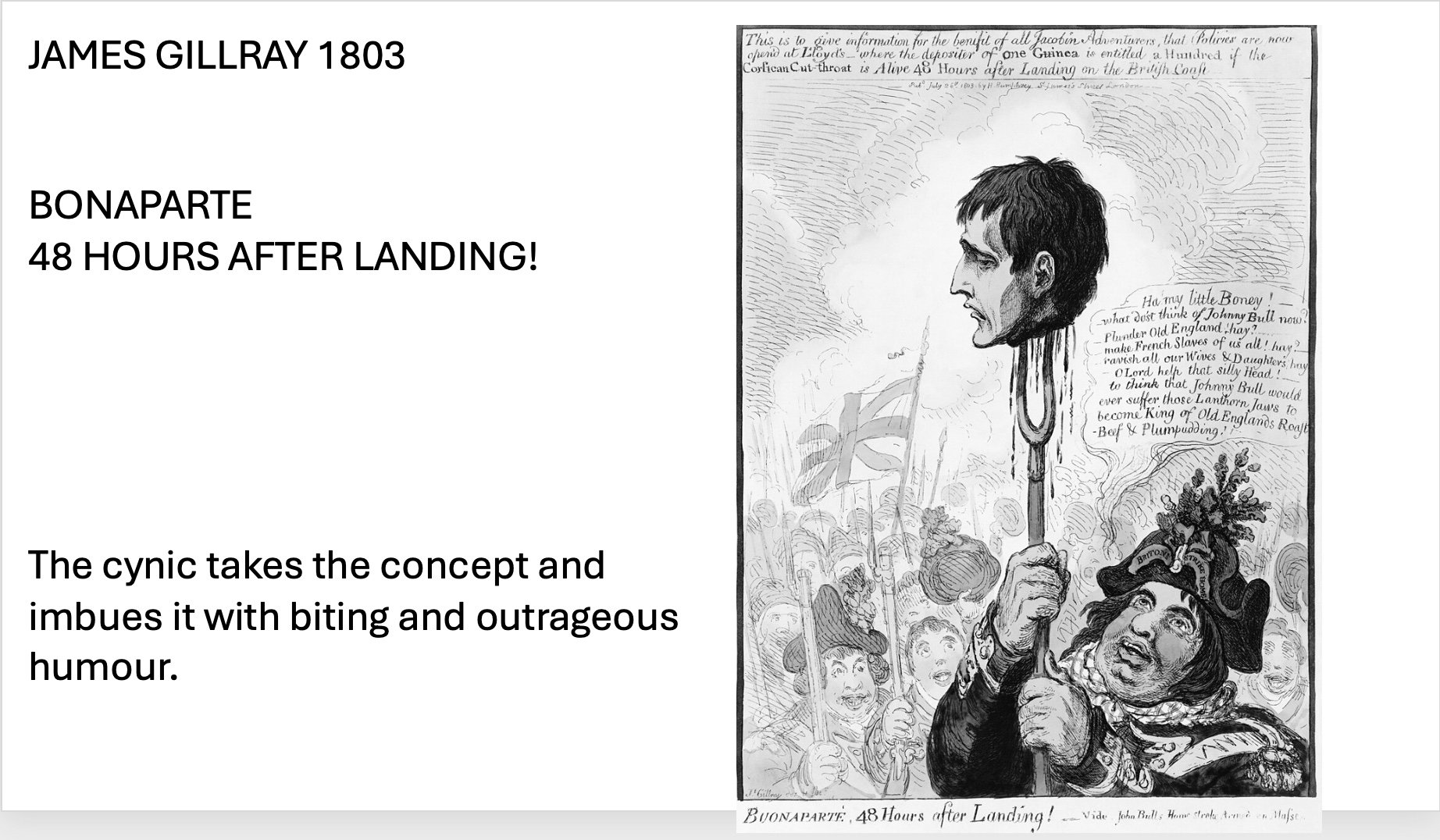
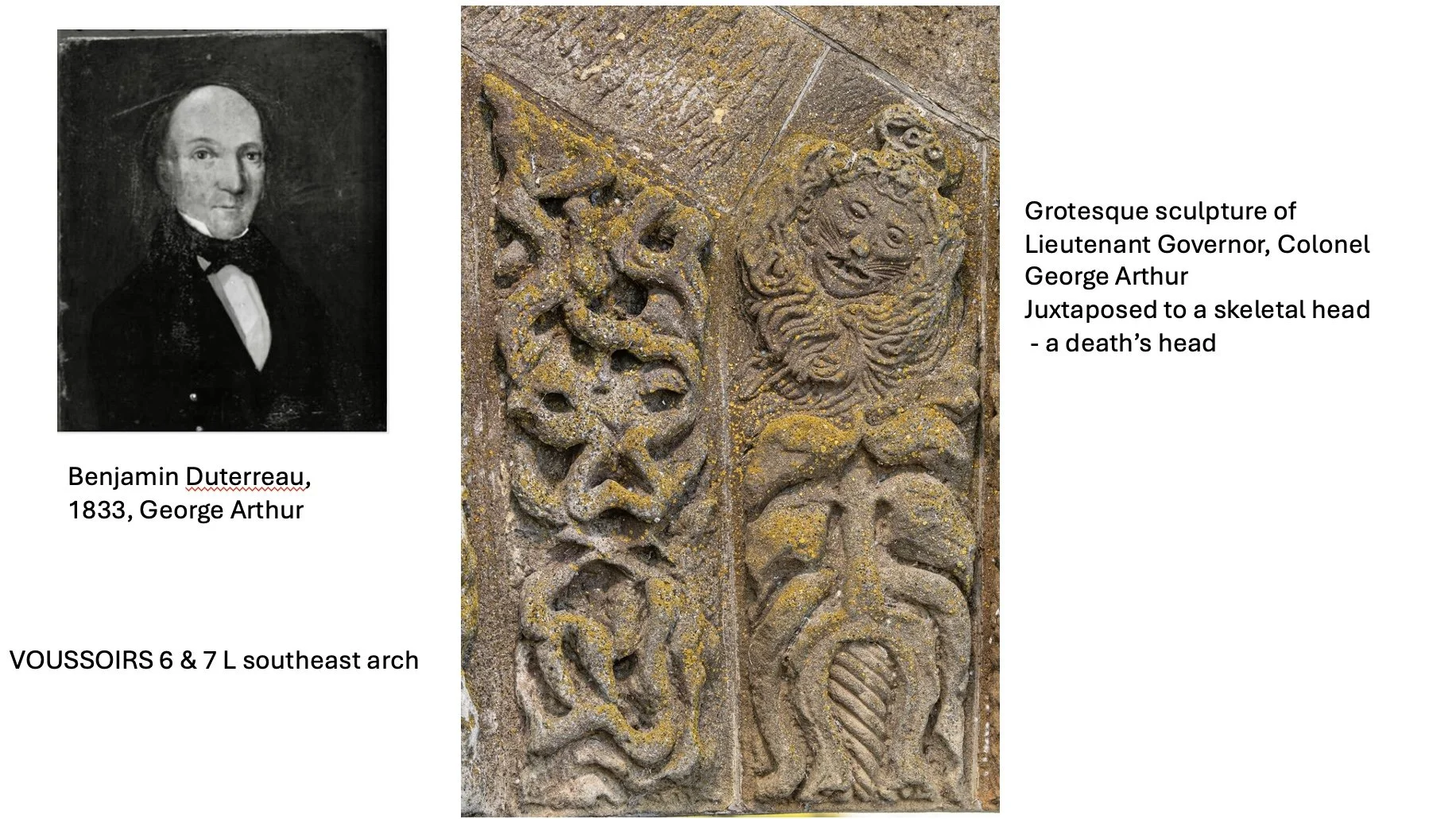
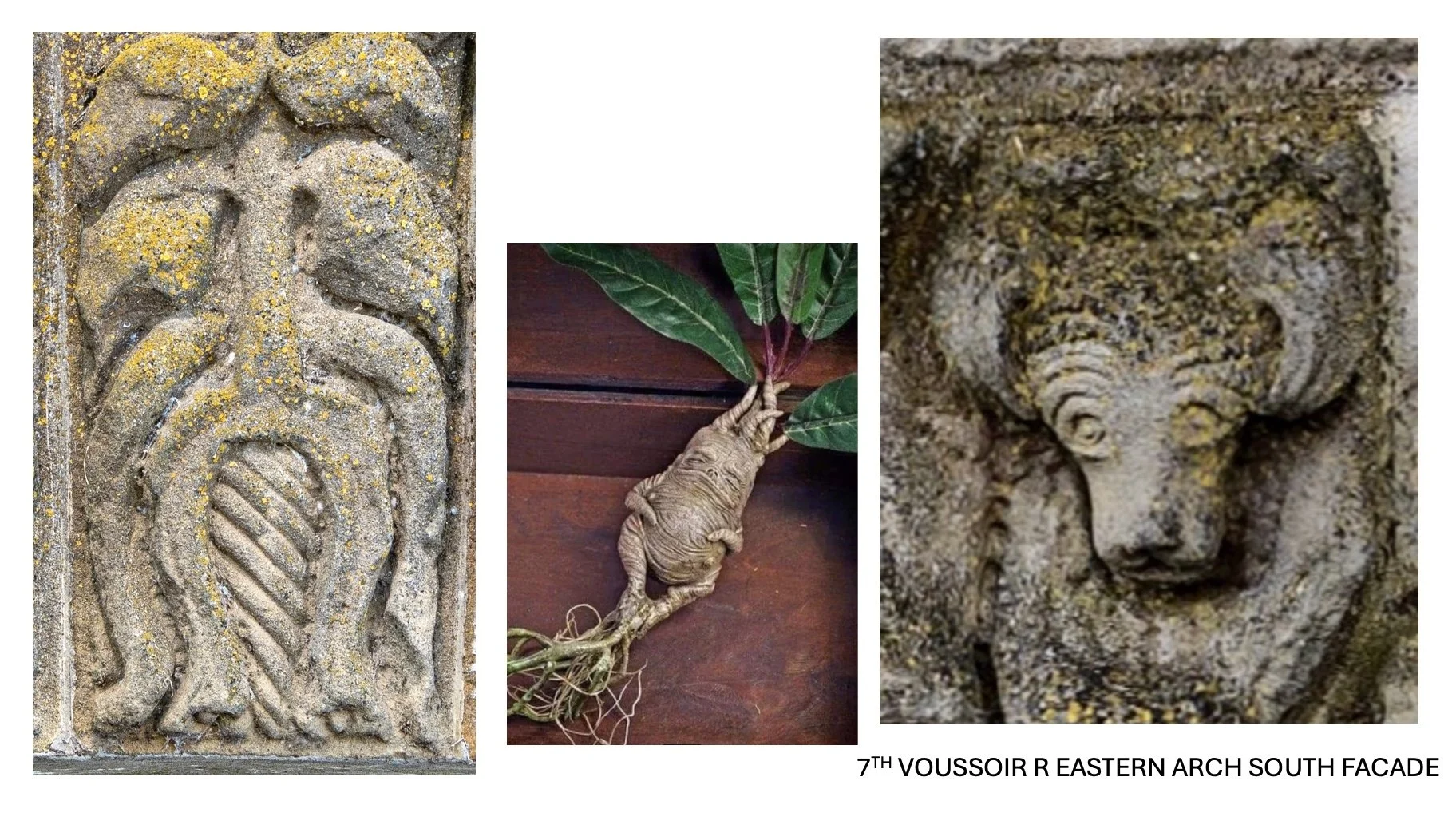
This grotesque of Lieutenant Governor George Arthur is little different from that of Napoleon Bonaparte on his imaginary entry into England. His lion’s head is cocked on a stem the base of which has the form of a hay fork. He was an agent of the British in the antipodes in a penal settlement, therefore his job was to enforce the rules of the Bloody Code. A satirist and a cynic needs someone or something to despise. There is little doubt this sculpture is the expression of loathing and contempt. The crown is ornamented with a cat o’ nine tails and a pair of ankle irons and it too small for the head. Duterreau’s unflattering portrait of Arthur shows us his bald head, hooded eyes and thin lips covering an edentulous mouth. The anthropomorphic lion has a comb-over under a royal mane, hooded eyes and a few fang-like teeth. The juxtaposed skull has drooping eyelids, too. The lion’s torso is a stem with four leaves and leg-like roots astride a two-in-one which symbolises balance, unity and harmony. The convicts knew that the penal colony was not balanced or unified. Men outnumbered women, poor the rich and the imprisoned the free. Factions bedevilled the settlers and harmony was not a pleasure the convicts experienced. In the carving its obscenity taints the governor. The plant is a mandrake, representing two pertinent legends:
Mandrakes are said to grow under the gallows where the semen of the hanged man drips. During Arthur’s authority, over 200 men and women were hanged in Van Diemen’s Land.
Also, mandrakes are said to scream when they are pulled out of the ground and the harvester dies. So a dog is tied to the base of the stem and enticed to run by his master holding a piece of meat. Thus, the mandrake is uprooted and the dog is sacrificed. It can be no accident that a worried dog is carved into the stone opposite the lion.
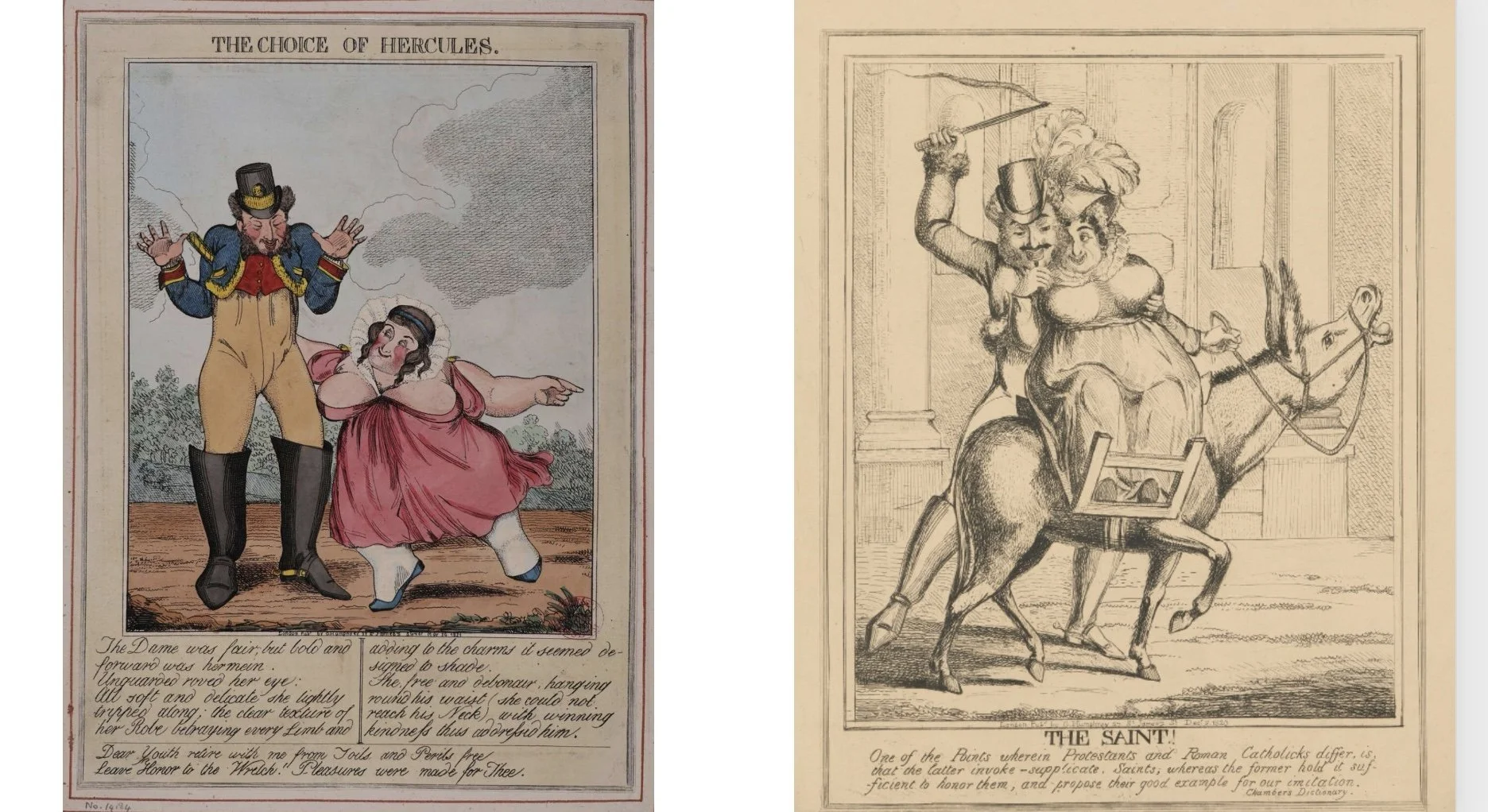
The caricaturists satirised the Prince Regent’s wife, cruelly. Princess Caroline was George’s despised and rejected consort . She had left England in 1814 when the Parliament paid her £35,000 to go. She had married George, Prince of Wales in 1795 and produced Princess Charlotte before the couple separated and formed two extravagant and licentious households. Already, the treasury coffers were low owing to war; and Royal expenditure which included George’s prodigal brothers was too much. So was public opinion. In Italy , Caroline and Bartolomeo Pergamo became lovers so when George III died in 1820 and she returned as the rightful Queen, he came along. She was short and busty, enhanced by an exposing decolletage. Her hair was curly and elaborated coiffed. She was not a beauty and it was said she loved a joke. A satirist needs the mood, talent and subject to ridicule …
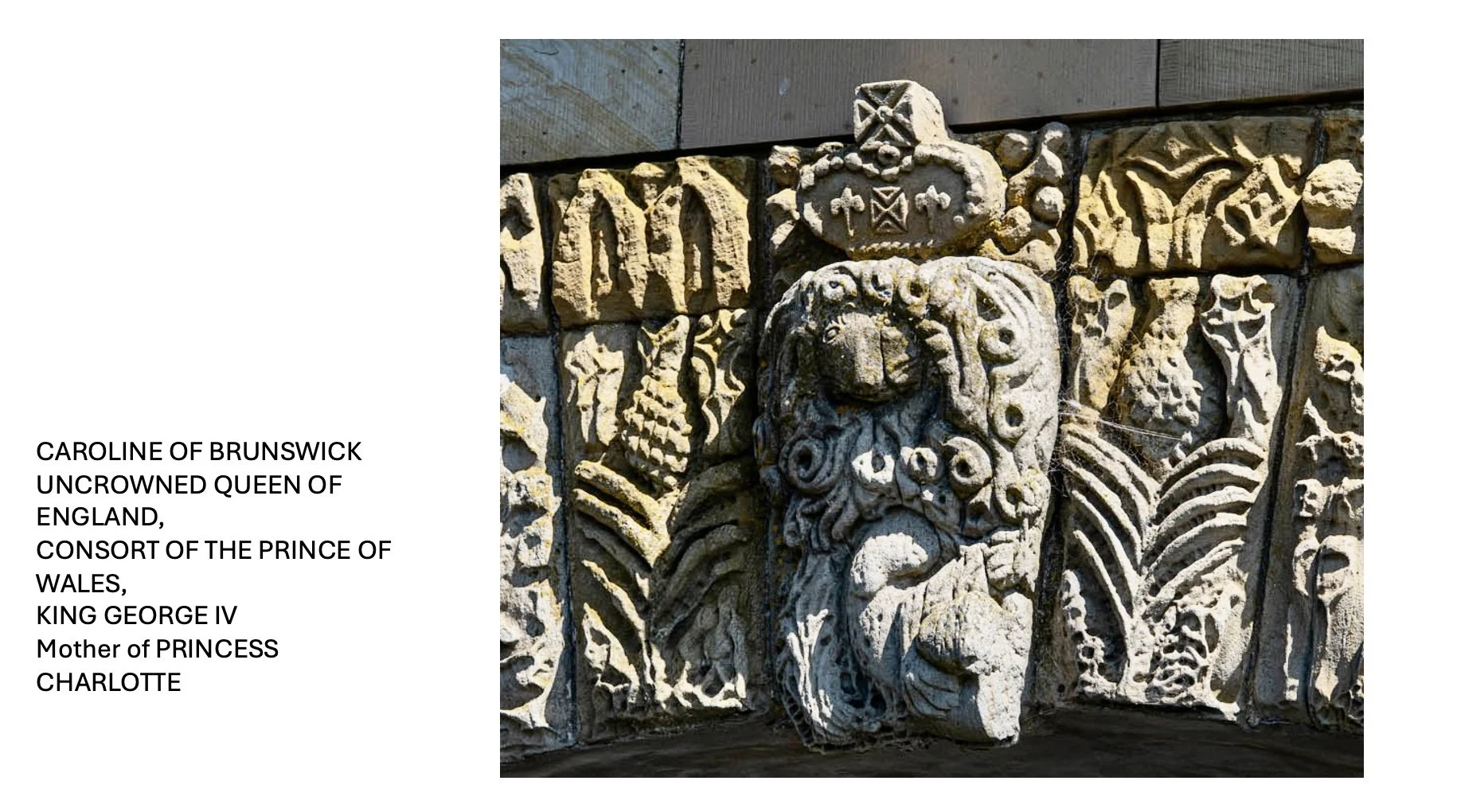
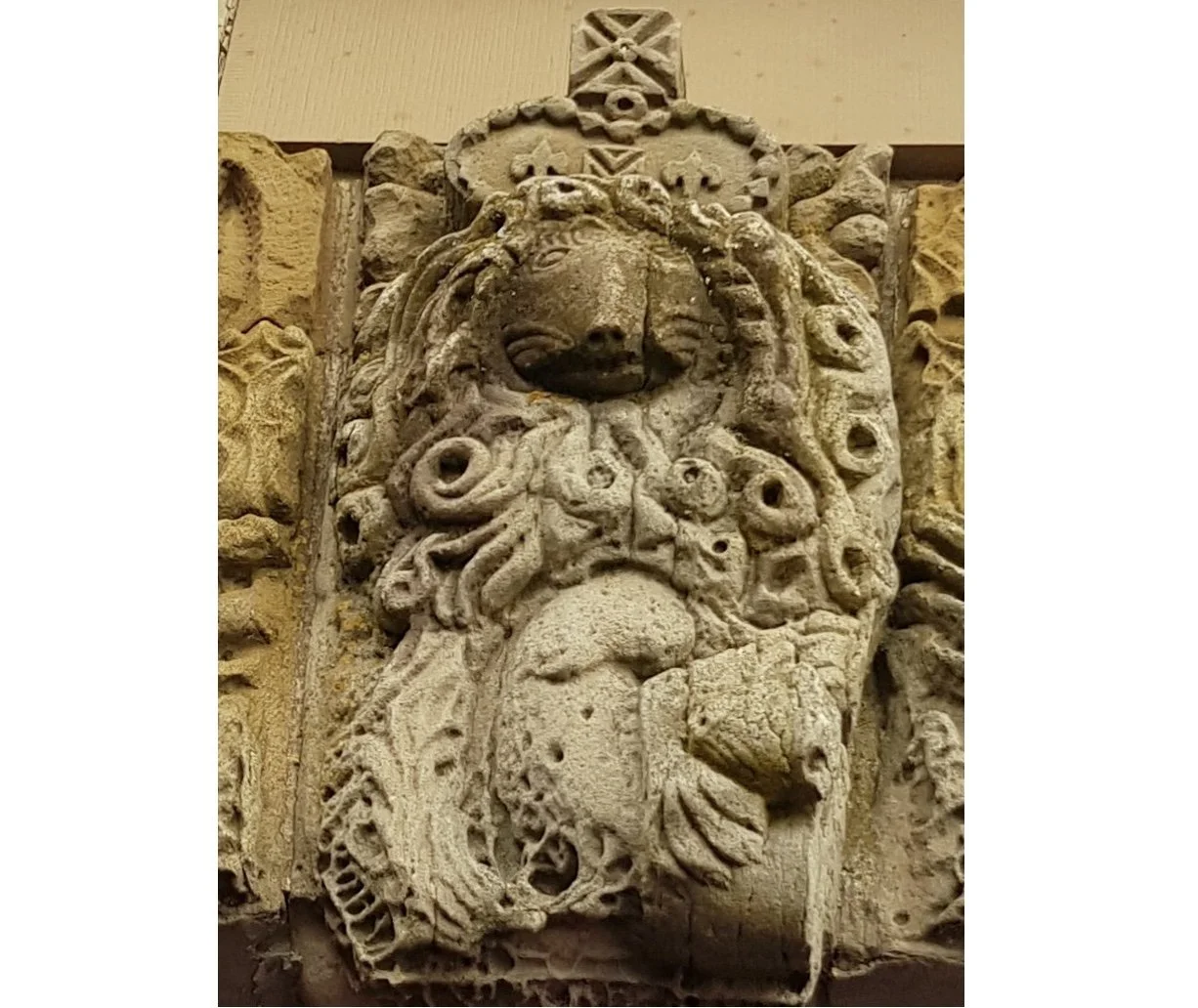
…as did the artists of the bridge. Caroline is the subject of the keystone of the eastern arch of the north face. They have carved her in grotesque, a rat with a puny crown displaying the three feathers of the Prince of Wales.
Her royally British mane is fabulously curled; her bosom is bare. Her left arm pushes away a whiskered rat kitten, Princess Charlotte. The supporting stones are pineapples, symbolic of waste, extravagance and wealth. Flanking the crown, are the letters M & V; in sculpture they refer to Mary the Virgin. The cynic is devastatingly honest; the stone carvers knew Caroline was not virginal, modest or loyal.
Rats are cunning and when a crisis threatens their place of nesting, they abandon it. England was in crisis when Caroline departed, abandoning her subjects.
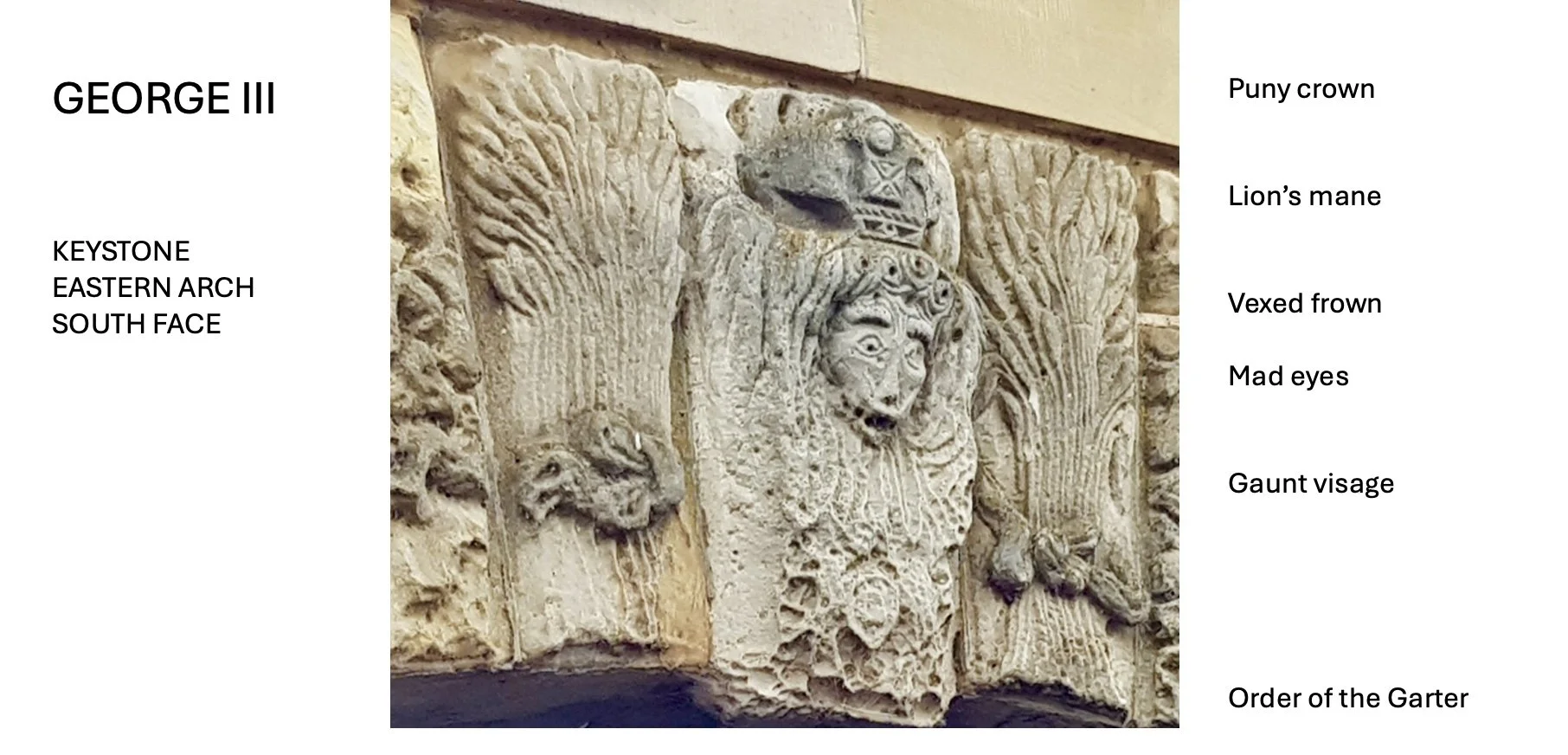
George III is on the south face opposite his daughter in law. He is a grotesque; the artist has violated the rules, tacit and explicit, that govern society’s awe of the monarchy, as well as the law, parliament and the church. On either side of him are sheaves of corn. I do not think they are about Van Diemen’s Land’s prosperity owed to wheat sales to New South Wales. In the antipathetic mood of the bridge, they represent the Corn Laws which caused so much division in wealth and suffering during George III’s reign and were not repealed until 1846. The convicts would have been aware of their injustice as they endured them, stole to overcome their impoverishing effect, were caught, tried and transported.
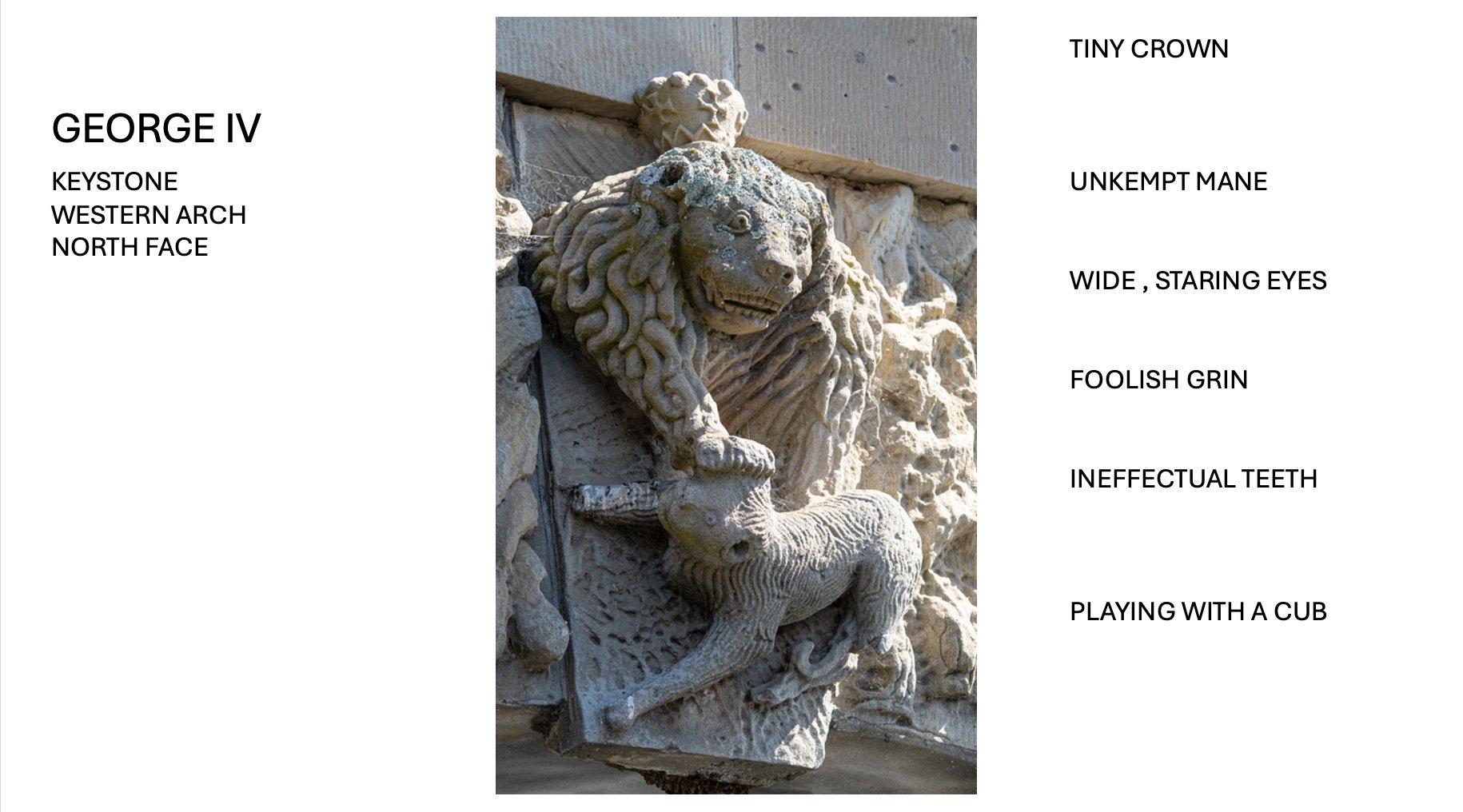
On the western arch of the north face is her husband, who was crowned George IV in July 1821. But Caroline was barred from entering Westminster Abbey so remained uncrowned queen. She became ill and claimed she was being poisoned, as rats are. She died three weeks later.
The carving of George is a parody of the pair of guardian lions that guard important institutions in Britain, though they originate in Asia. The male’s right paw is placed upon a globe, declaring his majesty over his realm; the female plays with her cubs. Here, there is an inversion and the male plays with the cub. I do not think this is an expression of the oppression of the British people, though many think so. I think the artist thought George played at being Prince and King..
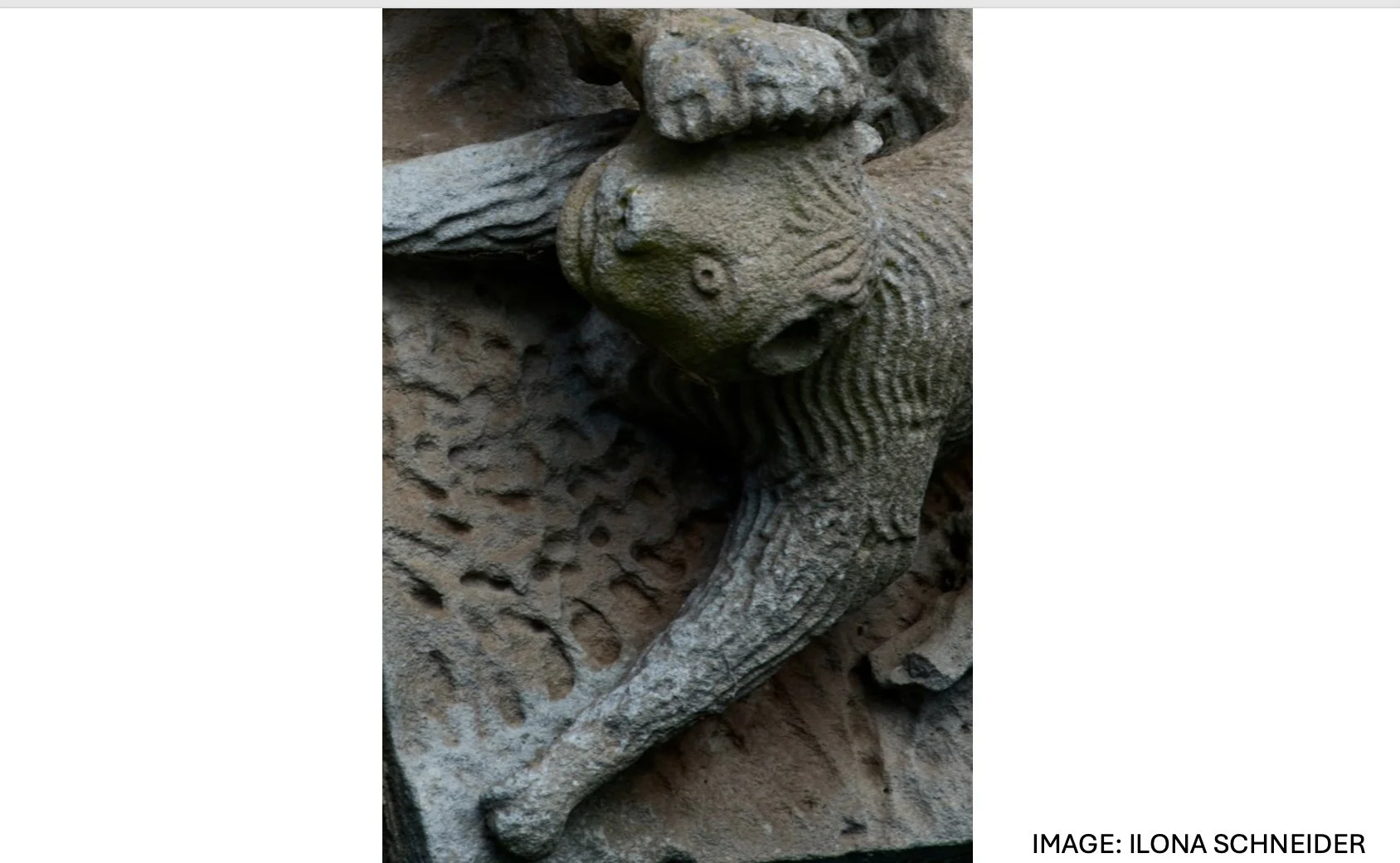
The bewildered creature is neither dog nor lamb but a cub. His tongue protrudes between his teeth; he could be a simpleton which would be an interesting take on the British people’s submission to the Monarchy.
On the south face, opposite George IV, is a judge in all his wigged glory. Paired with him is a visage without features except for two blind eyes. I call it No-name: he or she in the dock, publicly shamed awaiting the sentence that might be death or transportation. Is it funny?
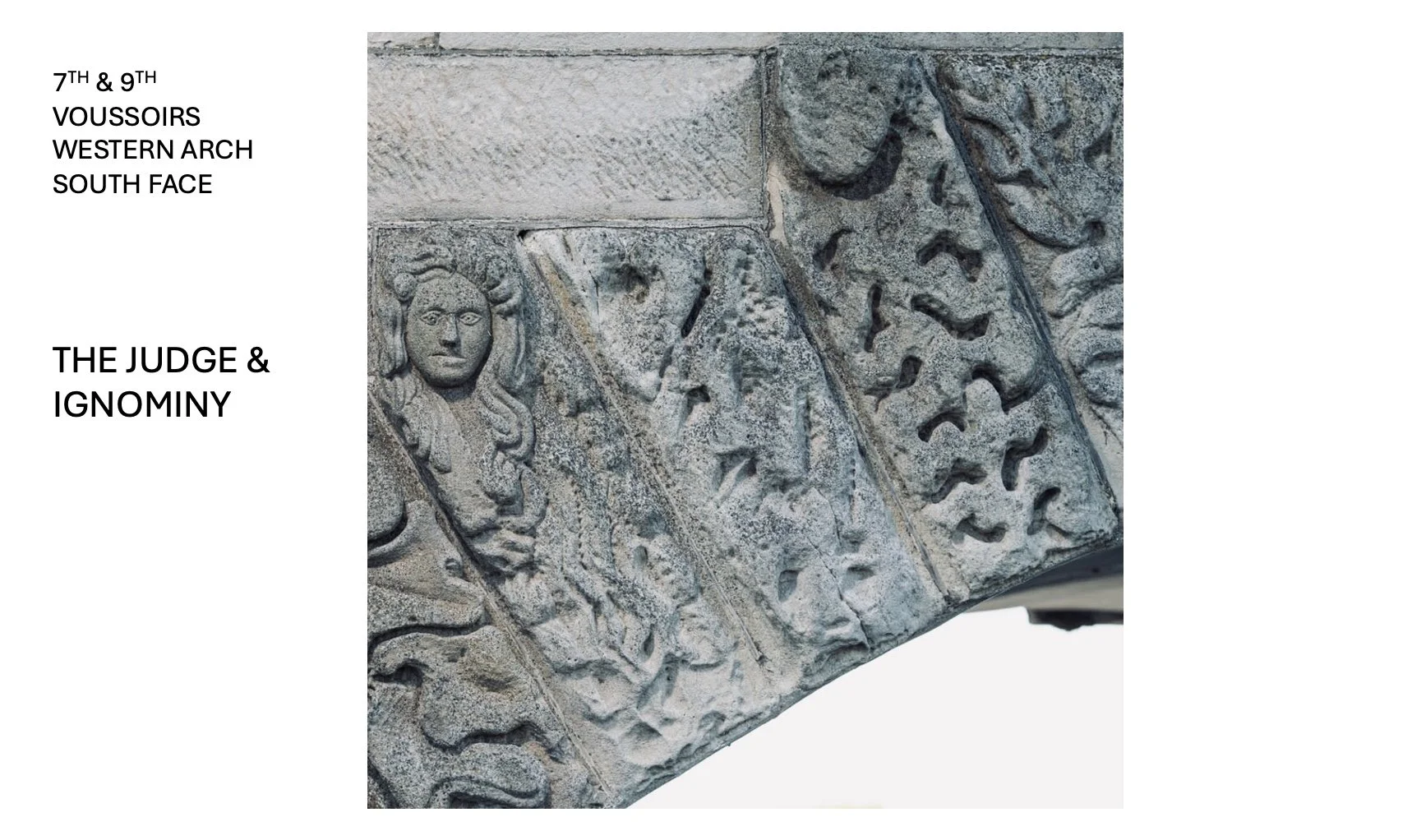
The cynic produces laughter at his subject and at himself.
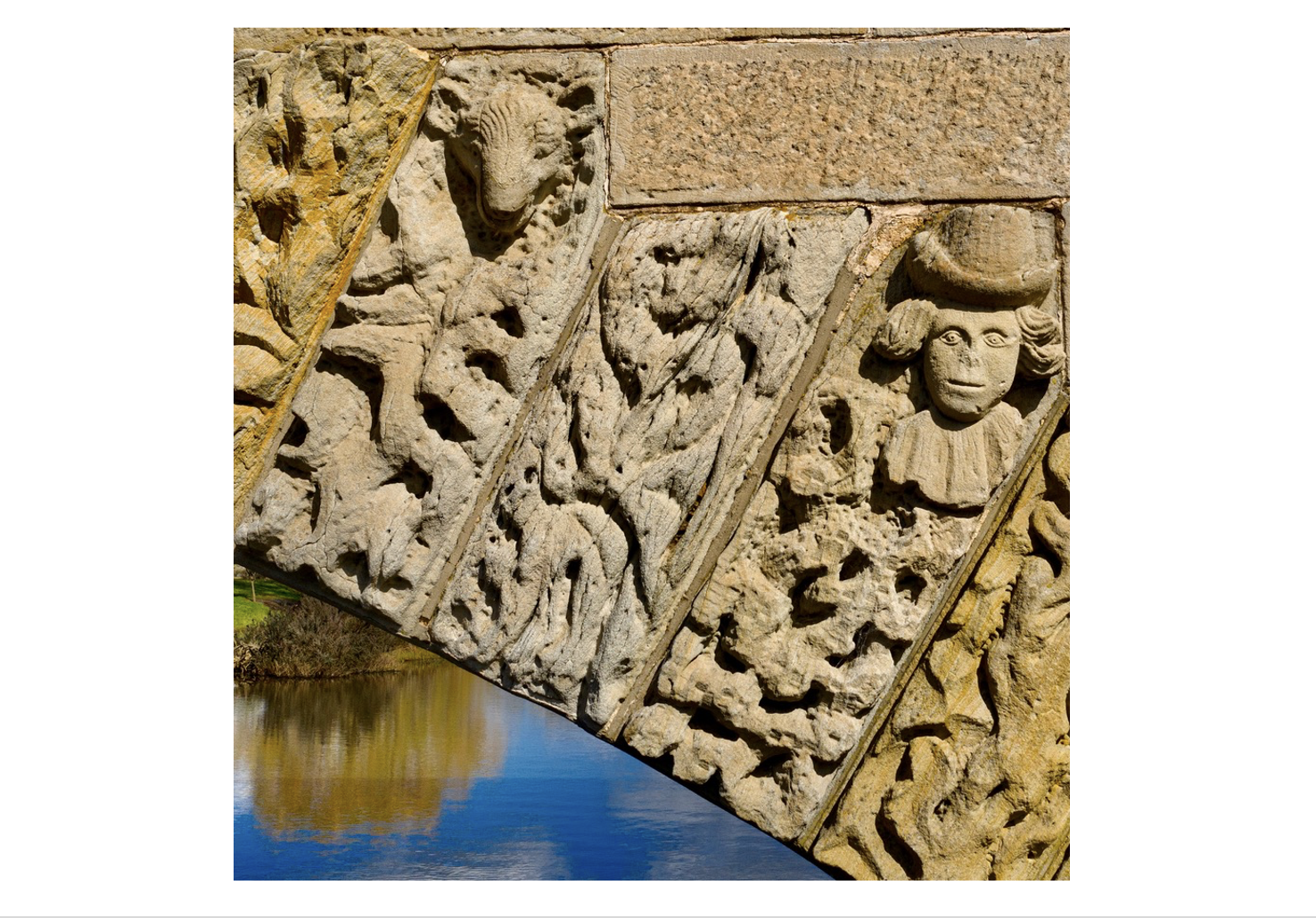
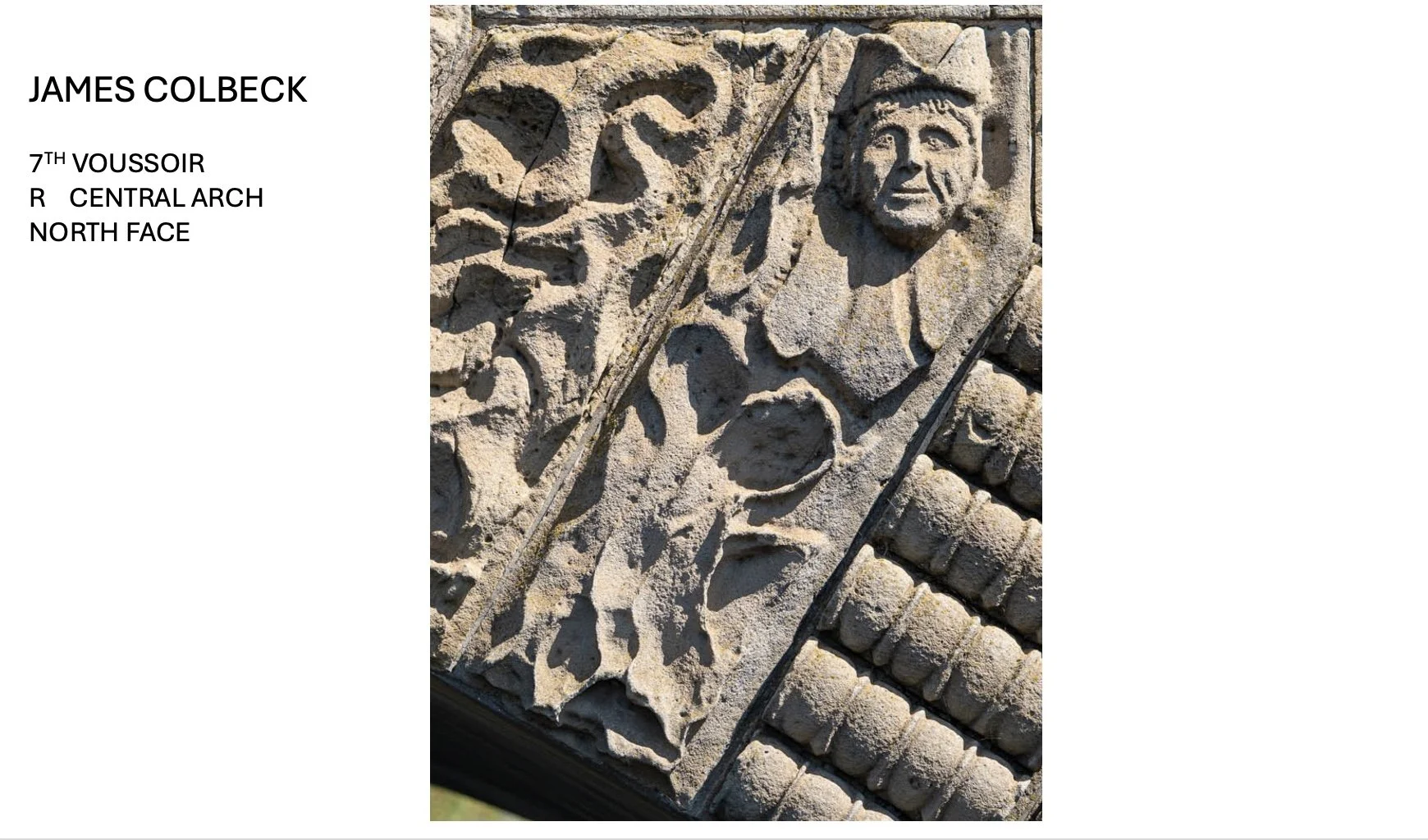
What is Colbeck saying from his 7th stone on the right side of the central arch of the north face? He is amused, cocky even, dressed in his convict’s flapped cap with a collar that could be an altar boy’s. He has associated himself with a form that looks like two erect penises, gouged.
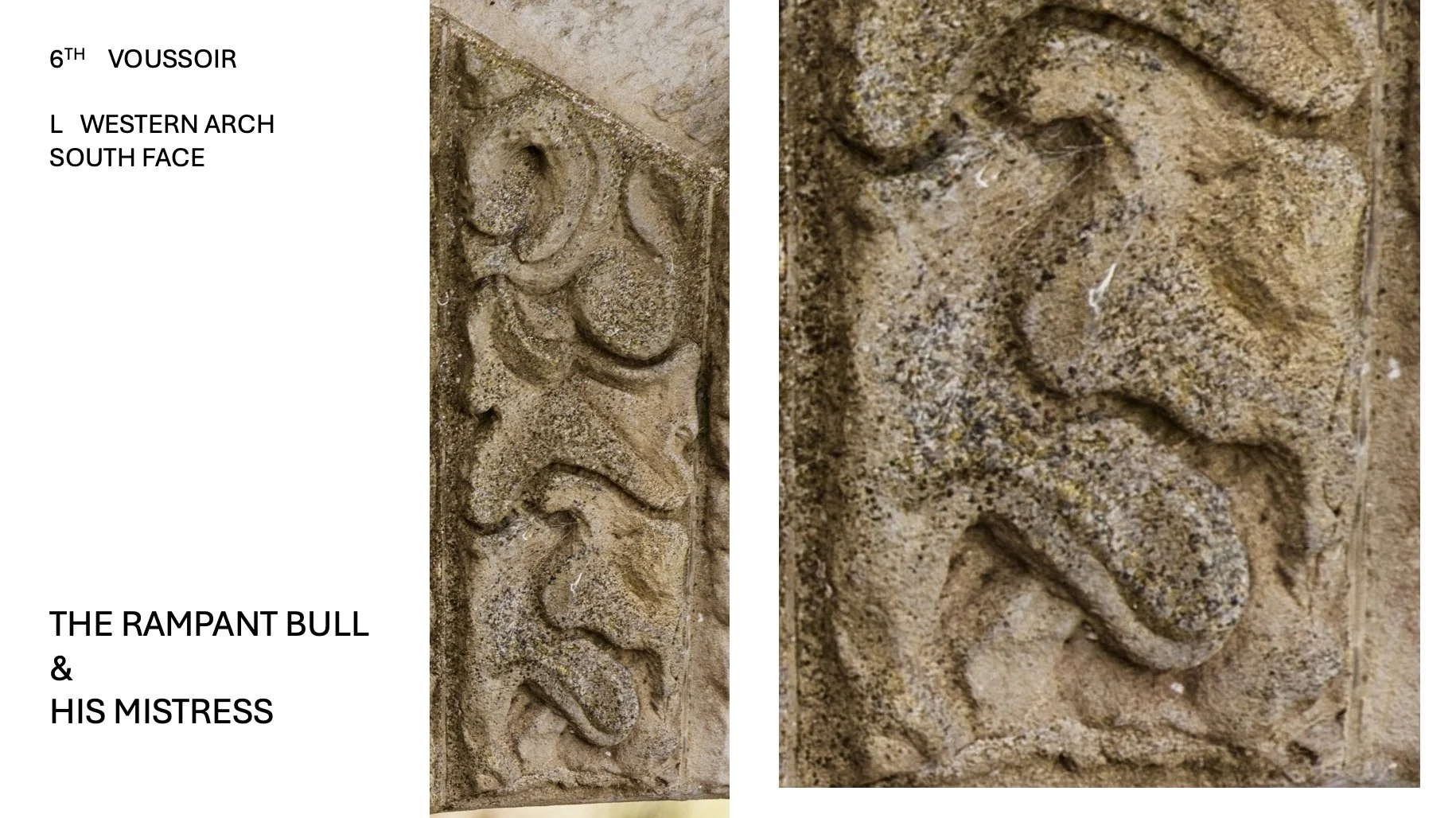
A rampant bull is holding up his oversized phallus, He is titillated by a cow that seems to be standing on a tree or in the clouds. Hera and Zeus, perhaps; or poor little Io, raped by Zeus under a cloud so Hera could not see. But she did see, and transformed her former priestess into a cow, so maddened by a gadfly that she sought the soothing balm of the sea.
What of the leafy face overlooking them? His right eye is womb-like; his nose is an arrow seeking its entry. His left eye and cheek seem to be a swan. His mouth is the upper edge of a fig leaf. Is he a wodewose, ‘a wild man of the woods; a satyr or a faun’? Famously, wodewoses fared poorly when wooing women.
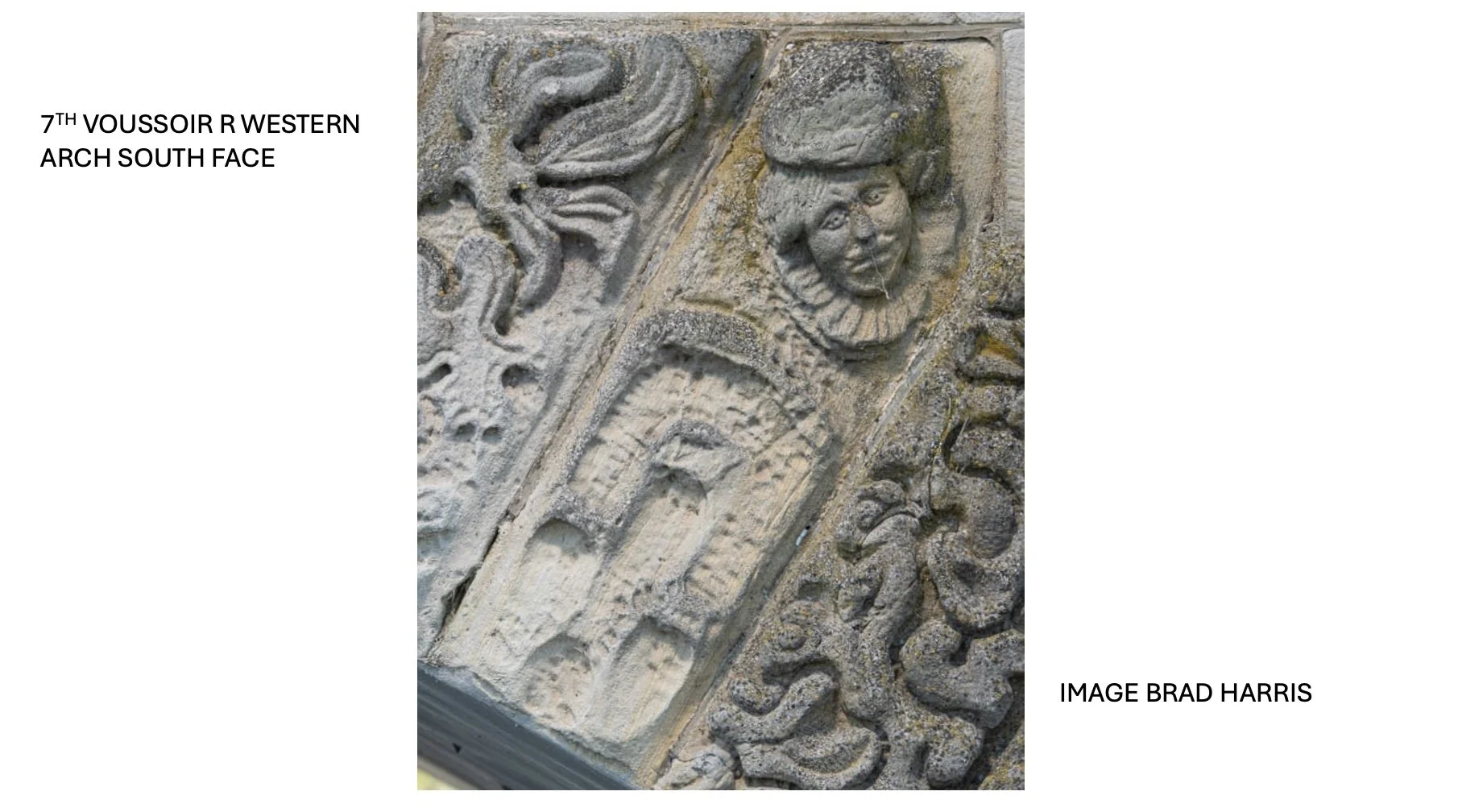
A similar gouged form is underneath a portrayal of a thespian. Did a superintendent draw a line, at penises in proud relief, even though this pair is flaccid?
The expression on the face is remorseful, sad; the left hand lifts the hat as if in farewell, reluctant. The fringe flops to the side, boyishly, and reveals a frown. The mouth does not smile below its trim moustache. An Elizabethan ruff symbolises the profession of an actor. Does this character belong to the stage or does he act the life of an acceptable member of society, veiling his crime of homosexuality? Is he farewelling his lover who has been sentenced to transportation? He is paired with the judge and No-name; also with a dog, a symbol of friendship and loyalty.
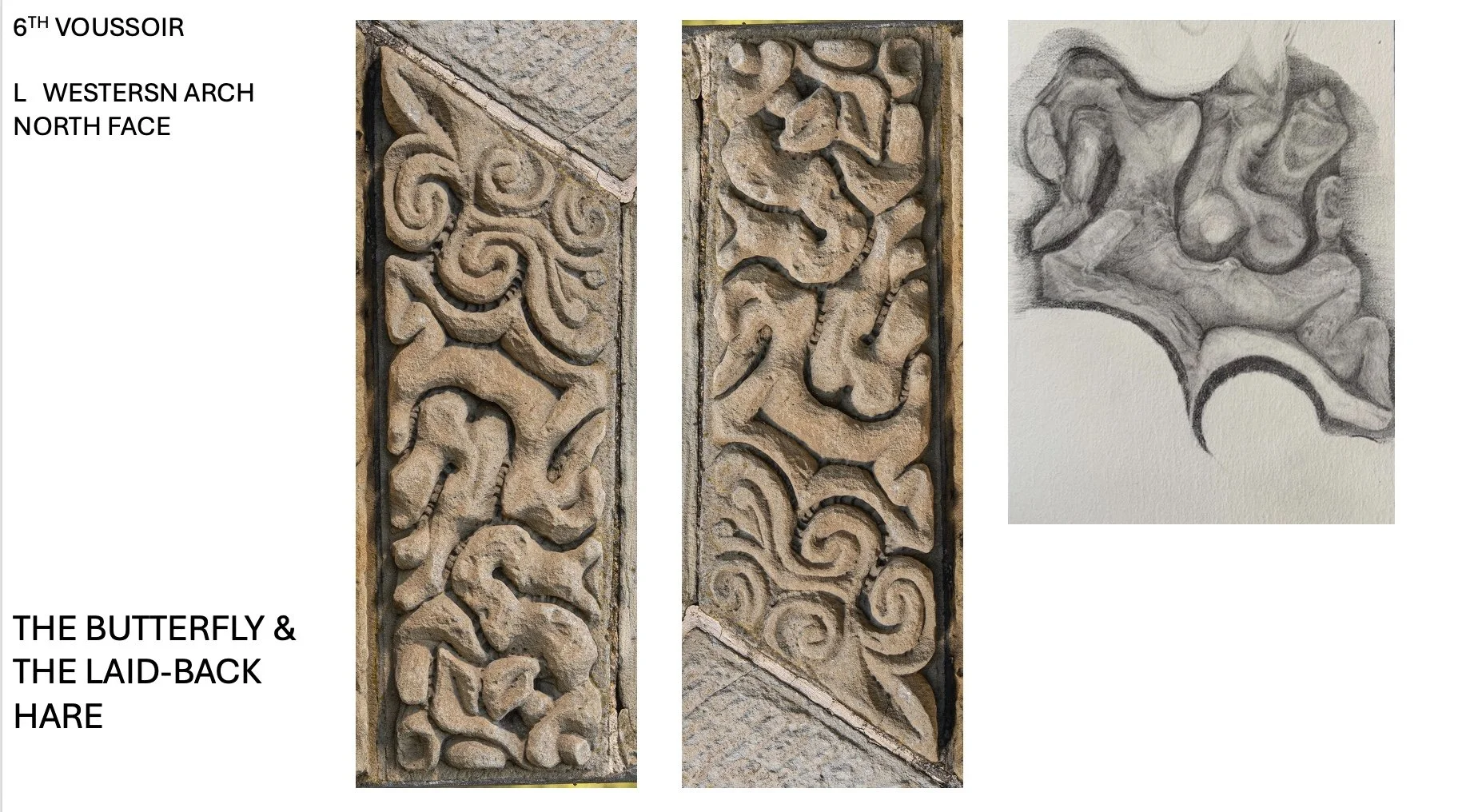
On the bridge there are many hares – most with erect phalluses. I wonder if the hare is the narrator of the story of the bridge – if he ties together the whole tale. Hares have been the symbol of promiscuity and homosexuality, even trans-sexuality, since ancient times. In AS YOU LIKE IT, where slipping between the genders is fundamental to the story, GANYMEDE (who is really ROSALIND) says THAT PHOEBE IS NOT THE HARE I DO HUNTS ……. but Orlando is ..
This hare lies laconically on his back when the carving is inverted. Associated with him is the representation of a butterfly. His genitalia are erect, displaced on his torso.
In Greek mythology, the boy Ganymede is Eros’s playmate. He became the God of Homosexuals. He was abducted by Zeus in the form of an eagle from his Trojan home because he was so beautiful. Zeus the pederast, Ganymede, the catamite. The butterfly is the symbol of the catamite.
Relationships like these occurred amongst the male and female convicts in Van Diemen’s Land.
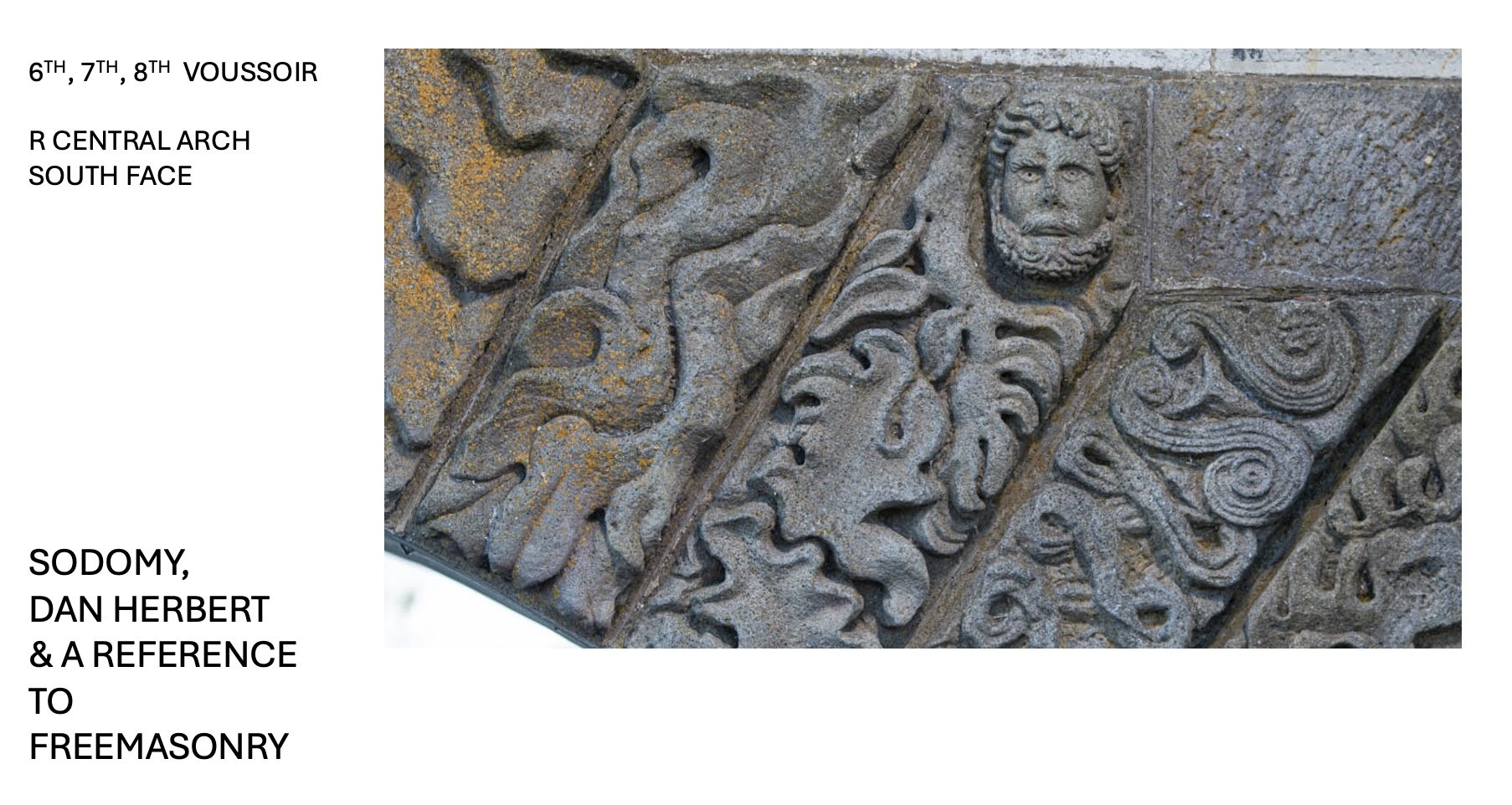
Was it all cynical? Could some carvings be simply symbolic? Herbert has placed his own portrait next to a scene of two creatures entangled in copulation. A hare on his back like the previous carving and, possibly, a hippocampus, a hybrid with a hoof and a fin. Why was he moved to carve these sexual allusions ? There is a manu fica in the bottom right hand corner as you look at the image; a thumb almost protruding between the index and third finger. This is an obscene sign of copulation. Was Herbert expressing his revulsion or merely clarifying the scene?
He is looking past a broken bough, perhaps a gum but more likely an apple tree, symbolising separation from the family or death of a member of the family. English oak leaves are falling. He has a masons square carved into his beard. Does it refer to the freemason’s logo of the square and pair of compasses or simply that he is a stonemason? John Lee Archer considered him the most capable of his masons … he being an intelligent, skilful workman and good overseer.
Civil Engineer’s Office
7 May 1835
Sir,
In compliance with your verbal request that I should select a Convict Mechanic, the most capable of directing the execution of the Ross Bridge, I beg to inform that “Daniel Herbert” a stonemason employed as the Overseer at the new Customs House is the only man I can recommend, he being an intelligent, skilful workman and a good overseer.
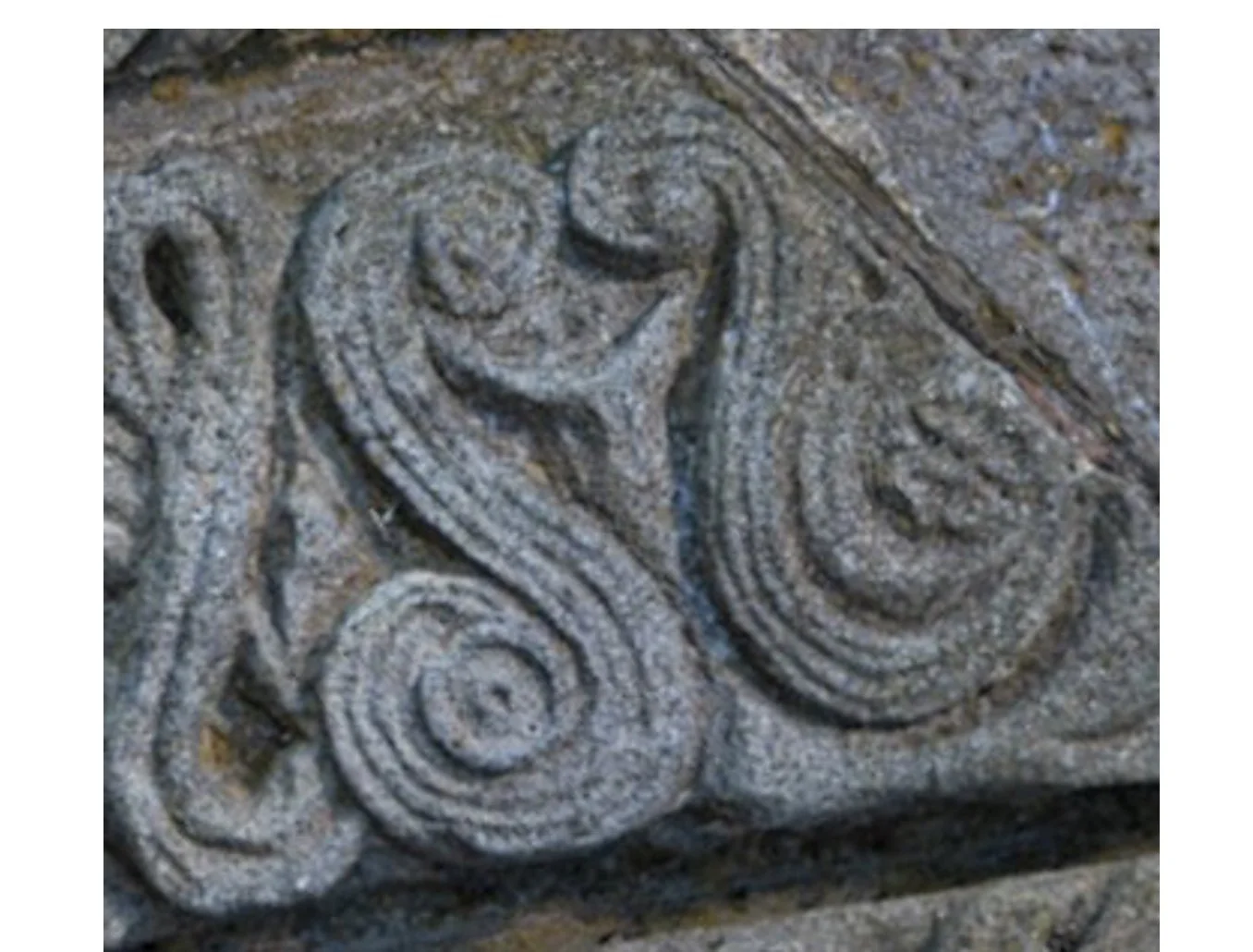
This beautiful small detail seems to be about freemasonry. The S forms are ancient symbols of eternal life; reflection in masonic terms is about self-examination, personal contemplation during the initiation procedure. In the lower coil of the left S is a axis mundi, the point within the circle. Opposite is a quatrefoil, symbol of the number 4, the seasons, the elements, the humours, the evangelists. In the upper coils of the two S shapes there is a sun and moon. Between them is a weathered crucifixion, meaning that in the artist’s mind is the thought of redemption and resurrection.
John Lee Archer was a freemason, the WORSHIPFUL MASTER OF THE TASMANIAN LODGEin 1836. I wonder whether he influenced his defiant, intelligent, stonemason overseer.
The carvings I have chosen are not lewd and licentious … they are metaphors in stone. They defy polite society; they tell a story of the society in which the convicts lived. They are ironic, satirical, subversive.
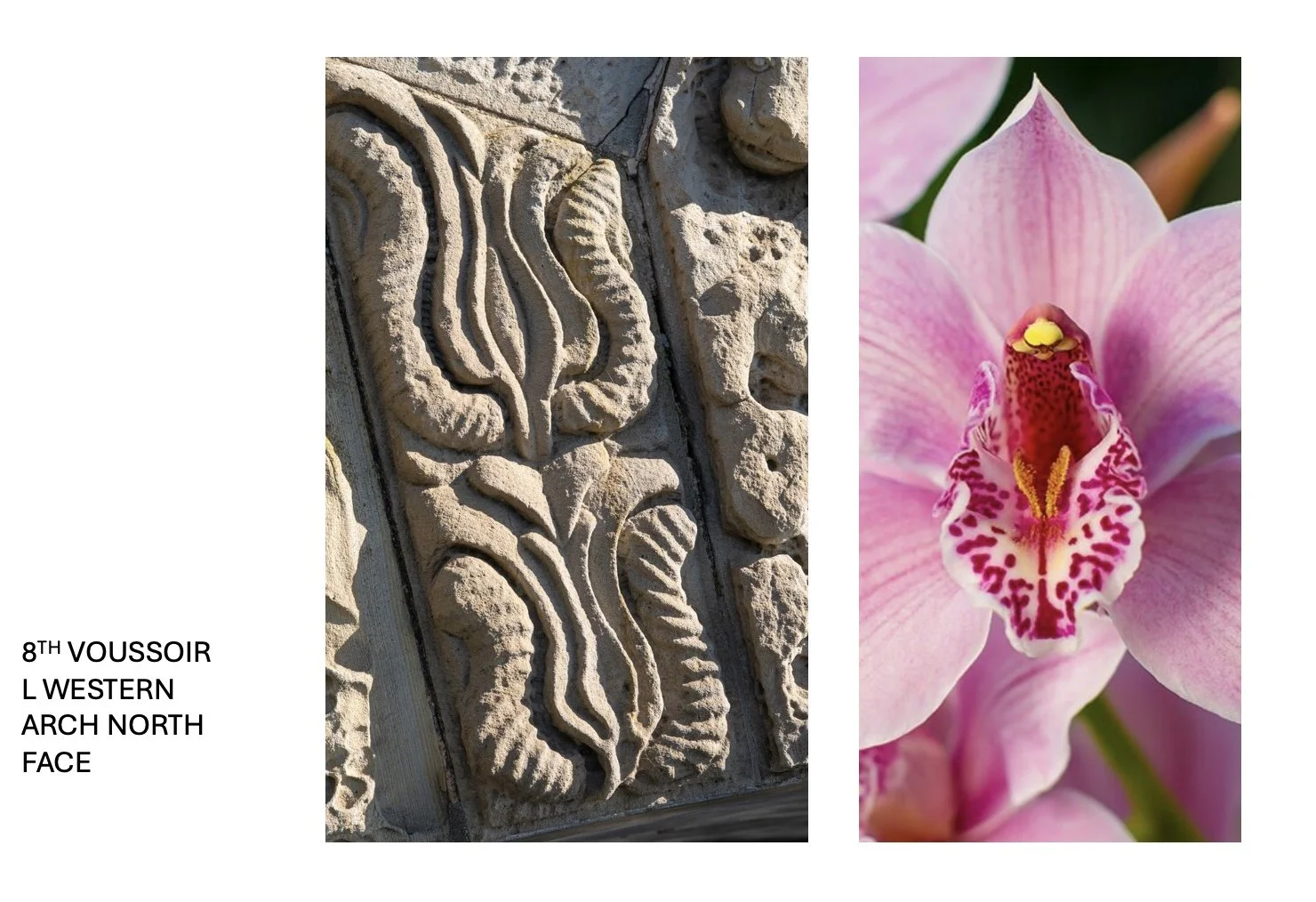
This pair of forms is not a lyre, tulip or an iris which would signify the Madonna. It is a diagrammatic representation of the flower of the orchid - two blooms one upon the other. Since time immemorial, the resemblance between the parts of the orchid to male and female genitalia has been described and contributed to magic and medicine.
This carving tells a truth about the bane of the colonial administration - the unnatural crime of sexual encounter between two women, equally as prevalent as sodomy.
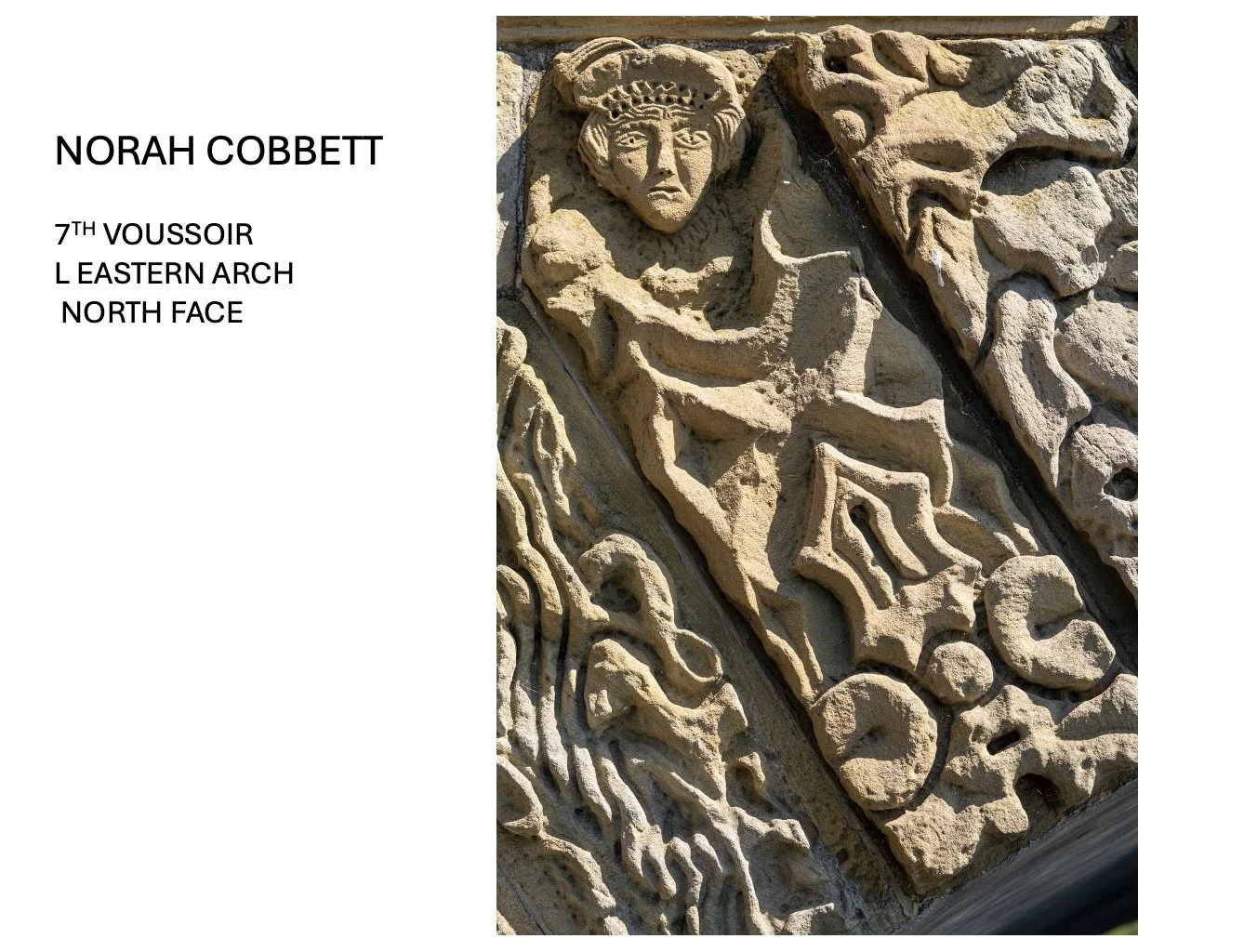
This carving is cruel because its subject would have known of it and probably seen it. Norah Cobbett was a convict who arrived in 1826. She repeatedly absconded from assigned service, subsequently found drunk. She assisted absconders, harboured convicts, and was found guilty of assault. She spent six months with a gang of cattle thieves and was persuaded by District Constable Jorgen Jorgenson to spy on them. He married her in 1831 because he felt duty bound to protect her because she was loathsome to convicts in the towns and the country, notorious as an informer. She became a millstone around his neck. They went to Ross in mid 1833. He had been appointed by Lieutenant Governor Arthur as Special Constable to rout out the clandestine building racket that was going on between the Ross Bridge gang and the settlers. I think Colbeck was the artist; he has laid her bare, utterly exposed and vulnerable. Her face is bitterly tragic, besotted and mad.
It is the cynic’s philosophy to speak frankly – the truth no matter how unpleasant.
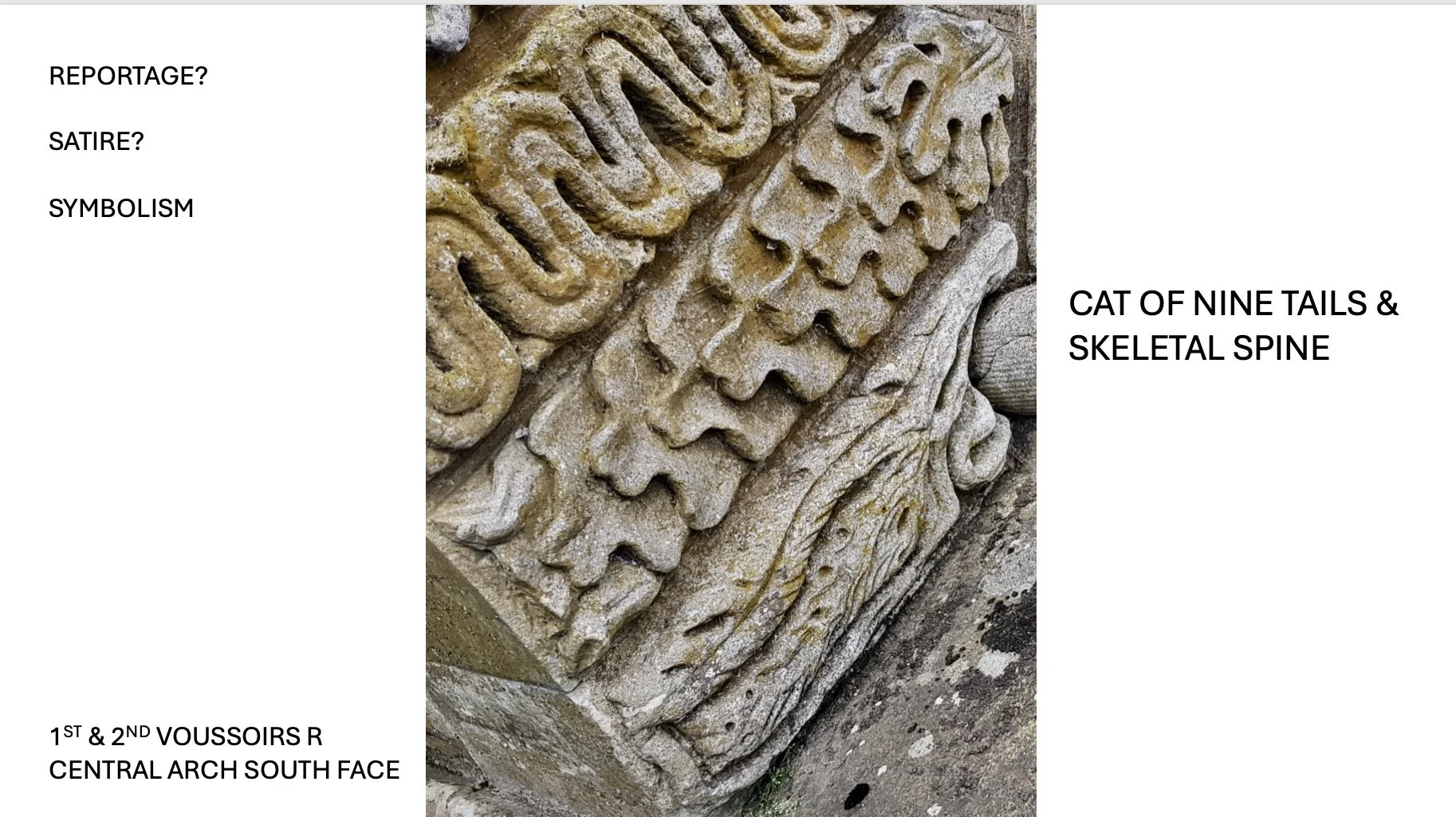
In this most revealing sculpture, the artist is saying something about flogging: to the administration, to himself in remembrance of his own turn, his mates watching him carve, feeling their scars, Major Turner perhaps, anyone who might see, including the flagellator. The glove atop the un-fleshed spine represents him, a former convict, despised for his collaboration with the administration.
But it is at the bottom of the arch, away from sight – only if you are in a boat would you see it. Out of sight and mind.
That is the particular oddity of the bridge: it was narrative architecture without an audience and therefore, full of undiscovered satire and cynicism.
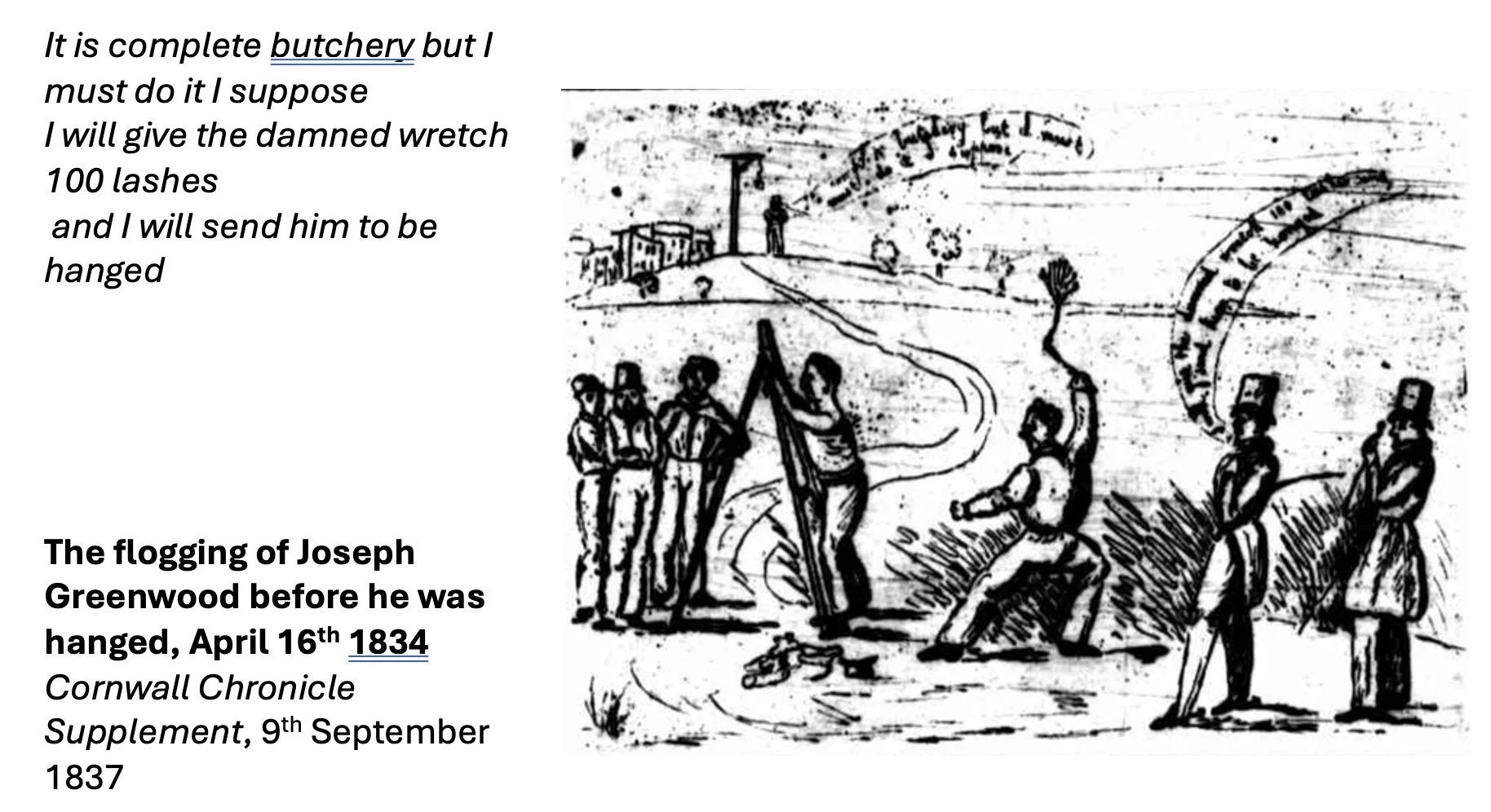
This was an illegal act, , to flog a man before he was hanged, signed by the Governor.
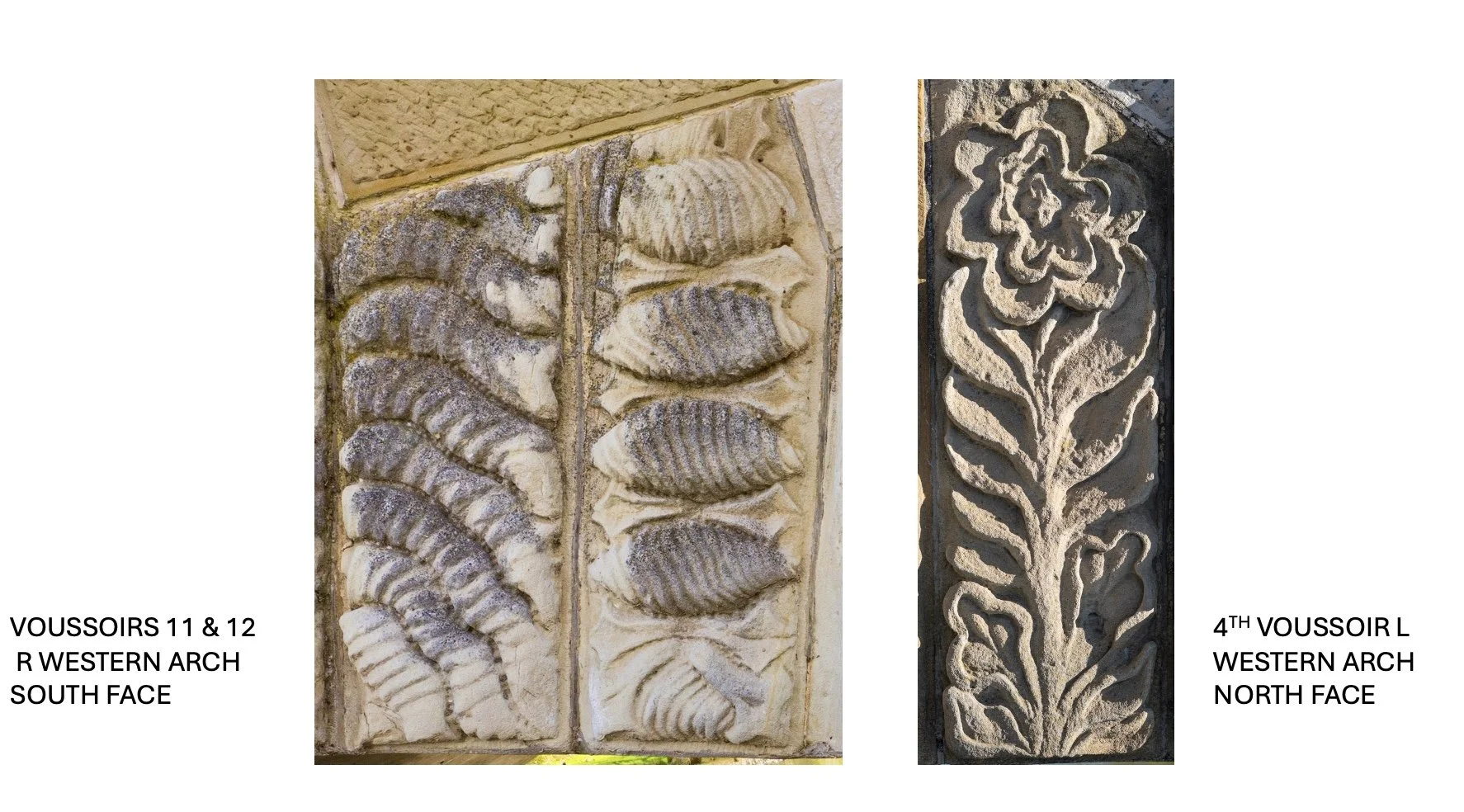
However, there are symbols of hope in the continuation of life of the cocoon and the larvae, and in the shoot sprouting from the base of the perennial flower.
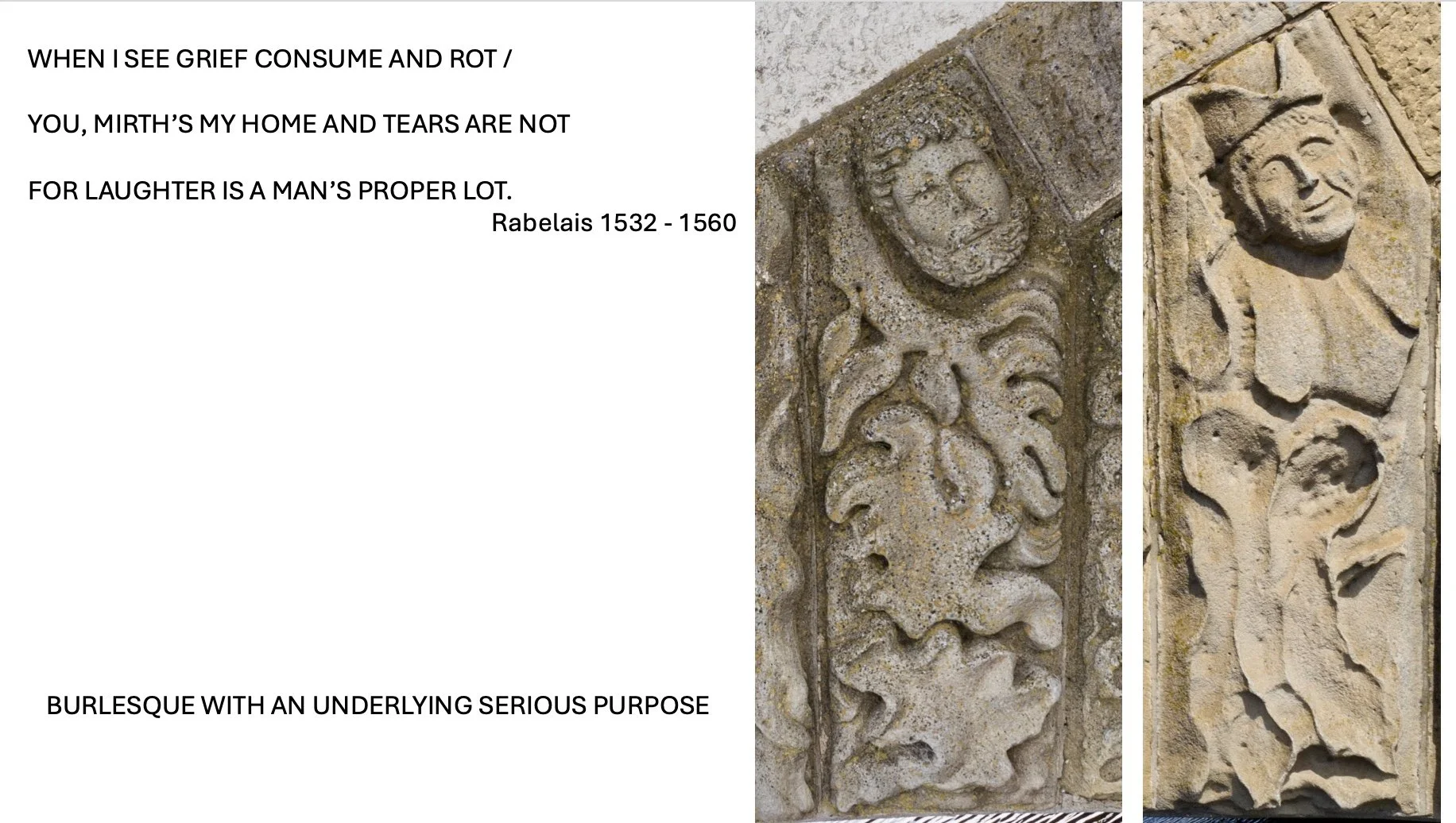
So we return to the convict overseers, the artists Herbert & Colbeck who endured transportation and degradation in the penal colony.
And yet, they created this gallery of sculptures with wry humour, a jaundiced eye, so they might survive their ordeal and that we might know and not forget our history … the experiences of the convicts in the time of the Bloody Code.
70% of us living in Tasmanian are descended from convicts.