THE BISECTED ORCHID
SOME PLANTS OF THE ROSS BRIDGE CARVINGS
from a powerpoint presentation before some members of the Australian Garden History Society at Ross on the 26th of October, 2024
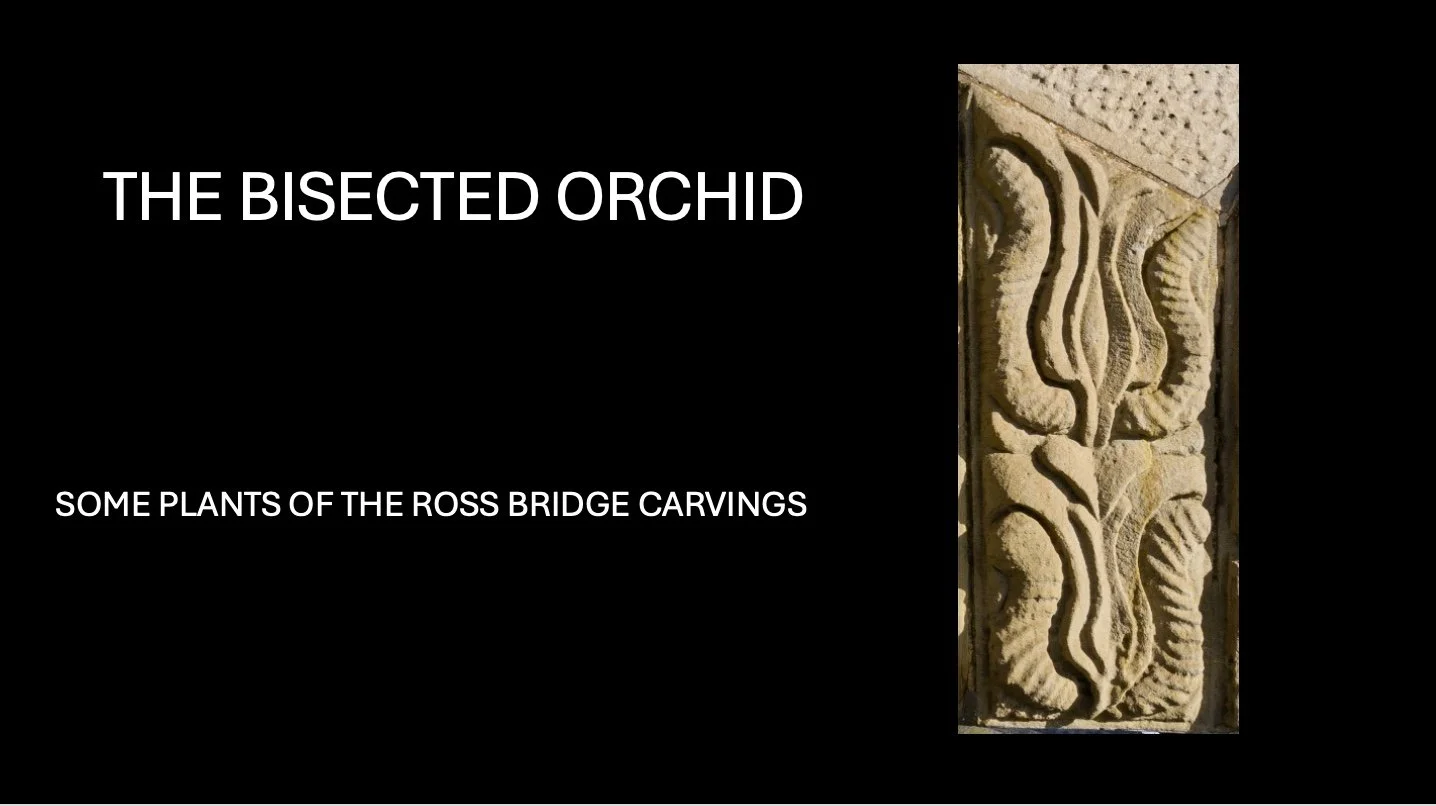
I chose this title because the arch stone is a good example of the metaphoric nature of the carvings. They had to be metaphors because their content was subversive, lewd, even licentious; therefore they are satiric, ironic, symbolic.
They tell the truth according to the convicts. Thus it is a rare, even one-off ‘document’ because convicts were not permitted to write of their experiences. There are books written by emancipists but very few written by convicts during their period of incarceration.
It is not a tulip or an iris, which might infer the Madonna. It is a diagrammatic representation of the flower of an orchid. It represents the sexual encounter between two women, the orchid flower having been likened to the external female genitalia since time immemorial.
Its truth is that ‘unnatural crimes’ between the convicts of both genders were common, the bane of the colonial administration and the Quakers who visited and bore witness.
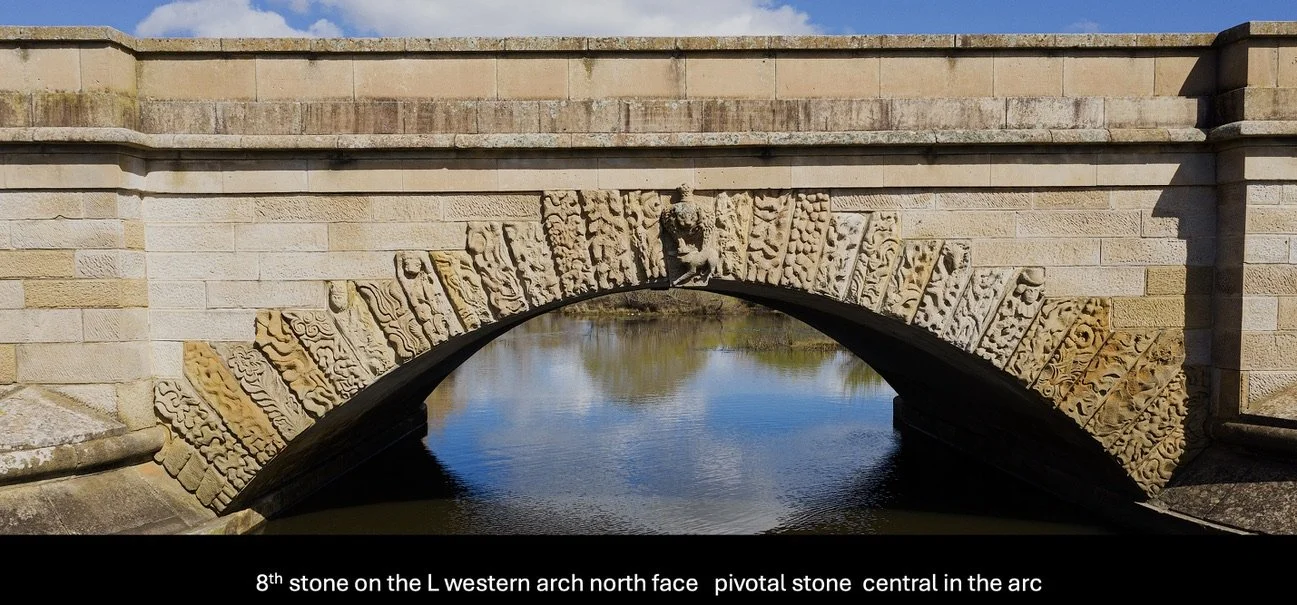
It is an important carving indicated by its pivotal position in the arch of fifteen stones. I do not think the sculptures were accidentally placed.
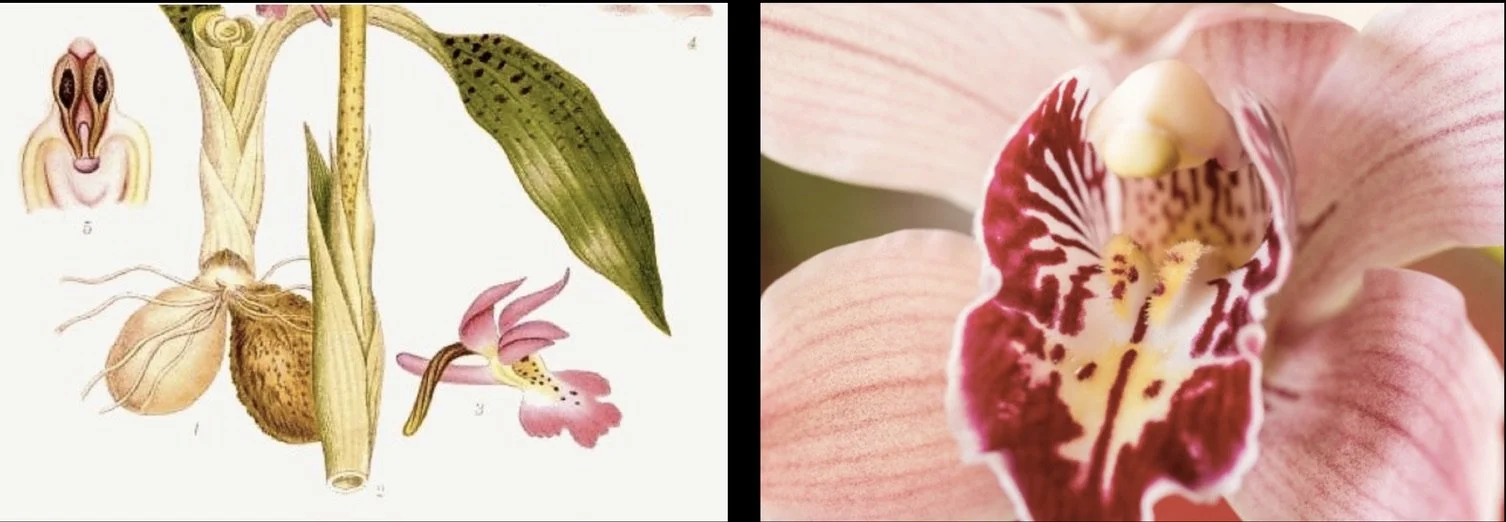
The orchid was known in ancient Greek times. Theophrastus (c. 371 – c. 287 BC), was a Greek philosopher and naturalist, mentored by Aristotle. He was considered the "father of botany" for his work Enquiry into Plants. Although his works contain many statements considered absurd today, they include valuable observations concerning the functions and properties of plants. It was he who named the plant orchid because its tuber resembles the testicle, which is orkhis in Greek.
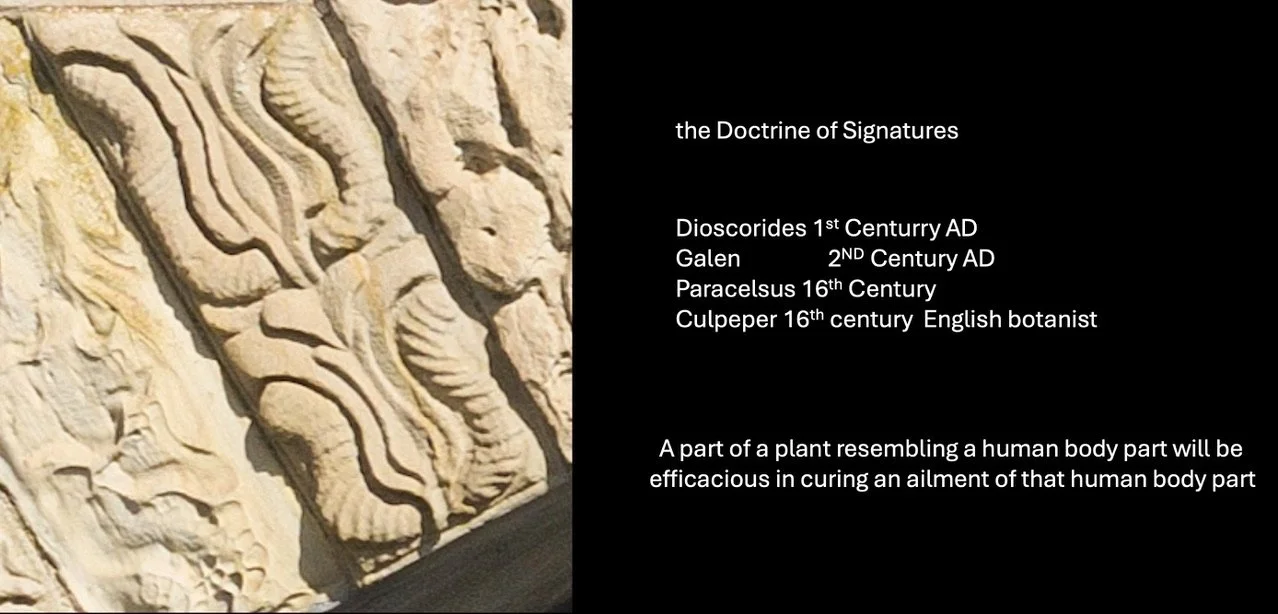
The Doctrine of Signatures was thought up by Dioscorides and developed by Galen in the 1st & 2nd centuries AD in their medical philosophies. It is based on the belief that the resemblance between the shape and colour of a particular part of a plant and a human body part imbues that plant with properties to heal a disorder of the corresponding body part. The notion persisted throughout medieval Christianity when the gullible and the inspired pondered the divine union between man and nature; that God meant man to know which plants were curative for which ailments.
Paracelsus of the wonderful name Phillipus Aureolus Theophrastus Bombastus Von Hohenheim, assumed the validity of the doctrine in the 16C: Behold the Satyrian root (another name for the orchid). Is it not formed like the male privy parts? No one can deny this. Accordingly, magic discovered it and revealed that it can restore a man’s virility and passion.
Nicholas Culpeper was a 17th C English botanist and herbalist. He wrote in the common vernacular and published The Complete Herbal to sell cheaply as a self-help medical guide. No man deserved to starve to pay an insulting and insolent physician, he said about 1640. His book was a commonplace article in English households and its contents would have trickled down to the villages through the practitioners of folk medicine, the cunning women and herbalists. The people were superstitious when the convict stone carvers were growing up. They were very poor and desperate for medical assistance which was not theirs to access because of the widening division in society between the aristocracy, the landed gentry, the emerging industrialists and the common folk. They were being dispossessed of their livelihoods owing to industrialisation; of the common land owing the enclosures; of the houses because of being unable to pay the rent; of their health because they were ill fed, their air was polluted by the mills, their water by the coal mines. Their accommodation was overcrowded because of their eviction and the influx of immigrants from Ireland and the country; it was rat infested and full of contagion. Their children went out to work in miserable conditions so their education was neglected. James Colbeck the chief overseer of the bridge’s construction. was illiterate.

But is it not fascinating that the orchid root is the subject of the 2024 research into its properties to heal an ovarian
disorder? The authors are Iranian.
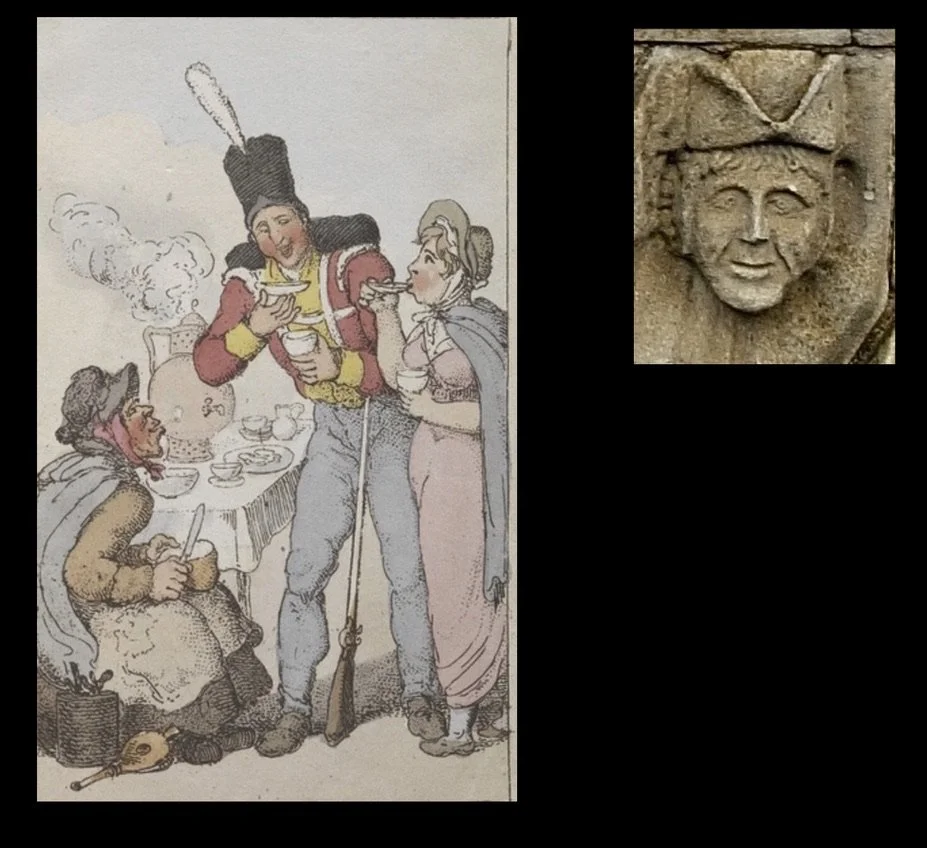
The powdered orchid root that was imported into England came from Persia (Iran) and Turkey; it was called sahlep.
When James Colbeck was in London as a journeyman about 1822 - 26, he might have patronised a saloop shop where sahlep was mixed with hot, sweetened milk and sold as a pick-me-up after a hard night on the slops and as an aphrodisiac, as can be seen in the cartoon by the position of the soldier’s gun. The orchid offered relief for sexual disorders.
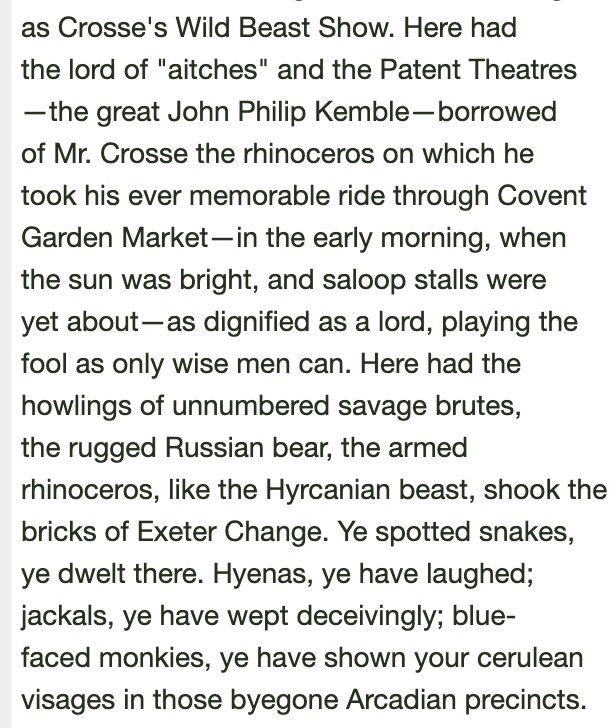
Let Dickens convince you of an early morning in London:
So why would the convict stone carvers want to declaim publicly the state of sexual encounters in their current way of life, apart from informing the public of the truth of the situation, or getting up the nose of their betters?
They were virile, fit, working men who were punished for seeking relief from their heterosexual deprivation. They were living in a time warp, far away from the emergence of the English middle class and the ascendency of Victoria to the throne in the year after the bridge was completed.
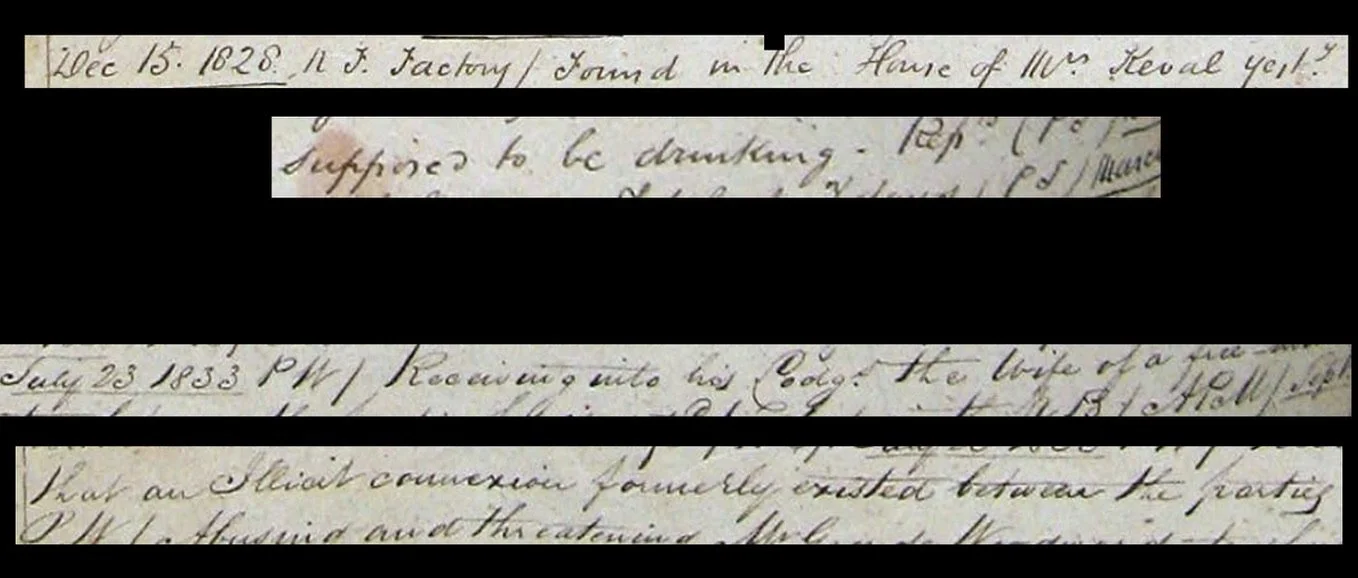
Above is an extract from Daniel Herbert’s conduct record, he being the overseer of the work on the bridge with Colbeck. One year after his arrival in the colony, Daniel was found in the house of Mrs. Keval, who was a renowned, feisty convict woman, the wife of Michael who was in the prisoners’ barracks on this occasion. LIkely her house was a brothel. In 1832, Herbert wanted to marry Mary Witherington but his application was rejected by the Lieutenant Governor. A few months later he was brought before the magistrate for receiving into his lodgings the wife of a free man with whom an illicit connexion was suspected. For that, he was returned to the prisoners’ barracks. (I think she was Mrs. Woodward because soon after, Mr. Woodward pushed Herbert off a wall and refused to pay money for work done. Dan took him to court.)
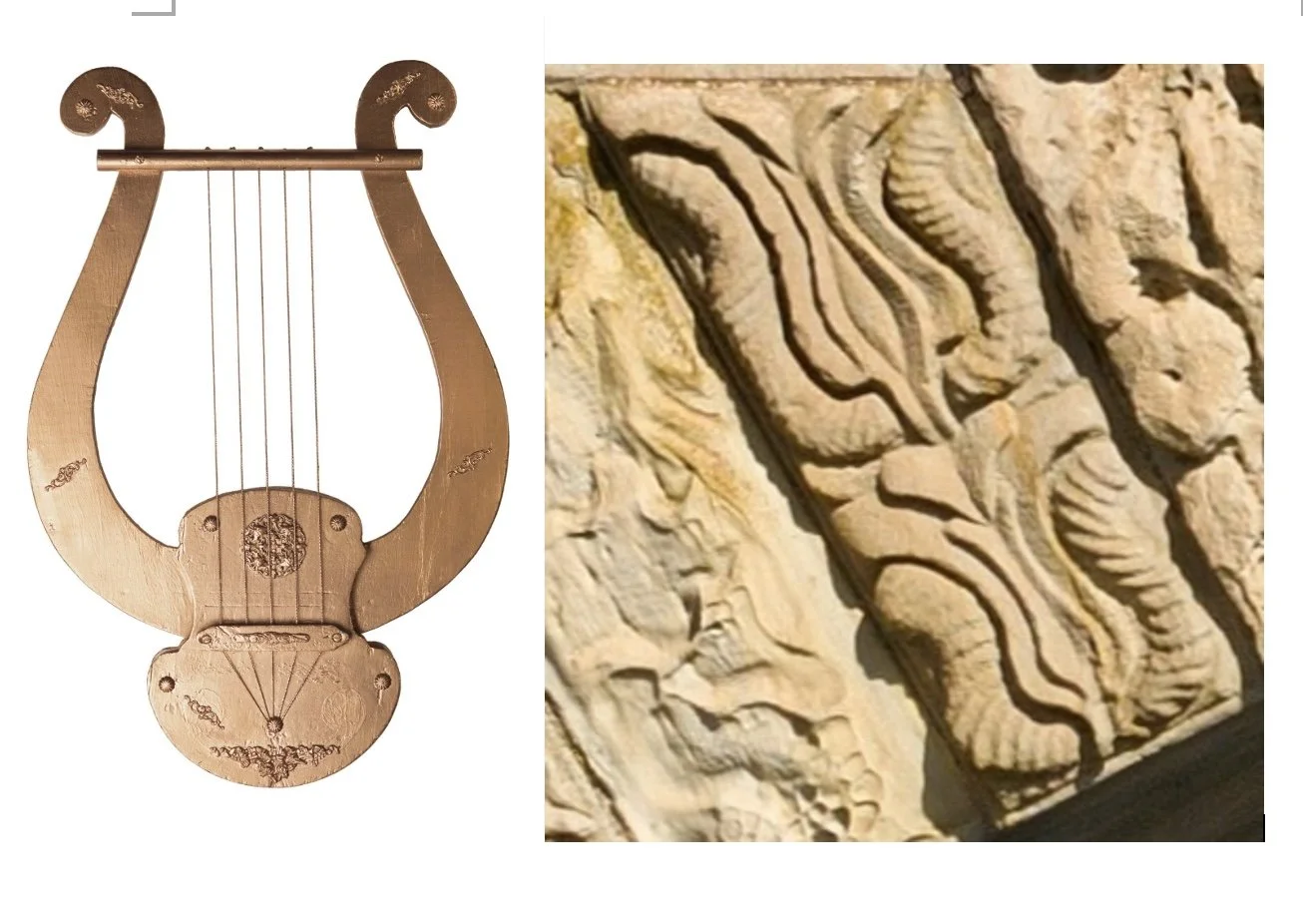
What if it were a lyre? Then we must invoke Orpheus, his musical talent and his love of Eurydice and his loss of her to the deities of the Underworld. Many stones have more than one possible interpretation; that is the purpose of a symbol, after all. To be recognised by the conscious mind and stimulate associations in the unconscious. Orpheus was a favourite of the Gods; some say he was the son of Apollo. He could enchant gods, humans and wild animals with his divine harmony, his poetry, singing and melodies played upon the lyre which Apollo had given him. He had tamed the sirens and the fire-spewing serpent that protected the Golden Fleece when he had been an Argonaut with Jason. But then he had fallen in love with Eurydice. She was bitten by a viper and died. His friends among the Gods pleaded with Hades and Persephone that he be permitted to bring her back to light from the underworld. His singing softened the heart of the lord and lady and overwhelmed the powers of Cerberus. Yes, he could lead her forth into life on the condition he did not look behind him while she was still in the dark. But at the very edge of the exit from that gloomy place, he did look around and though he was in the light, she was not and she was dragged down again, leaving him bereft. He was killed by the jealous Maenads, women followers of Dionysus, but his head and lyre were rescued by the Muses on Lesbos so his singing could continue forever. His lyre was flown to the heavens by an eagle where it is still, the small constellation of Lyra. Dan Herbert was a musician, a fiddler and organist, transported into the underworld. He looks outwards from its dismal shade, steadfastly southwards from his position on the bridge, in love with Mary Witherington and not beguiled by the rules laid down by a god. .
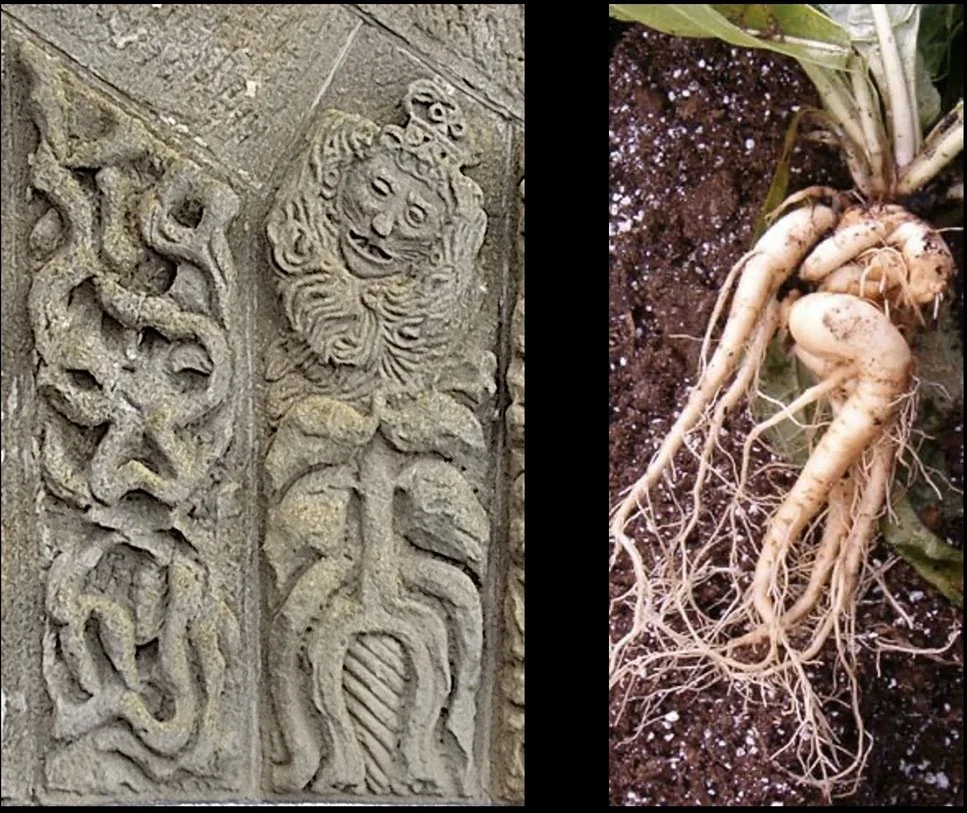
In the middle ages, the orchid was believed to grow at breeding grounds where animal and birds met to breed and spilled their semen. Similarly, the mandrake was thought to grow under gallows where the semen of a hanged man fell. Mandragora officinalis has a root that looks like a man; hence man-dragon. It was thought to have magical and healing powers and would scream and cause the death of someone who pulled it out of the ground. I think the torso of the anthropomorphic, crowned lion represents a mandrake, with the leaves growing close to the ground. The lion is a grotesque of the British agent, Lieutenant Governor George Arthur. His ill-fitting crown is ornamented with a cat o’ nine tails and a pair of shackles. His legs are like roots astride a phallic symbol called a two-in-one or androgyne. Normally it is about unity and harmony. But here it is a sardonic irony. Why is Arthur’s body a mandrake? Because in the twelve years of his governorship of Van Diemen’s Land, he signed the death warrants of more than 260 men and women. No wonder he is juxtaposed to a death’s head.
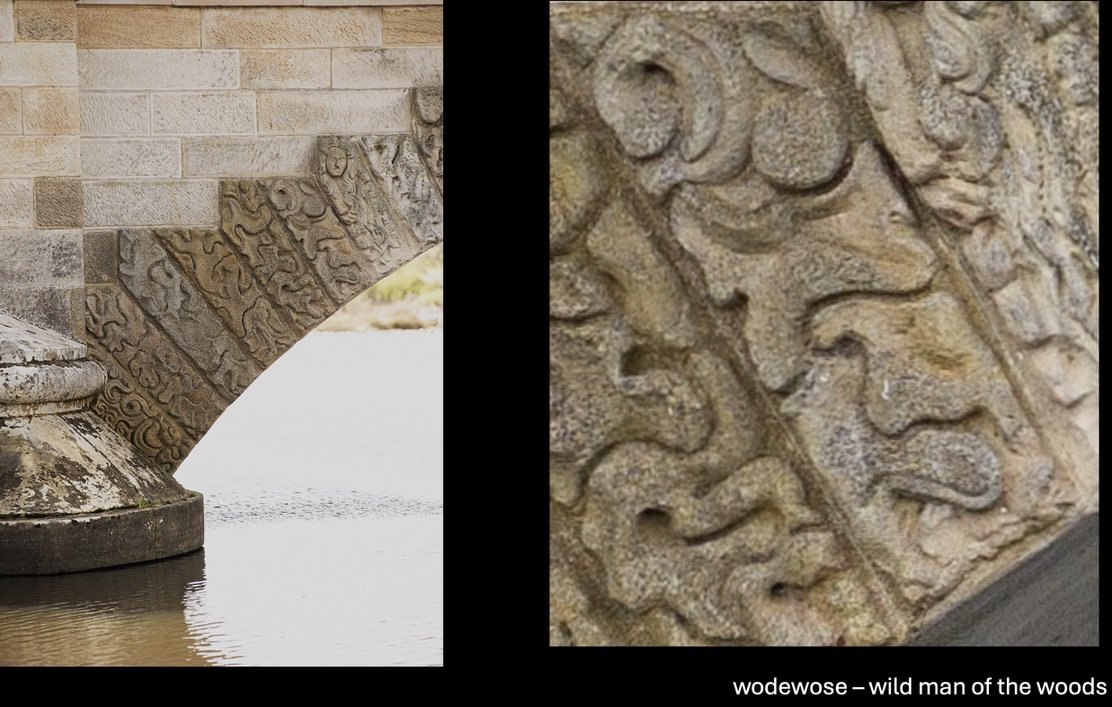
On the south face of the western arch, is the mask of a wodewose, a wild man of the woods. In Victorian times, he would become known as a greenman. He was an amoral brutish fellow seen in street pageants, pantomimes and plays. In medieval times he was the man with uncontrollable sexual passions who was destined to grow hair all over his body, become insane and run away into the thick, dark forest as a God-given punishment for behaviour which was not distinct from the animals. The primordial urges were ‘a vestige of our animality and ought to be dominated lest one regress into a chaotic, insane, and ungodly existence’.
He is gazing upon a bizarre communion between a rampant, aroused bull and a cow who seems to be in a tree. The metaphor must be about sexual excitement in the wild woods. Was it a dream?
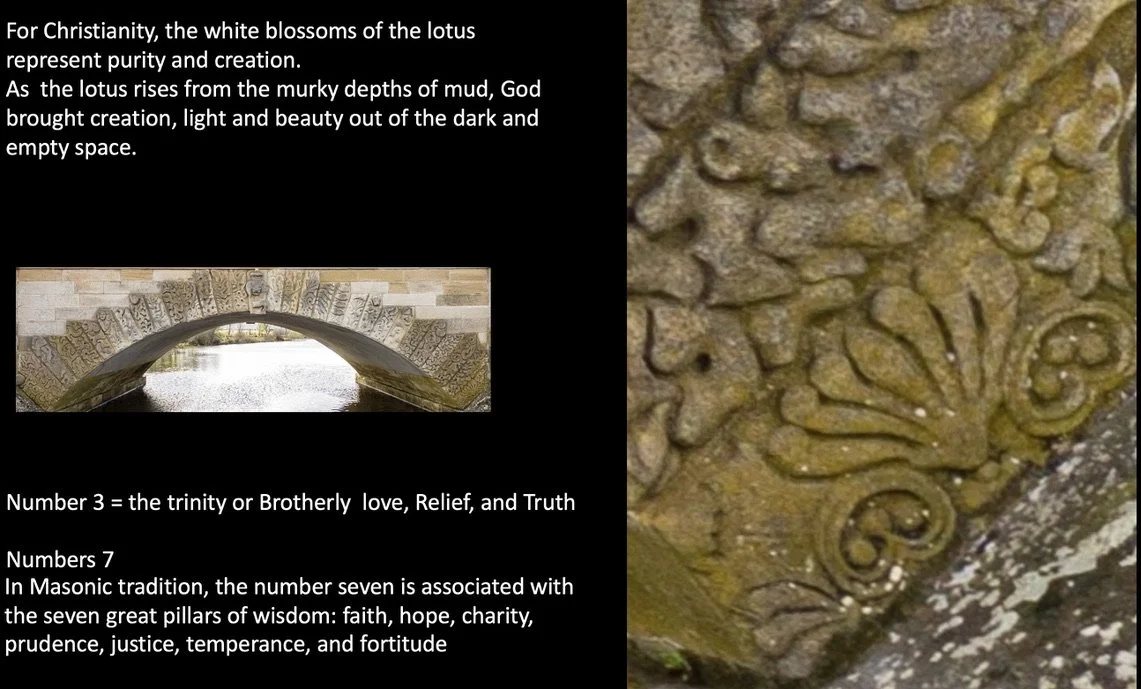
In a shaded corner of the same arch is a seven petalled lotus flower with two seed pods, three seeds within each.
Christianity highjacked the lotus and its meaning from more ancient religions; it is about purity rising from the murk of the underworld. Numbers have had significance since the ancients: Pythagoreans, Judaism, Christianity, Freemasonry, mythology, spiritualism, astrology until modern mysticism. In Proverbs 9, Wisdom built her house on seven pillars. In Isaiah, the seven pillars are fear of the Lord, instruction, knowledge, understanding, discretion, counsel and reproof.
In Freemasonry, they reflect faith, hope, charity, prudence, justice, temperance and fortitude.
But there are seven deadly sins, too: sloth, lust, envy, wrath, greed, gluttony, pride. On each of the petals was a mask now worn away. I wonder if they were diabolical, up-ending the overt intent of the carver and turning the carving into a sardonic comment on hypocrisy.
Three is a venerable number too. In Christianity it refers to the Holy Trinity; in Freemasonry, its meaning lies in the ideas of truth, brotherly love and relief of one’s brother when he is in need of help or relief of one’s soul form eternal torment by abiding by the rules of the Craft.
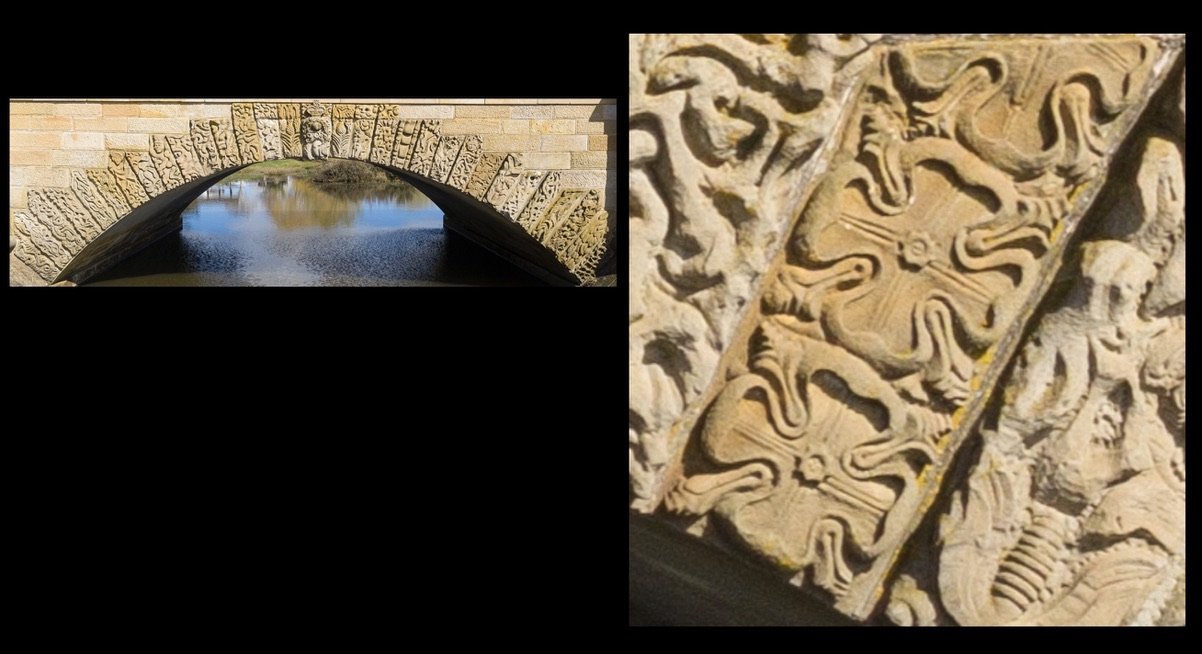
Once there were three quatrefoils on this stone. It tells us that the arch stones were carved on the river bank or in a workshop not on the bridge after they were fixed. In England, the carving was done in the winter when the weather did not permit safe construction. There are letters written between the Inspector of Roads, Roderic O’Connor, the Civil Engineer and Colonial Architect John Lee Archer and the Colonial Secretary advising that no building should or could proceed during the winter and times of flood and the labourers ought to be sent to other road gangs for the time being. Perhaps it was during these slack periods that the carving was done.
Quatrefoils are ancient ubiquitous architectural decorations. These are not four-leafed clovers because at the corner of each square is a stylised thorn. These a barbed quatrefoils representing a rose; not a Tudor rose that has five petals. The symbolism is in the number four.
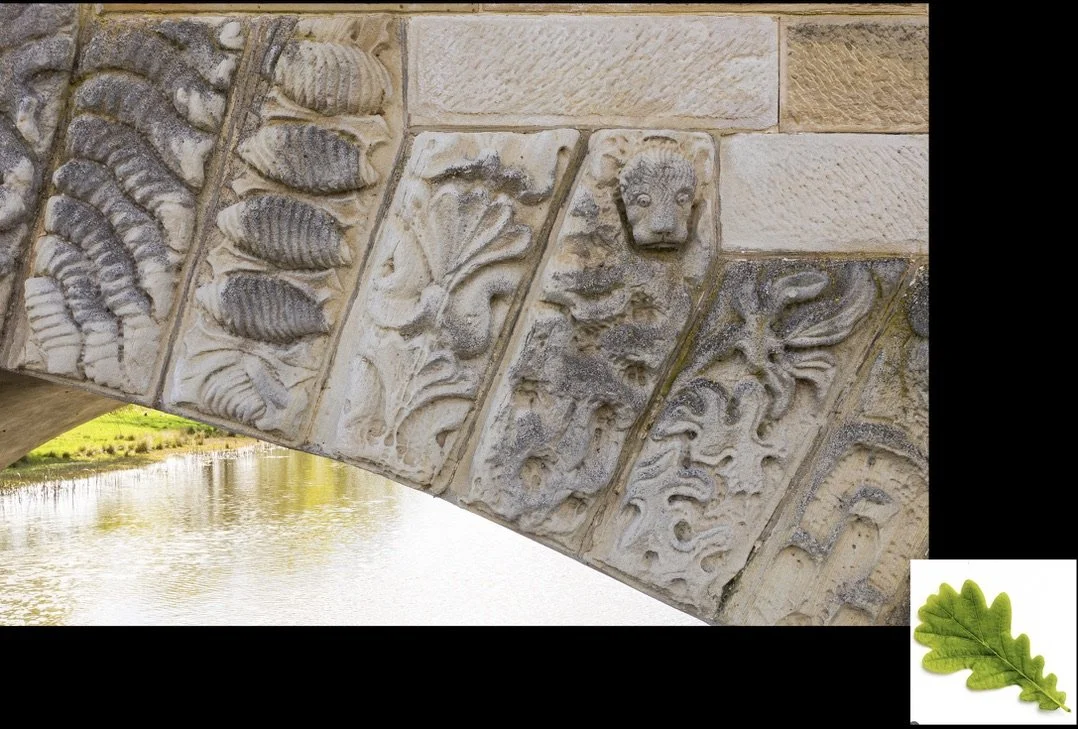
The five petalled icon was regarded by Norman Laird in his 1970 book on the Ross Bridge, as a representation of a hand, perhaps the Hand of God. I think it is likely to refer to the female. I cannot explain its juxtaposition to the caterpillars and cocoons.
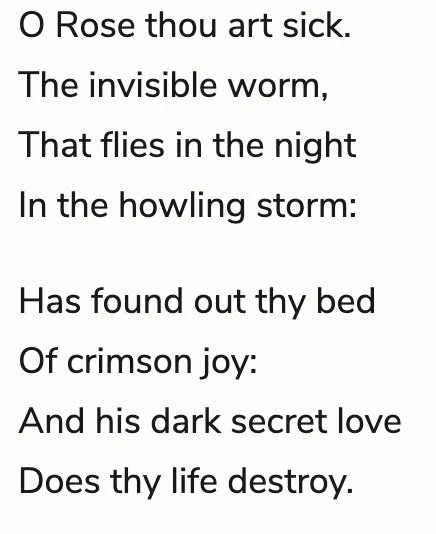
I think Daniel Herbert had an enlightened education for a young lad in Manchester in the early 1800s and William Blake’s poems might have been known to him. The Sick Rose reflects the sentiments of the bridge. Two stones along the arch are oak leaves symbolising home, England. Above them is a fairy-like leafy creature in flight.
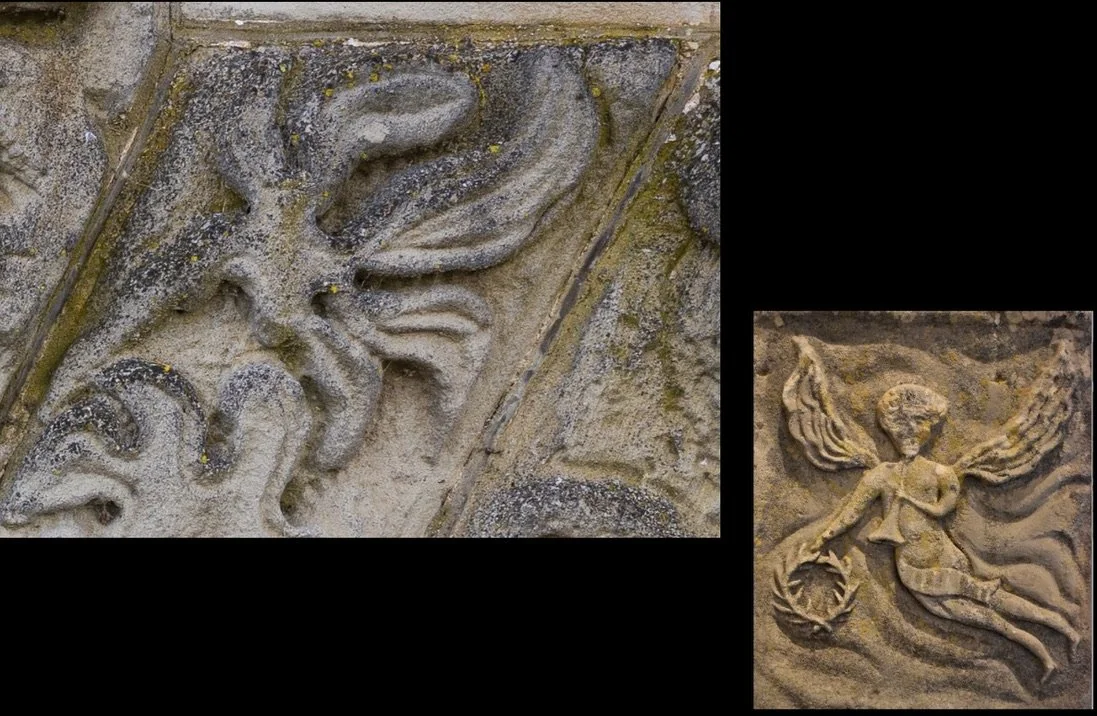
Can you see its face and long hair, its leafy wing-like arms, a sash or tail, and leafy legs? It is a dreamy figure similar to Dan Herbert’s beautiful Saxon angel carved for the footstone of Sarah Anne Ellis’s grave when he was newly, conditionally pardoned.
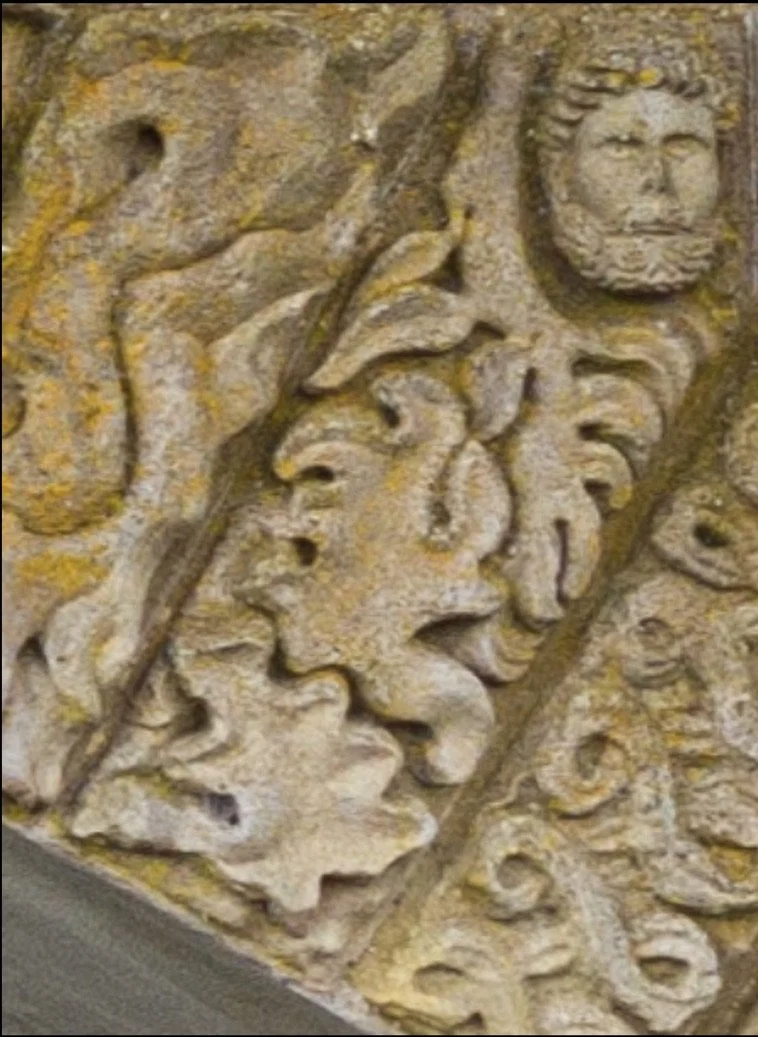
This is the self-portrait of Dan Herbert, purported to be the artist of the bridge. He is looking southwards, away from home, with a low brow and sullen expression. A mason’s square is carved into his beard. Below are two falling oak leaves; beside him a the branch of a gum tree. The tree represents life; a broken bough means separation or a life cut short. The story of this sculpture is poignant.
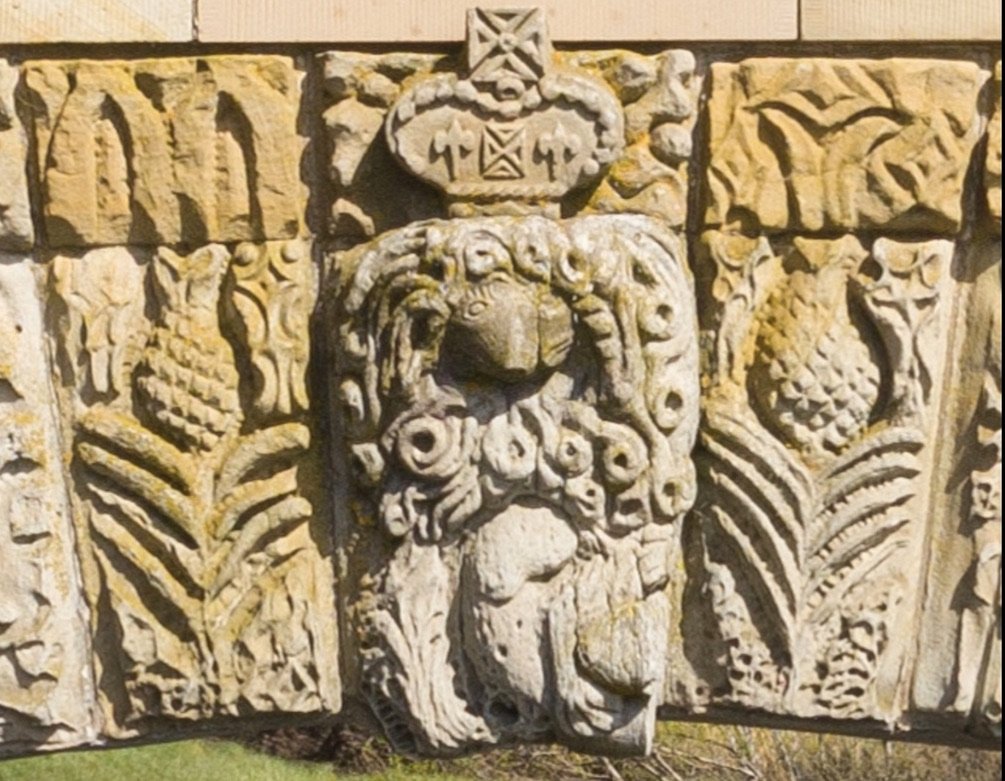
This Royal Rat is flanked by pineapples. In her crown are the ostrich feathers of the Prince of Wales. I think she is Caroline, who was the wife of the Prince of Wales and Prince Regent, George who became George IV. Their households were infamous for the squandering of public funds during the boyhoods of the convicts. PIneapples are symbols of prodigality and wealth.
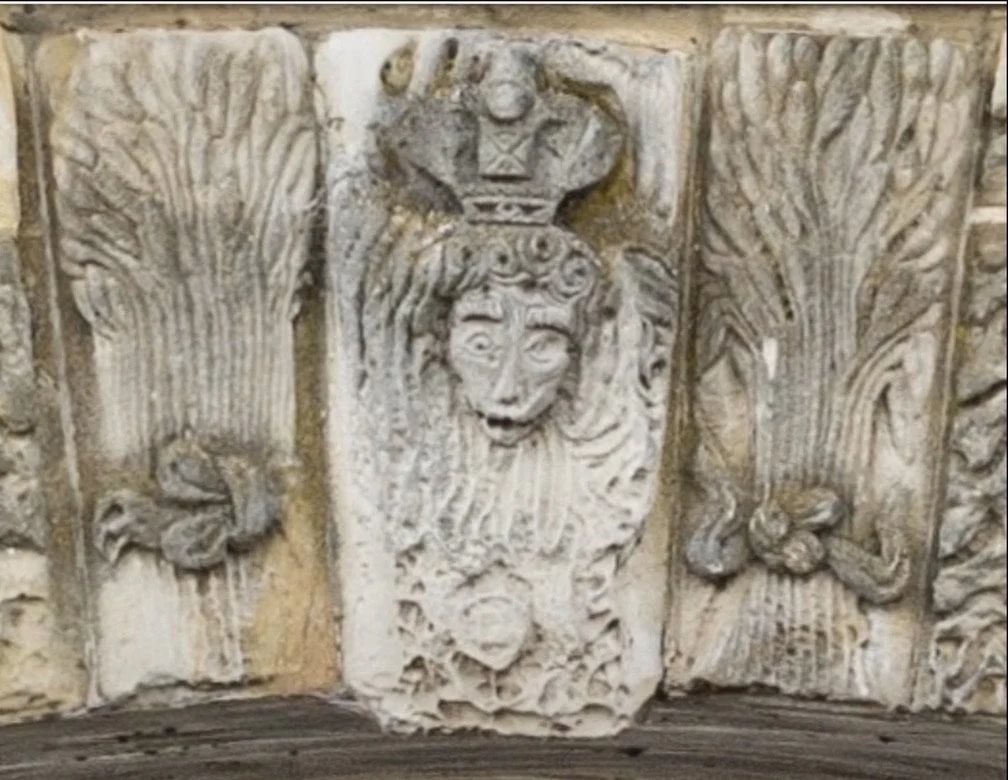
Opposite her on the same arch, is her father-in-law, King George III. He looks mad, vexed and sick. His crown is too small. His Order of the Garter on his chest has almost worn away. He is flanked by sheaves of corns. I do not think they represent the prosperity of VDL but the Corn Laws. These laws protected the trade of privileged English grain growers even after the trade blockade of the Napoleonic Wars was lifted. They were the cause of hunger and starvation among those who could not afford to buy flour or bread. So they stole to feed their families, were caught , tried and transported. The Laws were not repealed until ten years after the bridge was built.
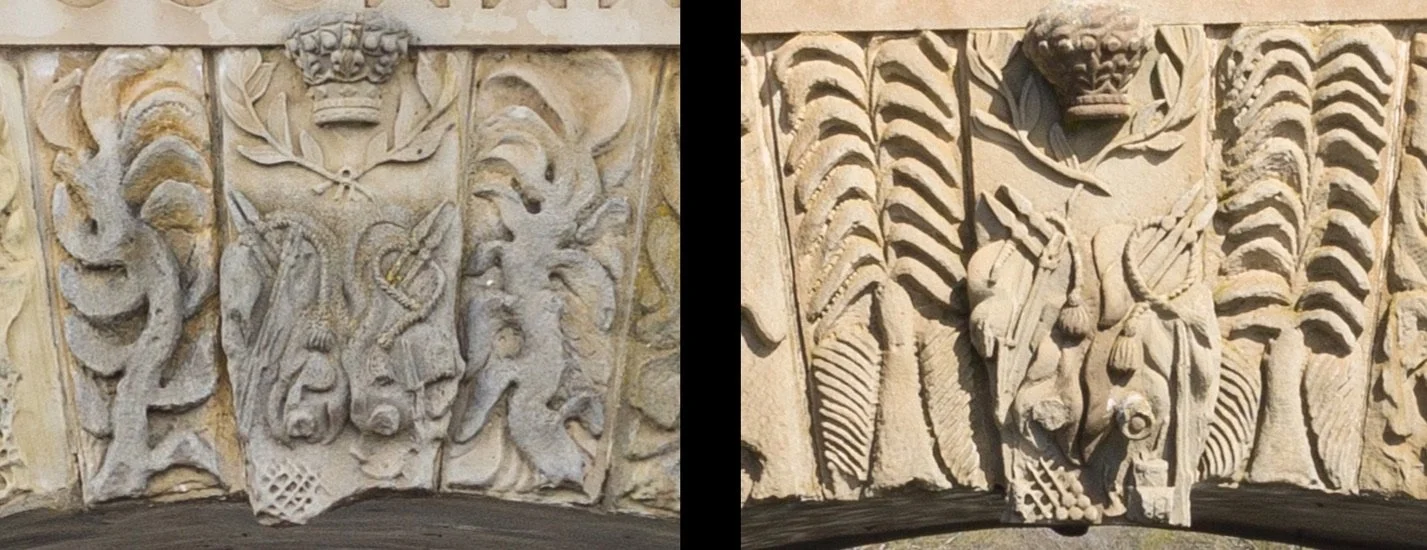
Trees support these military crests, gnarly ones on the south face and palm-like ones on the north. I asked the men of the barracks in Hobart what these could mean; they thought maybe it was about the military in nature. I suspect they are parodies. Whatever, the laurel is under the crown. The trees, I suppose, are about life whereas the cannons and cannon balls signify tumult and death.
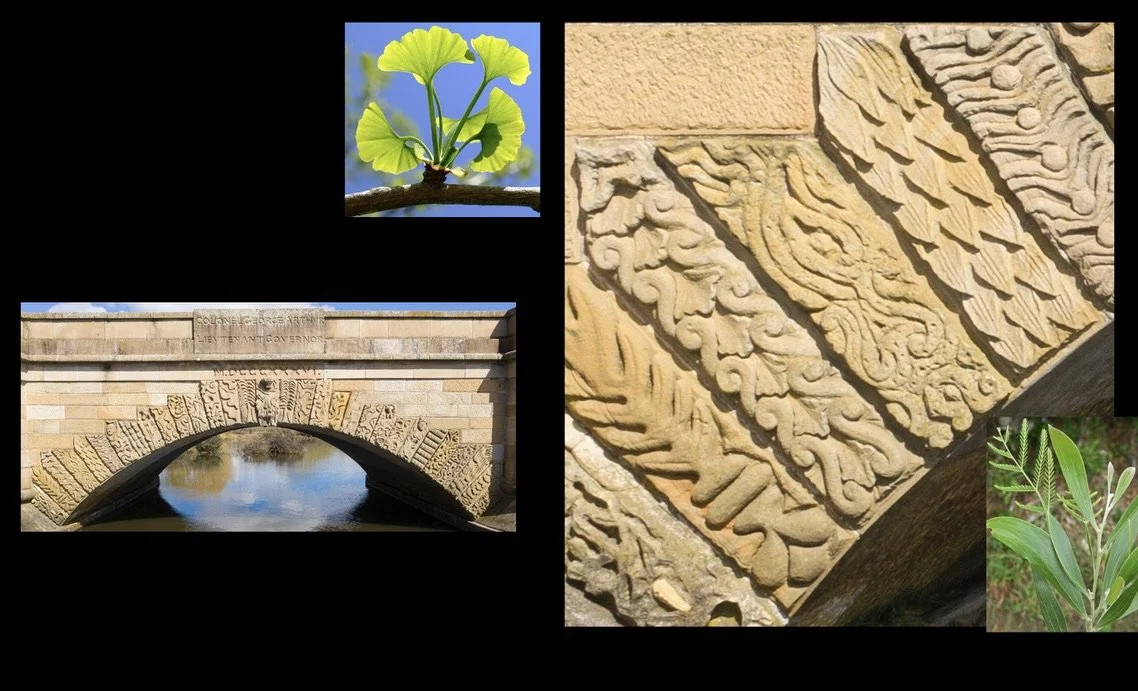
Here are four carvings about falling. On the left are seven ginko-like leaves falling between reflected spirals. In freemasonry, S shaped forms are symbolic of eternal life; reflected figures represent reflection upon one’s own journey as one casts off the dross of the flesh and enters a state of bliss. I think the next stone is about the fall of woman as the lozenge with the keyhole is symbolic of woman; she is surrounded by serpents. On the right, seven discs that once had faces, fall as if into the sea. On its left there are three rows of six leaves: 666, in Revelations is the number of the beast. Interestingly, these leaves have parallel veins as do acacias. One wonders whether they belong to the blackwood tree.
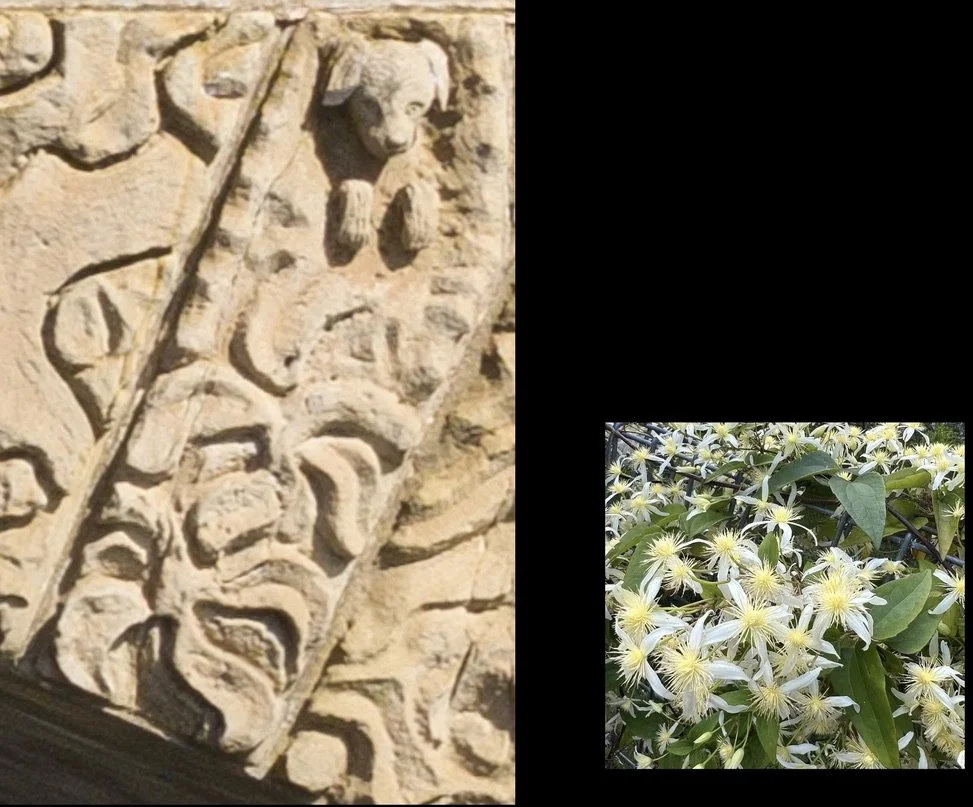
A little dog peers from a high window in a wall covered with four-petalled flowers. Perhaps it is a native clematis. So there is a gum tree, a blackwood and clematis. I think they are the only Australian icons on the bridge.
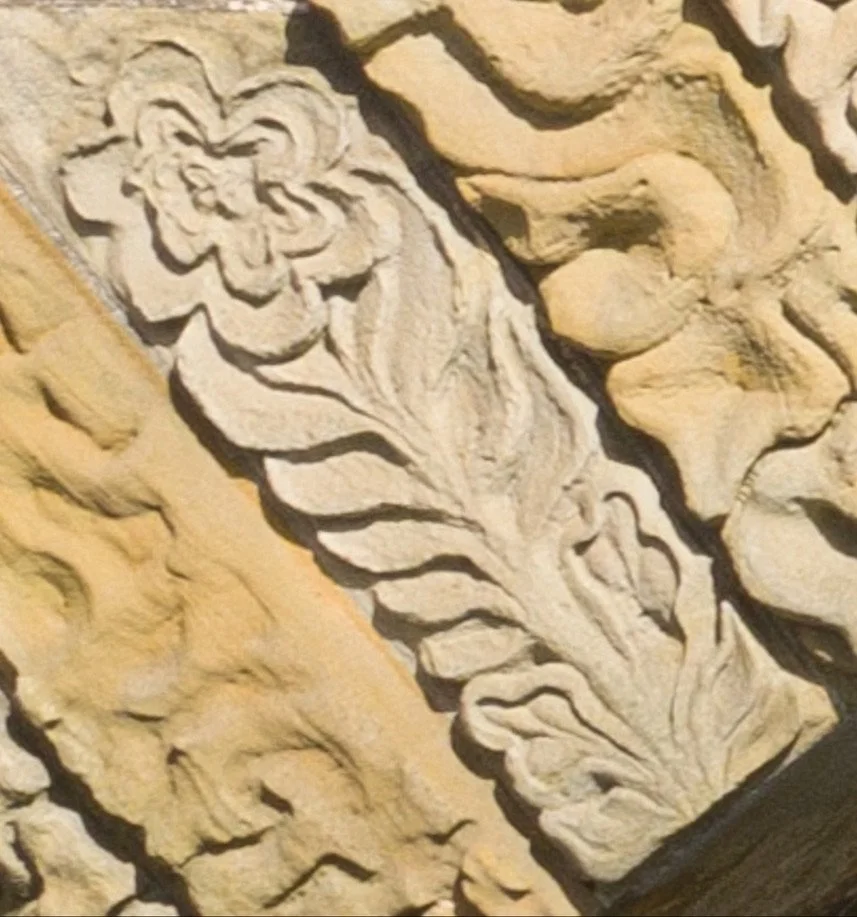
A perennial multi-petalled flower has shoots coming up from its base. This must refer to hope; a resurgence of life after winter.
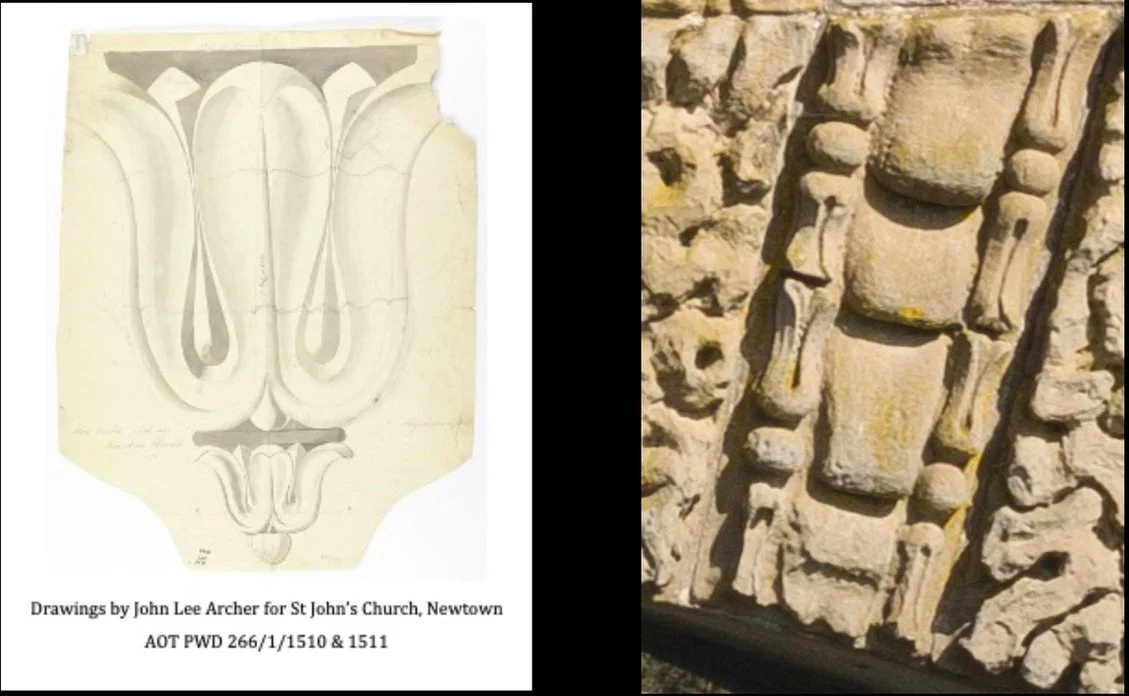
The drawing of an architectural decoration of a tulip was by John Lee Archer. He had selected Dan Herbert for the Public Works from the ship on its arrival in December 1827. He did not relinquish him until Lieutenant Governor Arthur asked him whom he would recommend as the stonemason to oversee the construction of the bridge in 1835. Archer chose his best man, Daniel Herbert, a skilled stonemason, intelligent and a good manager of men. At the time, Herbert was overseer on the Customs House site (now Parliament House).
The drawing was for St Johns Church Newtown where Herbert worked for a long time. The tulip can be seen at the top of church tower, possibly carved by him.
These are pillars of stylised tulips.
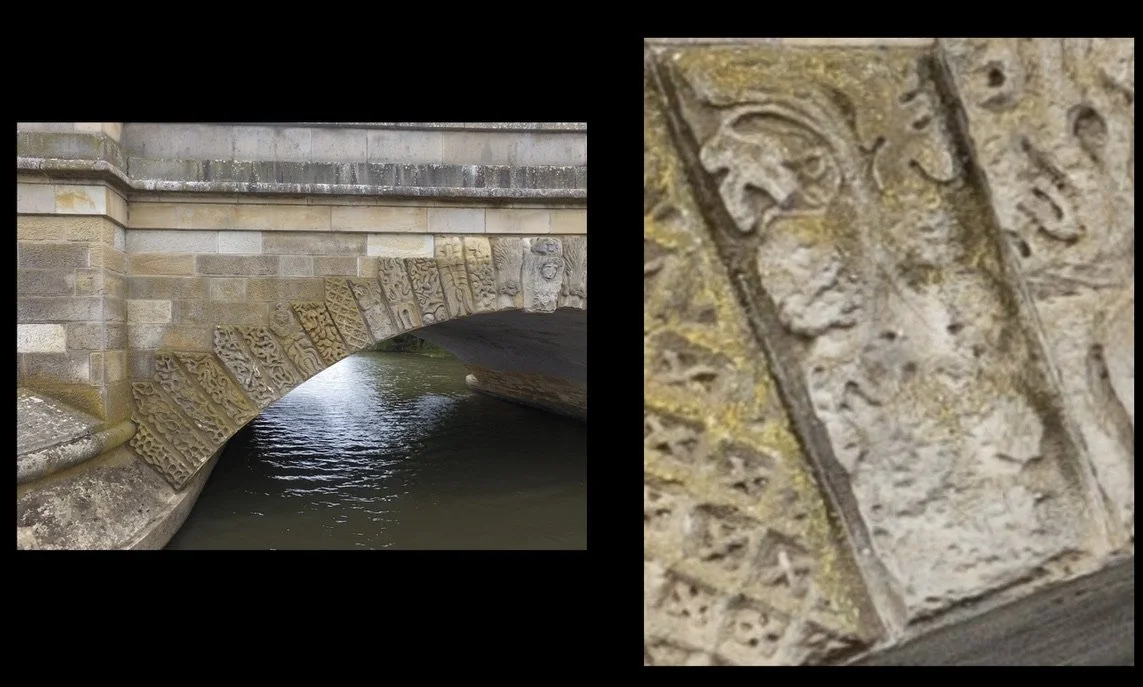
Last, there is a bunch of grapes on the same side of the arch as Arthur’s grotesque. In the context of the bridge, I think the underlying meaning is obscured by the appearance of a bountiful harvest. Colbeck and Herbert were the children of dissenting religions. Colbeck’s family were Methodists. Although it only surmise, I think Herbert was educated by the Bible Christians of the New Church in Salford near Manchester. They would have known their bibles. IN Revelations and Isaiah, chapter 63, God says of his enemies: I trod them in my anger and trampled them in my wrath; their lifeblood spattered on my garments and stained my apparel. How often had the convicts been forced to observe a flogging and had their clothes spattered with the victims flesh and blood? It seems their rage is like God’s, their enemies being the Monarch, the Tories and the colonial administration and they would revel in trampling them.
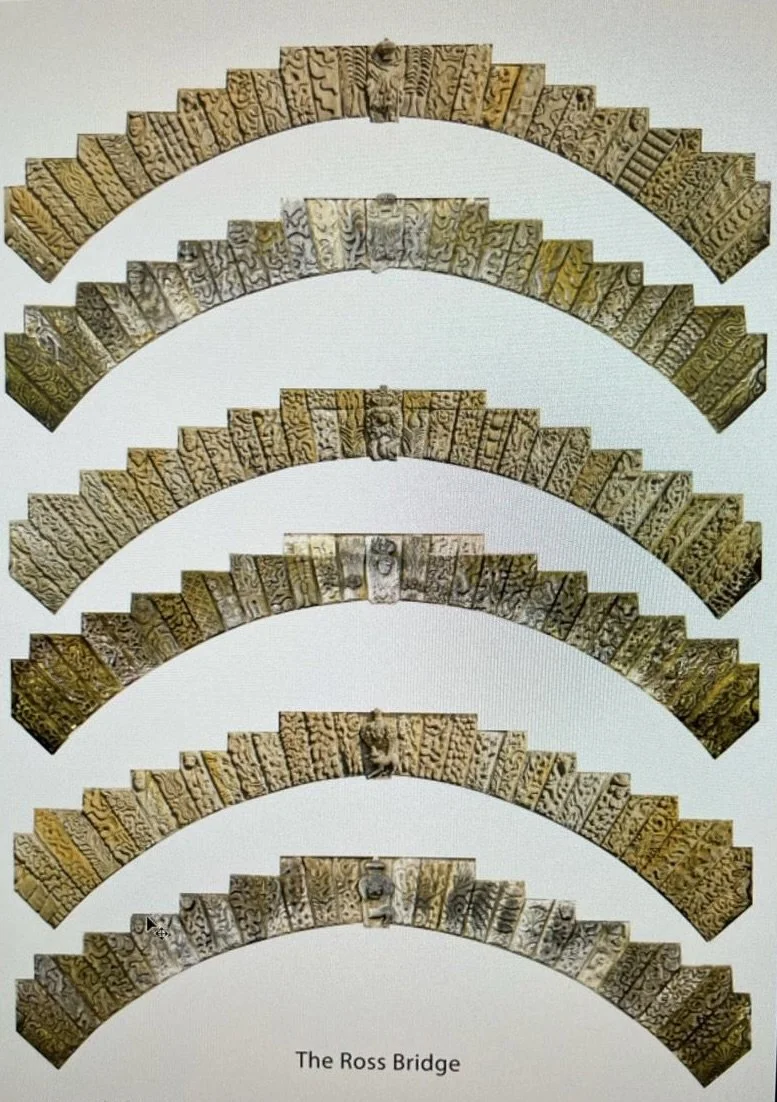
The bridge carvings form a document like no other in Australia. Convicts were not permitted to write of their experiences. But when there were ashlars and chisels and sympathetic men in charge who turned a blind eye to the nature of the carvings and time spent by intelligent, skilled sculptors expressing themselves , a testament to the life of the unprivileged, punished, inured working men of the convict class emerged.
This bridge is unique in the world yet it is weathering away.