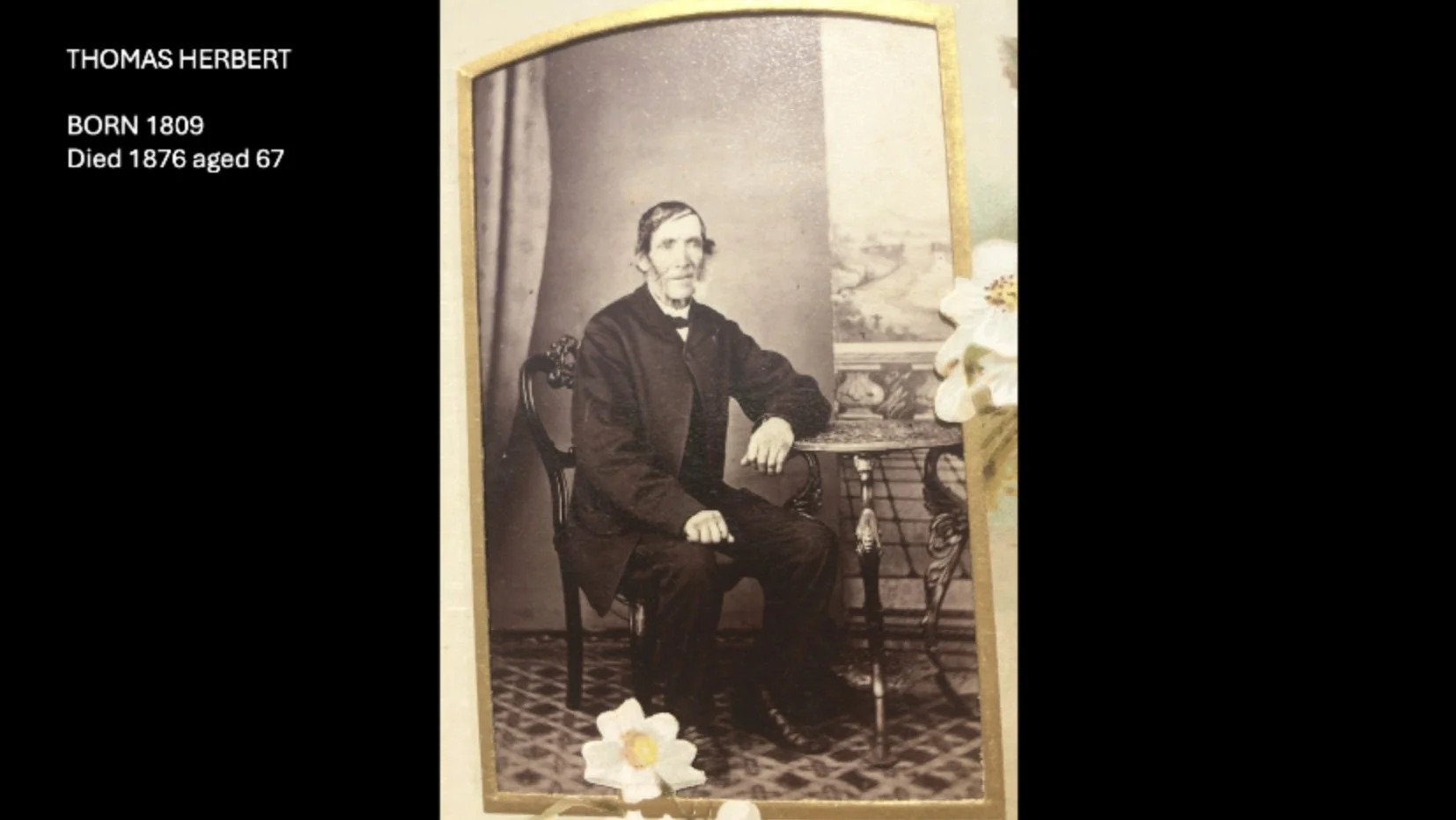
THOMAS HERBERT
QUARRYMAN OF THE ROSS BRIDGE ROAD PARTY
MY GREAT GREAT GRANDFATHER
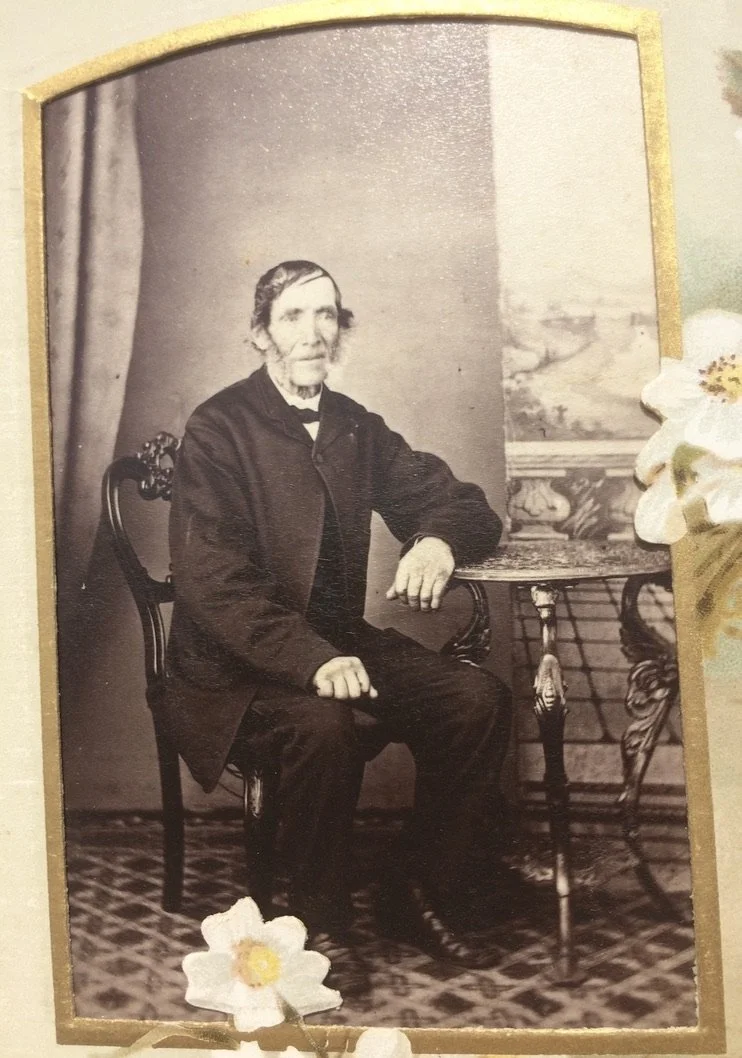
THE organiser of events at the STATE LIBRARY AND ARCHIVES OF TASMANIA, asked me to present a talk during National Family History Week melding my ancestor, who was a member of the Ross Bridge work party, with the sculptures. The following is an adaptation of that powerpoint presentation.
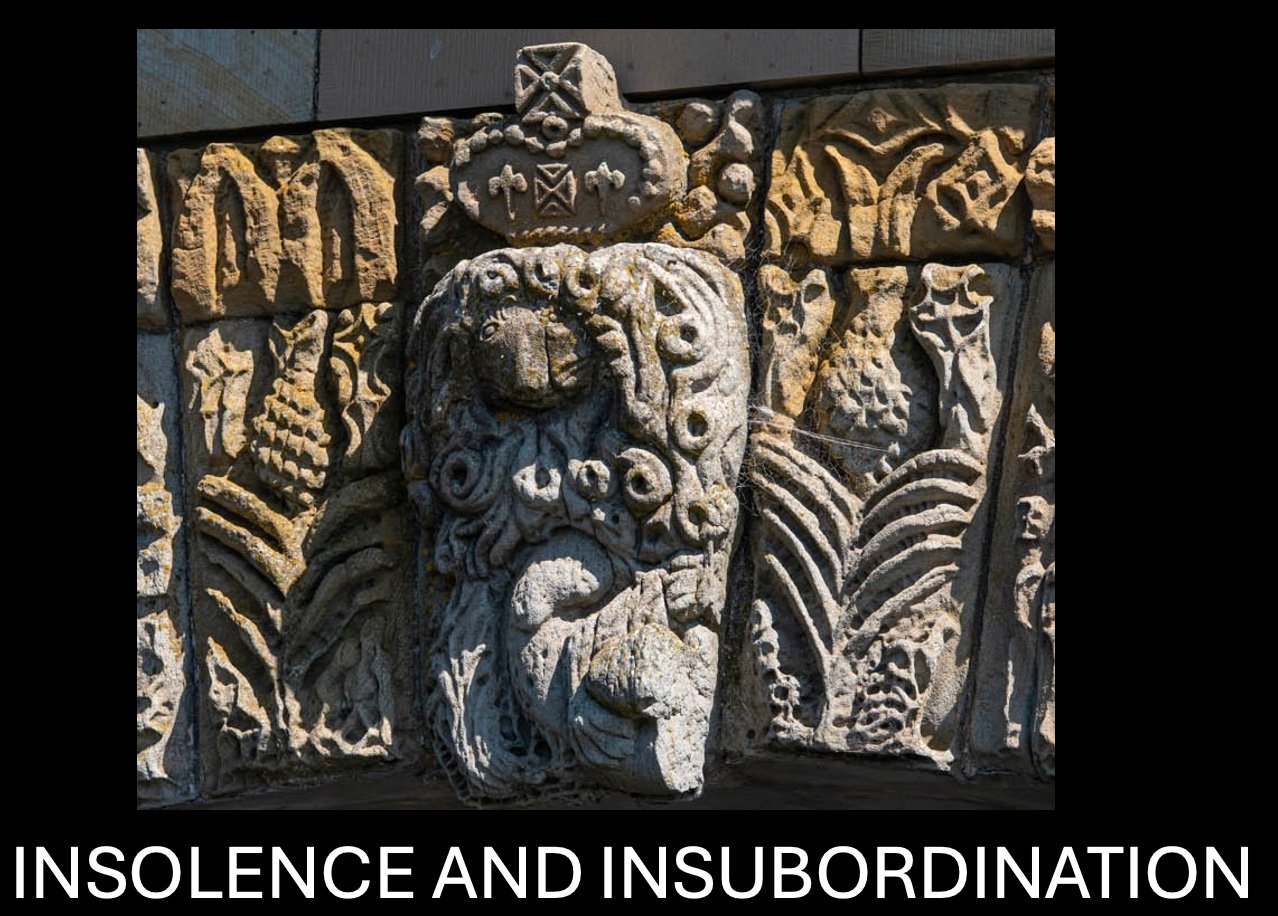
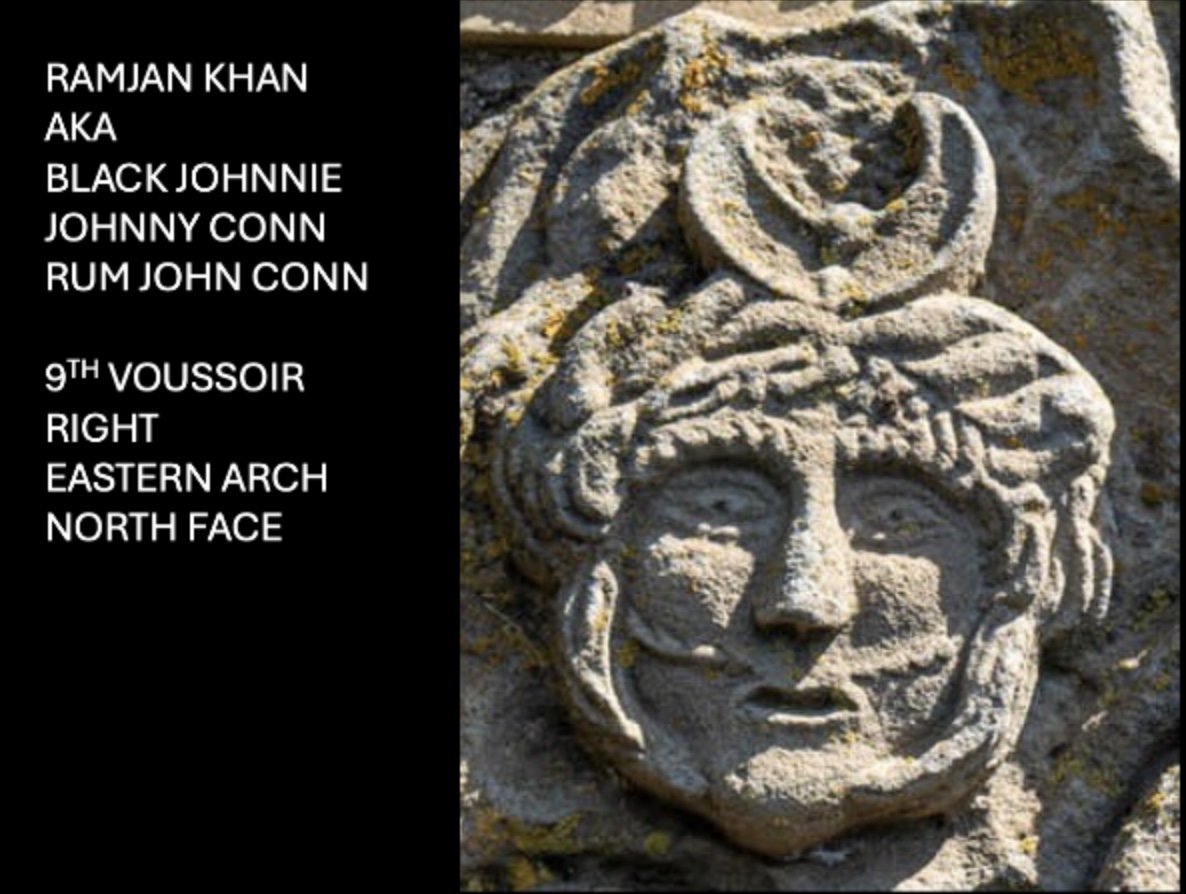
…..and this is Black Johnnie, whose real name was Ramjan Khan, carved onto the bridge. He had been farming along the river at Emu Bottom since 1823.
Tom Herbert would have known him and probably built his red brick house on a knoll above the river. That might have happened because when the convict gang arrived in Ross to repair the old bridge and prepare material for the new bridge, there were no plans — no decision about the material from which it would be built. So, the men made bricks and quarried stone and cut timber with which they built the settlers’ houses.
I imagine them at the end of the day, eating mutton curry and rice around Johnny Conn’s fire and listening to the tales of his adventurous life—and sympathising with him over the manner in which the English patronised him. He was a legend.
But how did Tom Herbert end up in the gang at Ross as a quarryman?
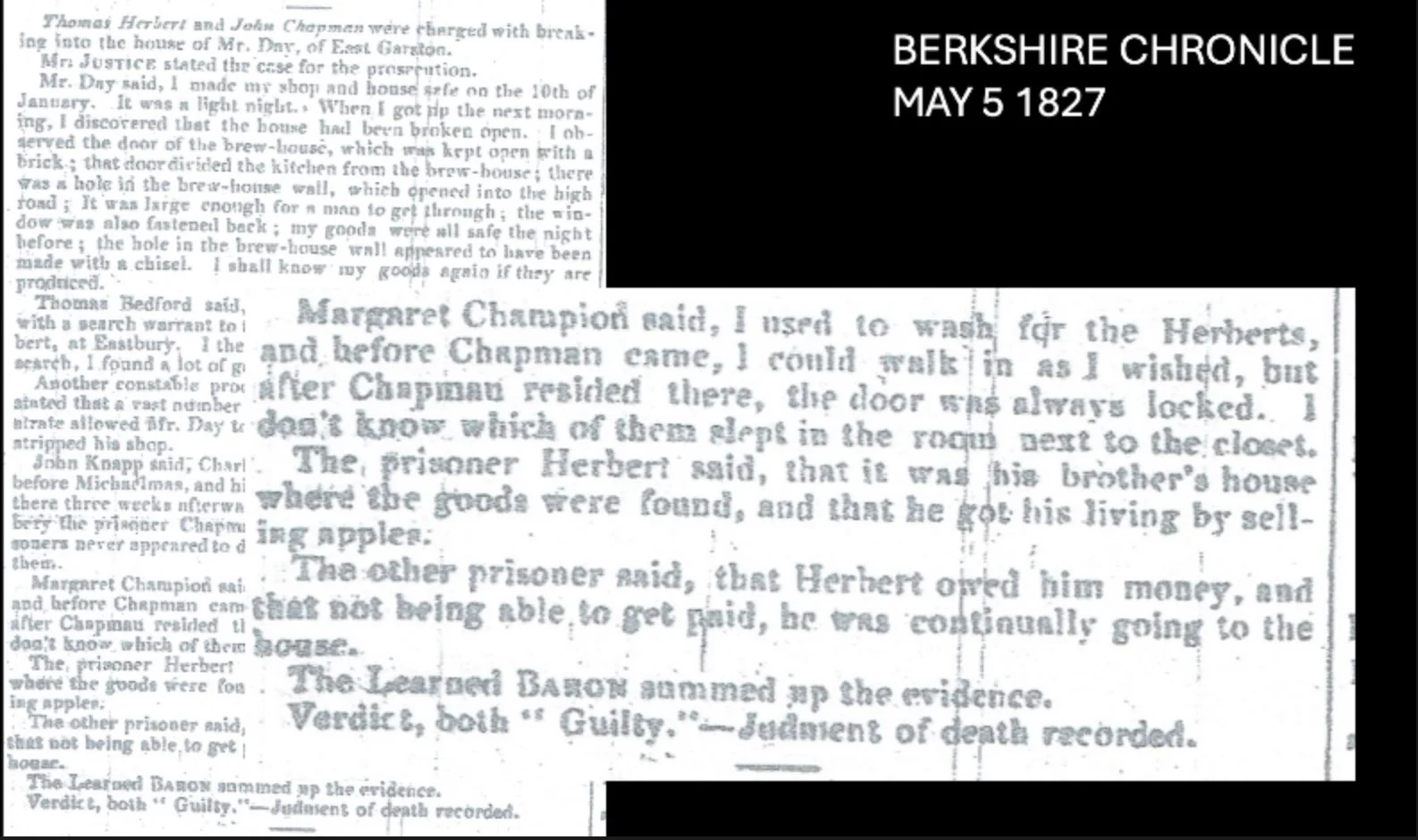
He was born in Wantage, Oxfordshire, in 1809 into a large extended family. His father was a wheeler. When Tom arrived in Van Diemen’s Land, he claimed he had been a groom and gardener but “lately out of employ.” At the Berkshire Assizes in May 1827, he said he made money selling apples. He lived with his older brother, Charles, in Wantage. Their cousin, John Chapman, alias, John Cudd, alias John Dibley (too many names to be other than dodgy) came to live with them from the Isle of Wight. Margaret Champion testified at court that she had washed for the Herberts and before Chapman came, she could walk in as she wished, but “after Chapman resided there, the door was always locked.”
Tom and Chapman were found guilty of stripping the shop belonging to John Day of all its wares. They were sentenced to death, reprieved and transported for life.
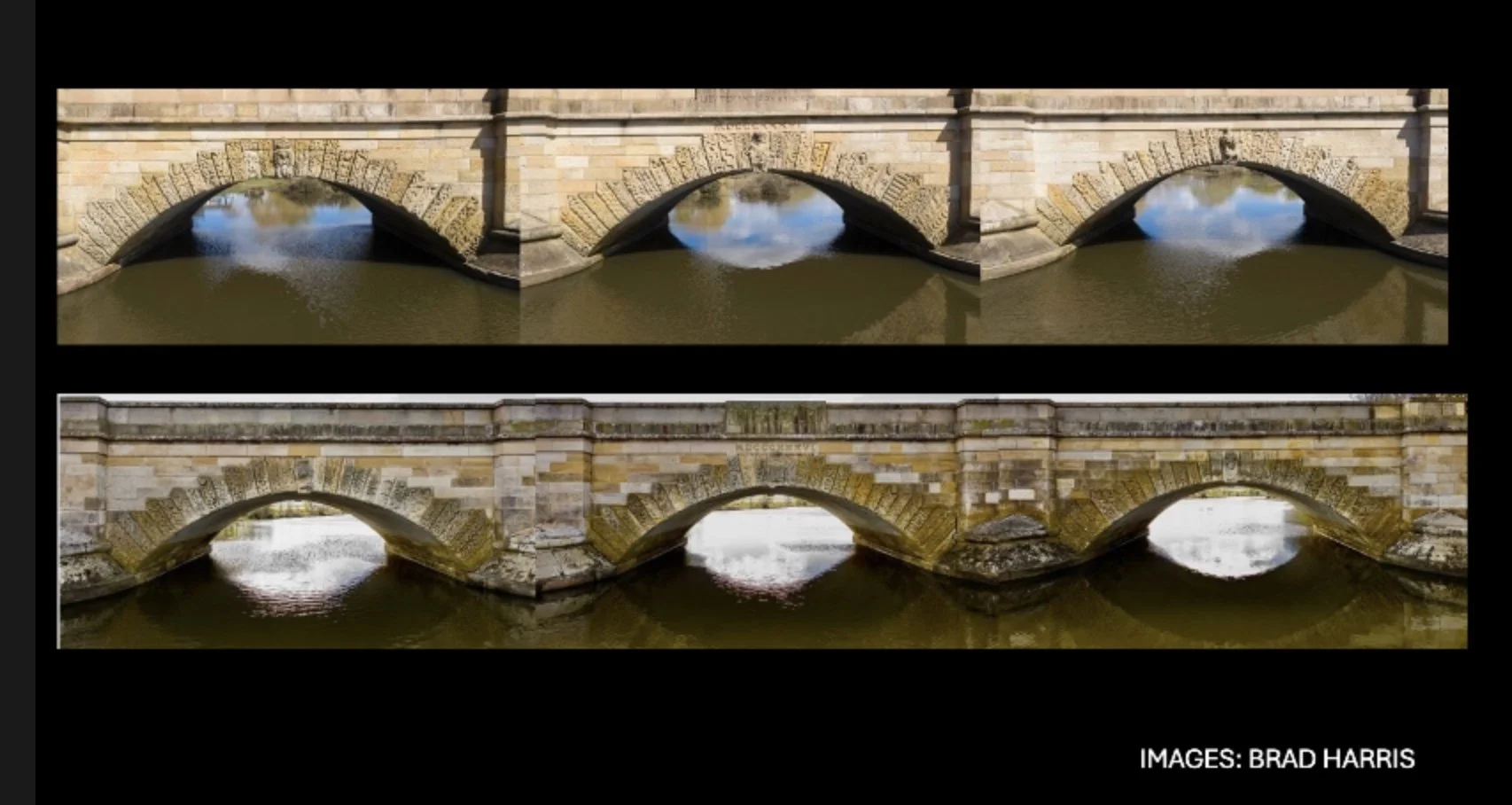
Insolence and insubordination: two common words found in convict conduct records that incur unpleasant punishments:
Insolence—offensive contempt
Insubordination—disobedience, rebelliousness
I am going to explore with you how my great great grandfather became a member of the Ross Bridge gang, contributing to the mood which is expressed in the subversive, satiric, ironic, cynical, lewd sculptures of the arch stones and keystones.
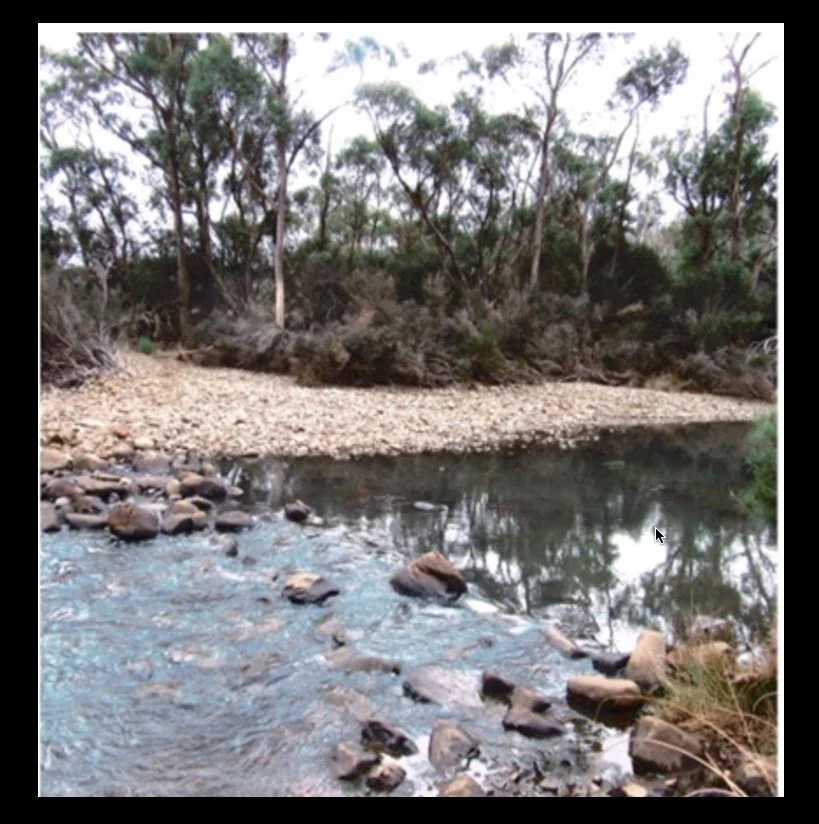
But first, let us consider Tinamarakuna, the river that flows from south to north under the bridge.
Governor Lachlan Macquarie wiped away that lyrical word and renamed the river after himself in 1811, as he was wont to do.
It was the life source of the land and its people, the Tyerrernotepanner people, who had nurtured its plains for their pleasure and hunting and thoroughfare …
…until white surveyors, governors and settlers beheld them as god-given for sheep.
I think it behoves us to pause and remember how the First Nations People cared for the land with reverence, and that they still do.
On October 20th 1831, aboriginal guides led George Augustus Robinson away from the Western Tiers and the Big River Tribe, down the native road by the eastern arm of their river, Tinamirakuna, to its southern reaches where they crossed it into Black Johnnie’s Marsh.
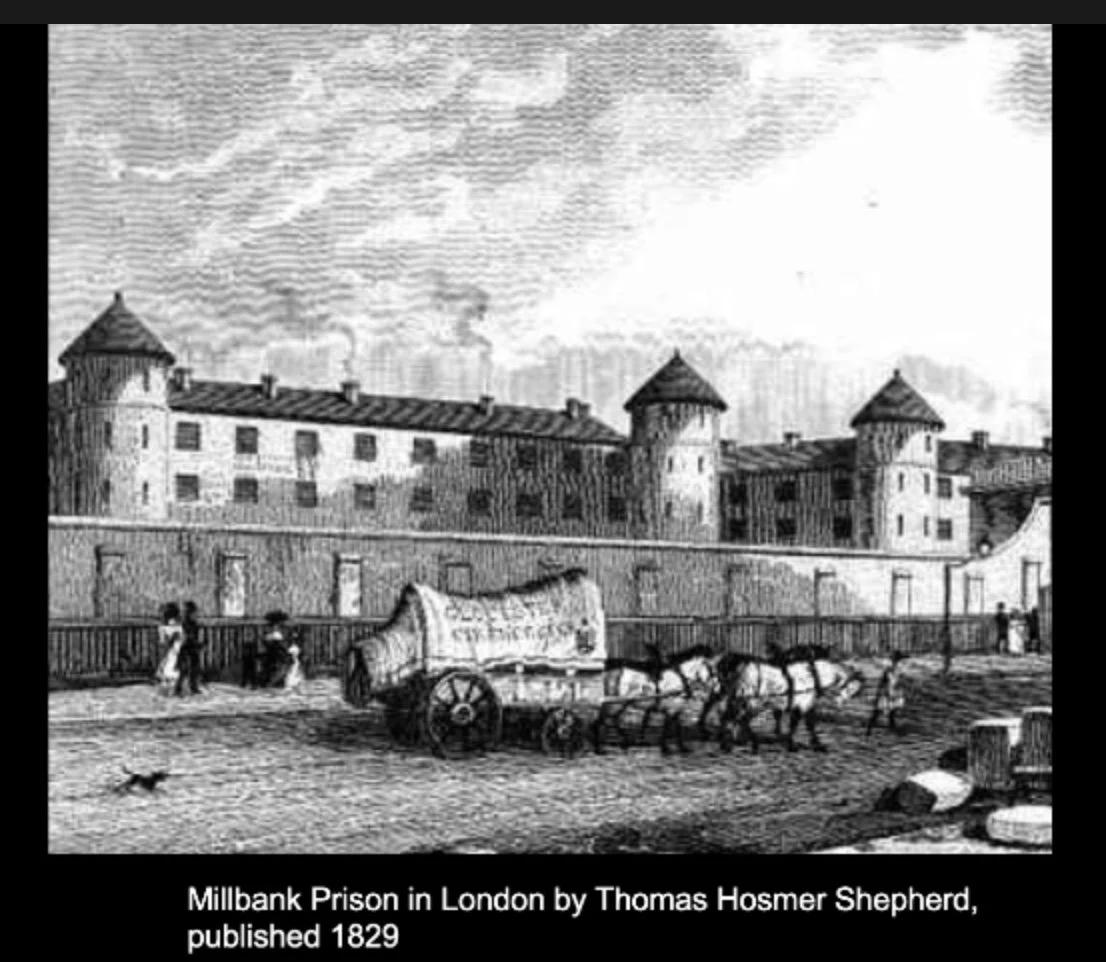
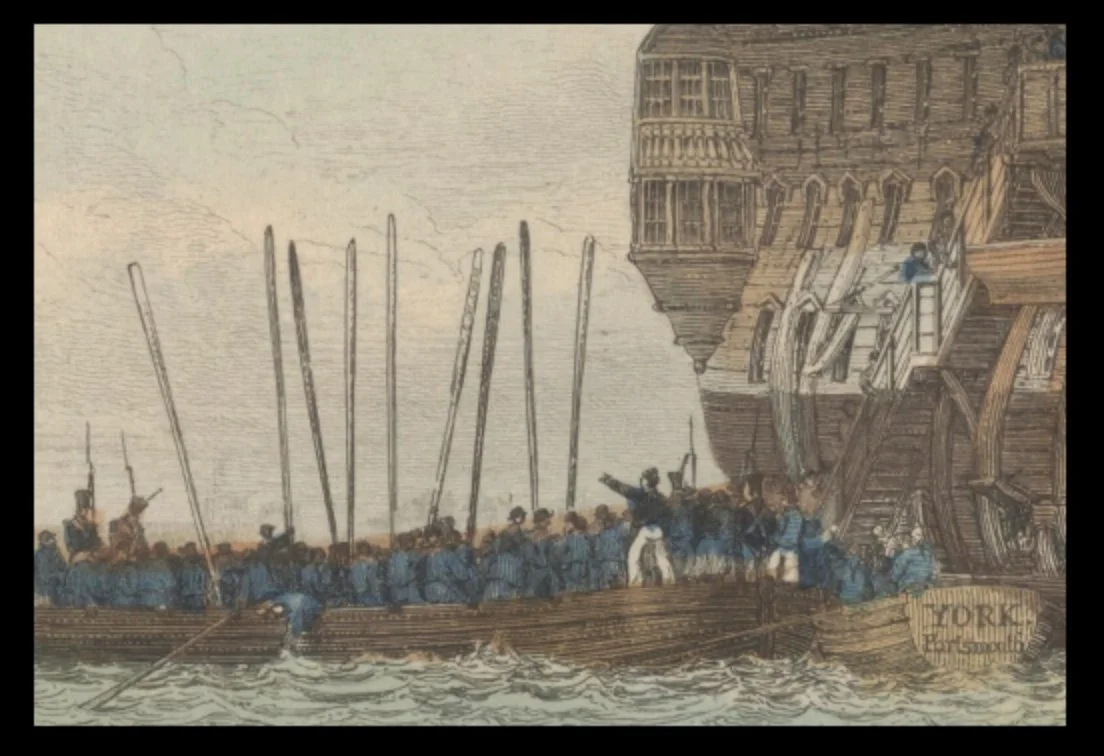
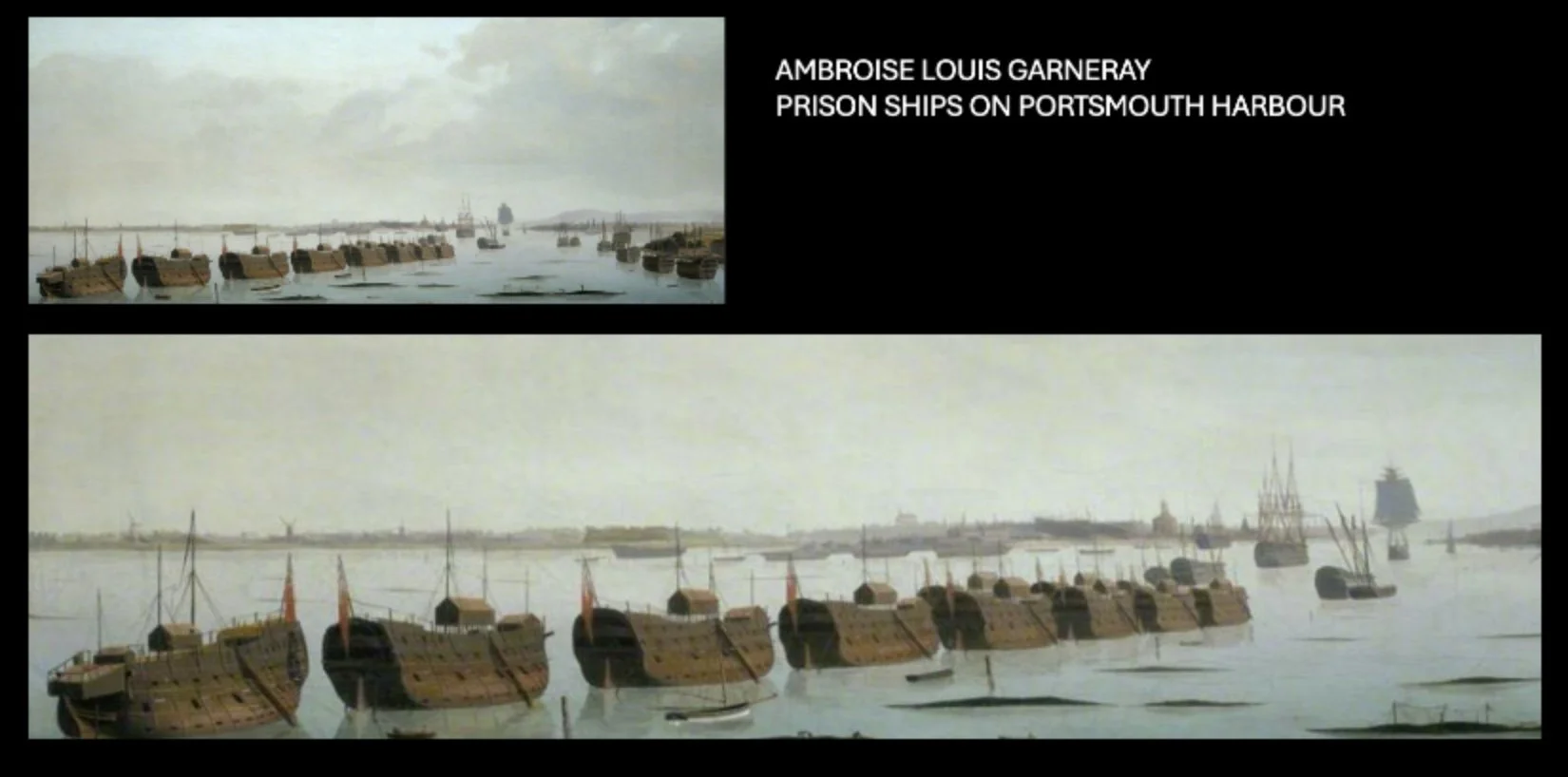
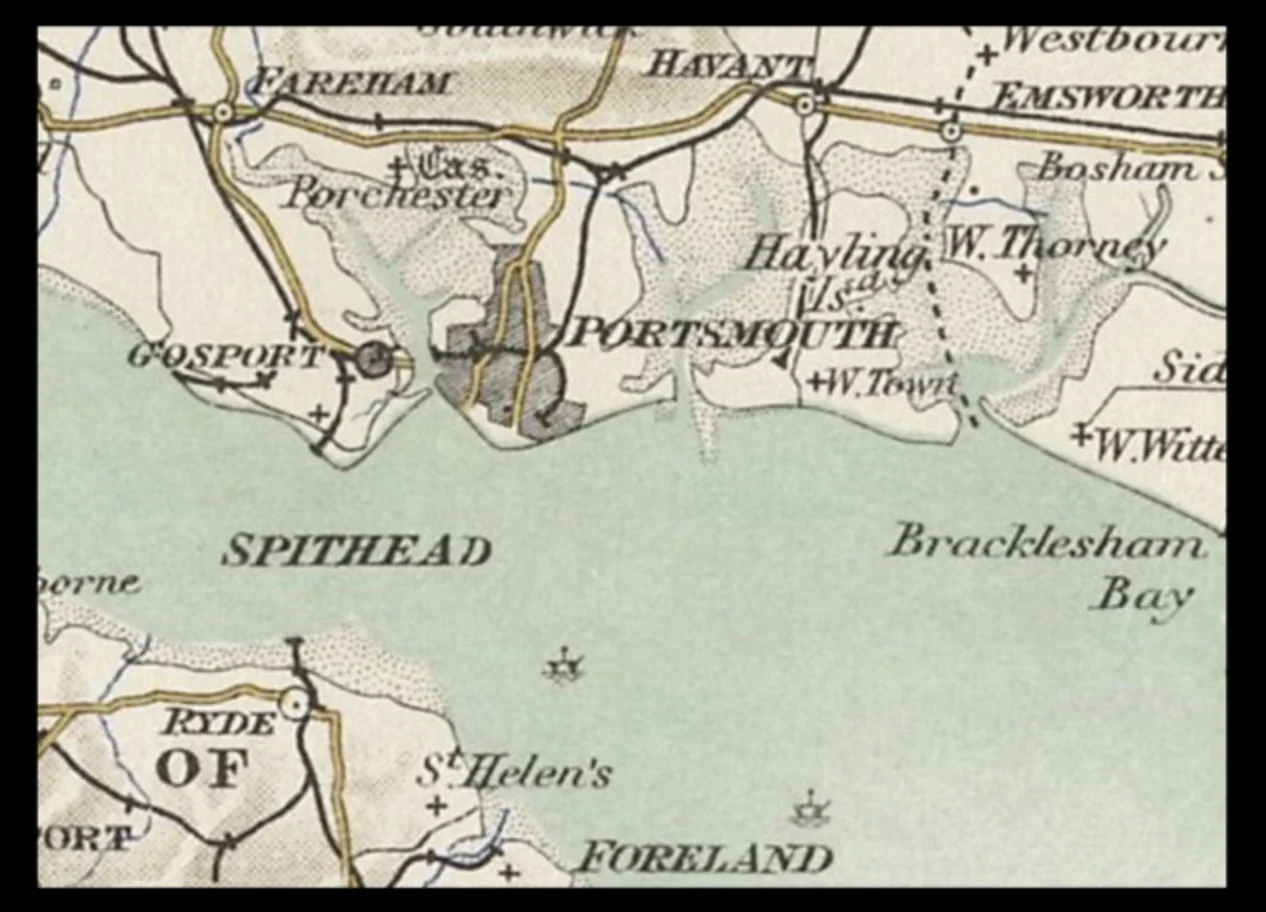
In May 1827, they would have been chained at the ankles, to the men each side at their wrists, and to the rails on the inside of a covered wagon without windows, and taken to Portsmouth where they would have been loaded into lighters and rowed out to the hulk York.
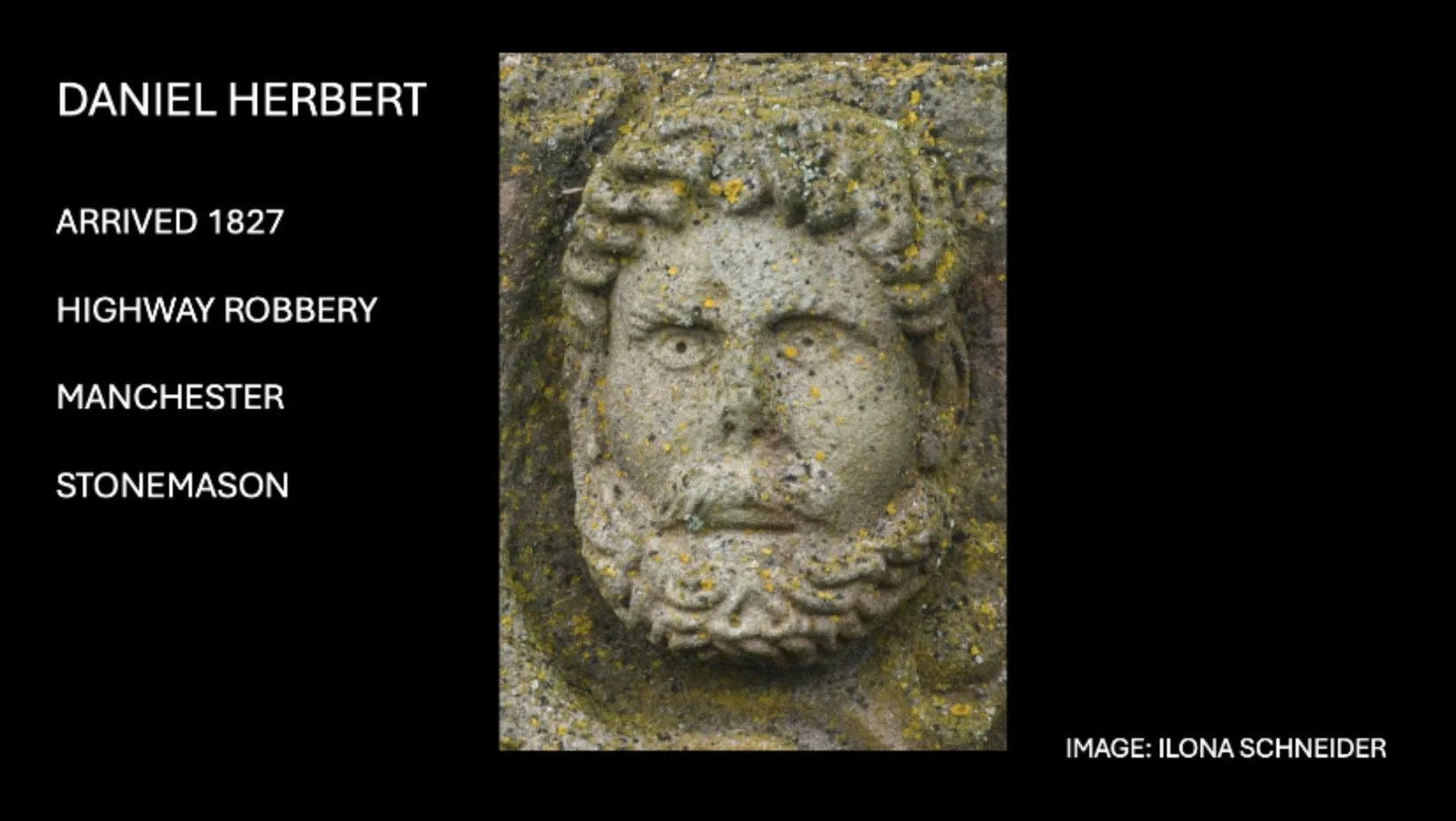
In another hulk, Leviathan, Dan Herbert was imprisoned— the man from Lancashire destined to become the legendary stone carver of the Ross Bridge.
Hulks were emasculated naval ships used as floating prisons since 1776, temporarily accommodating men, and even boys, from overcrowded gaols. The York was crowded with 600 men, most of them ordinary people who had been drawn into theft owing to poverty. They worked by day at the wharf or along the shore, in irons.
The death rate could be 25%. Some surgeons would allow men to die because a corpse could be sold to an anatomist for £5-6.
(Allowed to Die? Prison Hulks, Convict Corpses, and the Inquiry 1847. amckay@ucc,ie Anna Louise McKay University College Cork Ireland)
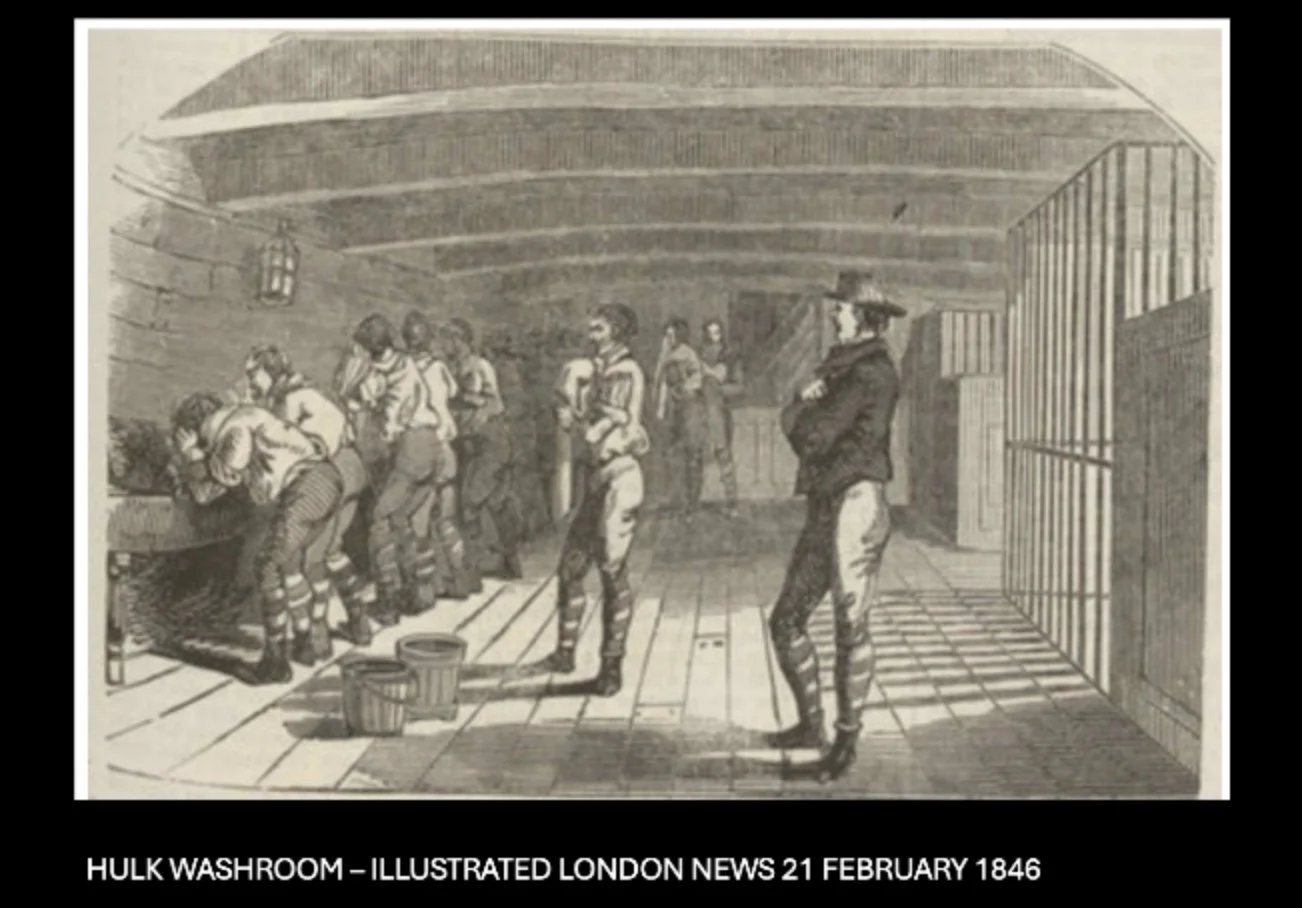
One morning in August, Tom was ordered to the washroom where he had to strip and wash himself thoroughly. He was given new clothes, shaved, and put into new wrist manacles and ankle irons. He was to be examined by George Fairfowl, the Surgeon Superintendent of the convict ship Asia. If the hulk was free of contagion and if Tom was healthy, he would win the paradoxical prize of a berth in the transport ship. Fairfowl wrote in his journal that these inspections were always dissatisfying, as the hulk surgeons wanted to get rid of troublesome men, and the prisoners wanted to be off the hulks, despite that meaning transportation. He selected 200 men that day, including John Chapman and Daniel Herbert.
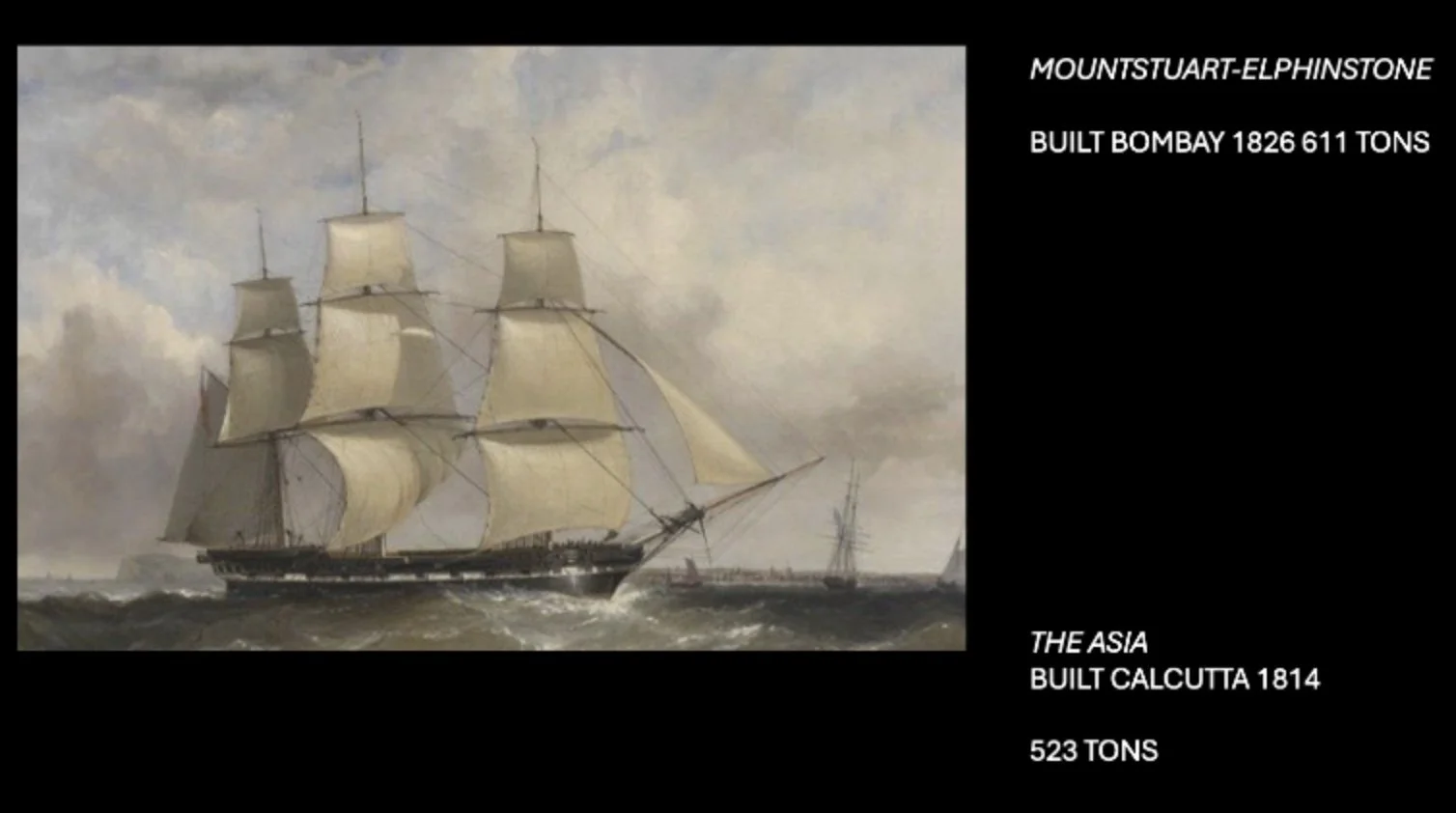
They would be rowed in the lighters to the transport ship waiting at anchor in Spithead. The Asia was similar to the Mountstuart-Elphinstone, also a convict ship built in India. The commander was Captain Hager.
Some men were farewelled by loved ones permitted to climb aboard the hulk. But we know from letters written many years later between two nephews of Tom’s, that Tom’s brother, father of one of the correspondents, had forbidden his wife and son to answer letters Tom wrote from Van Diemen’s Land when he was freed. He was “better forgotten”.
Copies of the personal diary of Francis Robert Martin, the First Mate of the Asia, are in the State Archives of Tasmania and in the Queen Victoria Museum archives in Launceston.
They departed on August 17th, 1827.
SATURDAY 18th — The land of Dorsetshire stretching like clouds aong the horizon covered with a veil of mist which the sun seemed unable to penetrate. Many a tearful eye and melancholy look turned towards it by our unfortunate passengers. Poor wretches, how few of them will ever again tread the soil of that loved country. The great part of them, however, seemed callous to feeling; squabbling for rations, lying at their length in the sun heedless of everything passing or talking in slang gibberish of some of their adventures occupying them mostly. The fineness of the weather and smoothness of the sea prevented all seasickness amongst them.
FRIDAY 31ST A report of a conspiracy to take the ship amongst the convicts which from the lax state of the guard would not be a very difficult matter — They kindly propose setting the captain and officers adrift in a boat and taking the boat to a port of South America. - on the lookout for ringleaders.
THURS 11TH SEPT—rain, rain, rain - convicts stewing below wet through with perspiration— the hatches are obliged to be kept open to give air to the folks below and the rain beats down in torrents so that the lower deck is swamped and steams with the animal heat.
THURS 13TH SEPT ringleaders of the mutiny affair in irons and they are to remain so until we arrive. Horrible work. They are a desperate set.
FRI 21ST SEPT Crossed the line.
SATURDAY A stiff gale - as our passengers have not since their starting experienced very rough weather before, many of them very sick; most of them however bore it very well, laughing and enjoying the falls and tumbles and duckings their comrades got.
WED 17TH OCT Cold
MONDAY 22nd OCT Served the convicts with a pair of flannel drawers each. Commenced serving wine to them.
TUES 23RD Convict John Chapman died
WED 24TH OCT Committed the body of the deceased John Chapman to the deep. The Guard drawn up under arms. The ship’s company and all the convicts attending. The poor convict amongst so many is not missed and sinks unremembered to his grave.
I wonder how Tom Herbert felt, now he had lost this last connection between himself and family. Was he conflicted, considering Chapman had coerced him into crime and this consequence when he was only 18 years old.
THURS 8TH NOV A tremendous sea struck the ship, broke the tiller short off about 6” from the rudder head. She was off course quite at the mercy of the sea.
Imagine, 200 convicts, the Guards, their wives and children, the crew, officers and captain - adrift in the thrall of the Roaring Forties. There was no spare tiller on board.. After many attempts at repair, a convict blacksmith adapted an anchor so the shaft could be lashed between the tiller and rudder head. The next day at 2 pm, they set sail.
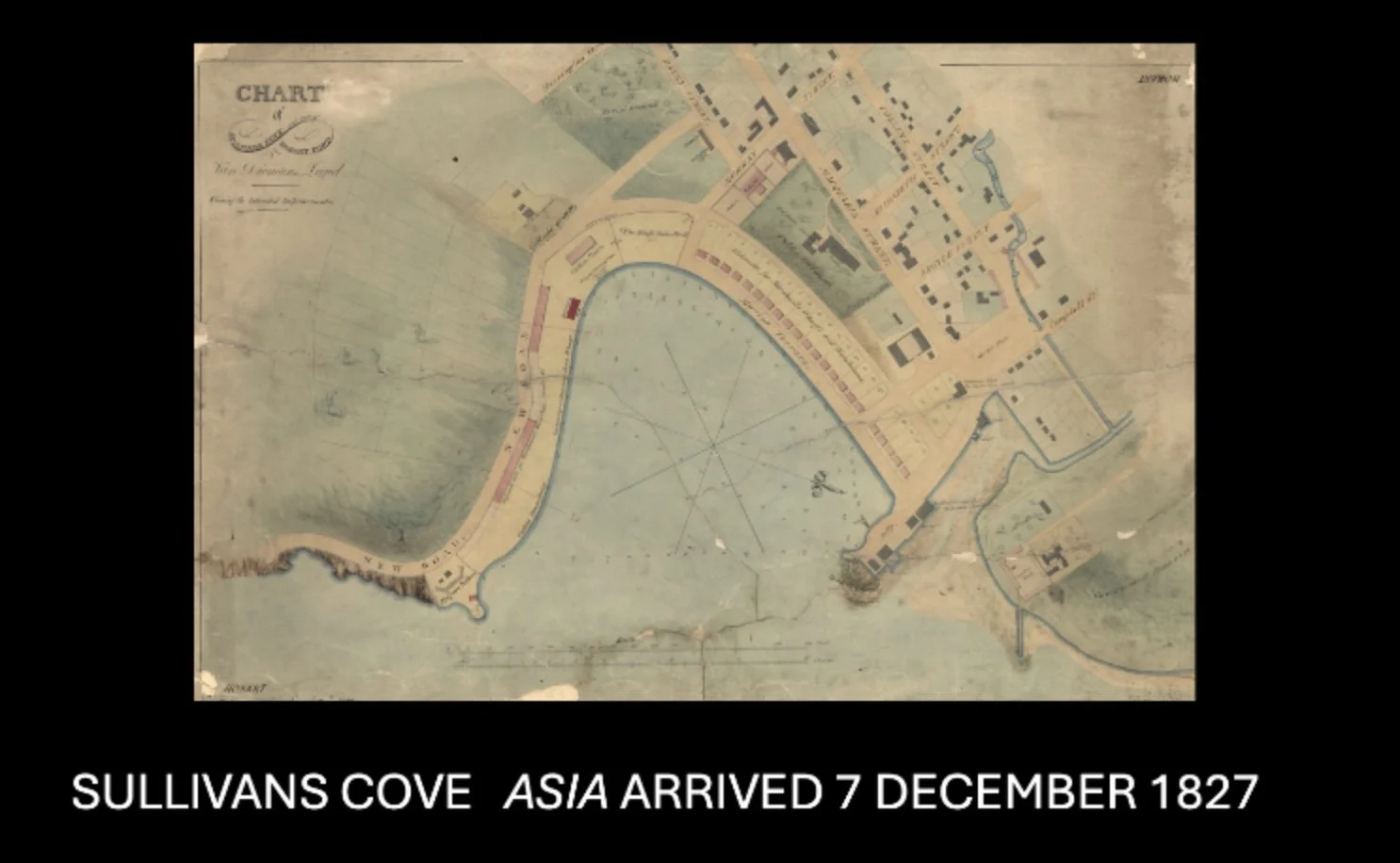
7TH DEC Entered D’Entrecasteaux Channel. Favourable wind.
The convicts were probably between decks in case of escape attempts, so they would not have seen the channel interspersed with islands broken by the most picturesque bays and coves, high mountains in the background, and here and there a cleared patch with a cottage and bark huts of a setter. Anchored in Sullivan’s Cove after 6 pm.
8th DECEMBER Mr Kelly the harbour master came on board at 5 am to secure a mooring. Captain Montagu, Deputy Colonial Secretary, and Mr Lakeland, Principal Superintendent of Convicts, mustered the prisoners and asked if their conditions and rations had been good, there were no complaints. They praised the appearance of the men.
Usually the convicts were ironed during the stay in port before disembarkation.
MON 10th TILL THURSDAY 13th DECEMBER - Government officers on board taking descriptions and examining the convicts who were found to be a very valuable set most of them being farming labouring men and much wanted in the colony. P.M. on Friday, they went on shore and the Guard also, giving us three cheers. Captn. Ager and the Doctor went on shore with them and the Governor paid them some high compliments on the health and cleanliness of the men they had brought out.
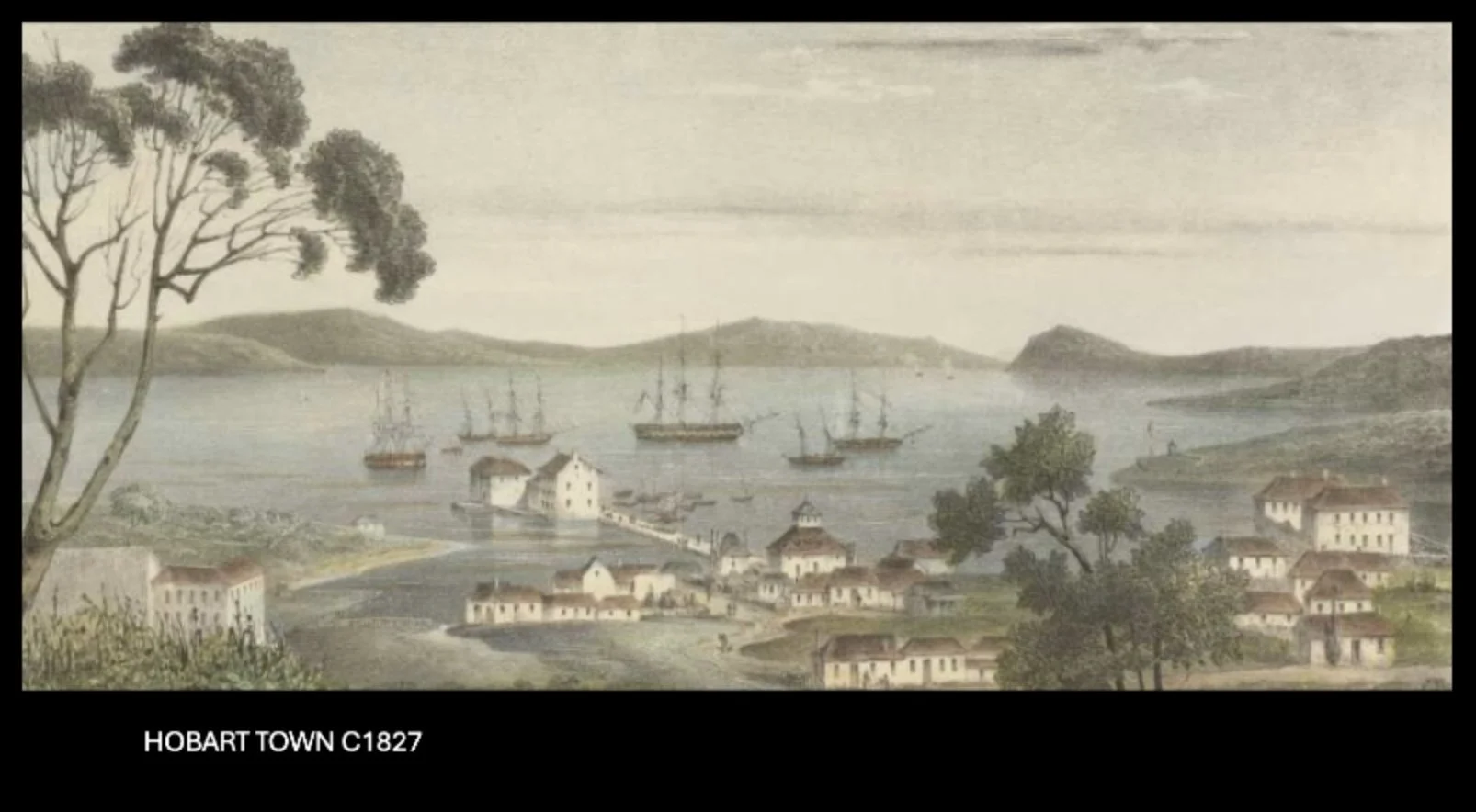
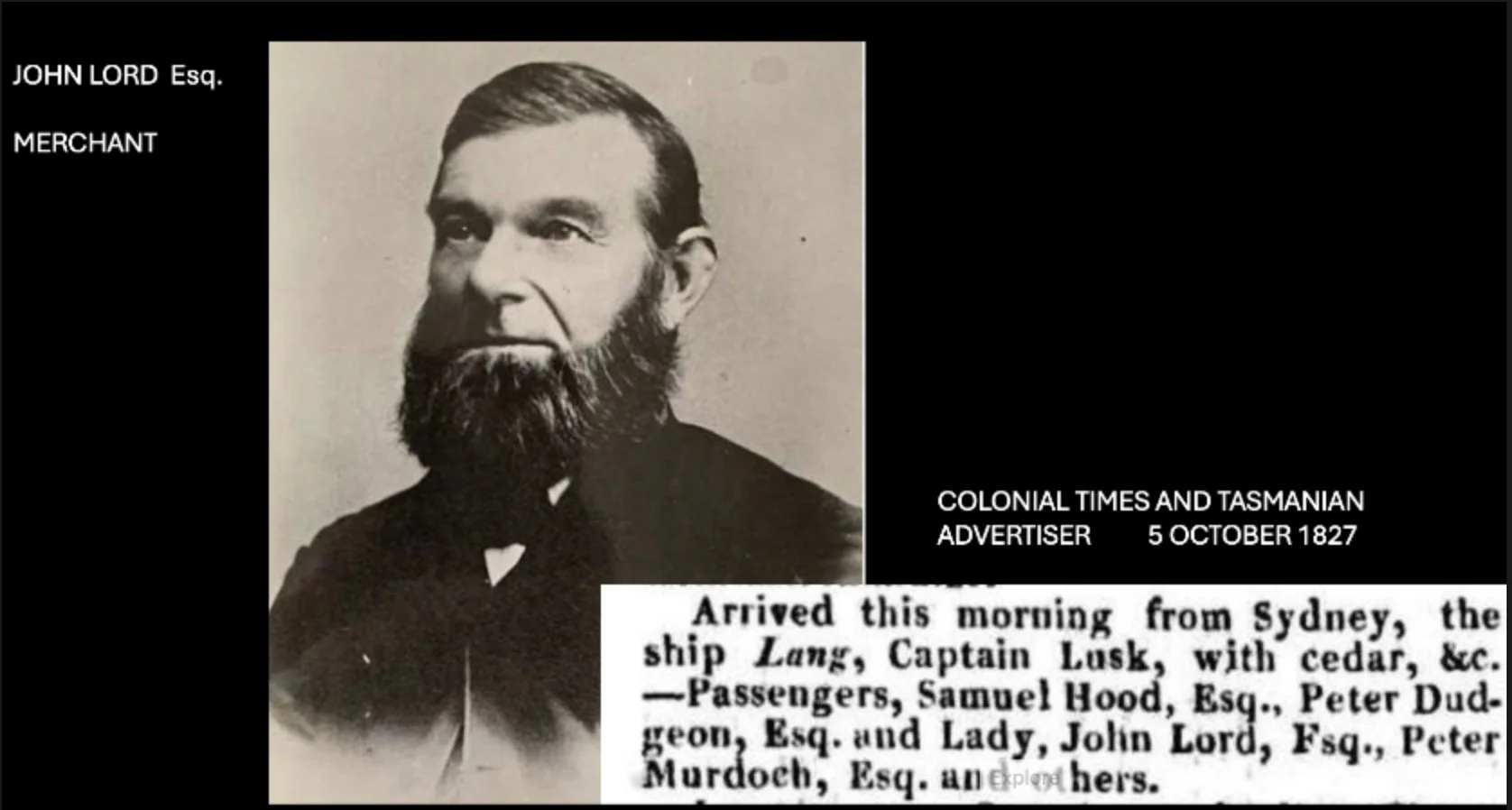
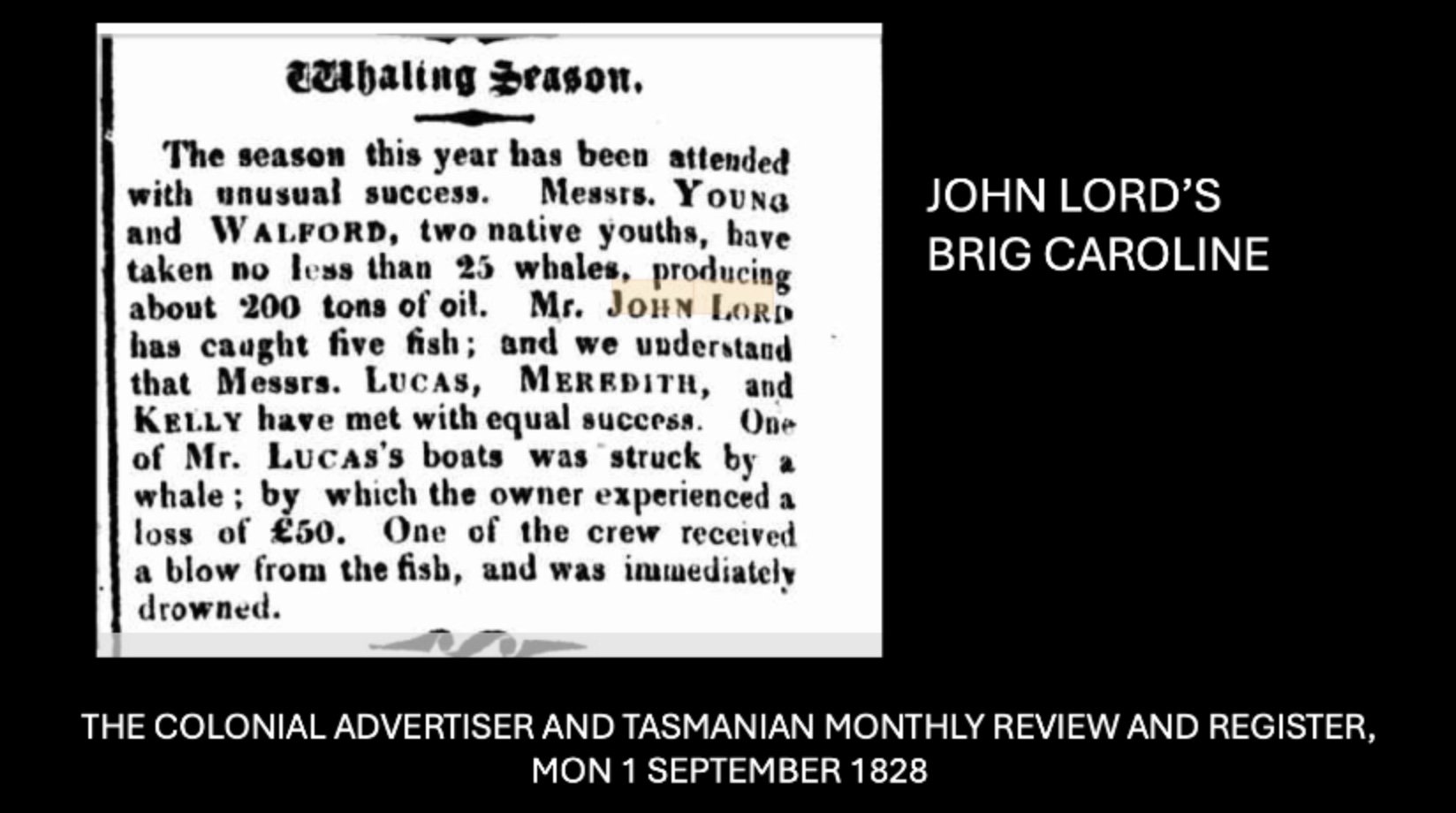
Tom was assigned to John Lord, a merchant who had arrived from India in October. He owned a schooner, Sarah Anne, and a brig, Caroline which he used for whaling. Whether Tom went to sea or spent his days shouldering bundles between schooner and warehouse, I do not know.
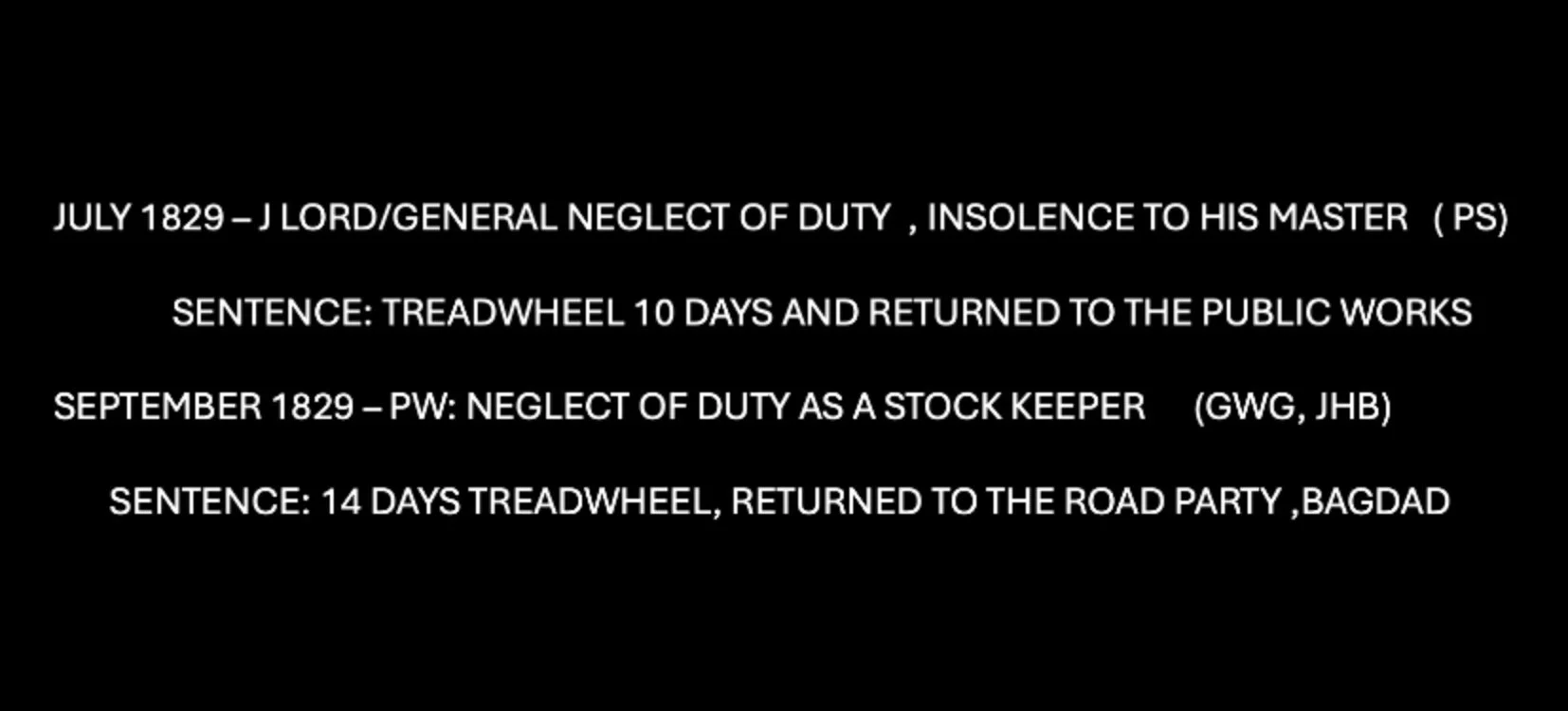
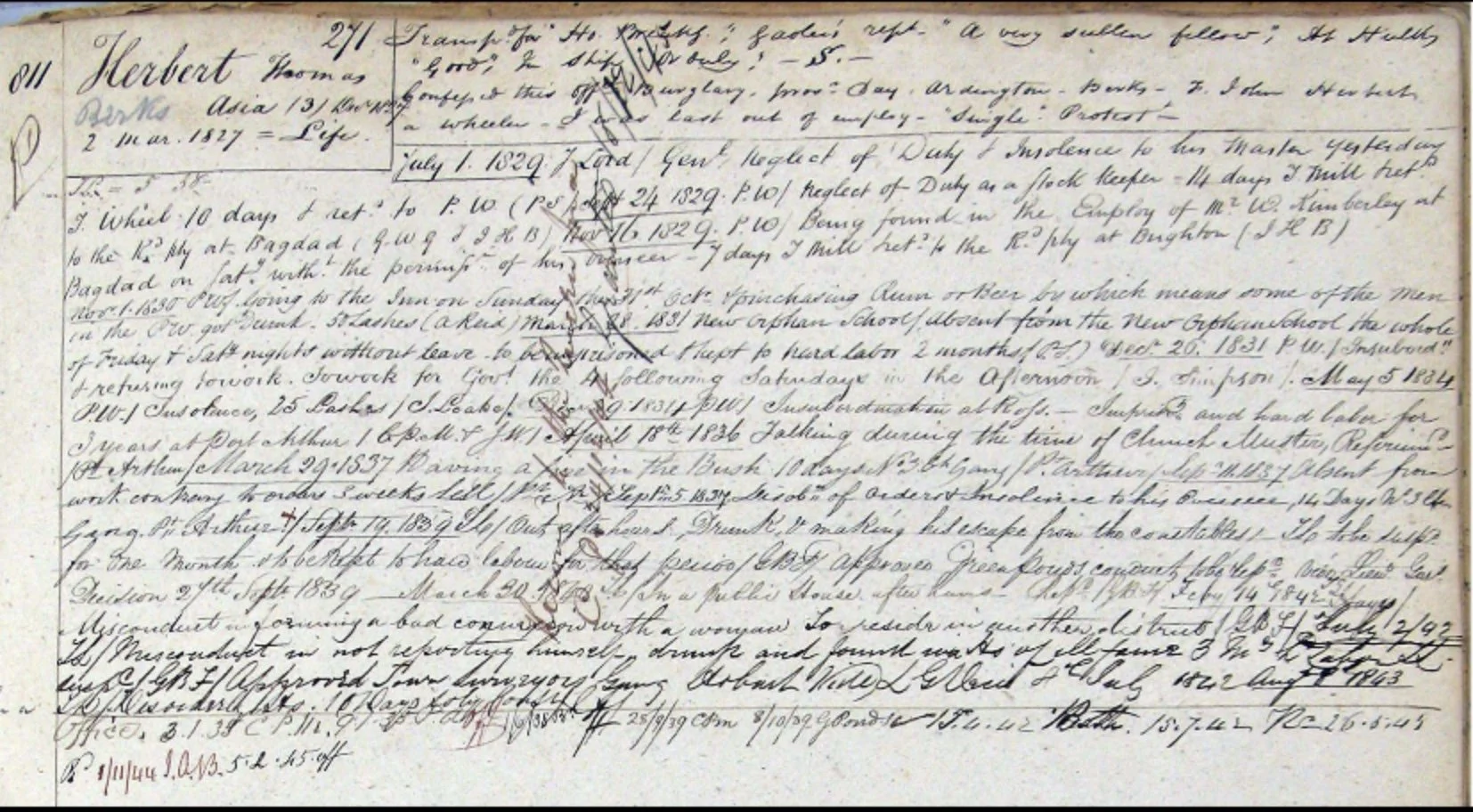
The convict records state Tom was tall for his times , 5’7” with brown hair and eyes. From the conduct record, his anger and growing defiance can be deduced from the listed misdemeanours and punishments they incurred. He seemed to have been well behaved for 18 months. Whatever the reason, in July 1829, John Lord took him before the Principal SUperintendent of Convicts, acting as magistrate, for general neglect of his duty and insolence to his master. For this he received 10 days on the treadwheel and removal to Richmond. There, he soon gave up his role as a stock keeper and for that received 14 days on the treadwheel and removal to the Bagdad road party. Although the treadwheel was a waste of good manpower, it did make the men fit - fit for the rock breaking work of a road gang. Roderic O’Connor, the Inspector of Roads, was a no-nonsense Irishman.
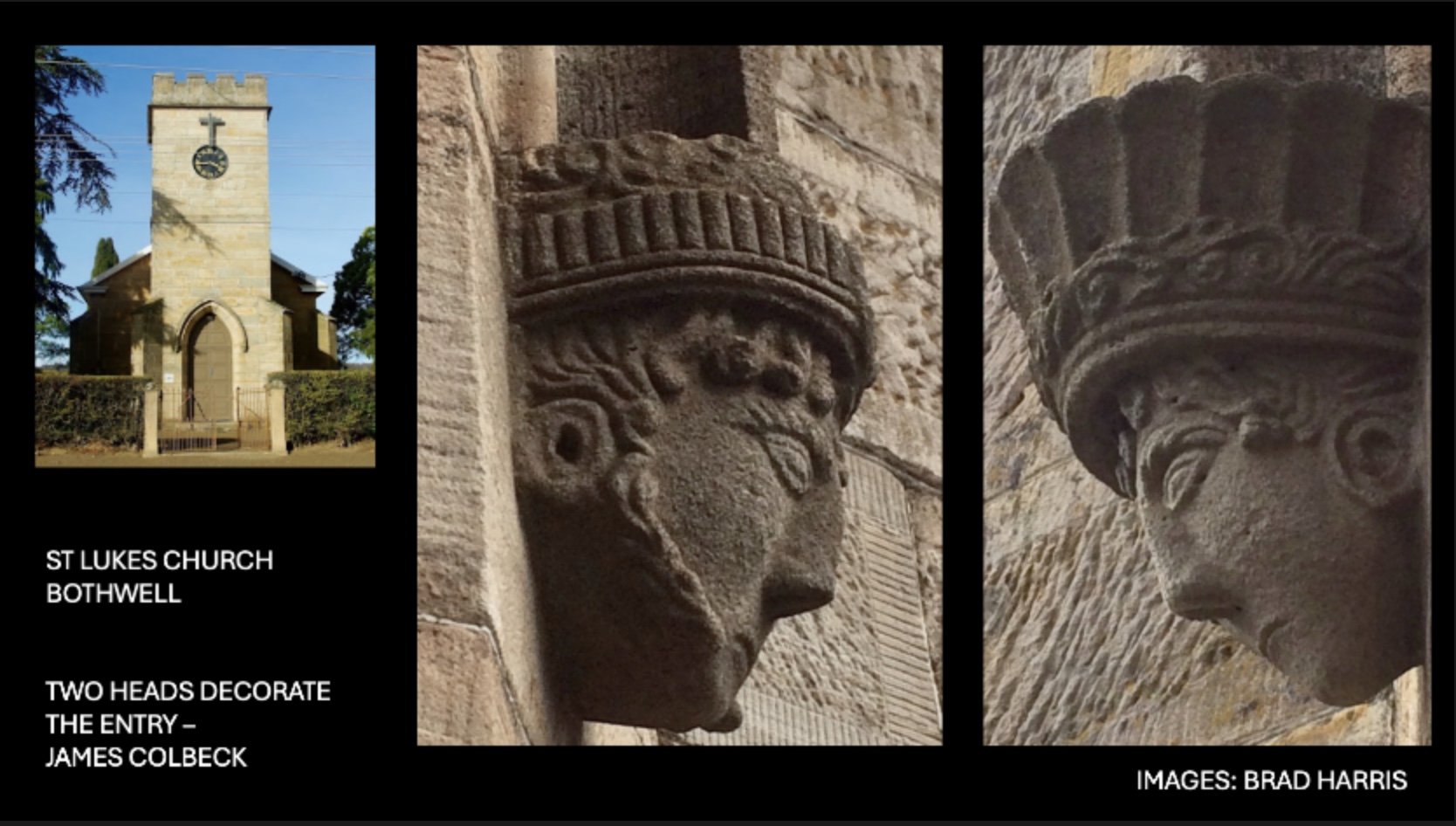
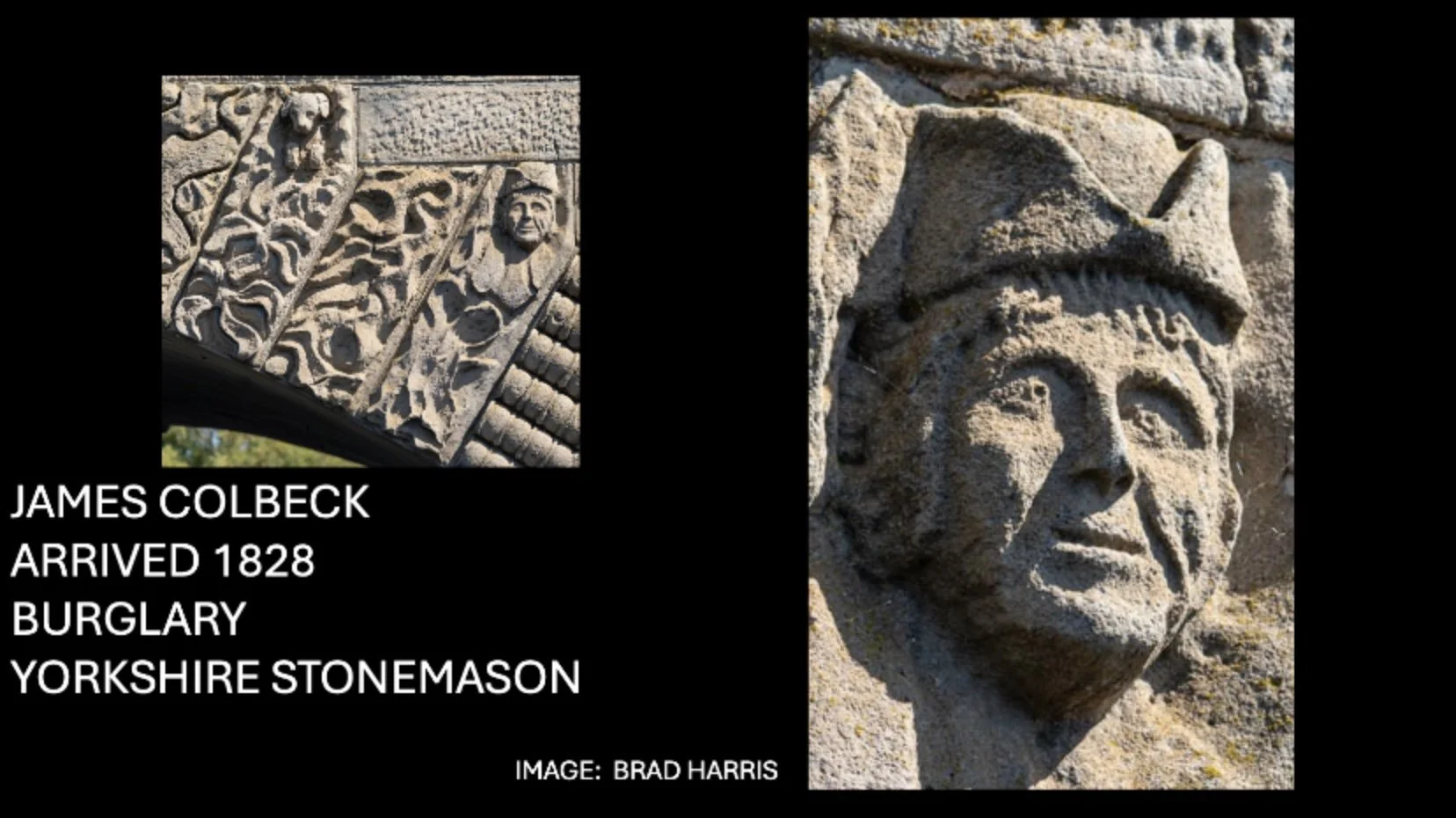
In May 1830, O’Connor sent his 5 best men to Bothwell where William Foord, builder, contractor, was building St Luke’s Church for the Presbyterian settlers. He had complained to the colonial secretary that the men assigned to him were useless. Hence the transfer of James Colbeck, stonemason, Frederick Edwards, stonemason, Tom Herbert, quarryman and two others. The two sculpted heads on either side the entry to the church are usually attributed to Daniel Herbert, but he was never in Bothwell. I think they are James Colbeck’s work and give us a clue as to who carved which portraits and caricatures on the Ross Bridge. They are in the style of Celtic stone heads found in Yorkshire where Colbeck came from: the ring ears, the prominently outlined almond shaped eyes, the simple nose, thin lipped straight mouth and small chin.
James Colbeck had whiskers, stated in his description list. Perhaps these are caricatures of himself and his wife Nancy, both sad and grim owing to their separation for life. He is laughing at himself ,wryly, and taking the mickey out of the Presbyterian self-appointed gentry who expect depictions of ancient Scottish noble folk.
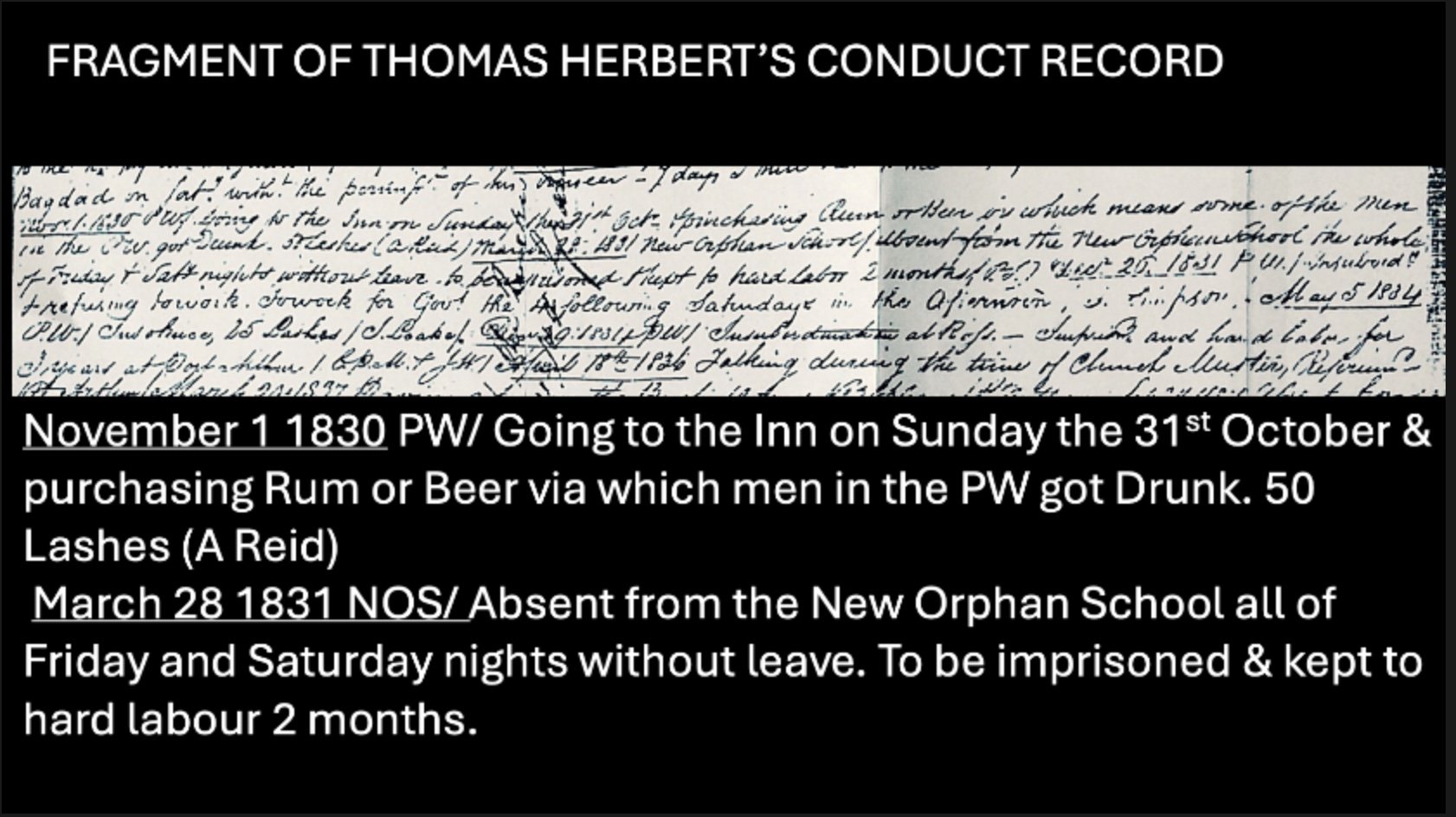
While in Bothwell, Tom was accused of going to the inn on Sunday and buying rum or beer by which the men of the public works got drunk. The magistrate was Alexander Reid, the Scot who had piously laid the foundation stone of the church on 5 June. He had just returned from the Black Line in which he had commanded a group of local men. I imagine he took out his frustration at the failure of the line on the hapless Tom who received 50 lashes. I expect he was the youngest of the gang and so was sent for the grog.
The church was finished in February 1831 and Captain D’Arcy Wentworth sent the 5 men back to John Lee Archer’s work site at the New Orphan School, even though O’Connor had expressly asked they be returned to Bagdad. He was ropable, especially after the five went AWOL for two days from their labour and were sentenced to two months imprisonment and hard labour, probably meaning the treadwheel, a punishment O’Connor deplored—better the men were working in irons. There is a flurry of letters between Archer, O’Connor, the principal superintendent of convicts and the colonial secretary; Archer mentions six men now imprisoned. It happened that Daniel Herbert was AWOL on one of the same days and sentenced to one month hard labour and imprisonment.
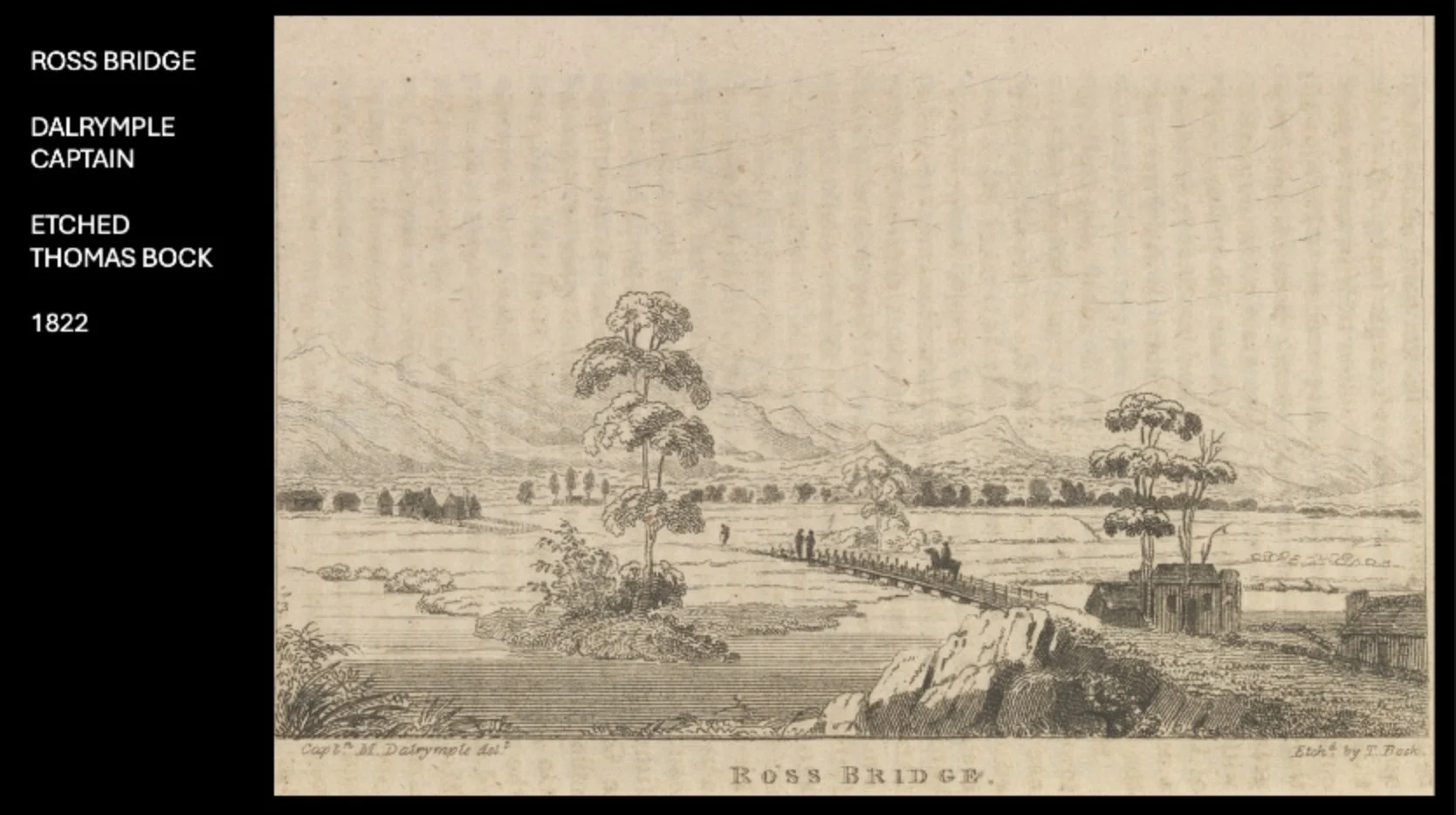
So, for a brief moment, Tom was reunited with his shipmate, Daniel Herbert in the company of his friend James Colbeck. Dan was returned to his work in Hobart Town. At the end of two months, O’Connor’s five were returned to WIlliam Foord’s gang of 40 men. He had been granted the contract to repair the old bridge at Ross and prepare material for the new bridge, as well as build accommodation for the convicts.
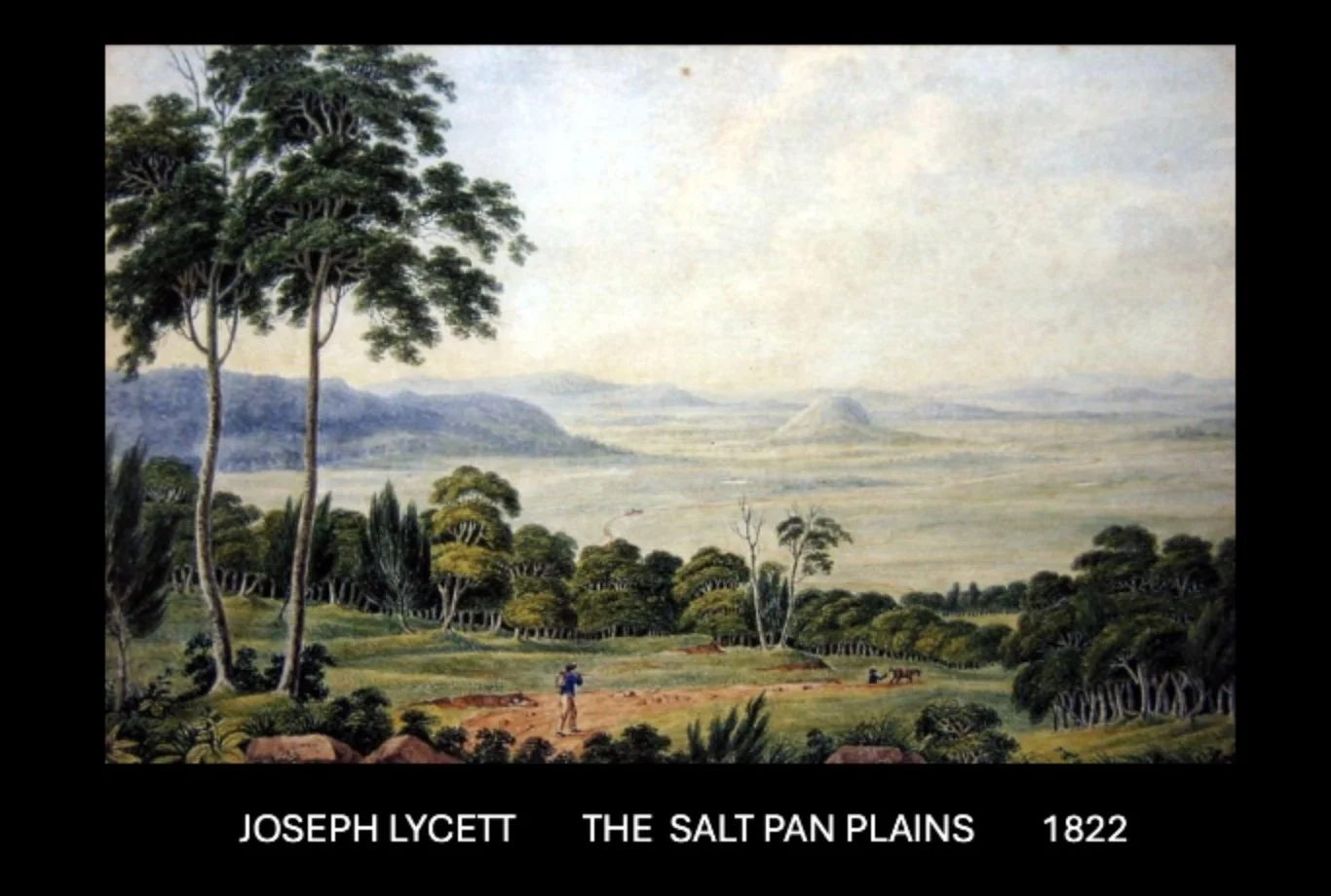
They were marched north, through the Salt Pan Plains, occupied since 1822 by William Kermode, a gruff Manxman who despised Lieutenant-Governor Arthur and who would give the convicts construction work in the years to come.
The gang arrived at Stocker’s Paddock on the west bank of the river in May 1833. One wonders whether they forded the river , or risked crossing by the tumble down bridge, or camped in the paddock though it was winter and floods affected the terrain; or crowded into the inn, Man of Ross, licensee being former soldier, Daniel O’Connor, later of St Peter’s Pass, to be owner of the Kenmore Arms.
But in 1831, there were no plans for the bridge, nor site, nor decision about the material from which it would be constructed. So the men set about quarrying stone, sawing timber in the tiers and making bricks — and Mr Foord’s brick house in Oatlands rose. So did the settlers’ homesteads and barns.
in March 1833, O’Connor visited the site and reported: […] I suggest that a good mechanic under the direction of the Civil Engineer would in my opinion be the cheapest and most expeditious matter […] and I would name Colbeck who is a stonemason in the party and who I conceive is fully competent to undertake it.
John Lee Archer visited the site in April and wrote that he had found a gang of 39 men, stonemasons, blacksmiths, carpenters, labourers, two brickmakers and a sawyer preparing timber in the tiers. I recommend that no work other than the preparation of the materials be undertaken until spring as any attempt to excavate the foundations would be futile. This was owing to floods. The delay happened every year. In Britain, the decorative work was done during winter, under cover, as the major construction could not be done in the rain and snow. Why not in Van Diemen’s Land, then? The traditional practices would have been transported with the men.
O’Connor and Archer compromised on the site and the materials: O’Connor’s preferred site, 300 yards downstream from the old bridge, was chosen because of the rock platform he had found there. Archer had preferred to build the new bridge alongside the old one, using it for a scaffold of sorts; but the riverbed there was of shifting alluvial soil. Archer’s choice of stone won over O’Connor’s preference for brick arches because a stone construction needed no mortar and the lime quarries were distant from the site and on granted land, so lime for mortar would be expensive. And the beauty of an arched stone bridge was incomparable.
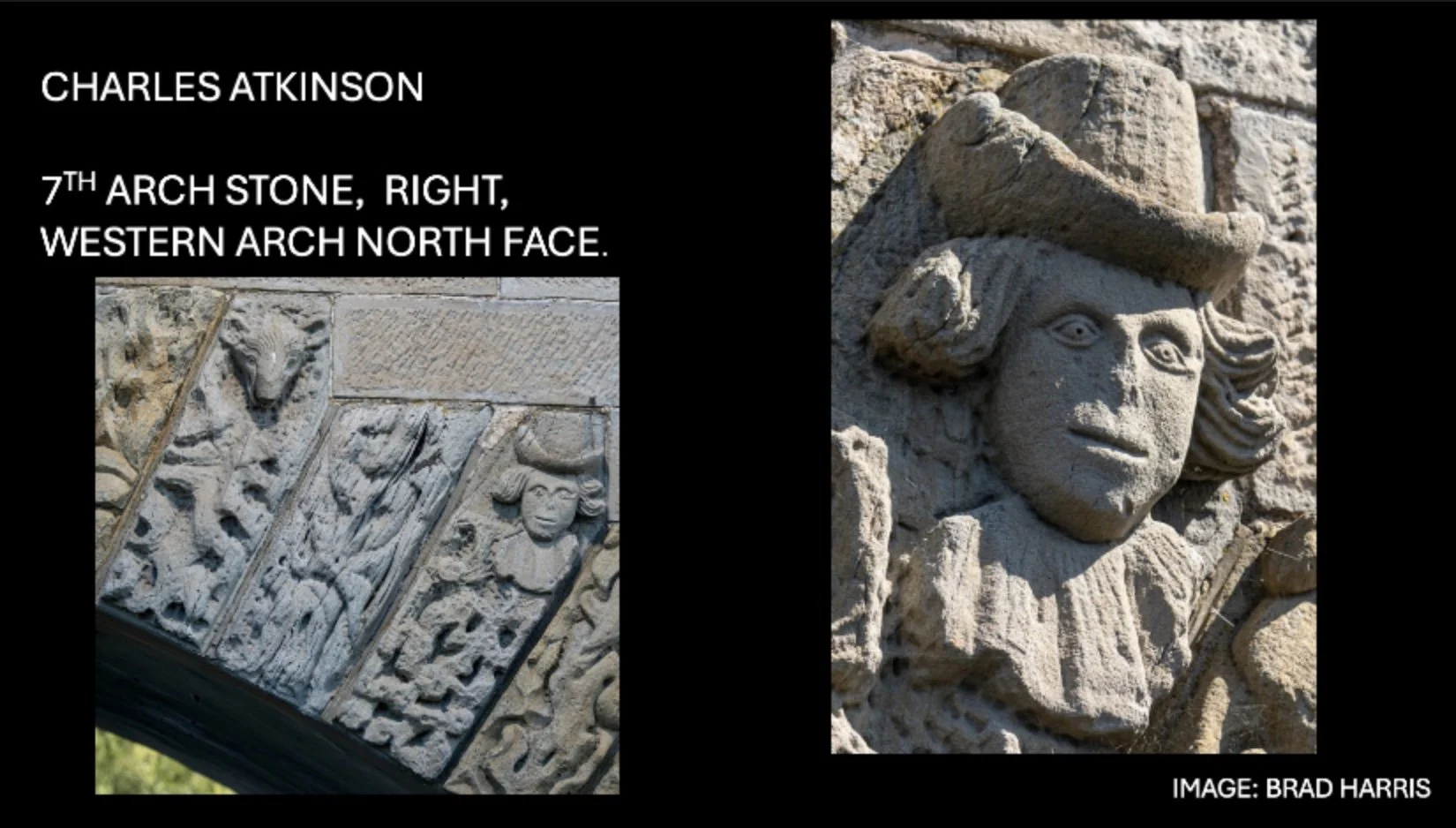
William Foord was dismissed for building his house with government labour and materials. After a series of incompetent acting superintendents, Charles Atkinson was appointed in November 1833. An architect, he had arrived in Hobart Town in May at the age of 27 or 28, and been employed in Archer’s office, drafting the plans of the Ross Bridge. He was a boastful young man and desirous of fame. He wrote to the colonial secretary:
I have made the bridge a mathematical problem. I have laid down lines for my guide, imagining in the vanity of my heart the Lieu. Governor thought no one else competent to undertake it ….
Yet Archer had been in the colony since 1827, designing and superintending the construction of every public building.
I think the convicts, Tom Herbert included, thought him a bore, as they paired him with a boar; the homonym cannot be a mistake.
Tom was probably a good stonemason by the time he arrived in Ross. He would have worked closely with James Colbeck in Bothwell, like an apprentice. I say this because, on gaining his conditional pardon, he became a stonemason and builder. So, it is likely he discussed with Colbeck the style and content of the sculptures— the artist’s intent.
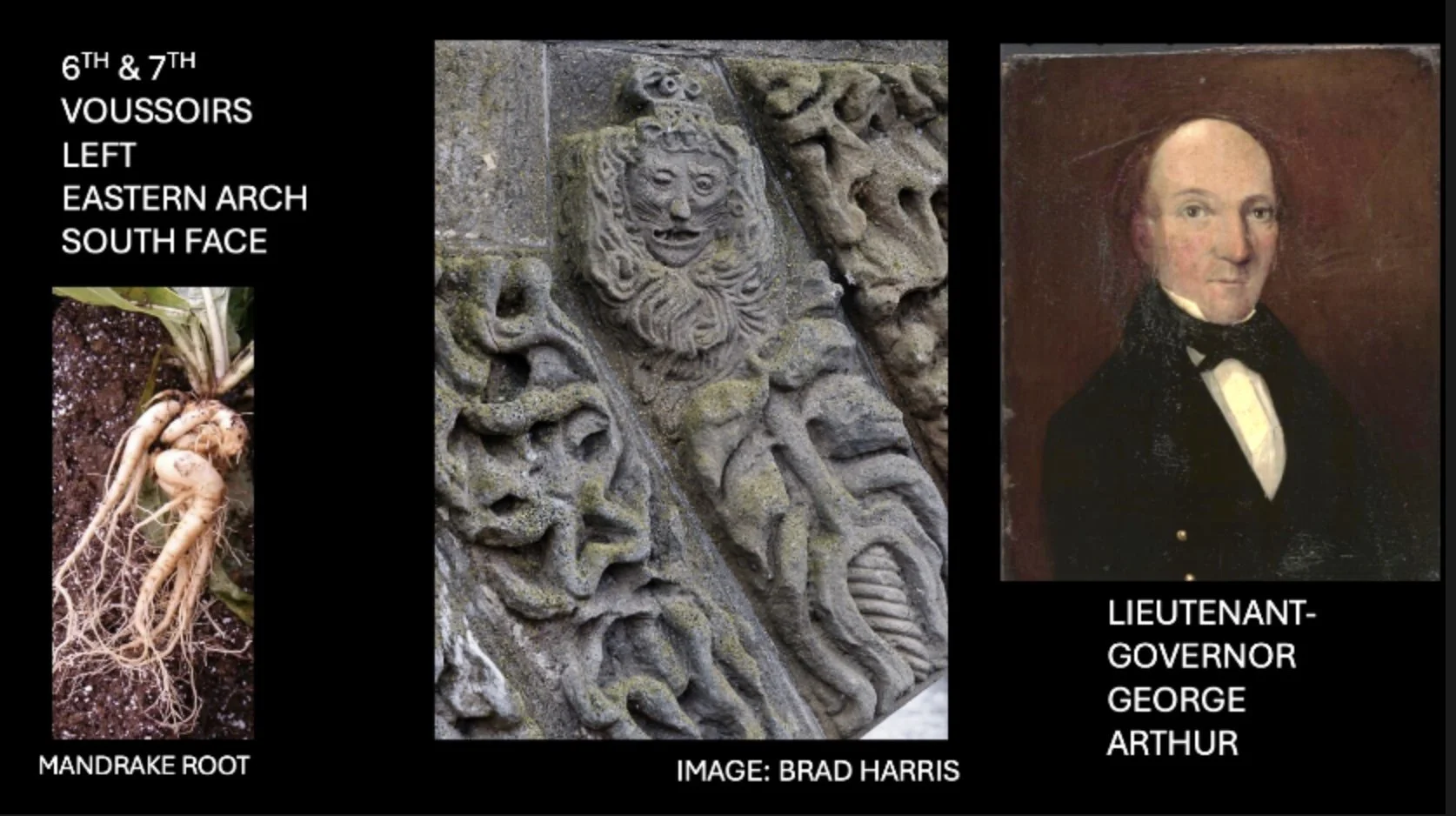
Their intent carved into the grotesque of their nemesis, Lieutenant-Governor George Arthur, is undeniable. The portrait — or is it a caricature — was painted by an unknown artist in 1833 (though it is attributed to Benjamin Duterreau). Note the bald head and the comb-over in the carving; the hooded eyes in both the carved face and the death’s head juxtaposed; the high cheekbones in skull, carving and portrait; the poor dentition of the lion and the unflattering shape of the mouth in the portrait. The crown and mane signify he is a representative of the British monarchy. His sceptre over his left shoulder is a thigh bone.
The anthropomorphic lion’s torso is a four-leafed plant with leg-like roots, suggesting it is a mandrake. The mandrake plant has a root described as an homunculus, or little man. It is used in magic. There is a legend: the mandrake grows under the gallows where the semen of the hanged man spills.
Together, the mandrake and death’s head refer to over two hundred executions performed in the penal colony while Arthur held sway.
The shape, which would seem an obscenity in our day, upon which the torso props is a two-in-one or androgyne, the ancient symbol of unity, harmony and balance. Therein lies the irony; the convicts knew, everyone knew, the colony was not in balance—men outnumbered women, mendicant outnumbered the moneyed.
Did the young Thomas have a wry, ironic humour? If so, it would have been tinged with angry defiance. When he was a free respectable citizen of Richmond, he became a member of the Congregationalist congregation and of the brotherhood of Oddfellows. I think both fraternities were known for their sternness rather than risible humour.
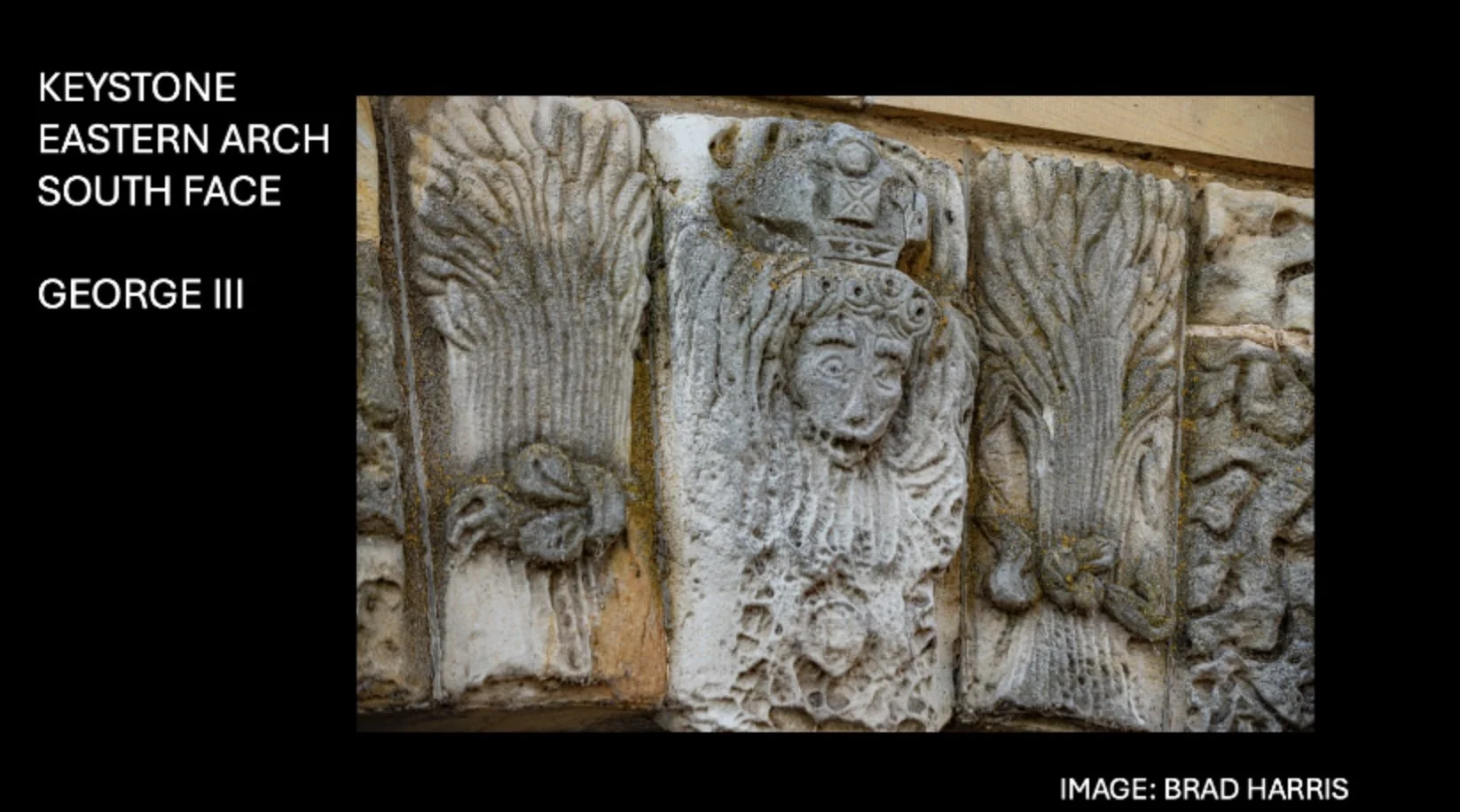
The keystone on the same south facing arch is George III, equally grotesque. His crown is top heavy, his mane extravagant like a wig, his eyes are wild and his teeth fanged. He seems to be wailing. His brow is deeply furrowed in vexation. As boys, the convicts would have known he was mad. He knows he has to hand on his realm to his dreadful sons. He wears the Order of the Garter. It’s motto, Honi Soit Qui Mal Y Pense means ‘shame be on him who thinks evil of it.’ The artist might be saying to a gawping viewer: “If you think evil of my work, shame be upon you because you think evil of the king.” Satire has two meanings.
He is flanked by sheaves of corn, representing the Corn Laws which were not repealed at the end of the Napoleonic wars. The aristocratic landowners who enclosed the common land so they could grow grains were represented in parliament by the Tories. George III was said to support that party. Failure to repeal the Corn Laws benefited the landed gentry and impoverished the poor; so they stole to feed their families, were caught, tried and transported.
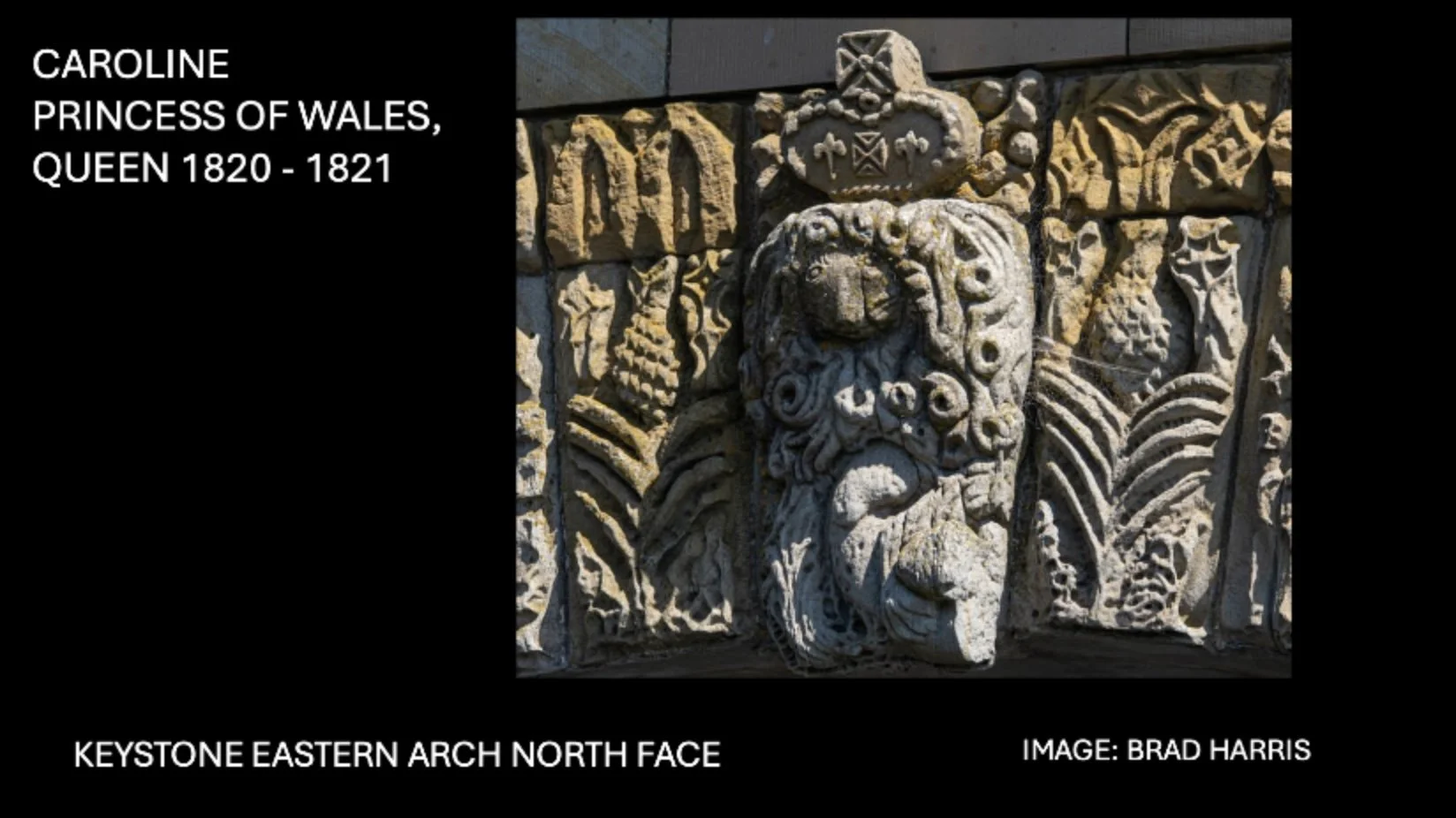
On the northern side of the same eastern arch, George’s daughter-in -aw is a grotesque rat. Caroline of Brunswick married George, the Prince of Wales, in 1795. They had Princess Charlotte then separated. The two households were so extravagant that Lord Liverpool, the Prime Minister, offered Caroline £35.000 to leave England. She accepted, abandoning her subjects to the crisis of the Napoleonic war and the domestic effects of industrialisation, and her daughter to George’s,— now the Prince Regent’s — household. A rat leaving a sinking ship. Her crown is decorated with the three ostrich feathers of the Prince of Wales, George III’s oldest son. She has an extravagant coiffure, beguiling eyes and a rat’s snout and mouth. Her left arm is crooked around her kitten, rejecting, not hugging, it. She is bare-breasted. The pineapples symbolise extravagance and waste. Their leaves are M and V— Mary the Virgin but she was not chaste — another example of irony.
She returned to England in 1820 on George III’s death because, now, she was the Queen of England. She was welcomed by the masses but rejected by her husband, newly George IV, and she was cruelly lampooned by the satirists. Note her curls, the ostrich feathers in her hat and her very low decolletage, as in the sculpture. George tried to divorce her through an act of parliament but it failed. On the coronation day, when Caroline arrived at Westminster Abbey, the doors were barred against her. She became sick, saying she had been poisoned and died within three weeks. Perhaps she had been poisoned like a rat.
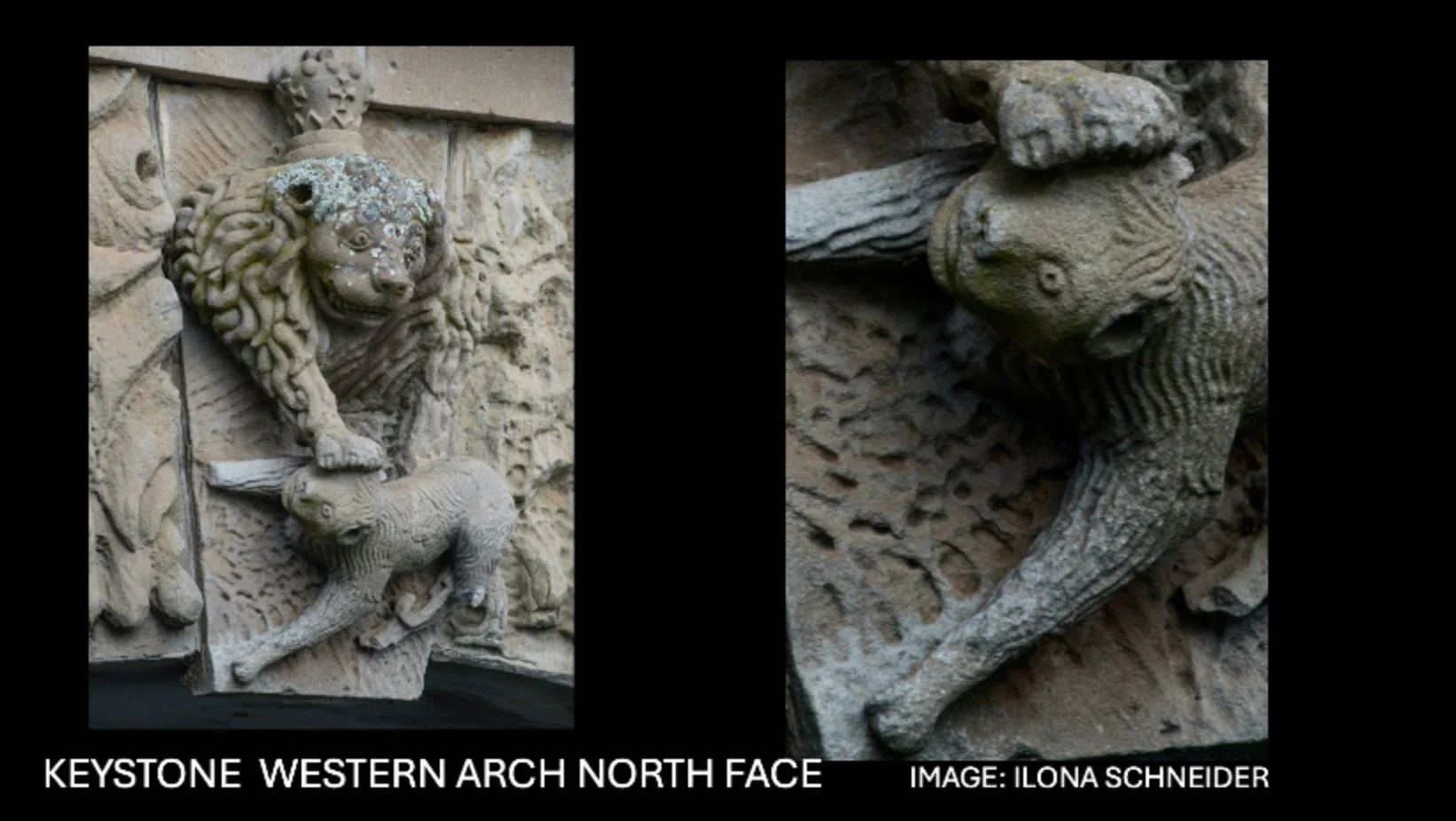
On the same northern facade but on the western arch, the keystone represents Caroline’s husband, George IV. This prominent sculpture in high relief is usually cited as the whole meaning of the bridge: the oppression of the people by the monarchy— one side of the satire. I think it has another meaning. The crown is toy-like; the mane is bizarrely flamboyant, the eyes are not tyrannical, the mouth has a silly grin and the teeth are puerile. He parodies the guardian lions that grace the doorways of grand institutions in Britain, the Asiatic lions. The female of the pair plays with her cubs; the male has his paw on an orb signifying sovereignty. Here, the convict artist has inverted that maxim: the king plays with the cub—he is womanish and weak. The cub’s tongue protrudes, perhaps in contempt or as a simpleton, the artist saying that the English are simpletons not to rise against this ridiculous man who is playing at being King.
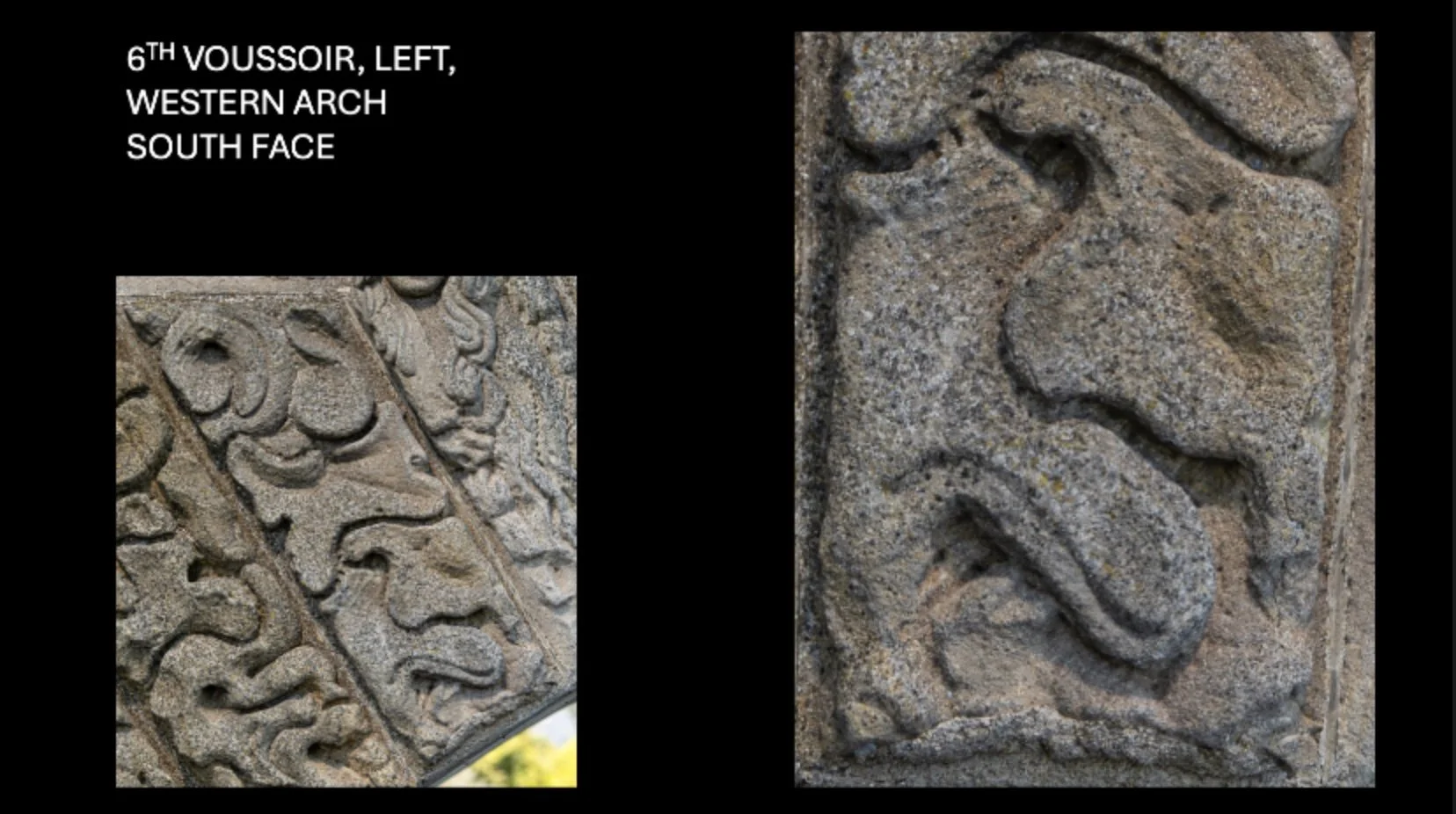
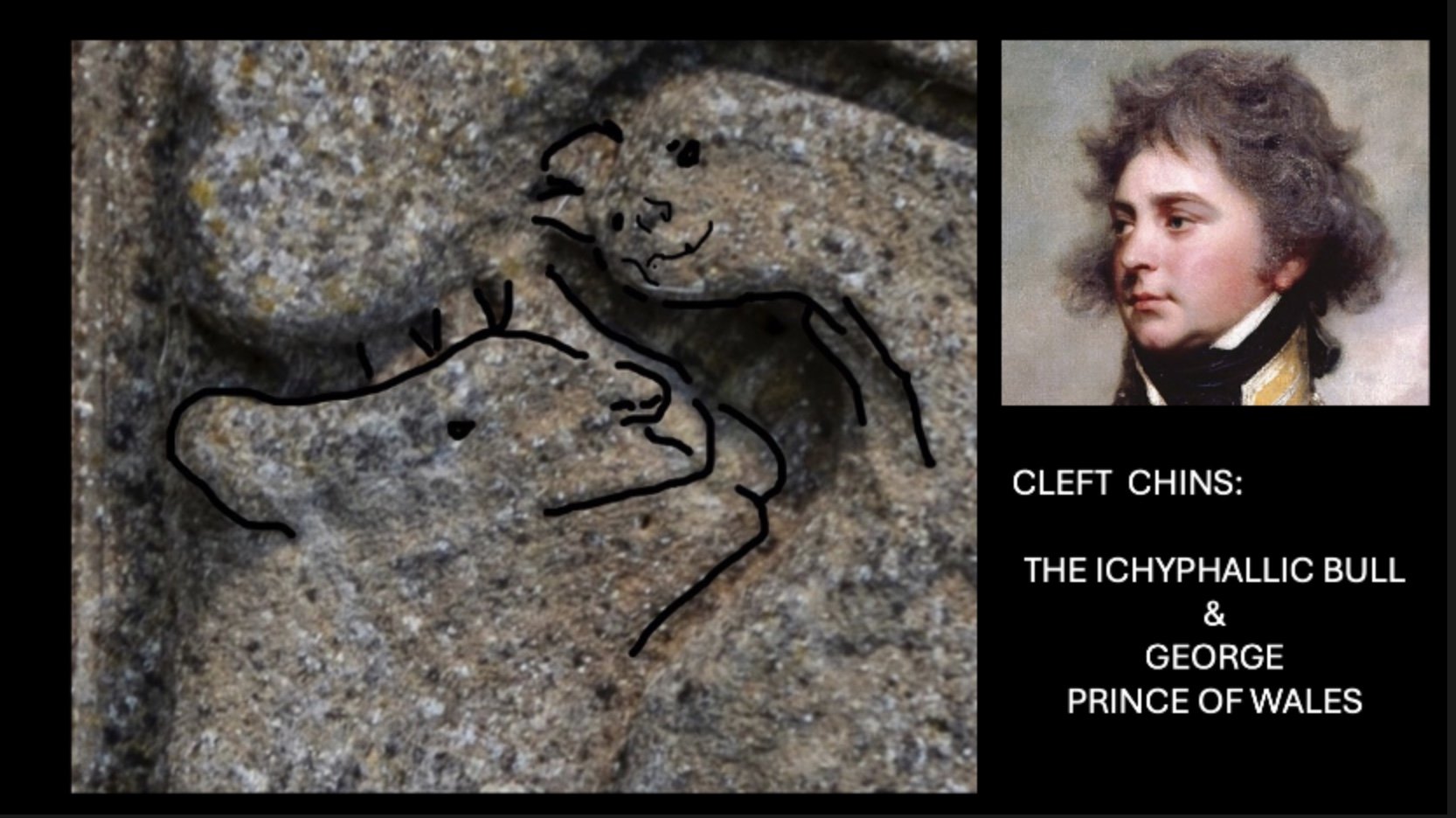
This stone must tell a story— the benevolent foliate mask overlooking the lovers’ scene is a symbol of Spring and regeneration. The lovers are a cow up a tree and a rampant bull with a heavy phallus he is holding up with his foreleg. There seem to be creatures lying on a branch at his feet, so perhaps he does not have his feet on the ground. On outlining the magnified image, I came to his cleft chin.
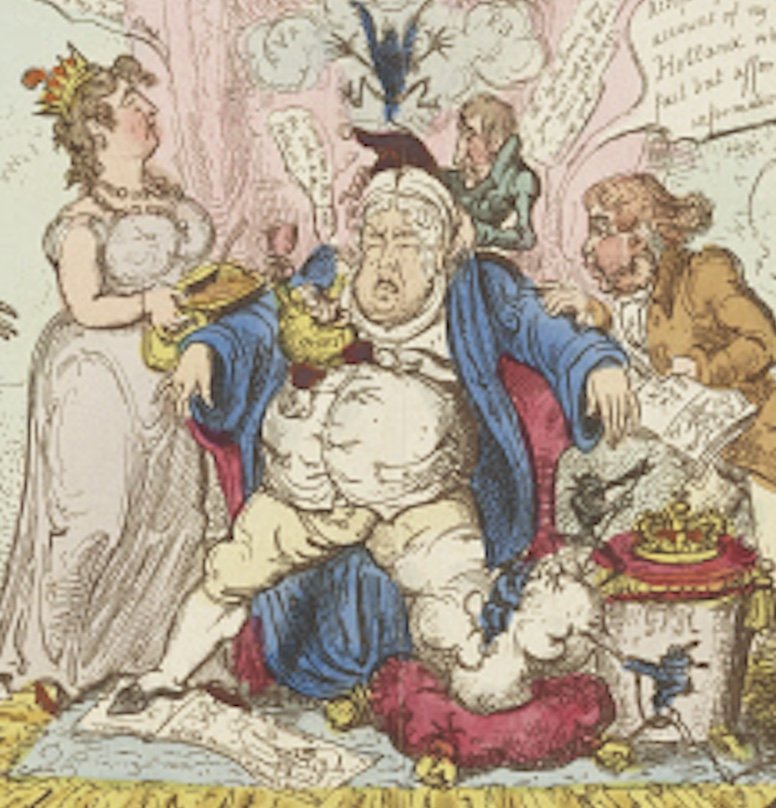
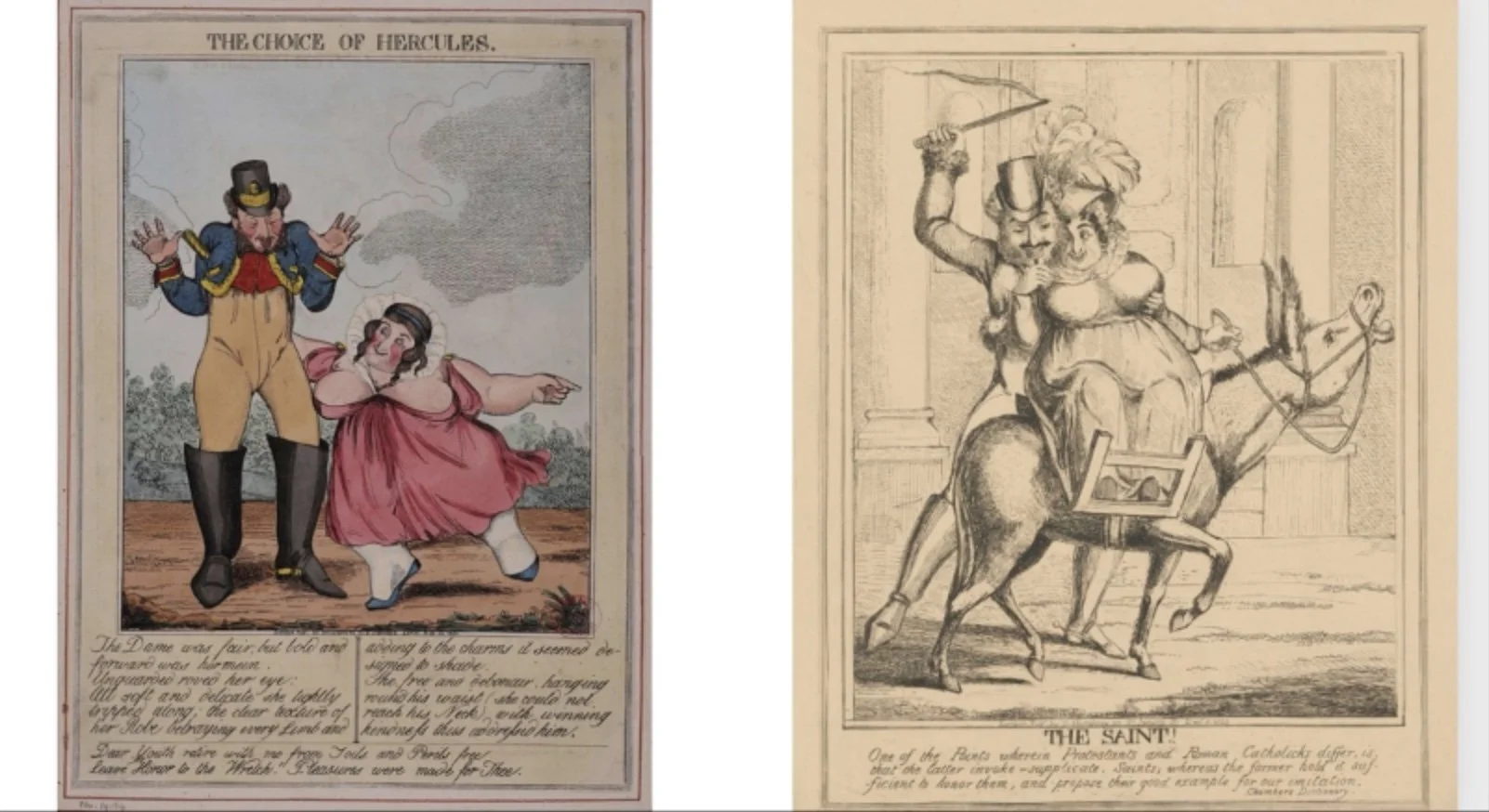
George the Prince Regent, had a cleft chin. He was a womaniser whose self-indulgences amused the satirist, George Cruikshank, who, in 1814, expressed them in a print of which this is a detail, A Levée Day.
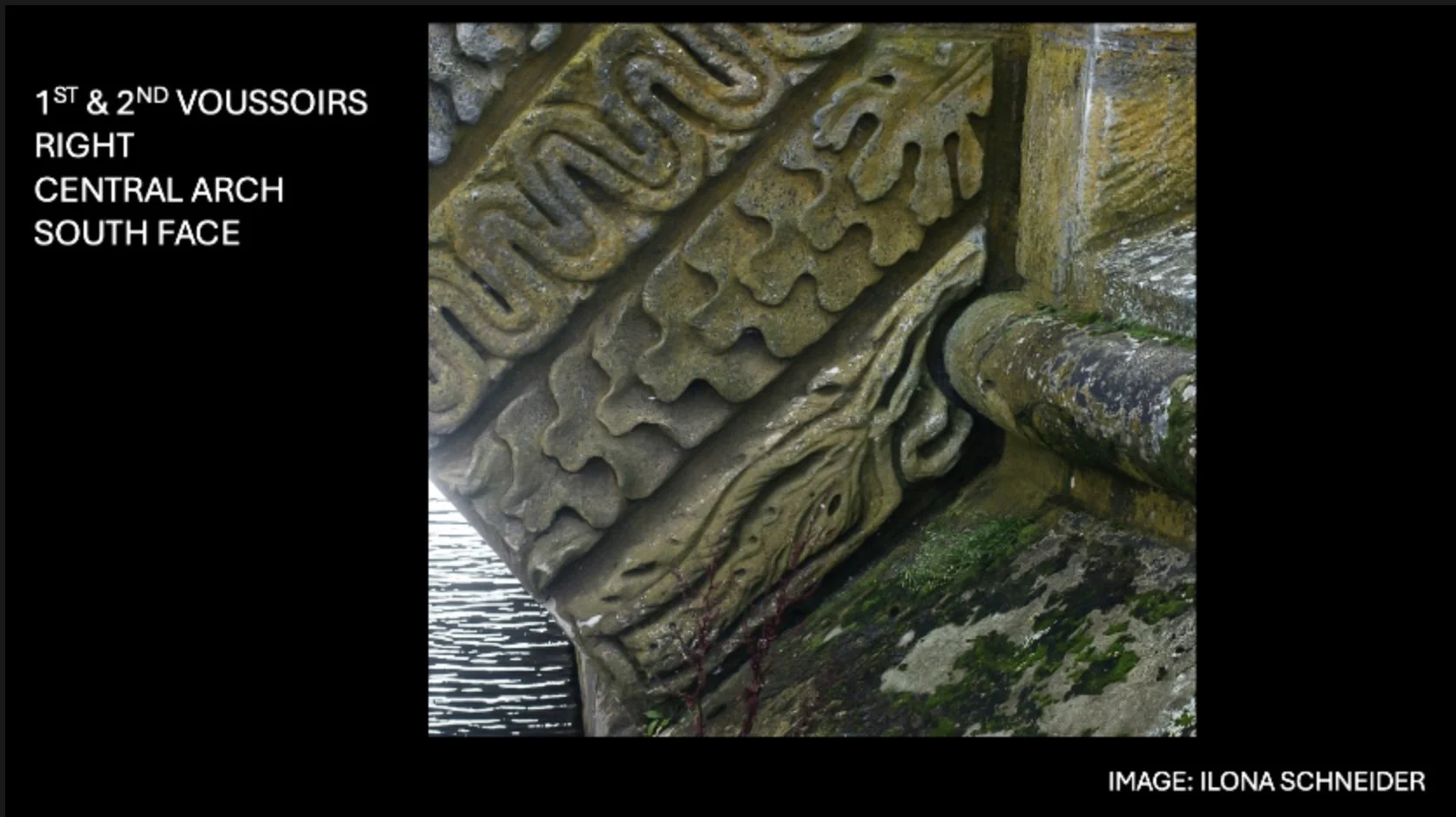
Tom Herbert was flogged twice for insolence. Hidden at water level in the central arch of the south face, is a cat o’ nine tails and a flayed spine, on top of which is a fig leaf disguised as a glove. In images of the day, the flagellator does not wear a glove. A fig leaf symbolises nakedness. Is the artist saying something about revealing the naked truth as a cat o’ nine tails reveals the deep flesh beneath the skin?
it was a punishable offence to publish critical works while a prisoner of the crown. It was risky, therefore, for the stone carver to display his contempt for the administration through this image of flogging.
No matter how resentful an exile was, nostalgia— homesickness — must have hovered over every day. When he was free, Tom wrote home to his favourite brother. Two nephews corresponded in 1897 between New Zealand and London — the son of the ‘favourite brother’ wrote that his father had received two letters but had not answered either of them. When the son suggested he advertise for his Uncle Tom, the father forbade him, also forbidding his mother to answer the letters. Tom was ‘better forgotten’. In this carving, a man is pouring water from a bucket on to two fish on the land. Underneath the earth is a mother and child. Colbeck had left his wife Nancy and son Henry on the other side of the world. It is as if he is pouring the water of life onto his family which is gasping for air.
Tom married Mary Quinn, née Collett in 1844, while they were still convicts. She had two children who took the Herbert name. Five more were born, all surviving childhood. They had a house in Richmond but farmed at South Arm for about ten years., though he was always described as ‘stonemason’ on his children’s birth records and on his own death record.
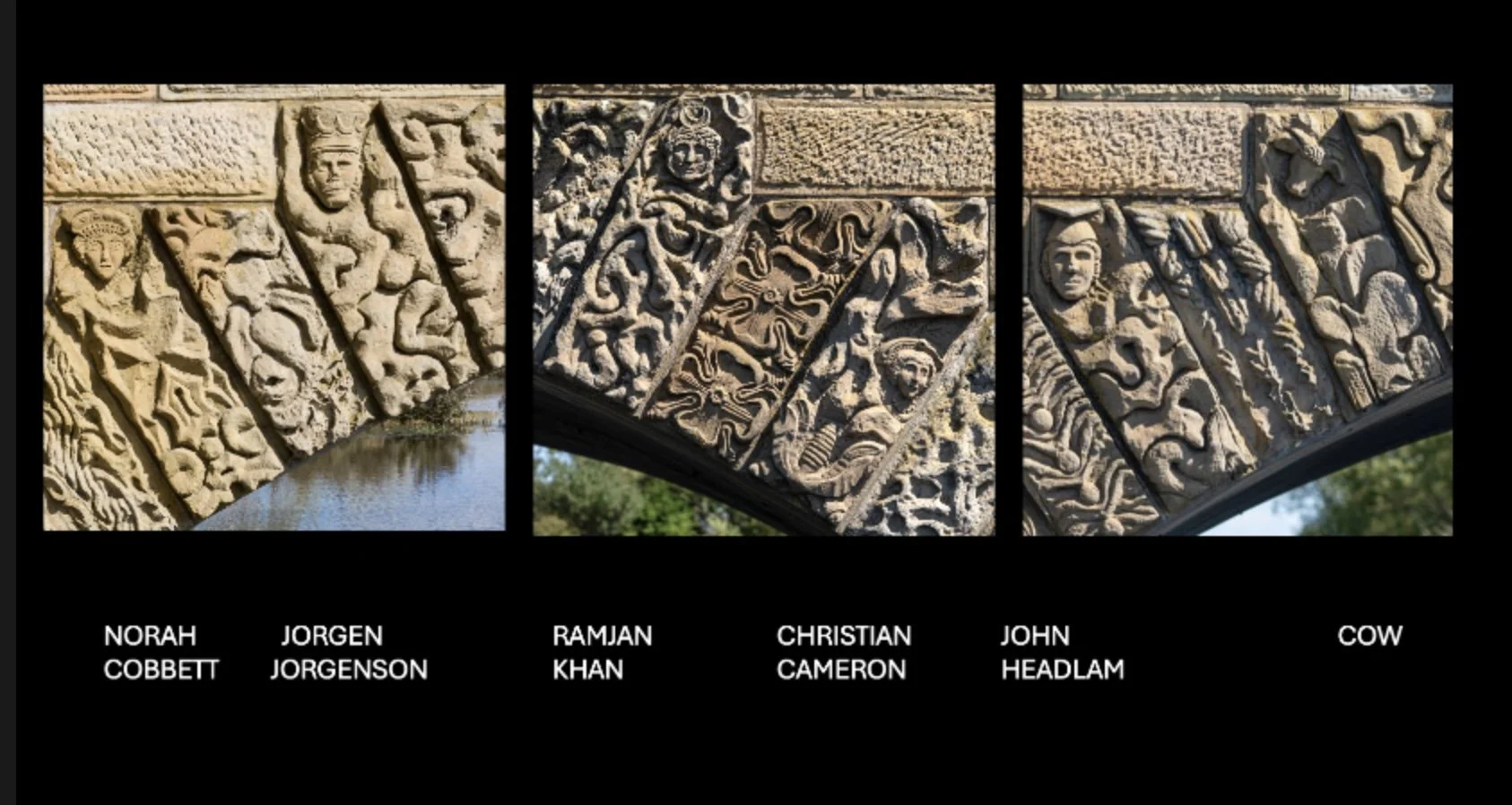
Tom would have known the characters in this tableau vivant, except perhaps for Christian Cameron who became Ramjan Khan’s wife in 1835.
Together they tell a story: On 1 September 1833 at dawn, Jorgen Jorgenson and six constables rode along the Macquarie to John Headlam’s house and shot two of Headlam’s valuable dogs. Jorgenson had been appointed special constable to investigate the clandestine building practices of the Ross Bridge work gang. But he was obstructed because everyone benefited from the convicts’ work and government’s materials. The village of Ross was thriving. He took his frustration out on John Headlam. He had been a teacher, hence the mortar board, until he returned to his granted land and became a farmer (hence the cow) and an innkeeper. He accused Headlam of harbouring convicts and not collaring his dogs. So he shot them. For his overzealousness, he became the subject of complaining letters from settlers to the Lieutenant- Governor, and he was forced to resign. Norah Cobbett was his drunken and feisty wife, here so blatantly exposed as a whore. Johnny Conn lived over the river from Headlam; he would have heard the shots and ridden over the ford at the bottom of his land to assist his neighbour in time of attack — from bushrangers.
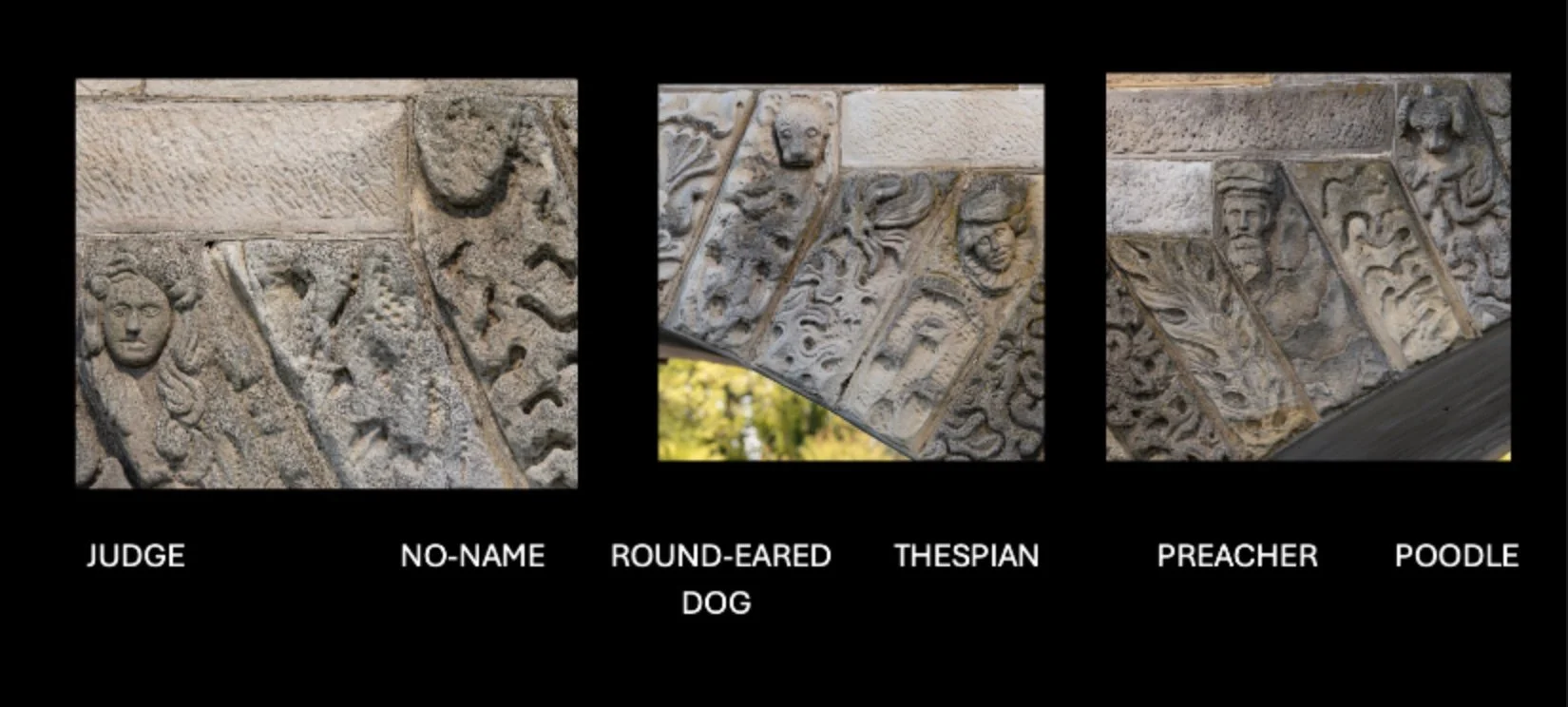
On the southern face, a similar tableau must tell a story too. A judge and a faceless, shamed convict in the dock; a round-eared dog which must be a French bulldog because of its ears, and a thespian, doffing his hat, farewelling his friend the exile, perhaps. The bearded Yorkshire preacher juxtaposed to hellfire’s flames is paired with another French dog, a poodle. The dogs represent francophiles or republican reformists and radicals.
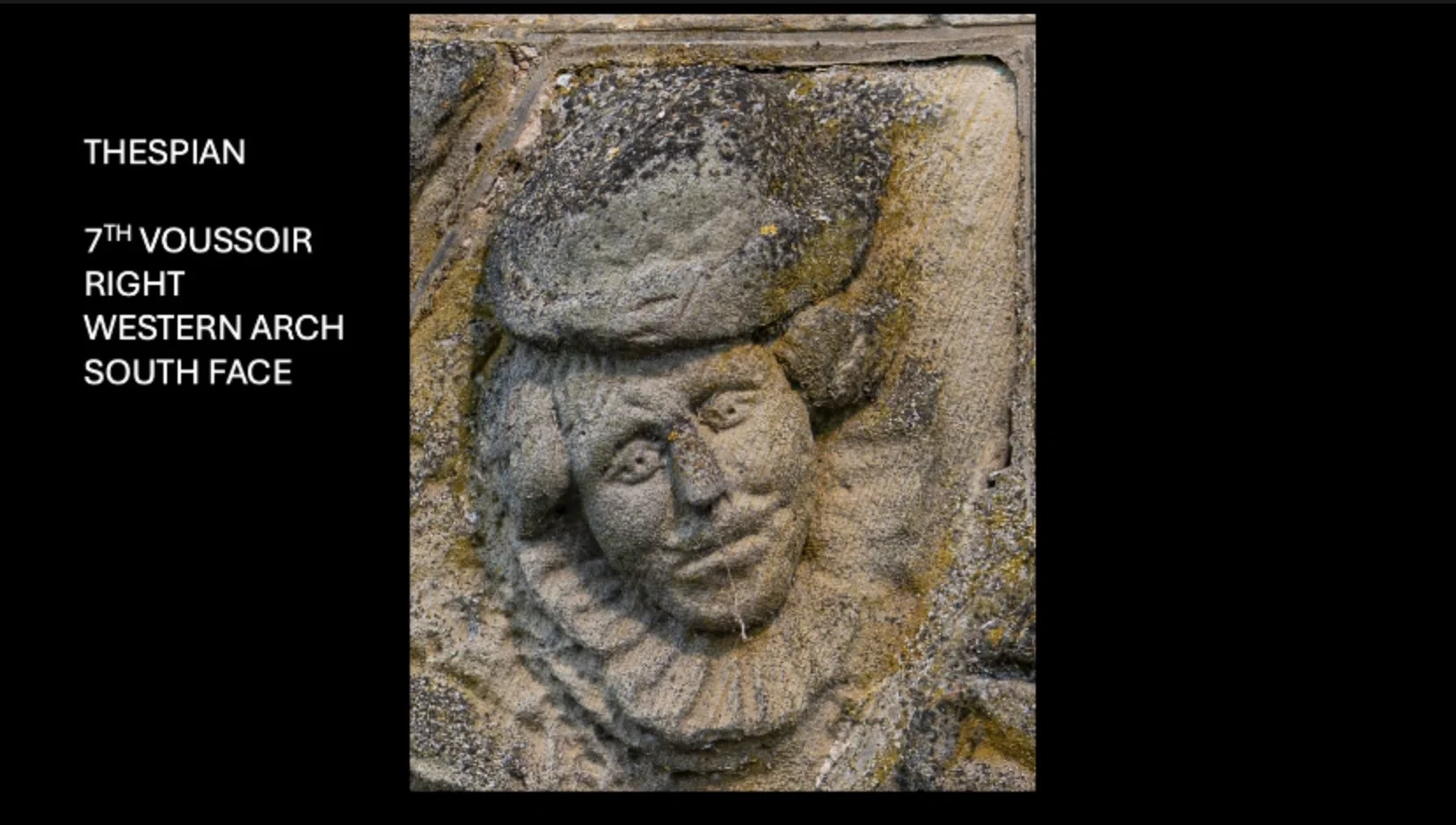
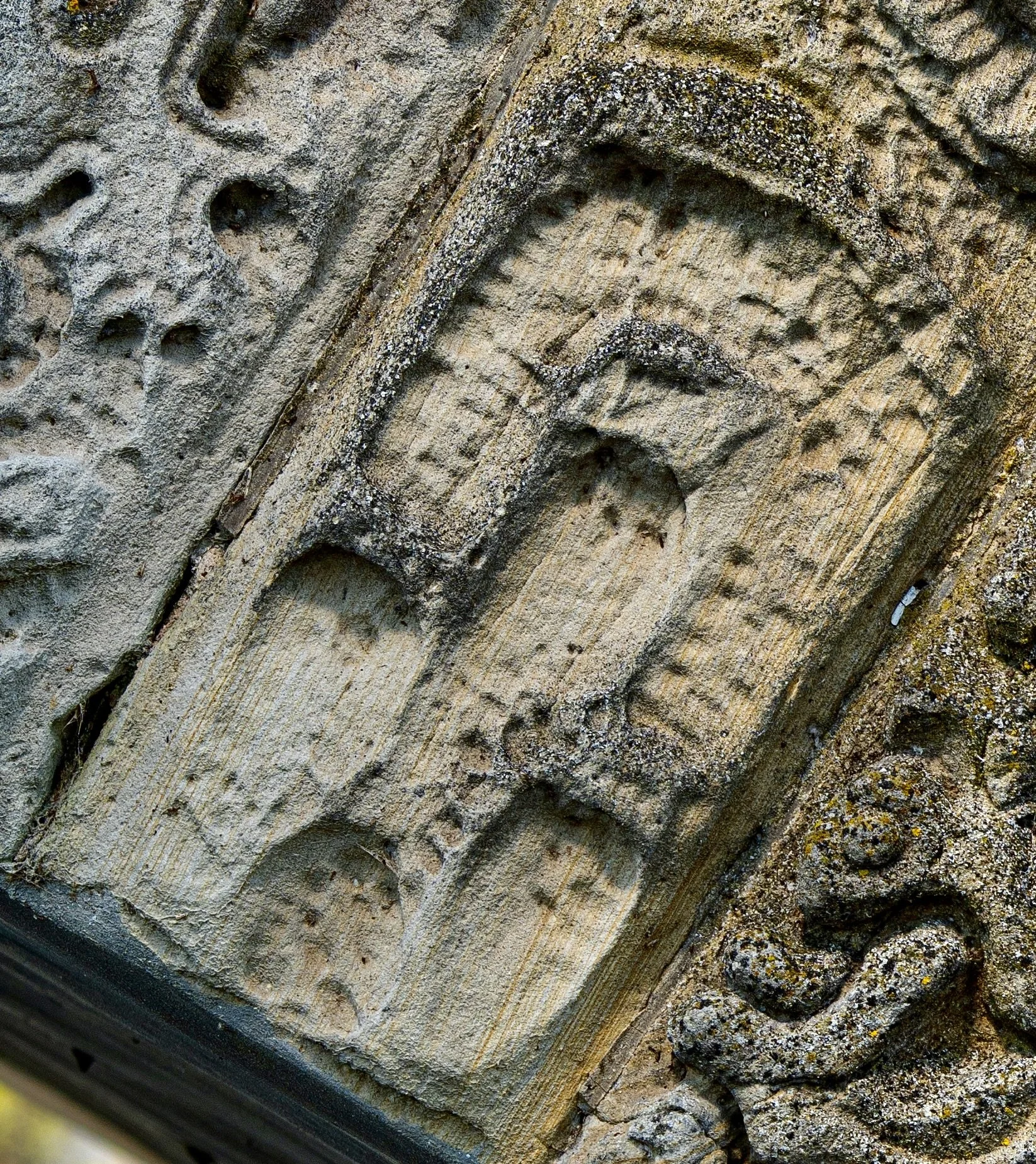
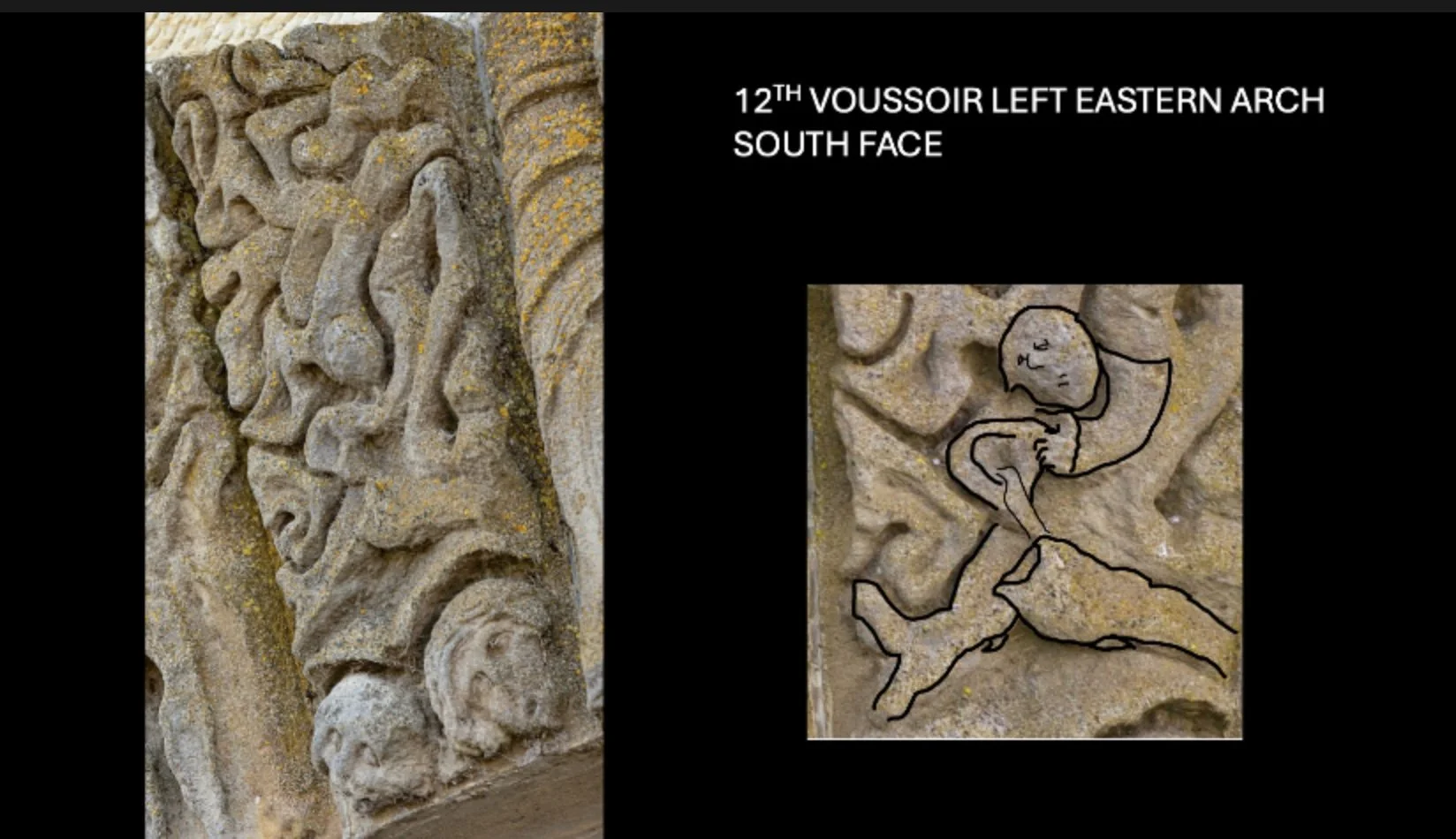
The Thespian seems to embody two concepts: the judge, the accused and sentenced, and the farewelling friend, and something about the strange gouged form below the face. It appears to be two penises joined. Why they are not in relief can only be conjectured. A similar shape below James Colbeck is erect, not flaccid, also gouged and seems funny, a joke. But not so with the Thespian. Is the actor’s ruff a sign of an actor on stage, or does it tell us that every day, this man had to play a part in society that was not his true self? And is the faceless man his lover? The expression of his eyes and lips, the slight frown and the farewell gesture imply so.
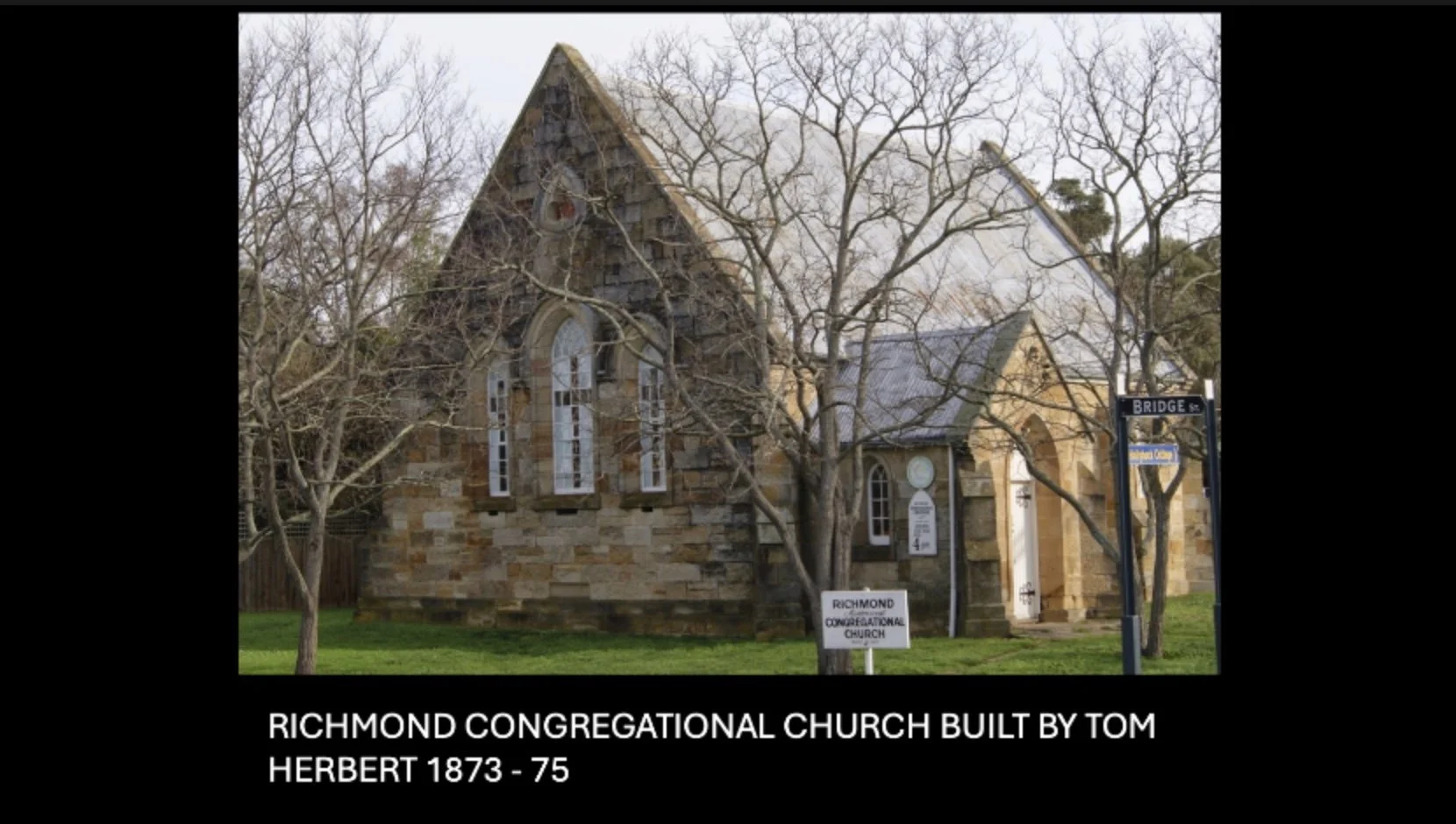
In the years just before he died, Tom built the Congregational Chapel in Richmond. It still stands but not as a church. He fell from a scaffold and died of pneumonia after fracturing his scapula in 1876.
In
Memory of
Thomas Herbert
Died 26 May 1876
Aged 67 years
Tried by the plummet and the square
By golden rule here lies
One who on earth had builded up
A mansion in the skies
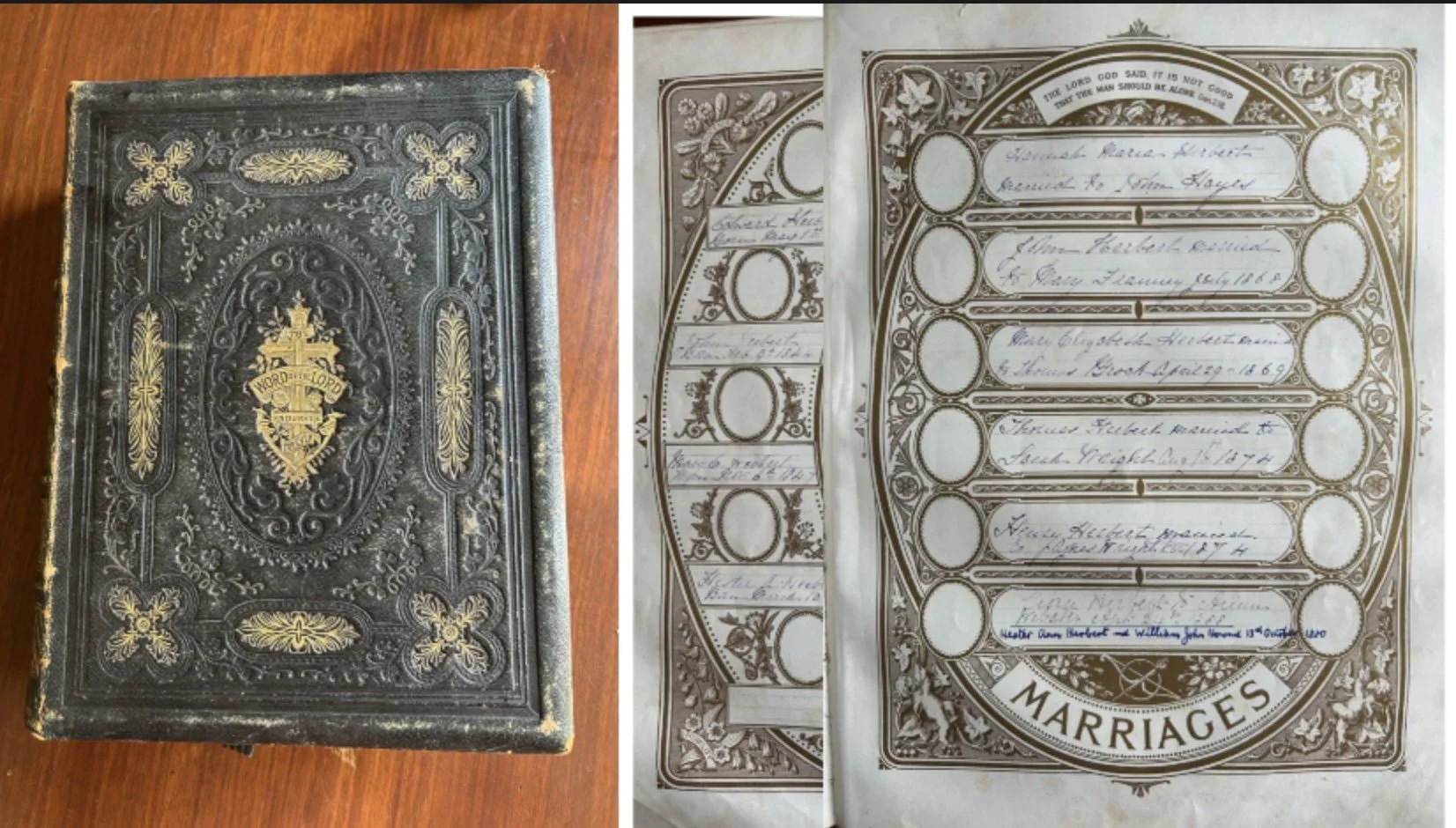
I own his Bible, which is of the Baptist persuasion. Within are lists of his children’s births and marriages .
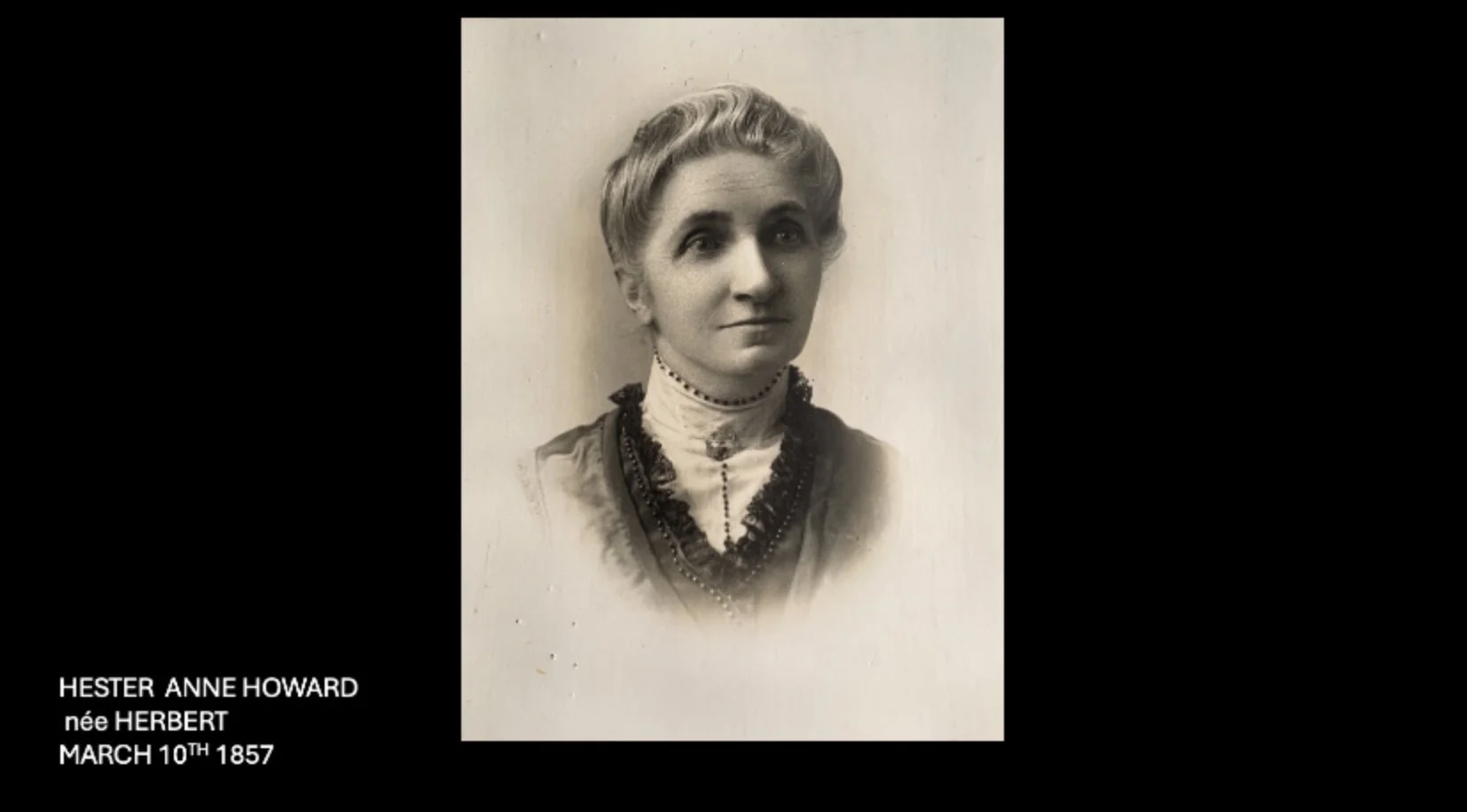
Hester Anne was his youngest child, my grandmother’s mother. She bore seven children, one of whom, with a science degree, became a Rhodes Scholar; another a lawyer who practised in Melbourne. Their sisters were accomplished women, although they did not benefit from a grammar school education.
I wish I had met him to thank him for his endurance, his stoicism, and to ask if the success of his descendants is some consolation for his hardships, for being “best forgotten” … we who have had no reason to be defiant, insolent and insubordinate.
Later, Atkinson describes his method of encouraging the men to work by “the principle of task work” - permitting them to work for themselves out of government hours. On December 26th 1831, Tom was found to have been insolent and refusing to work. His sentence was “to work for the Government the 4 following Saturdays in the afternoon”, meaning he lost the chance to earn money working for himself by task work.
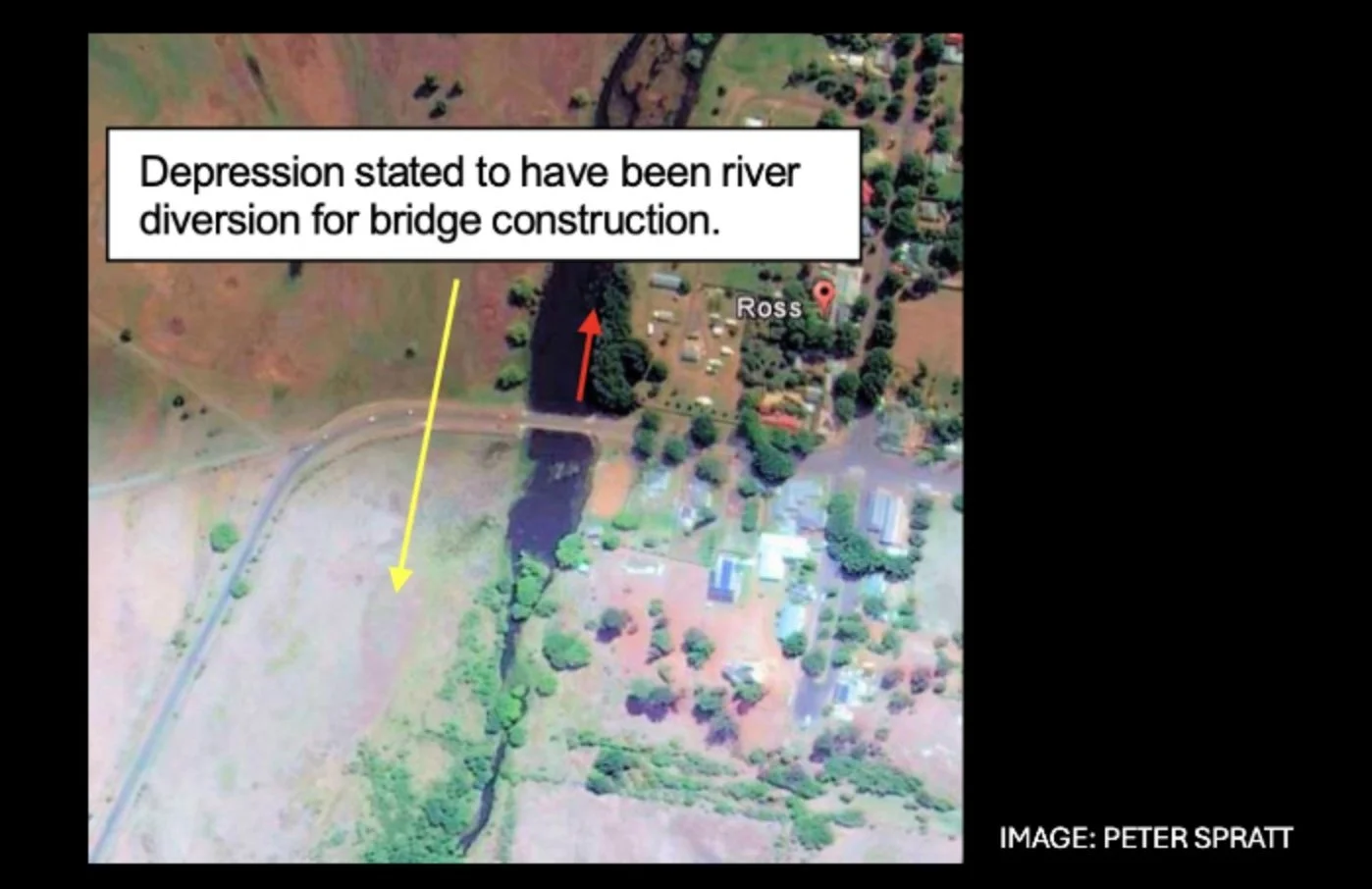
The first job was to dam the river and dig a trench to divert the flow and expose the riverbed. This must have happened because in late December ‘33, Atkinson reported that the eastern cutwater was in place.
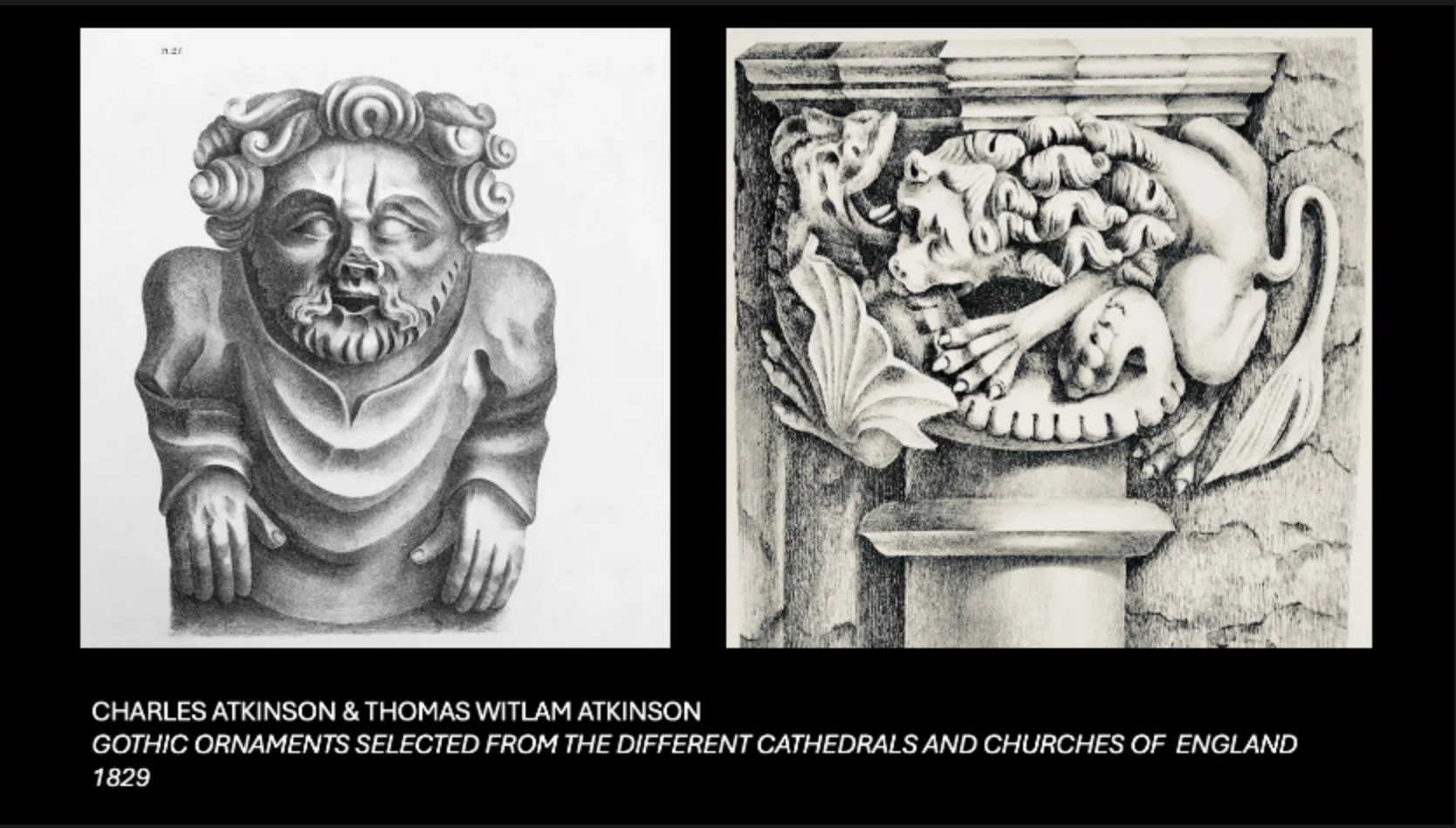
in London in 1829, Charles and his partner, Thomas Witlam Atkinson, had published a portfolio of 44 lithographs of gothic stone carvings in cathedrals and churches of England. They had drawn them from the original and then on to stone.
So Charles had an intimate knowledge of architectural decoration. I think the carvings were likely to have been his vision; perhaps the keystones only, but maybe the 7th and 9th arch stones too.
MAY 5 1834 INSOLENCE — 25 LASHES
DECEMBER 29 1834 INSUBORDINATION AT ROSS—IMPRISONMENT WITH HARD LABOUR FOR 3 YEARS AT PORT ARTHUR.
IT IS NOW THAT TOM HERBERT BOWS OUT OF THE ROSS BRIDGE STORY.
DID HE CONTRIBUTE TO THE TEMPERAMENT OF THE GANG WHOSE STONE CARVERS
SCULPTED THE SUBVERSIVE CARICATURES AND GROTESQUES?
THOMAS HERBERT CONVICT NUMBER 811 CONDUCT RECORD