Satire, cynicism, subversion and symbolism in the art of the Ross Bridge
During July 2023 Jennie Jackson delivered a presentation to a local community which was well received. It has been adapted for further discussion on this site.
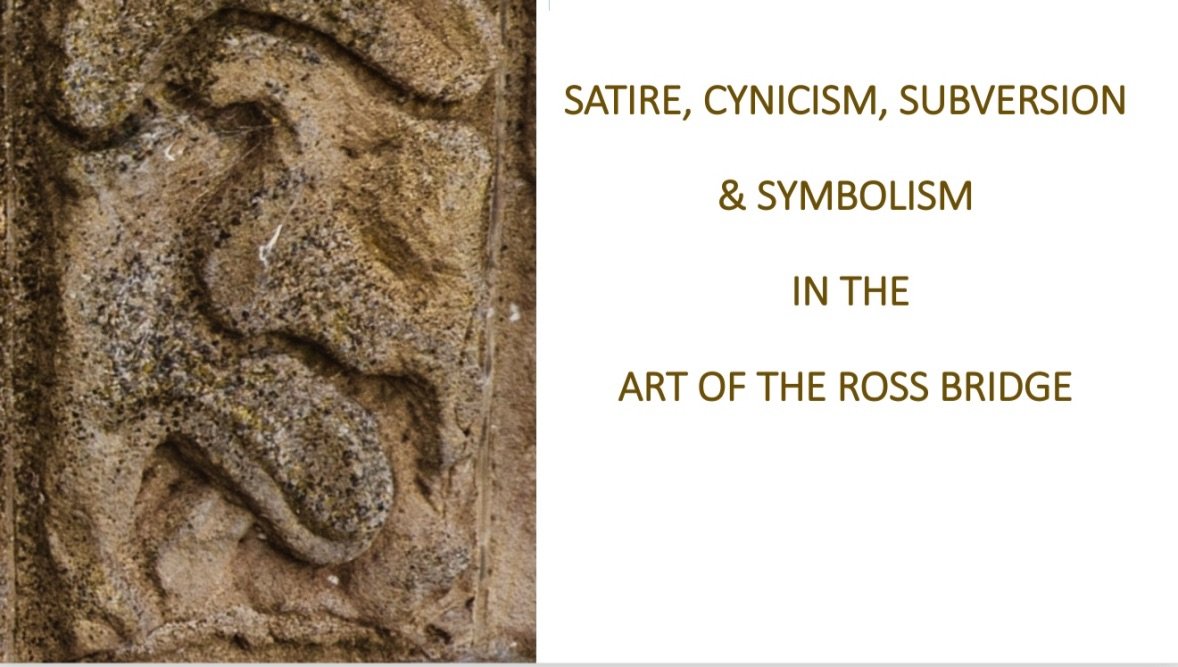
My understanding of satire is that it is a way of criticising an event or a person’s stupidity and vices. It is peculiar for its extravagance, and intellectual exuberance, its absurdity, irony, confusion, ridicule and often, its obscenity and profanity.
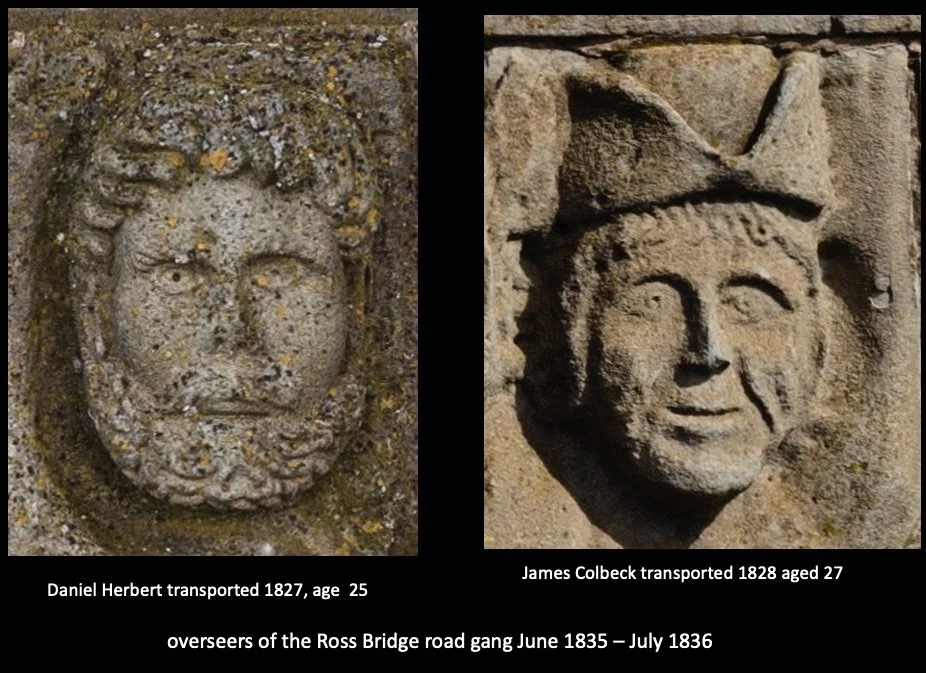
Knowing that the sculptors were convict stonemasons and that an element of satire is intellectual exuberance, one wonders about the origin of their intelligence and wit. Daniel Herbert was transported in 1827 for four acts of highway robbery that were no more than thuggery.
James Colbeck, who was married with a child, committed one act of burglary. Both men were sentenced to death at the Lent Assizes in York, Herbert in 1827, Colbeck in 1828, by the same judge, Baron Hullock. Their sentences were reprieved and they were exiled for the terms of their natural lives.
Colbeck’s family were Methodists living in Dewsbury in Yorkshire. He was illiterate but an experienced mason. Herbert had a fine hand and stated he had been employed by a sign-writer before he was arrested. His father had died in Birmingham when he was a baby and I imagine his mother had brought him and his siblings back to Manchester to be near her family. Perhaps he joined his cousins, the Rogers children, in a reasonable education.

It is important to consider the pair of sculpted portraits at the entry into St Luke’s Church in Bothwell which have been attributed to Daniel Herbert. He was never there, according to his conduct record, whereas, James Colbeck was from 1829 until early 1831. Colbeck worked in a convict gang that was repairing the barracks and building the church which had been commissioned by the Scottish gentry of the district. We know that Colbeck had whiskers from his description; we know he was married to Anne Stapleton, known as Nancy; we know he worked in London for some years between 1820 and 1826, so would have been aware of grotesques and gargoyles. The man who employed him was Thomas Grundy, a stonemason who was commonly contracted by the architect Sir John Soane whose architectural decorations were redolent with symbols.
I think he carved these caricatures with his tongue in his cheek; they have the headwear of Celtic noble people; their expressions are grim. The carving is naive; the eyes are bulbous, almond shaped with a proud outline; the ears are ill-defined and the noses are plain; the mouths, though downturned, are thin-lipped, otherwise undetailed. They resemble some of the caricatures on the Ross Bridge. It seems they represent James and Nancy, dismayed about their separation for life. Therefore, they are fooling the Presbyterians, being satirical, the sculptor laughing at the gentry and at himself for his minor triumph over them.
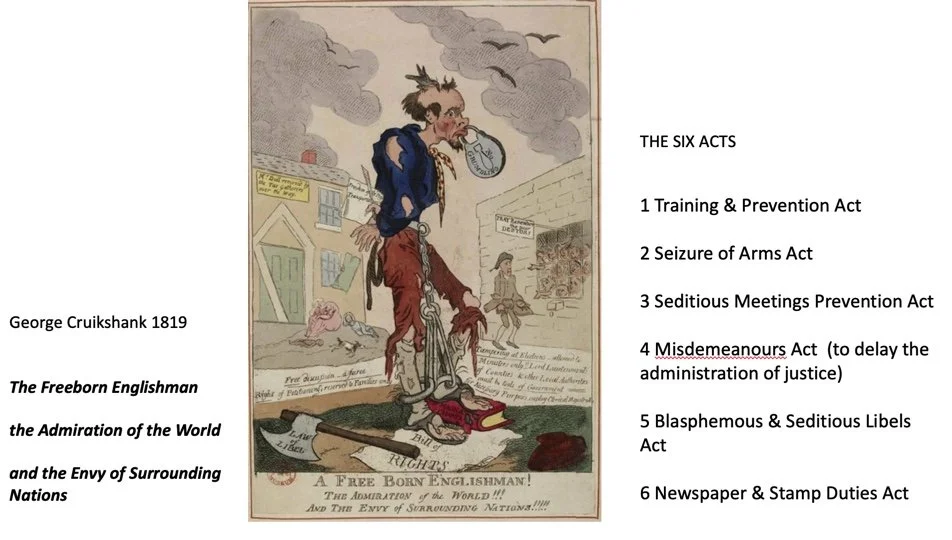
The satirical print reached it zenith at the end of the Regency when King George III died and his execrable son, George, the Prince of Wales, became the uncrowned king. Between 1800 and 1820, the king’s madness had meant he was incapable of ruling, so George had become the Regent.
Herbert and Colbeck were children and apprentices during this period, enduring the political upheavals caused by industrialisation, the enclosures of common land, the Napoleonic wars and their aftermath and the Corn Laws. They would have been among the 60,000 people who had assembled peacefully in St. Peter’s Field in Manchester on August 16th 1819, to hear Henry Hunt speak on reform by peaceful means. Before he had uttered two sentences, the magistrates and ministers of religion, who were fearfully observing the meeting from a house across the road, called the Riot Act, ordering the assembled militia and cavalry to disperse the crowd which consisted of people of all ages, women and children. The mounted soldiers advanced upon the masses with swords and sabres like reapers in a field of wheat. People died and hundreds were injured. Despite condemnation from the press, the Pittite Tory Parliament, in cahoots with the Regent, promulgated the Six Acts, notorious for their restriction of assembly and suppression of the free Press.
Is it not ironic, that in this country, there are still Pitt Streets and Pitt Waters, any number of Liverpool, and Castlereagh Streets and Sidmouths?
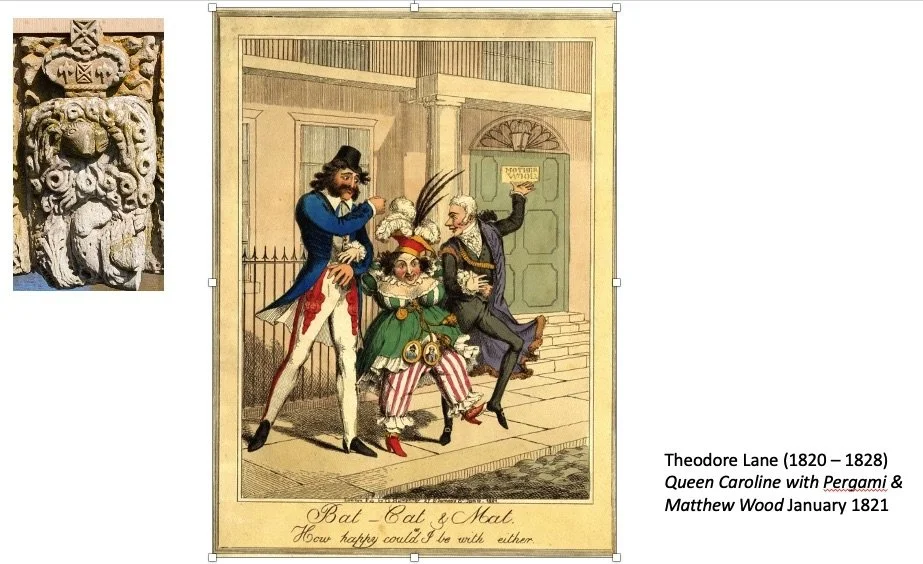
A satirical work demands an artist with a particular temperament and talent, as well as a subject to ridicule.
After the death of George III, the Regent and his estranged wife, the Queen Consort, Caroline, became the butt of derision. Reasonably assuming her right to be crowned, Caroline returned from Europe where she had been in exile since 1814, members of the parliament having pleaded with her, even bribing her, to leave London owing to the scandals surrounding her household. The masses lauded her and some Whig politicians believed it would be of benefit to the monarchy and stability of the country, if she ruled beside George. In the caricature above, the radical Whig MP, Matthew Wood is celebrating her return with her lover, Bartholomeo Pergami. Theodore Lane, the satirist, had her in his sights and tracked her mercilessly. Repeatedly, he drew her with extravagant, ridiculous hats atop a flurry of fly-away curls and an exposing decolletage in the company of Pergami.
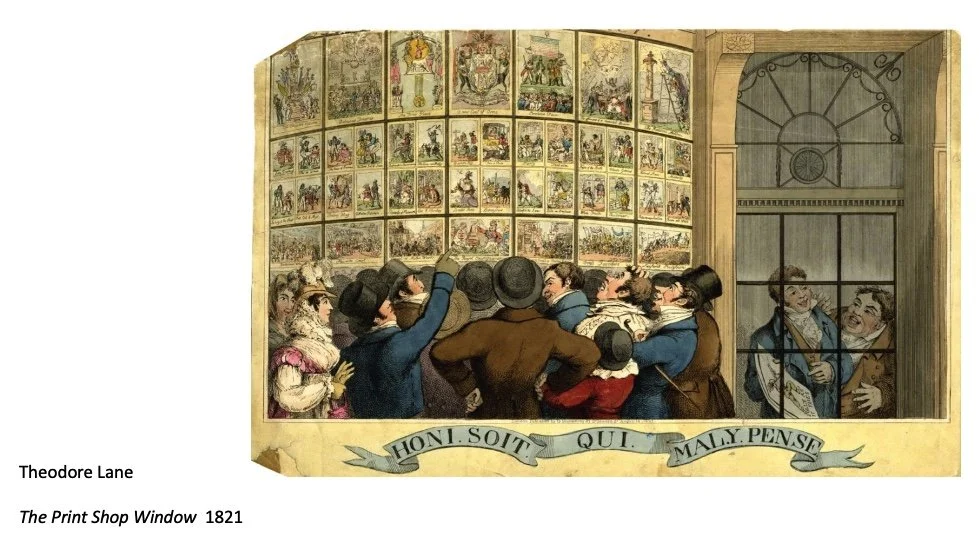
About this time, James Colbeck was a journeyman in London, amongst the architectural decorations and print shop windows. He would have been unable to afford a print at 1/6, or thereabouts, but anyone could gaze upon them with a crowd to debate them. In the image above, everyone of the prints in the window is by Lane, mocking Caroline. Honi Soit Qui Mal Y Pense is the motto of the Order of the Garter, the highest honour conferred by the monarch. it is translated: Shame be to anyone who thinks evil of it. Probably Edward III was declaring: “ shame be upon anyone who thought ill of him pretending to the French throne”. The meaning has evolved; imagine Lane standing among the crowd laughing: “Shame be upon any of you who think ill of my work, for you will not be thinking ill of the monarch”, which, of course, was his intent.
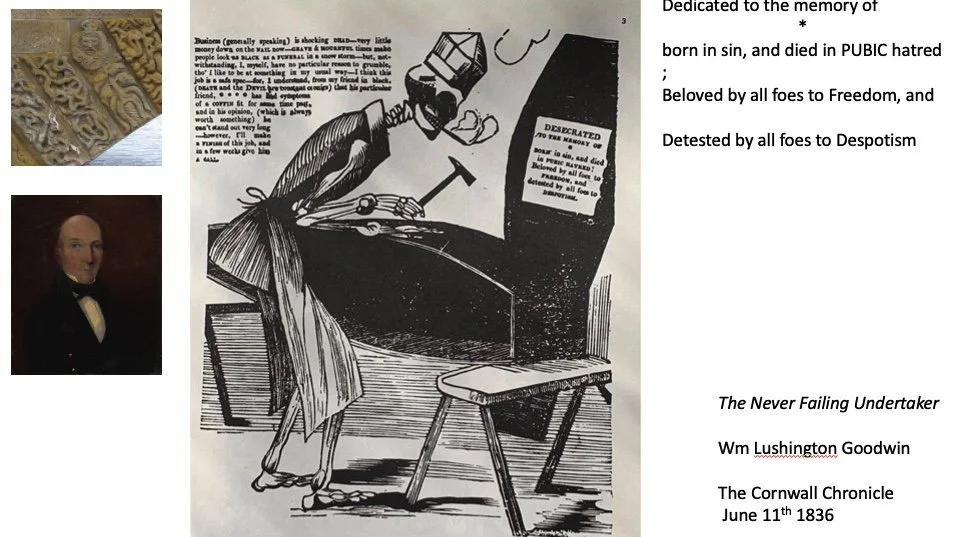
Remembering there has to be a talented artist in a frustrated mood and an object to ridicule that is despicable and disdained, Van Diemen’s Land was not without its satirists. William Lushington Goodwin, owner, self-appointed journalist, editor and publisher of the Cornwall Chronicle, publicly despised Lieutenant Governor George Arthur. The skeleton undertaker is preparing the coffin for Arthur who “has died in PUBIC hatred.” Pubic is not a misspelling; we will never know what vile allusions people made towards Arthur but the stone carvers had already carved him as a grotesque, anthropomorphic lion with provocative pubes; see the inset on the left.
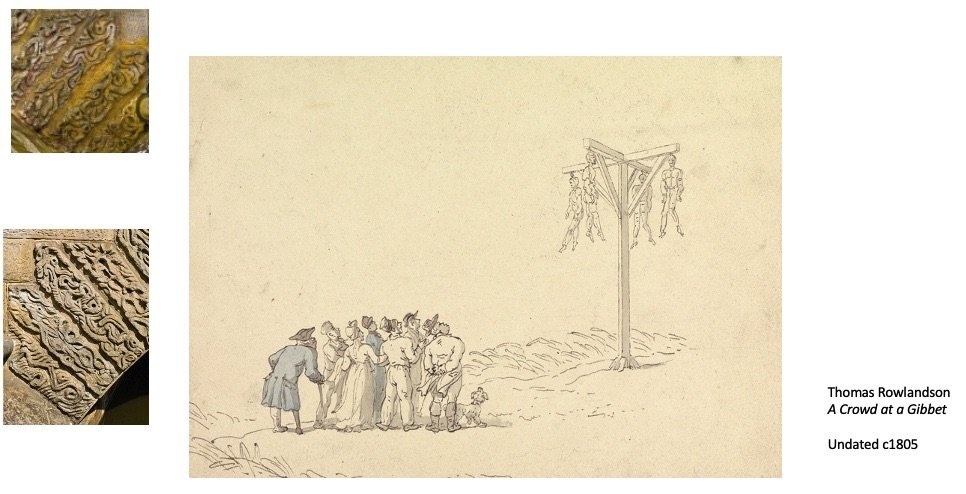
Another requirement for satire, is antipathy towards a prevailing attitude, such as the Bloody Code and its implementation by the Tory government. The above print is deceptively quaint; the subject is gruesome. Hanged, rotting bodies are suspended from a gibbet on a hill by a road. The artist’s and the viewer's disgust is eased by the comical crowd and the little dog. That is the cleverness of satire and its purpose: a balance between horror, hostility and amusement.
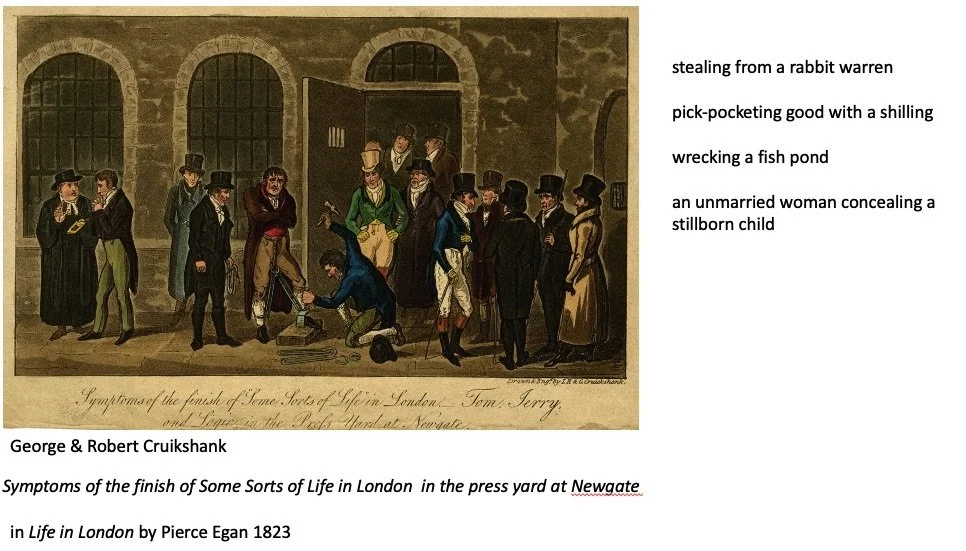
The Bloody Code was a series of laws in Britain in the C18 and C19s which mandated the death sentence .
In 1688, there were fifty laws demanding the death sentence; by 1815 there were 225. They targeted the poor; many were to do with property. Established landowners controlled the Tory parliament and, with emerging wealthy industrialists, displaced the once-dignified and self-supporting trades folk through the enclosures of common land, the development of suburbs that rapidly degenerated into slums and the destruction of the age-old way of business between the spinner and the weaver and the public. Adding to the general misery were the Napoleonic wars, their aftermath, the Corn Laws and the refusal to repeal them after the trade blockade with Europe was lifted at the onset of peace. Common people lost their livelihoods, their homes, the means to educate their children and produce or buy food. So, they committed crimes, were caught, sentenced and transported, if not hanged.

The bloody code was transported to New South Wales and Van Diemen’s Land with the convicts where the lash was meted out for trivial misdemeanours. Father Ullathorne, the vicar-general to the bishop of NSW between 1832 - 36, returned to Britain where he gave evidence before the Molesworth Commission into the state of the colonies, particularly to transportation. He bore witness against the recalled Lieutenant Governor Arthur. Later he wrote:
Where a master in England finds fault, in Australia he threatens the lash; where the master here grows angry, there the master swears and invokes the lash; where here he talks of turning away, there he procures the infliction of the lash; for idleness, the lash; for carelessness, the lash; for insolence, the lash; for drunkenness, the lash; for disobedience, the lash; where there is reason, and whenever there is not reason, the lash, the lash, the lash ….. (cited in Wolter 2014, p202)
Although the above image is of a slave ship, there was argument at the time that little difference existed between the slave and the convict.

Satire was not confined to political subjects. An artist with talent, a gripe and something to ridicule turned his attention to women. There was no empathy for the maiden who suffered from menstrual distress and the constraints of society that would destroy her should she become pregnant having been unable to reject the attentions of a determined, entitled man. In the convict world, it was a crime for an assigned servant to become pregnant, whether by rape by the master or consent. Her sentence was hard labour for a time in the female factory where she remained until her baby was weaned, unless the mite died first.
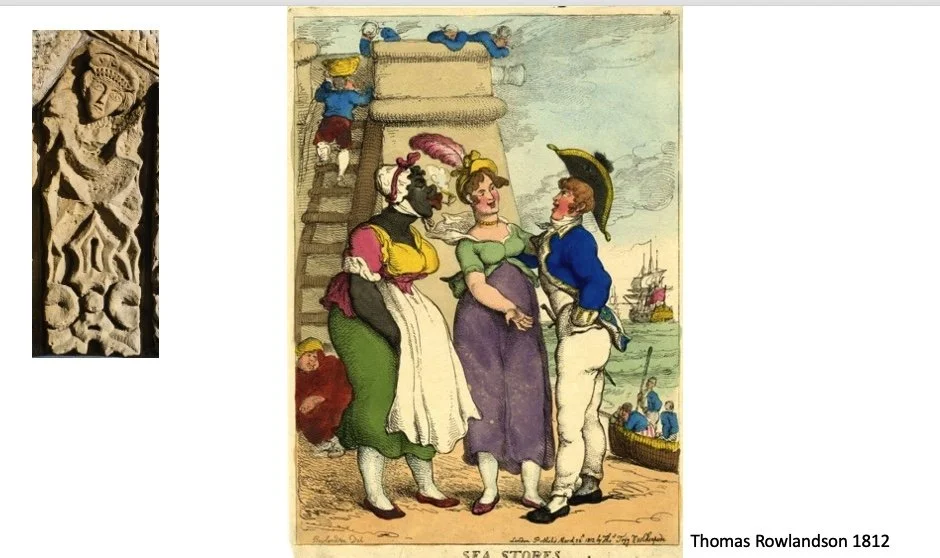
Prostitutes did not escape the lampooning. Neither did the midshipman in this case: his erect sword, the cocked hat, his hand in his pocket.
Satire is swollen with sexual allusions, absurdity and obscenity.
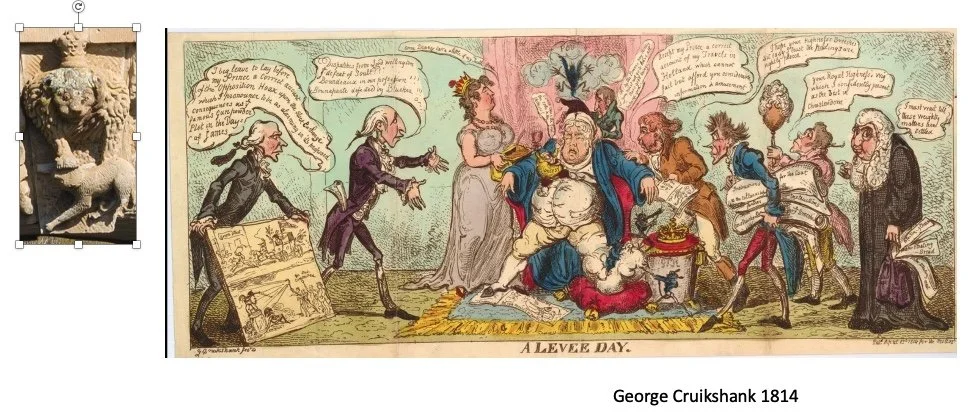
But sometimes there was an element of cruelty and contempt that, still, was meant to be funny. This is CYNICISM. The cynic takes the concept and imbues it with biting and outrageous humour. The situation is turned into a joke with personal, disdainful disrespect for those whom the artist perceives as selfish, self-indulgent, prodigal, base and hypocritical. He views society from its outskirts with a jaundiced eye. The prodigal Prince Regent suffered from his vices. He is pictured in great physical, emotional and mental distress, beleaguered by petitioners from parliament, the church, the court, the press and barb-tailed demons on his head and gouty foot. His breath is laboured by the imp on his chest, labelled Dropsy, who is offering my port wine. His mistress forces food upon him.
The caricature answers his cruelty with cruelty; it subverts by violating the rules, tacit and explicit, that govern society’s respect for the monarchy and MPs and for the sick.

The Royal Rat is subversive for the same reasons. But there is no doubting her identity: Caroline of Brunswick, the Princess of Wales, who in January 1820, on the death of her father in law, George III, became the Queen Consort. The sculptor has carved a grotesque, her features completely distorted but not entirely beyond recognition. Her crown is British, with its cross patté and fleur de lis, an emblem of purity and integrity. It is too small; her curls were remarked upon on her arrival in London in 1795 and continued to be caricatured on her return from exile in 1820. on either side of the crown, there seem to be a wolf on the left and a snake on the right below the end of a thigh bone. The wolf may refer the wolf in sheep’s clothing, the snake to the snake in the grass. The thigh bone was an ancient sceptre representing strength and authority. Above the pineapples of the supporting stones are the letters M, V standing for Mary the Virgin. She was not a virgin, the reason for her being bribed to leave England in the first place being the incompatibility between her licentious household, separate from the equally immoral Prince’s, and the reverence shown her by the hopeful masses, added to the fear of MPs that the shenanigans would destabilise parliament.
Her decolletage and ample bosom, her ridiculous headwear and big nose defined her in the satirical prints as they do here. Her left arm is curled around a rat kitten, not hugging but rejecting it. Princess Charlotte was the only child of Caroline and George; she was dismayed when her mother abandoned her the care of her father on her departure when the child was sixteen. Rats leave sinking ships; Britain’s economy was in a downward spiral after the wars and years of Tory rule that could not contain the expenditure of all the sons of George III.
Pineapples were the symbol of prosperity and wanton extravagance. We know from David Copperfield (Charles Dickens) that they could be seen at Covent Garden.
when Caroline returned from Europe, George, the uncrowned king, attempted to have parliament renounce her right to the throne and permit him to divorce her. But the Act of Parliament necessary was not presented to the House of Lords for fear of the effect its passing would have upon the radical masses. Caroline was barred by crossed bayonets at the door into Westminster Abbey; she went home and died three weeks later, claiming she had been poisoned … as are rats.
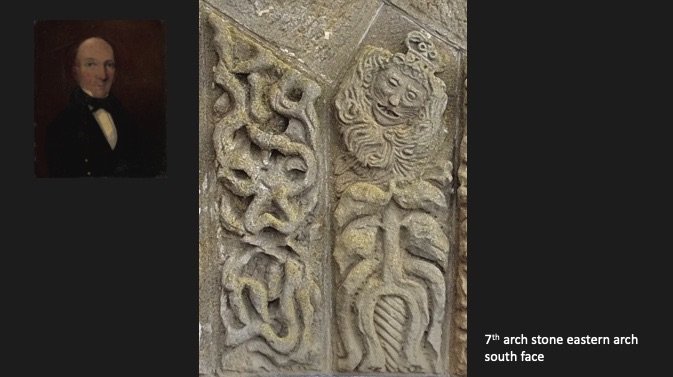
The satirist requires a subject to disdain; the cynic lives beyond the bounds of society, looking. His way of life in itself is an expression of his contempt. The convict stone carvers had no reason to respect the Lieutenant Governor, Colonel George Arthur. He had arrived in the penal colony in May, 1824, instructed to implement the recommendations of the Bigge Report: to make transportation an object of real terror, to institute harsh penalties, to correct situations where treatment had become lenient, to refuse emancipists a position in society; any weakening of this attitude by ill-considered compassion for the convicts was not to be tolerated. And it was not. It is not an accident that into the juxtaposed stone is carved a death’s head. Under its chin are crossed bones; above its left temple is a shackle with a thumb bone beside it. Below is a forked tongue or tail.

See how subversive is this anthropomorphic lion! Benjamin Duterreau portrayed Arthur’s hooded eyes and mean lips in 1832. The stone carver has been similarly impressed. The crown does not fit and it is ornamented with a cat o’ nine tails and a pair of ankle irons. hair from the balding pate is carefully combed across the forehead. The lids half-cover the eyes; the cheekbones are high; the mouth smiles with thin lips and the dentition is fang-like. He is an agent of the British, hence the lion’s mane and the thigh bone as a mark of power and authority.
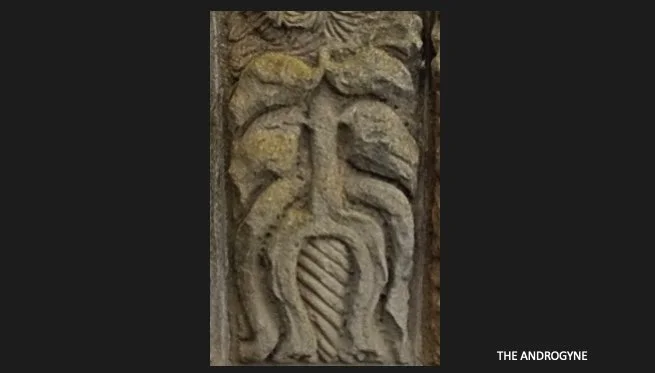
The stem-torso sits astride a vagina filled with a tumescent penis, the form emphasised by the thread of a screw. The symbol of copulation is called an androgyne, male-female. It existed before the Abrahamic religions as a sign of the unity of all things, the Perfect One comprising and including all opposites: earth/sky; male/female; good/evil; balance and harmony. With Abraham, the patriarchy and monotheism ushered in the masculine God and the separation of nature and the male unto whom the female was subordinate. St Paul’s letters call the members of the early Christian church to become one with Jesus, return to the oneness with nature, gentile with Hebrew. Forever, there has been the search for the re-unification of all opposites, master/slave; free/chained. So, why is such an icon propping up the torso of George Arthur. Irony; mockery of Arthur’s projection of perfection, particularly as father and husband; of his unquestioned authority; of his evangelical religious outlook.
However, the convicts knew the colony over which he ruled was not in balance; males outnumbered females; corruption outweighed integrity and cruelty, kindness; the mendicant were more than the rich and the imprisoned greater then the free.
“ We are many - they are few” is the last line of Percy Bysshe Shelley’s poem, The Masque of Anarchy, written in 1819 after Peterloo; but his exhortation to rise up against the oppressor could not be undertaken when death as punishment was within the the power of the few.

The stem with four leaves is a Mandrake, I think; a mandragora officinarum. This would explain the root-like legs that sit astride the androgyne, as the root of a mandrake is anciently regarded as man-like. The plant has magic and medicinal properties and many legends surround it. Two of them are pertinent.
It is said to grow under the gallows where a hanged man’s semen has spilt. In Arthur’s time as governor, two hundred people were hanged.
There is a legend that when the plant is pulled out of the ground, ot screams and the harvester dies. So, a dog is tied to the base of the stem and the dog is enticed to run after his master who holds out meat. The plant is uprooted and the dog is sacrificed.
On the 7th stone on the right side of the arch is a very worried dog; its position matches that of the grotesque of the governor on the opposite side of the same arch. In the centre of its furrowed brow is a disc, giving the appearance of the All-seeing Eye, implying that Arthur’s ruthlessness would not go unwitnessed. The notion of this third eye was probably introduced to the convicts by freemasons, perhaps during their apprentices, perhaps in the colony. James Colbeck might have been exposed to the craft while a journeyman in London; Thomas Grundy, his employer was a freemason. The architect of the bridge, John Lee Archer was the Worshipful Master of the Tasmanian Lodge 313 in 1836.

Another anthropomorphic lion subverts the monarchy. In all his madness, George III is carved into the keystone between the grotesque Arthur and the dog. He is supported by sheaves of corn, symbolising the Corn Laws and the avarice of the landowners, being the source of so much poverty and starvation among the poor until their repeal in 1846. I imagine the scornful laugh of the stone carver and his audience as he bestowed on his king a puny crown; as he ‘honoured’ him with an Order of the Garter: Honi Soit Qui Mal Y Pense. Shame on him who thinks ill of it. Once upon a time, Edward III is thought to have declared this referring to his pretension to the French throne; but a convict might be warning a passerby who gazed upon it, or appealing to anyone to not think ill of him for his intent was just.
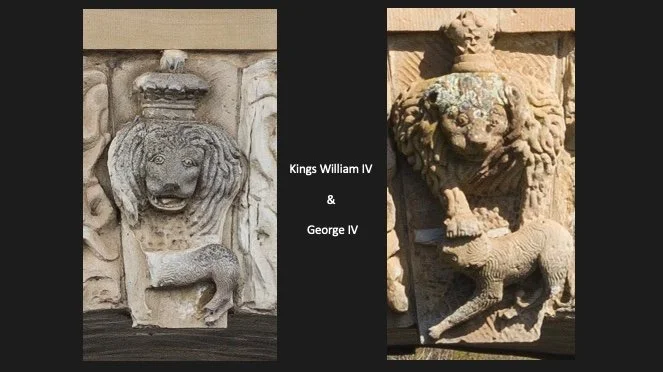
At the western end of the bridge are George III’s two sons, George IV and William IV, ridiculed. William succeeded George in 1830. He was a shrewd king sometimes, but was also known as Silly Billy and the Sailor King. George was crowned in 1821, his health failing.

Of the paired lions known as Foo Lions or Foo dogs, which guard banks and similar offices in London, the males have their paw on orb representing empire and majesty. The female is playing with her cubs. But in the antipodes, the male is playing with a cub, or puppy. His facial expression is inane, his grin is foolish, his bite would not hurt anyone with the tiny teeth and his eyes are wild with excitement. The crown is un-kingly and his mane is as extravagant as George’s dress. The puppy has bewildered eyes and his tongue protrudes. It seems the carver is saying the people of England who allow themselves to be played with by the monarch, are simpletons.

The antipathy towards Arthur’s attitude towards convicts is expressed in the bridge’s carvings. “…to break them like horses.” It was against the rules for a convict to write critically about the system. But there were no rules about carving. However, to carve a symbol of the punishing regime might have incurred a penalty and Colbeck and Herbert had been promised their free pardons if their behaviour as overseers of the Ross Bridge gang was exemplary. The flail could be a catkin or seaweed; the leather glove atop the spine could be a fig leaf, disguised because of the risk. The pair of carvings is at the bottom of the central arch on the south side; it was difficult to see when rowing on the river. The plaited handle and thongs with notches for knots define the figure as a cat. The fig leaf glove represents exposure of the naked truth.

Symbols expand the meaning of an object or event or concept to more than one thing. In the image above, the elements, air, fire, water and earth are carved into the four stones below Daniel Herbert’s portrait. At the top of the stone next to him, is an icon of reflected spirals.

Between the spirals is a Tau cross, symbolising the crucifix. The stone carver might have been displaying his move towards redemption or he might be pleading: “My God, my God, why have you forsaken me?” Carved into Herbert’s beard is a mason’s square, though he could never be a member of a lodge owing to his criminal past. The reflected spirals are masonic symbols; they refer to eternal life and reflection upon one’s worldly behaviour. Freemasonry is not of the Christian religion and Christians reject freemasonry because of its opposition to the revealed truths of the gospels. Masons only have to believe in the Supreme Architect of the Universe and the immortality of the soul; that life on earth is a preparation for the state of eternal bliss. Reflection is a part of the way to the state of grace.
In the lower coils of the spirals are other masonic symbols: the point within the circle and the quatrefoil.
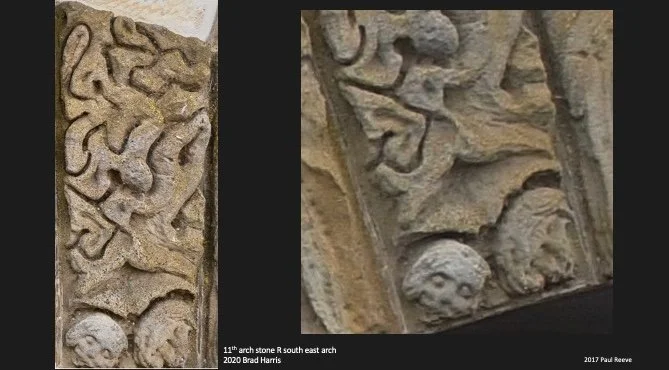
I think this is the most poignant carving on the bridge. It is not a satire or grotesque; there is nothing cynical about it. The symbol of the fish, water, the flaccid penis and the biconvex form the stone carvers use for the surface of the earth, are symbols that make up a sad story. Below the ground are two heads, a child and a mother, probably not dead but beyond his reach on the other side of the world. Two fish are landed but a man is pouring water from a bucket onto them; the front one has a gasping mouth. To his left on the edge of the stone, as we look at the carving, it is the penis symbolising his powerlessness, his impotency to change the awful separation between himself and his family. Water is life’s essence; it is used in baptism. It has purifying qualities. He is using it to keep alive the love between himself and his wife and child. Tis is not seditious iconography; it is a symbol of forlorn hope.
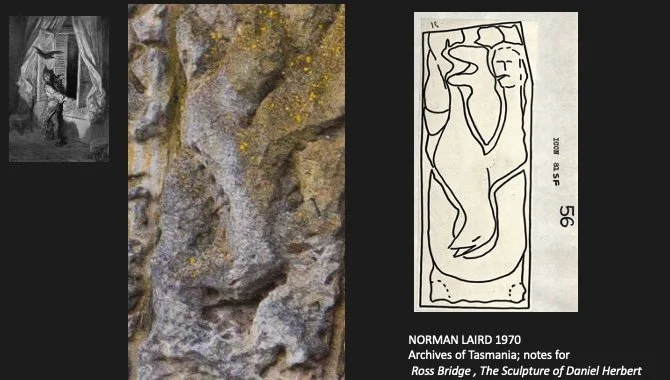
On the same arch as the mad king, the governor and the worried dog, is this harbinger of death, a hanging bird. Norman Laird wrote in his book, Ross Bridge, The Sculpture of Daniel Herbert in 1970, that the Celts believed malevolent birds were in the service of the gods. Raven or Crow deities were mostly female. He notes that death is believed to come in the form of a great, black, screaming bird in the night, the feminine half of the twenty four hour cycle, associated with the moon. He suggests this carving is a female symbol of death. Misogyny?

Is this misogyny too? A grotesque portrait of a woman? It parodies the Sheela na gig, a figurine found in Ireland, the west of England and France whose meaning is conjectured but not really known.
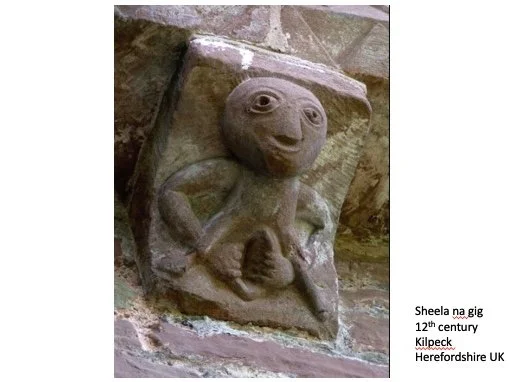
A grotesque hag, with prominent eyes and pendulous breasts opens her vulva to display the opening of her vagina. She is found on churches, castles and private buildings. Perhaps she warns against the sin of lust,; perhaps she wards off malevolent spirits. Or is she the all powerful old crone who oversees birth and death?

On the bridge, a hag’s face is carved on the right edge of the stone. Beside her are two curls, possibly pubic hair. Below them are two dried-up breasts, we might call dugs; between them is a lozenge, an ancient symbol of woman. Within it is a keyhole, the opening of a passage to a traditionally sacred place. Is this derisory in this carving? On either side of the lower half of the lozenge are two fingers opening the vulva to reveal the introitus, derogatorily called the slit. At the apex of the stone, seen on the earlier image, is a dart, the male principle.
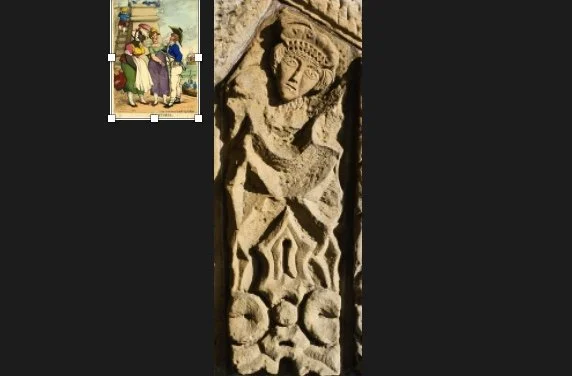
Another lozenge appears in this bitter carving of a convict woman portrayed as a prostitute because of her tizzy hat. She is Norah Cobbett, who was transported for stealing 17/6 from her master. Although she received a good report from her doctor before sentencing, she was transported and died in abjection, suicidal and abhorred by all. She had shacked up with a gang of stock thieves and had been induced to inform on them by the man who eventually married her to protect her, Jorgen Jorgenson.
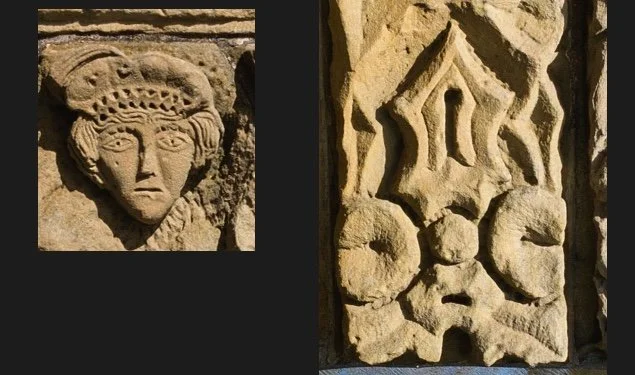
Her tragi-comedic caricature is in the style of the heads at St. Luke’s Church, Bothwell. Her genitalia double as a monster’s mask, the anus for the mouth, the vulva as a crown. How cynical was the stone carver who presented this poor outcast to the world for posterity! Even among outcasts there is a hierarchy.

In the satiric mood of the Ross Bridge carvings, two cross sectioned lilies or irises must be poking fun at woman-kind. The vulval image is ubiquitous, coming through the ages from antiquity. Sexual relations between the sexes was the bane of the colony’s administration. Sodomy was projected as one of the major reasons to cease transportation. Rape, coercion or consensual, sodomy and lesbianism were commonly practised among the closely confined prisoners. This sculpture of these two flowers could be two women caught in flagranté, the motif between them being a tongue.
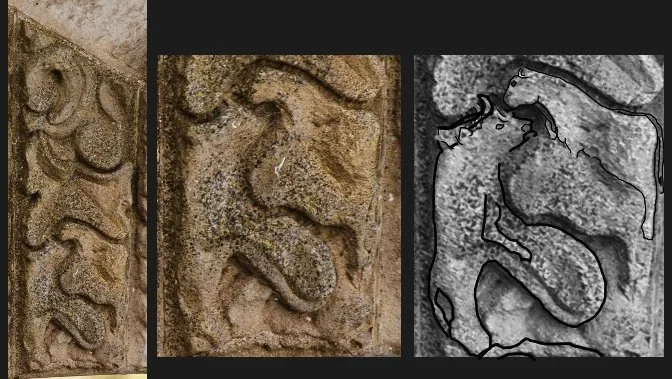
The supremacy of the male may be carved with irony in this arch stone. At the top is a Green Man, the symbol of revitalisation of the plant world after winter. His bearded chin is a four-lobed leaf, the upper edge being his benevolently smiling bottom lip. Below him is a rampant bull with his front hooves on either side of an oversized penis. His hind legs appear to be standing on a branch on which squats a squirrel like creature. His head is raised, nose to nose with a cow. She seems to standing on a leafy branch of the same tree. Is the bull or the king or the artist? The joke is: “Here am I, a criminal carving a grotesque of the king with his mistress up a tree!” Or
“ Look at me! I might be a powerless convict but I am virile and nobody, not a soldier, a magistrate, not even the governor himself can take that away from me. I have triumphed with my work.”
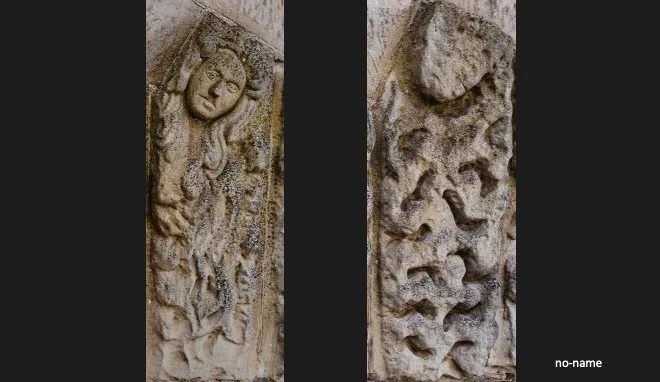
Not even a judge? The pairing of these two caricatures suggests a judge can efface a prisoner’s identity, honour, freedom and future. No-name is the title I have given to the faceless character on the right.

No-names, Herbert, 810; Colbeck, 915 - numbers until they exorcised their demons in their sculptures on the bridge. But did they? Three tenets of the cynic’s philosophy were freedom of expression, liberty of the spirit though the body is restrained and self-sufficiency meaning confidence in one’s own worth rather than a dependence on money. I wonder what Herbert and Colbeck took away from their work when they returned to being jobbing stonemasons, conditionally free, tainted with the convict stain, never to be commissioned to create such thoughtful and thought-provoking original work again. They were unique among their peers, as unique as the bridge is in the world.
But who knew? WHO KNOWS NOW? How many stop and gaze with curiosity and wonder at the one hundred and eighty-six arch-stones of this architectural masterpiece? There is no other bridge like it in the world and yet we are letting it wear away.

The thing is, the bridge is a 186 page political document, all the more unusual because it is sculpted. It is exceedingly rare because it was written by convicts during their sentences, criticism being punishable. It is probably the first political and narrative document written by and for working men in Australia. Although they were convicts, they were working men in the village of Ross, employed by the settlers; they had some agency. They have written about their harsh conditions and punishment though the message is obfuscated by satire and symbols because of the restriction on free expression. They carved their opinion of the monarchy and of the colonial regime from the point of view of outsiders who had experienced their most punitive aspects. They satirised women whom they observed to be of loose morals in the colony. So the Ross Bridge is an example of narrative, decorative architecture reporting the lives and opinions of convicts and working men in the colonies.
Only one convict succeeded in publishing satirical essays on the state of Hobart Town society while he was there; Henry Savery, writing as Simon Stukely. His pseudonym protected him but his publisher, Andrew Bent was sued by Gamaliel Butler and fined.