ON THE REVELATION OF A COLONIAL SCULPTURE
A Biography of Daniel Herbert
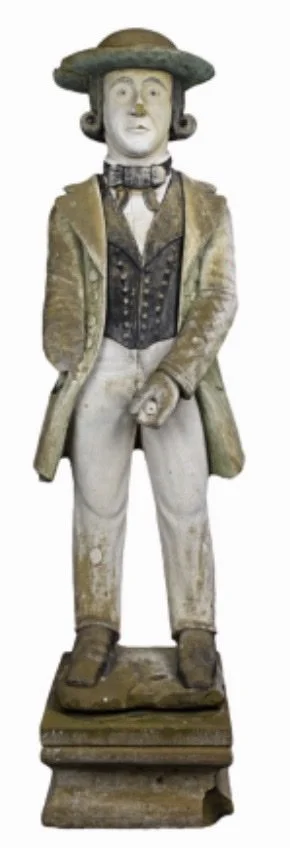
A singular sculpture was unwrapped at the Maritime Museum of Tasmanian on Friday 2nd February 2024, 222 years after Daniel Herbert was baptised, having been born on the first inst. (The record of Baptisms from the Paul Street Independent Chapel, Taunton, Somersetshire, 1801 - 1802. England & Wales Non-Conformist and Non-Parochial Registers 1567 - 1936). In the museum, it is placed prominently opposite the head of the stairs, the statement admitting probabilities and possibilities as to its origin and subject. The stand alone statue is purported to have been commissioned by William Kermode of Mona Vale, caricaturing Lieutenant Governor George Arthur. But the truth is, little is known.
Why has it remained hidden? Another surmise: the answer lies in the impolite subject (the man is urinating) combined with the properness of its former custodians. Their prudery is proportional to the preservation of the sculpture, its condition being good after 188 years, as well as to the preservation of the satire heaped upon Arthur by a few of the gentry and all of the convicts. Of this attitude, history tells us plenty.

Daniel Herbert was baptised in Taunton Deane, Somersetshire on 2nd February, 1802. His father was a corporal in the 6th Inniskillen Dragoons, having enlisted in May 1793 in Leeds. (Pearce C. M. Daniel Herbert: Colonial Caravaggio? THRA papers and Proceedings Vol 58 April 2011). The regiment was garrisoned in Exeter during the Bread Riots in which the poor rebelled against the farmers, merchants and gentry and the insatiable navy - all those who contributed to the rising cost of flour and the starvation of the poverty-stricken and under-employed. Daniel was the fourth child of Daniel and Mary Herbert, née Rogers, who had married in Liverpool in 1790. Sarah had been born in Liverpool in 1793; Stuart was baptised in Romford in 1797 where the regiment was garrisoned; Elizabeth was baptised in Banbury when the dragoons were moving from Uxbridge to Birmingham. It seems Mary was a camp follower, a most miserable existence for a pregnant mother of toddlers. In 1802, the regiment was in Nottingham where there was a ‘smell of revolution’ among the ‘low folk’, before it moved on to Birmingham where Corporal Herbert dies on 29th May, 1803. (PRO, London, WO/12/710 1802 and Cannon R. 1847 The History of the Regiment of the Sixth or Inniskilling Dragoons.)
Mary’s parents were Sarah, née Edwards, and John Rogers of Liverpool. Corporal Dan’s parents were Sarah and Stewart Herbert of Manchester. Mary’s husband, Corporal Dan, had been a member of the Freemason’s Lodge 311 attached to the regiment. (www.UGLE.co.uk) In the register he is described as a “gentleman soldier”. Perhaps Mary received a small tribute from the brother masons, enabling her to return to her family in Lancashire. It is possible that she is the widow Mary Herbert who married Thomas Bulmer when Daniel was fifteen years old, in Eccles, Manchester. He may have been living with the master stonemason who had taken him on as an apprentice who may have been his uncle, John Rogers of Coates Street off Jersey St., Ancoats. The Bulmers lived in Pollard St. a short walk away. (Pigot’s Directory Manchester and Salford, 1821)
When Dan arrived in Van Diemen’s Land, his occupation was marked as stonemason in the description list but he claimed for his conduct record that his last employment was as a sign-writer. Perhaps he was telling a half-truth; he had a neat hand.

Anne Newby’s grave, Old Cemetery, Oatlands
Dan had committed his first crime in Manchester at the end of 1819, within two months of Peterloo. During the months before August 1819, the villagers throughout the West Riding of Yorkshire were preparing for a mass meeting in St. Peter’s Field, Manchester to protest against the unsympathetic attitude towards them of the Tory government in London. Daniel and his family could not have avoided being caught up in the great upwelling of desperation among the people. The Bulmers were poor. In 1814, Thomas, who had been a chapman and dealer, had been sentenced to the pillory and three years in gaol for a misdemeanour probably associated with his insolvency, which had been proved the previous year. (Lancashire Quarter Session Records and Petitions 1648 - 1908 for Thomas Bulmer. ancestry.com). He and Mary were associated with the independent religious, probably the Bible Christians. Ultimately, on the 16th of August, 60,000 people, more or less, assembled in front of St. Peter’s Church to hear the orator, Henry Hunt urge them to peacefully offer “up a joint and sincere prayer to the Legislature to relieve the poor and needy, by rescuing them from the hands of the agents of the rich and powerful, who had oppressed and persecuted them […] They were there to exercise the great constitutional right of laying their complaints and grievances before the throne.” (Hunt Memoirs III p116cited in Riding J, 2018 Peterloo). But he had not spoken for more than two minutes before the constabulary moved to arrest the people on the hustings. The gawking magistrates and clerics who were in a house overlooking the scene, then ordered the mounted cavalry and yeomanry to disperse the crowd. Many of the mounted sosldiers were veterans of the Napoleonic wars; they used their sabres as if cutting down wheat in a field. Eighteen people dies; about 600 were injured. Imagine Dan, trying to protect his mother and sisters, warding off the great horse, ducking out of the way of the sword blade, glancing into the screwed, targeting eyes above him.
Afterwards retaliatory crimes were committed y young men against those perceived to be on the side of the establishment. In October, dan Herbert, now seventeen years old, robbed John tanfield, linen thread maker of 60, Shudehill, a five minute walk from Pollard St., even less from Jersey St. He was sentenced to two years imprisonment in Leeds Castle. Perhaps, as was the custom, he was permitted to earn a little cash for work and he learned sign-writing while there.
Within weeks of his release, he robbed Ellen Benson of nearby Aqueduct St. of two blankets. The Bensons of 3, 7, and 10 Aqueduct Street were spinners and weavers; William Benson owned the Fox Tavern on the corner of Deansgate and Jackson’s Row. He had been a member of the yeomanry at Peterloo. He was committed to seven years transportation. He spent four in the hulk Retribution at Sheerness at the mouth of the Thames. Probably, he was set to work on the wharf as a stonemason. He was released after four years and two months, one of three-in-a-hundred men recommended for Royal Clemency for good behaviour.
It is likely he walked home with his mate William Stringer, arriving in August. In September, he committed the first of four acts of highway robbery, a euphemism for thuggery. On each occasion, he walked east from Ancoats with some friends to the district of Saddleworth under the moors. They waited for an unsuspecting traveller to walk by, mugged him and stole his money, pocketbooks and anything they thought useful, then left the stunned men by the wayside. On the way back, they stopped at inns to buy bread, cheese, gin or ale. Any remaining money was divied between them when they were at home in Ancoats. Perhaps these were ‘survival crimes’, planned to achieve the outcome of transportation. If so, the design was successful for Dan. They were apprehended near Upper Mill by two men, “considerable merchants of Staley, Chesire, and delivered to York Castle dungeons on the night of October 23rd. (North Eastern Circuit Assizes Minute Books ASS1/41/14; Indictment Papers ASS1/44/142; Deposition of George Bannan PRO ASS145/60)
Daniel was sentenced to death. At the end of the Lent Assizes, 1827, Baron Hullock J recorded the death sentence and pronounced its commutation to transportation for life. Herbert was delivered to the hulk Leviathan at Portsmouth on April 12th, where he remained, working onshore, until August when he was transferred to the convict ship Asia. George Fairfowl was the surgeon superintendent, making his fifth voyage to the antipodes. It was the Asia’s third trip and she arrived in Sullivan’s Cove, VDL, on 7th of December, 1827.
During the next week, the men would have been medically examined, interviewed by the administration’s clerks, inspected by the Superintendent of Convicts, John Lakeland, and the Superintendent of Public Works, the architect and civil engineer John Lee Archer, issued with distinctive clothing according to their place on the Lieutenant Governor’s hierarchy of prisoners, remaining in chains all the while. dan’s ploy to gain desk work was denied him. He was placed in the public works, lodged in the prisoner’s barracks and permitted to work for himself on Saturday afternoons. Possibly, he found work with Isaac Chapman, an enterprising Methodist who was a cabinet maker, carpenter, builder and undertaker. (NSW & Tasmania Australia Settler and Convict Lists 1787 - 1834. ancestry.com.) Dan’s first appearance before the Principal Superintendent of Convicts was at the behest of Mr. Chapman in June 1828. (AOT CON31/1/19) The accusation was that he was not performing his work according to the agreement hehad with Chapman. He was ordered to finish the job as agreed.
In about 1833, family legend tells that Dan was commissioned by William Davidson, the Director of the Government Gardens (now the Royal Tasmanian Botanical Gardens), to carve the pedestal of a sundial that was to be a gift for Elizabeth, his wife, and to carve a mantelpiece for his private cottage in Elboden St. This leads one to wonder whether Isaac Chapman was in charge of the public works at the gardens about 1828 when the director’s cottage and hothouse was being built from sandstone quarried on the site, and whether Dan, employed by chapman, met Davidson then.
Only six times between 1828 and 1833, was Dan absent from night-time muster or away from barracks all night. Sometimes he was reprimanded; sometimes he was sentenced to the treadwheel: three days, seven days, three days. When he was arrested in Devine’s pubic house after hours, he was given ten days on the treadwheel with the added insult of working in irons for a month. The next time he was absent at night, he lost his right to work on three consecutive Saturday afternoons. After that, for being absent from his labour and from muster in the prisoners’ barracks at night, he was flogged, twenty-five lashes. Even after that, he absented himslef three times from his duty of barrack muster.
On Friday, March 25th, 1831, he did not go to work in the morning. It happened that three other masons and two skilled quarrymen were absent from their labour at the new orphan school on that day, too. His companion from the Asia, Thomas Herbert was one of them. He had been a quarryman with a road party at Bagdad when Rod O’Connor, the Inspector of Roads, lent him with the four others to the builder William Foord, who had begged the colonial secretary for some useful men to counter the useless ones he had been assigned on his being contracted to repair the Bothwell barracks. While he was there, his tender to erect the St. Luke’s Church was accepted. When it was finished in February 1831, the three stonemasons, James Colbeck, Frederick Edwards, and Andrew Daymond and the two quarrymen, John McMullen and Thomas Herbert, were sent to Hobart Town by Captain Wentworth, although O’Connor had “expressly desired Mr. Foord to return them to the road party at Bagdad”. They “have been placed in the chain gang”, he bemoaned in his letter to the colonial secretary, John Burnett, on the 5th of April, ‘31. They had been punished for being awol on Friday 25th and Saturday 26th of March: Tom Herbert, McMullen and Daymond had been absent the whole of Friday and from muster on Saturday night; Edwards and Colbeck were absent from Friday and Saturday nights’ musters. They received two months imprisonment and hard labour. Fred Edwards and Dan Herbert were to serve one month. If Dan had joined them, perhaps his enthusiasm had been blighted by the raw, one-week-old scabbed stripes on his back. According to a letter to the colonial secretary from John Lee Archer, there were six men in that chain gang whom he wanted back on site; he suggested their sentences could be changed to working in irons. The number six suggests Dan was with them in punishment as he had probably been in their brief, blithe freedom. In the end, Dan stayed in Hobart Town while four of the others returned to Mr. Foord and soon marched to Rossbridge. (AOT CSO1/311/7501)