SHELLEY AND THE MONARCHICAL KEYSTONES
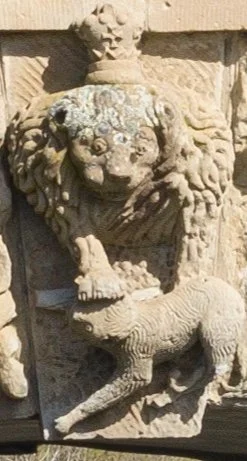
Rat Princess Keystone North Facade East Arch.
Prince Regent Keystone North Facade West Arch.
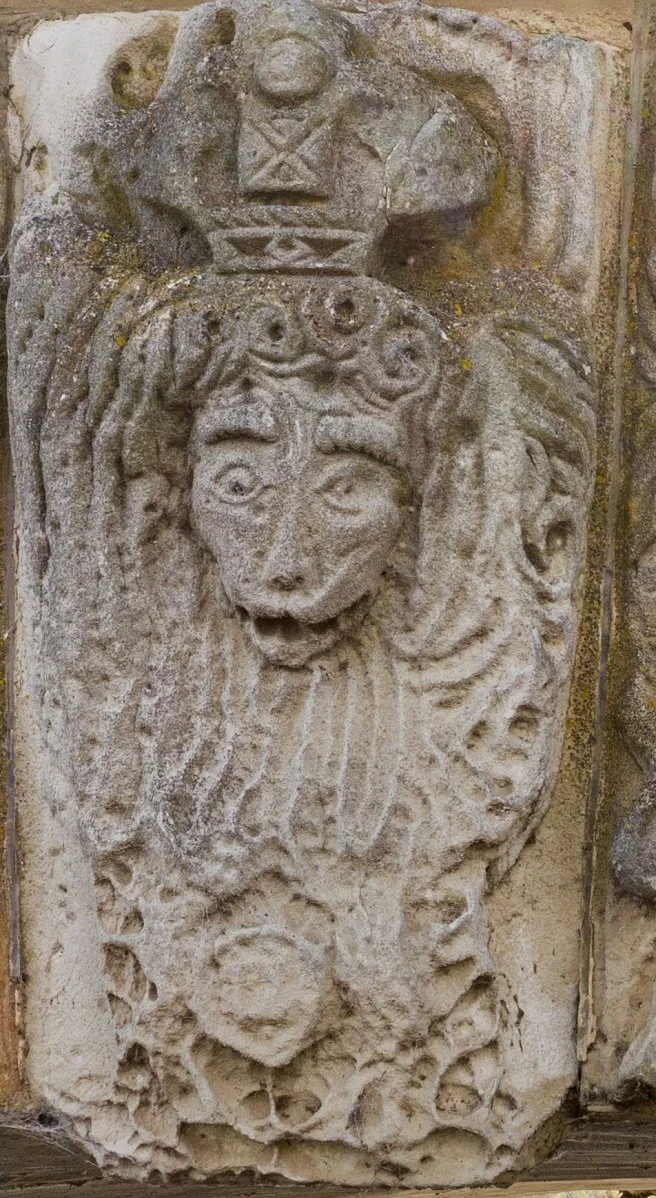
George III Keystone South Facade East Arch.
In The Poetical Works of Shelley, there is a fragment: TO THE PEOPLE OF
ENGLAND, written in 1819, in the year before Dan Herbert committed his first crime.
People of England, ye who toil and groan,
Who reap the harvests that are not your own,
Who weave the clothes your oppressors wear …
A couple of poems later is this sonnet, ENGLAND IN 1819:
An old, mad, blind, despised, and dying king, -
Princes, the dregs of their dull race, who flow
Through public scorn, - mud from a muddy spring, -
Rulers who neither see, not feel, nor know,
But leech-like to their fainting country cling,
Till they drop, blind in blood, without a blow, -
A people starved and stabbed in an untill’d field, -
An army which liberticide and prey
Makes as a two-edged sword to all who wield, -
Golden and sanguine laws which tempt and slay;
Religion Christless, Godless – a book sealed;
Senate, - Time’s worst statute unrepealed, -
Are graves, from which a glorious Phantom may
Burst, to illumine our tempestuous day.
The king in his relapsing and remitting disease; princes in their luxuriating and leeching of the state’s coffers; the oppressed people who were stabbed on the untill’d field of Peterloo because they were protesting against their own, imminent starvation; the army which preyed on the people and destroyed of the cries for liberty; the Church of England, the House of Lords, the failure to emancipate the Roman Catholic minority – these are the graves from which Liberty may burst forth to enlighten the darkness of the age. It was an expression of Shelley’s Godwinianism, the peaceful revolution of the many people against the oppressive few.
In Autumn of the same year, 1819, Shelley wrote THE MASK OF ANARCHY, after he had learned of the massacre at St Peter’s Field. His audience was to be the working-class people of England who had marched across the hinterland of Manchester in their thousands on August 16th to peacefully plead for political reform in the open space before St Peter’s Church. As the speakers were ascending the hustings, the clerics and magistrates decided to read the riot act and called out the militia and yeomanry. The poem was not published until 1832 … while Dan Herbert was in Hobart Town before he was transferred to Ross.
Simultaneously, Shelley began a satirical play in verse, OEDIPUS TYRANNUS or SWELLFOOT THE TYRANT, about the political division caused by the return of Princess Caroline, the wife of the Prince Regent on the death of his father, George III, the old, mad, despised king. It was published anonymously in 1820 but only seven copies were sold before the rest of the print run was seized. Is it too much to believe that the artist of the bridge was able to read the satire before it was published again in 1839? Or was the zeitgeist surrounding the Queen Caroline Affair, inspiring multiple seditious pamphlets and caricatures by the reformist cartoonists, writers, printers and pressmen, sufficient to inspire the sculptor to create an equal satire when, owing to double-edged fortune, he could decorate a bridge?
Regard The Rat Princess: it is the keystone on the eastern arch of the north face. The crown is roundly full and would almost fit the rat’s cranium if it were not for the extravagant coiffure. The cross patté is a symbol of valour and honour, representing royalty. The two stemmed flower-like forms could be the fleur de lis of the Prince of Wales, the Prince Regent, or the lily or iris, symbols of the Madonna. On the juxtaposed stones are the letters M and V, referring to Mary the Virgin. Peering around the arch of the crown as if in a coat of arms, are a wolf and a serpent rather than the lion and unicorn. Above the snake’s head is the top of a femur. (The artist used a thigh bone as a sceptre in another of his mocking works, to metonymize the British regime in Van Diemen’s Land).
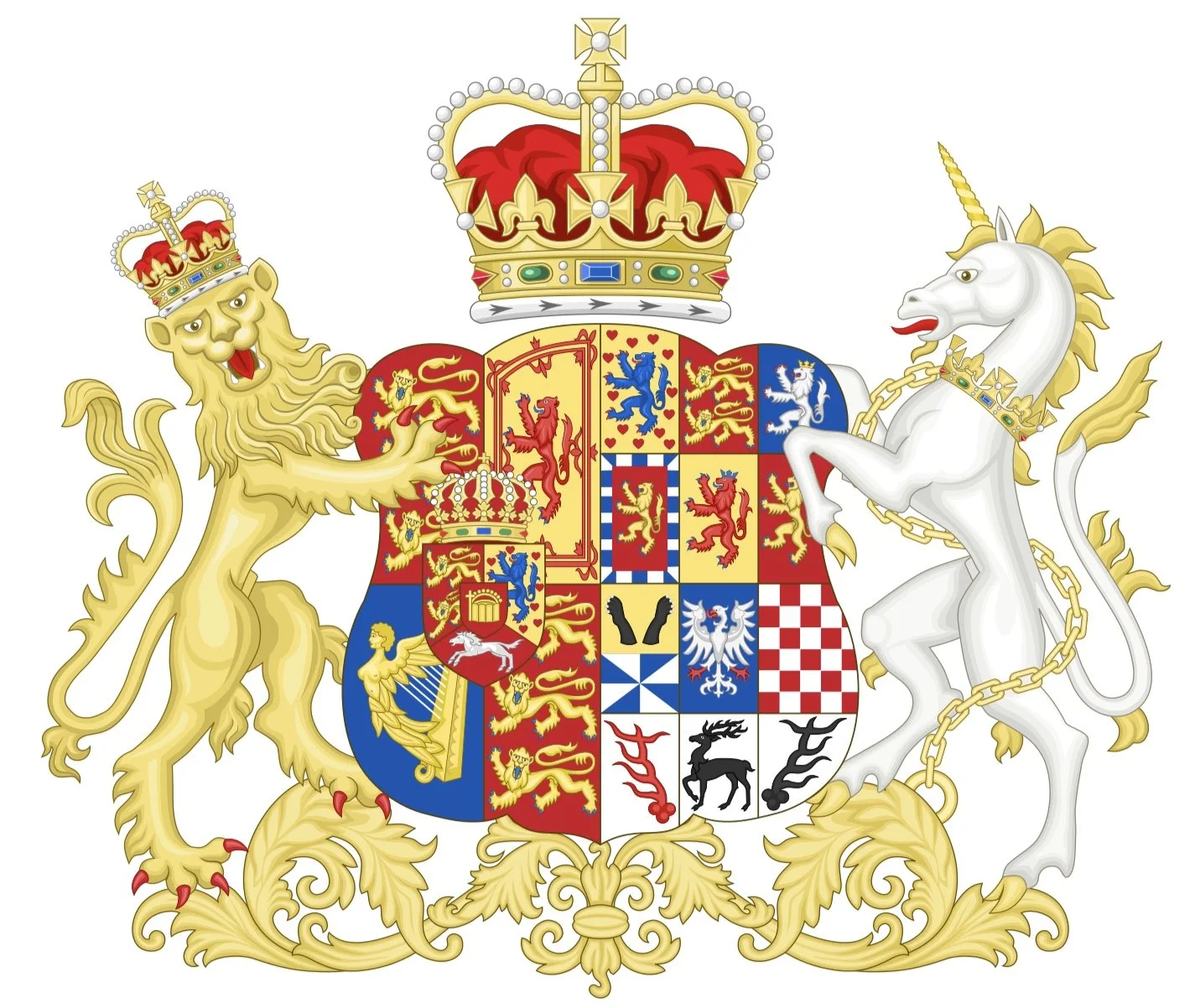
Caroline’s coat of arms (i)
Princess Caroline, wife of the Prince Regent until 1821, is the rat, the symbol of filth, inhabitant of sewers; promiscuous and ubiquitous, able to squeeze through tiny spaces, gnaw through structures; notorious for abandoning sinking ships. Caroline chose to abandon her British subjects to the profligacy of her spouse. She was a wolf in sheep’s clothing, a snake in the grass; never would she have been able to fulfil her uttered reassurances on equality to her adoring public. She was immoral according to the social mores of the day. To the artist, her sexual transgressions were the stuff of hypocrisy and deserved sarcasm; she was neither honourable nor virginal. But he carved her proud, for she had the power to undermine the monarchy through the people’s lauding and magnifying her on her return from Italy in 1820. She was despised by the equally specious Prince Regent and Tory parliament. Between her arrival and the coronation of her husband, they set out to vilify and destroy her.
Swellfoot: Hark! How the Swine cry Iona Taurina;
I suffer the real presence; Purganax,
Off with her head!
Purganax, ( Lord Castlereagh) one of Swellfoot’s three ministers, points out that first he must empanel a jury of Pigs, the reference to the ‘swinish multitude’, the common peopleii.
“Pack them then”, says Swellfoot. (How little politics have changed!)
She was not a handsome woman, dumpy, full breasted and immodestly dressed with ridiculous hairstyles, according to contemporary cartoonists. The sculptor gives her no bodice at all. Her left arm is rejecting a rat kitten which is an inaccurate allusion to her separation from her daughter, Charlotte, forced by the prince; though Caroline did choose the option of leaving England for £35,000 a year.iii She counted on her daughter’s protection on her succession to the throne but in 1818, Princess Charlotte died with her stillborn baby and all hope for Caroline. Ultimately, she was barred with bayonets from entering Westminster Abbey and becoming Queen. Three weeks after George’s coronation, she died, some declaring she had been poisoned, like a rat.
Into the keystones on the western arch are carved two lions, “dregs of their dull race who flow through public scorn – mud from a muddy spring”. The south-face sculpture is broken and less competently carved than that on the north face, which complements the Rat Princess. He is her husband, George, Prince of Wales, the Prince Regent. His crown is puny, sitting on a mane that matches the princess’s hair in its profusion. The face is fat, recalling Leigh Hunt’s insulting allusion, the “Fat Adonis”.
Swellfoot. Contemplating himself with satisfaction …
… these powerful limbs are clothed in proud array
Of gold and purple, and this kingly paunch
Swells like the sail before a favouring breeze,
And these most sacred nether promontories
Lie satisfied with layers of fat; …
The smile is foolish and the dentition is childish. The right paw is upon a puppy or a cub; a wide-eyed young animal with a protruding tongue and with a small paw and curled tail. It is not a lamb. Anciently of China, foo (fu) lions are the paired creatures that guard gates and doors. They were ostentatiously present in London in the Regency. Usually, the male’s paw is pressed on a sphere, as if he is master of the Earth; the female restrains a cub that lies on its back. On the Ross Bridge, the lion has been emasculated; he cuffs a cub whose face bears neither fear nor malice; who does not lie supine. The once princely lion has become the female, synonymous with disempowerment.
Image: Ilona Schneider
The bridge is like a critical newspaper of the decade between 1810 and 1820, Leigh and John Hunt’s The Examiner, for example, in which were published Shelley’s poems. As The Examiner, its works are an attack on the conservative establishment. That an ordinarily educated man could carve the monarchs satirically, tells us about the cultural empowerment of the common people. This was a profane attack by a vulgar artist on all that was ‘proper’, all that had been appropriated by the noble and religious, yet whose capacity for refined and moral behaviour was now open for judgement.
The idea that Dan Herbert was influenced by Shelley’s politically critical spoof, OEDIPUS TYRRANUS, was exciting in its seed but it failed to fulfil its promised flower; the truth about the poem’s publishing date crowded out the sun. However, the series of angry, satirical reformist poems were written when the convict masons were adolescents and their England was in turmoil. The publishers were not keen to invoke the ire of the censors. Leigh Hunt, Shelley’s chosen editor for THE MASK OF ANARCHY, had been imprisoned for two years (1813– 15) charged with an intention to traduce and vilify his Royal Highness in his criticism of Robert Southey’s sycophancy. Hence the delay in the public’s introduction to Shelley’s exhortations to rise up: Ye are the many – they are the few.
My theory that John Lee Archer mentored Herbert, may explain an apparent exposure to the works of Shelley, written in 1819 and 1820, not published until 1832. Also, I have thought for a long time that Herbert grew up in a household that owned books because he could read, he had a fine hand and he was intelligent. It is possible he had read Byron, early works of Shelley, Keats, the less radical Coleridge, Wordsworth and Walter Scott; the gently satiric Jane Austen, William Blake and Shakespeare, Milton and the Bible. It is likely he nurtured a resentment against the political system that perpetuated poverty amongst his peers; hence a possible avidity for the poetry of the second generation of reformist writers who had gathered around Leigh Hunt.
(i) https://commons.wikimedia.org/wiki/File:Coat_of_Arms_of_Caroline_of_Brunswick.svg
(ii) Edmund Burke 1790 Reflections on the Revolution in France
(iii) Jane Robins 2006 Rebel Queen Simon & Schuster London