A NARRATIVE FRIEZE IN THE CHAPTER HOUSE OF SALISBURY CATHEDRAL AND MORE GARGOYLES
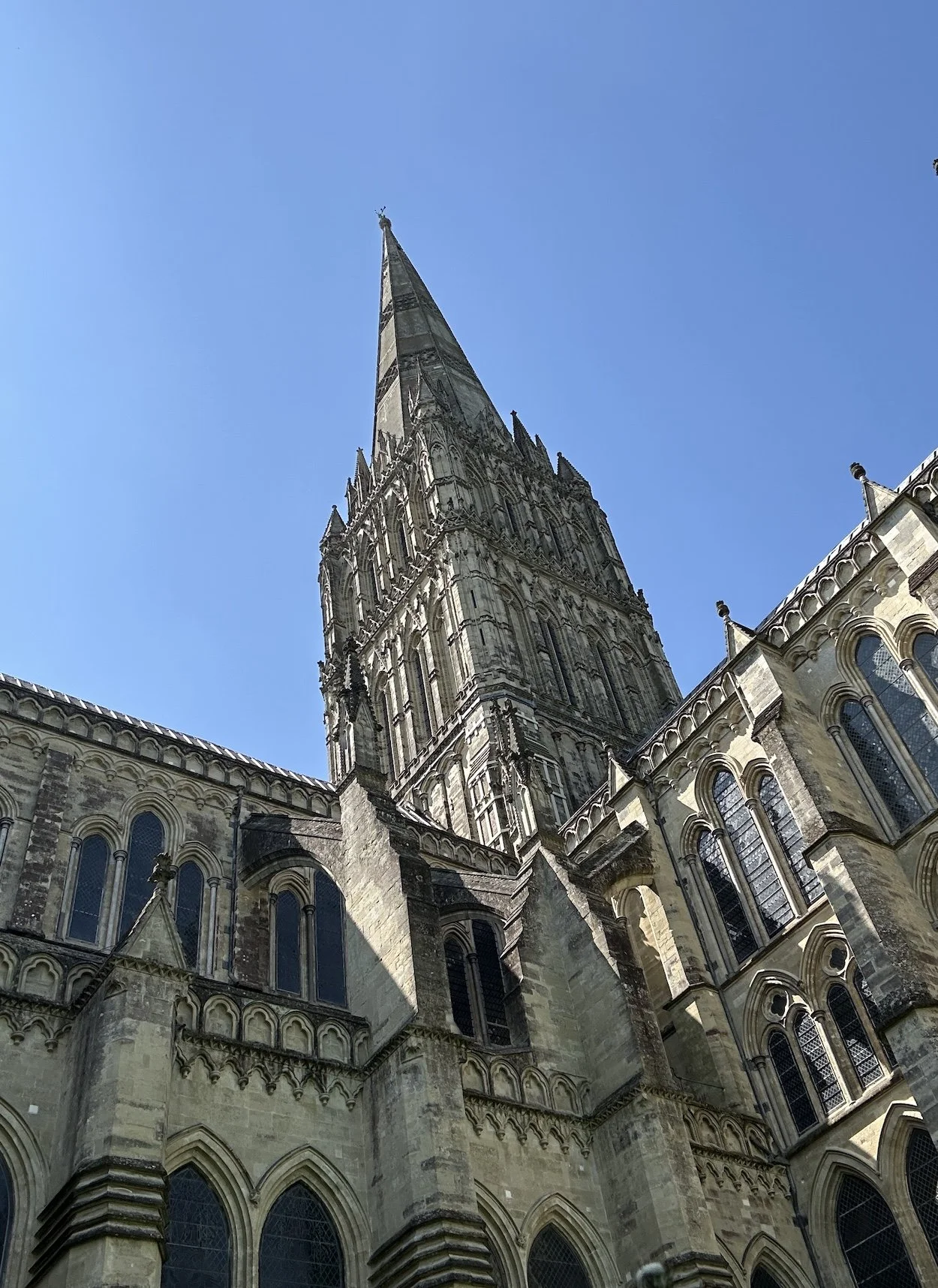
The Ross Bridge carvings are an example of narrative architecture; the trouble is, it is hard to work out the stories. The narrative frieze in the Chapterhouse of Salisbury Cathedral tells stories from Genesis and Exodus, the books written by Moses, probably. The cathedral was built between 1220 and 1258; the Chapterhouse added in 1263 and the spire was completed in 1330. It is 123 metres high, breathtakingly remarkable.
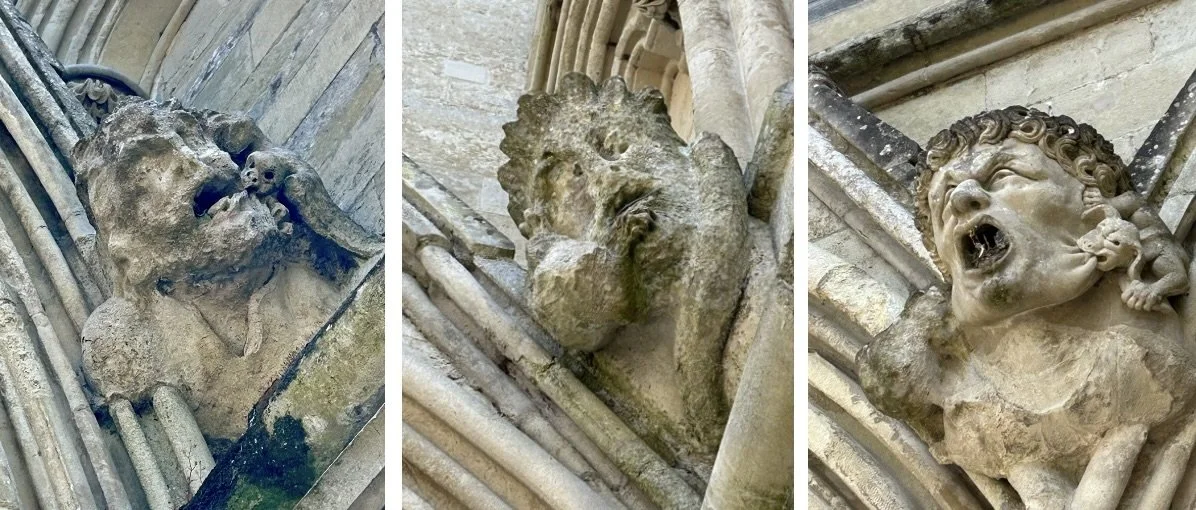
Gargoyles on the south facade.
Before I went inside I looked for gargoyles as I always wonder what influences played on the convict stonemasons’ minds. These make one wince. Two of the grotesques have hybrid creatures mauling their cheeks. The one on the right is particularly nasty with long canine teeth and ears and muscled arms. On the left, the man is being attacked by a winged creature with a snouted face. In the centre, it seems the hind legs of a long necked wyvern-like beast are scrabbling over the poor man’s face while its head reaches for a nipple, perhaps. What cautionary tales are they impressing upon the common folk gazing up at them? Or what devils are they scaring away? What is in the mind of the sculptor?
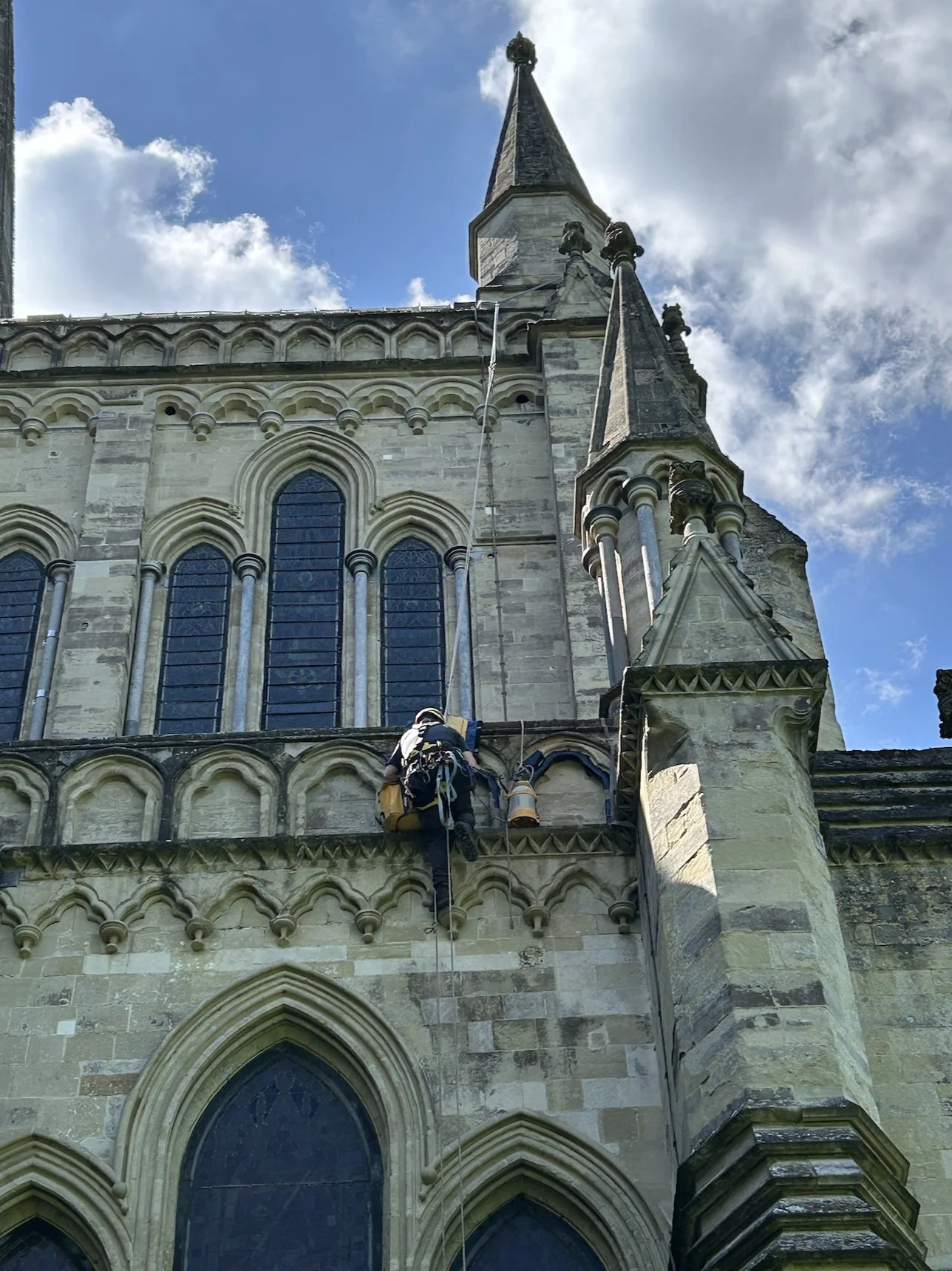
a stonemason at work
… and still looking upwards, a 21st C mason at work, hanging by a rope wound around the spire far above him, steadying himself with his right knee against the string course.
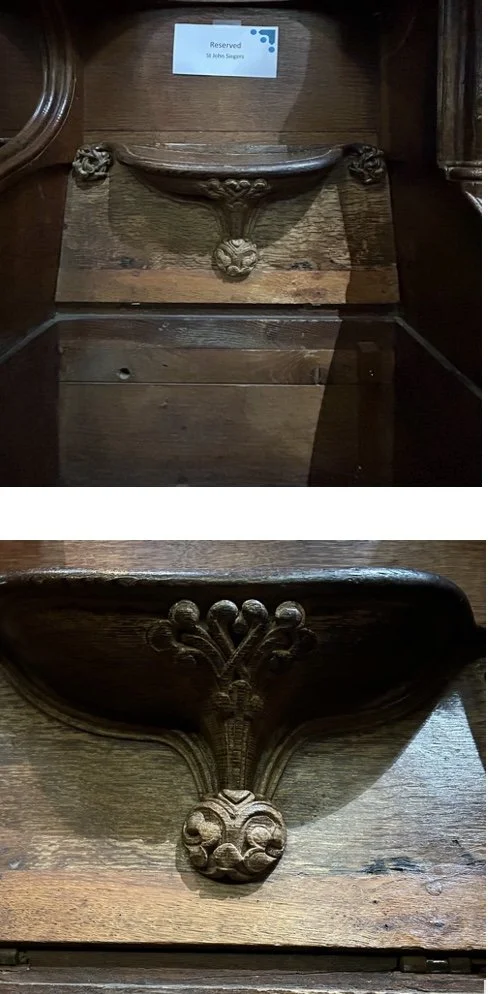
A misericord
Only one misericord was accessible to the hoi polloi; the guide told me that those in the quire (choir) of Salisbury were plain, usually of flowers and not vulgar and funny as in other cathedrals. I wonder if the stonemasons as apprentices or children lifted up the choir seats to laugh with the woodcarvers of centuries ago.
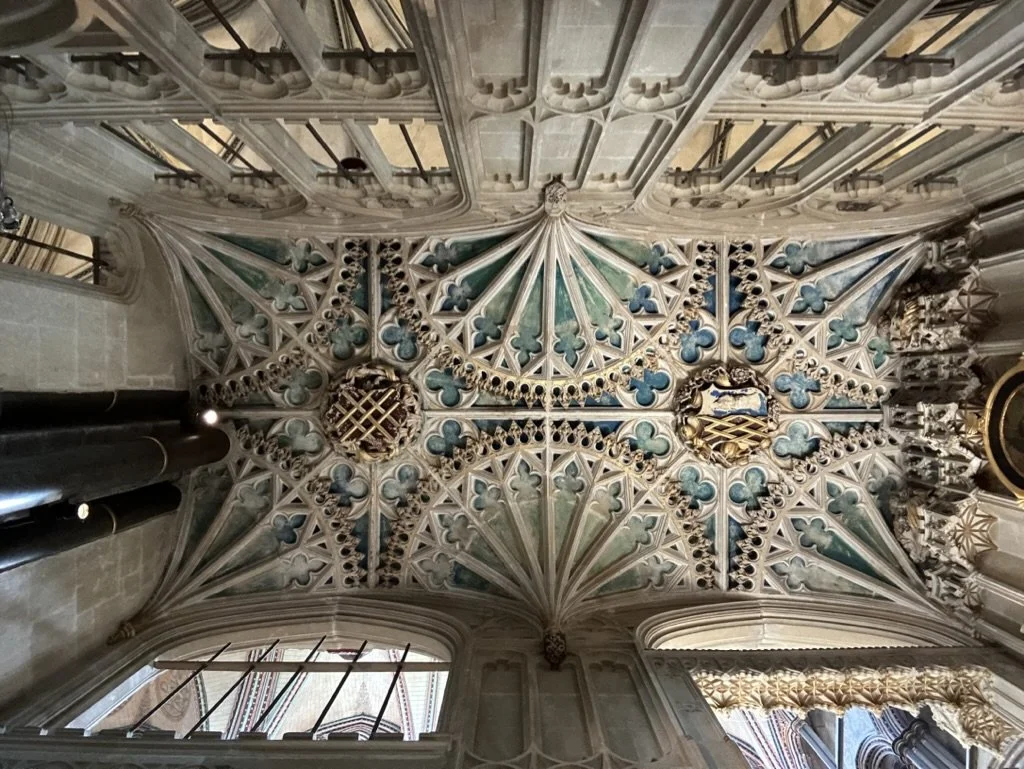
Bishop Edmund Audley’s chantry chapel 1524
A chantry was a payment for chant or a place where a priest would be employed to chant, recite or sing the Mass over and over again, day after day specifically to benefit the person who had paid. It was believed that the more Masses that were said for someone’s soul, the quicker they would escape the ‘lesser hell’ or Purgatory. The really wealthy could pay for private chapels to be built with elaborate tombs so the dead donor could be present at the Mass. Henry VIII’s son, Edward VI (who died in 1553) oversaw an extreme protestant reformation and the Doctrine of Purgatories was annihilated; the chanting stopped, though it had become a substantial source of income for the church. That Bishop Edmund Audley’s chapel with its glorious ceiling survived is a blessing as its builder had lauded Katherine of Aragon, Henry’s first and Roman Catholic wife (d 1536) with her symbol, the pomegranate. The chapel was built in 1524 when she was still Queen but only for another three unchallenged years. When the reforming mobs arrived in the 1540s, the brightly coloured statues, carvings and embroideries were destroyed.
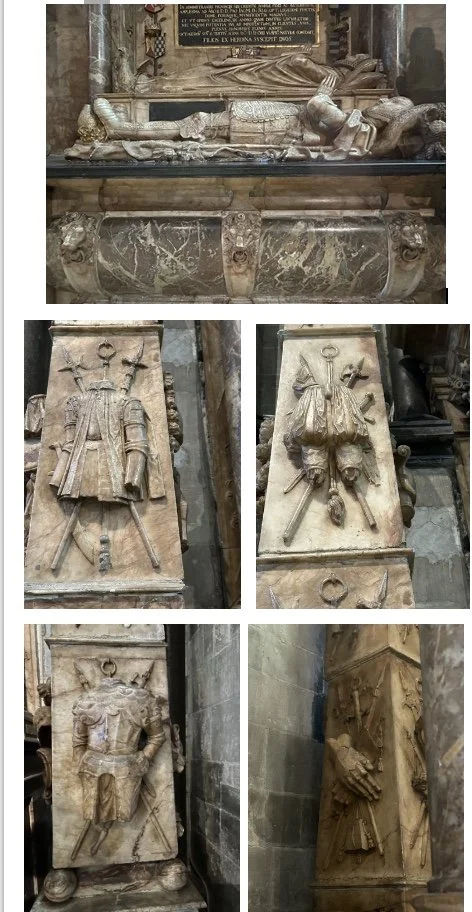
Edward Seymour and Katherine Grey
The story of Edward Seymour and Katherine Grey is a sad and tumultuous one as were so many who came from ambitious families in the Tudor times. C
Katherine and her two sisters, Jane and Mary Grey were claimants to the English throne on the death of Edward VI, Henry VIII’s son. Jane was installed as Queen by her powerful relatives but after nine days she was beheaded by order of Mary I, Henry’s Roman Catholic daughter. When the Protestant Elizabeth I ascended, she was wary that Katherine and her male heirs would conspire against her. Katherine married Edward Seymour without Elizabeth’s permission; he was sent away to the continent for his education; Katherine was imprisoned in the Tower of London. On his return he was sent to the tower; they had two sons who were considered illegitimate, though he always thought they had a right to the crown. Katherine was placed under house arrest until her death at age 28. Edward, released from imprisonment, returned to court, remarried twice, yet after his death, Katherine’s body was exhumed and placed with his in Salisbury Cathedral.
But the fascinating thing about this memorial is all his gear, even his pantaloons!
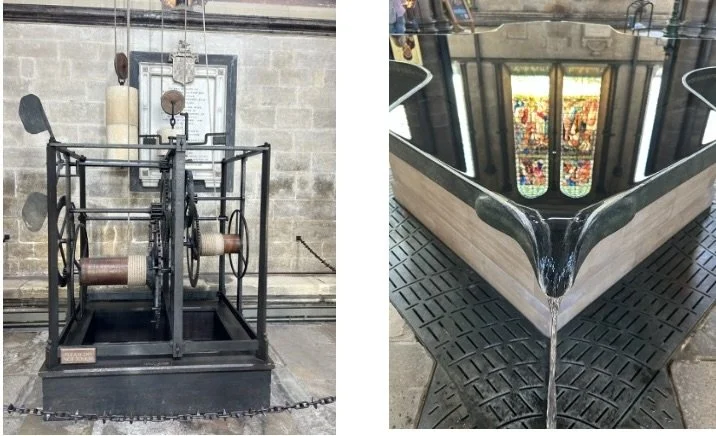
Over the centuries, Time and Tide have waited upon man: this contraption is the world's oldest working mechanical clock, made in 1386 or earlier, telling the time by striking a bell every hour. The exquisite font, forever filling and flowing like the “cup that runneth over’ reflects and exhorts us to reflect. It was created by WIlliam Pyne and installed in 2008.
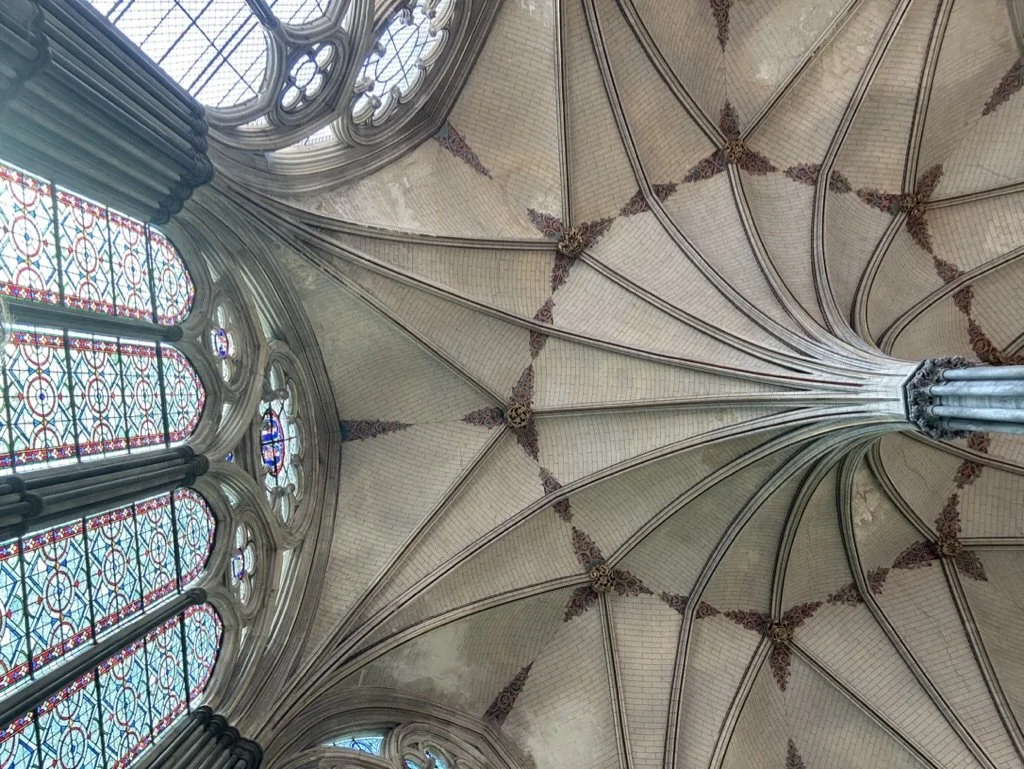
The ceiling of the Chapter House.
Within the Chapter House is held the Magna Carta, one of four copies written in 1215 when King John met the barons at Runnymede and was forced to sign the first version of this all-important document.
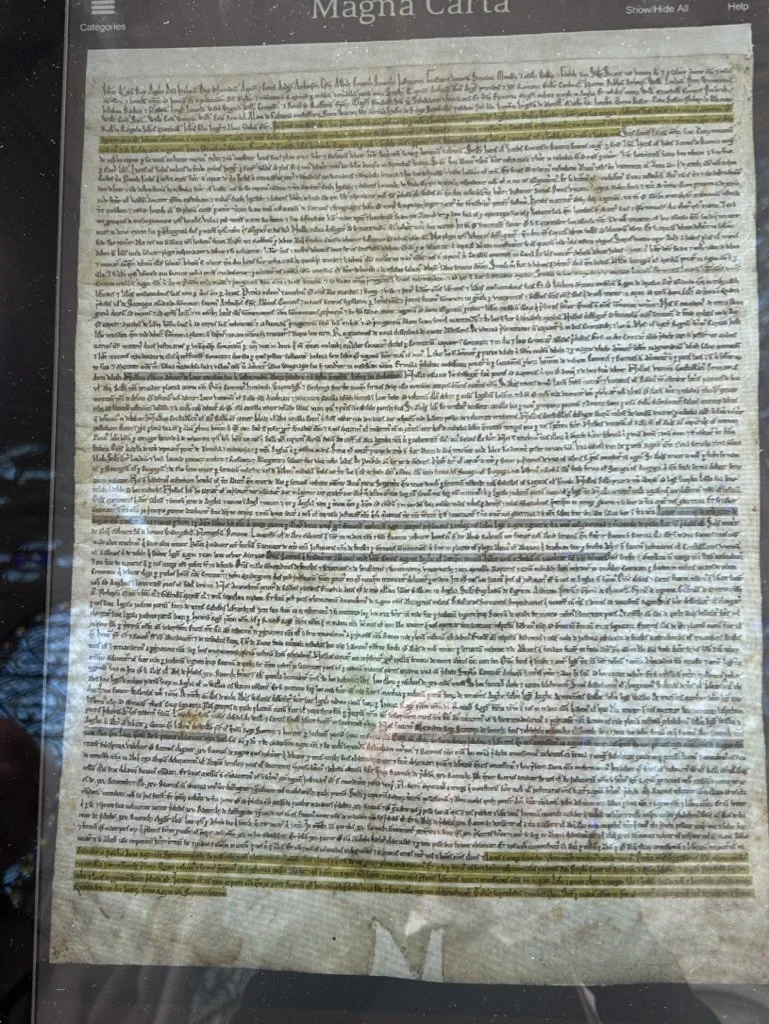
This image of the Magna Carta is taken from a screen outside the darkened, tent-like room where the original is housed securely under glass and where no photos are allowed. To stand in there before the original was a more reverential experience than beholding any of the religious icons. This document is the forerunner of the laws pertaining to human rights in the English speaking countries and which emerge from the United Nations.
Also in the Chapter House is a narrative frieze of the bible stories from Genesis and the first chapters of Exodus.
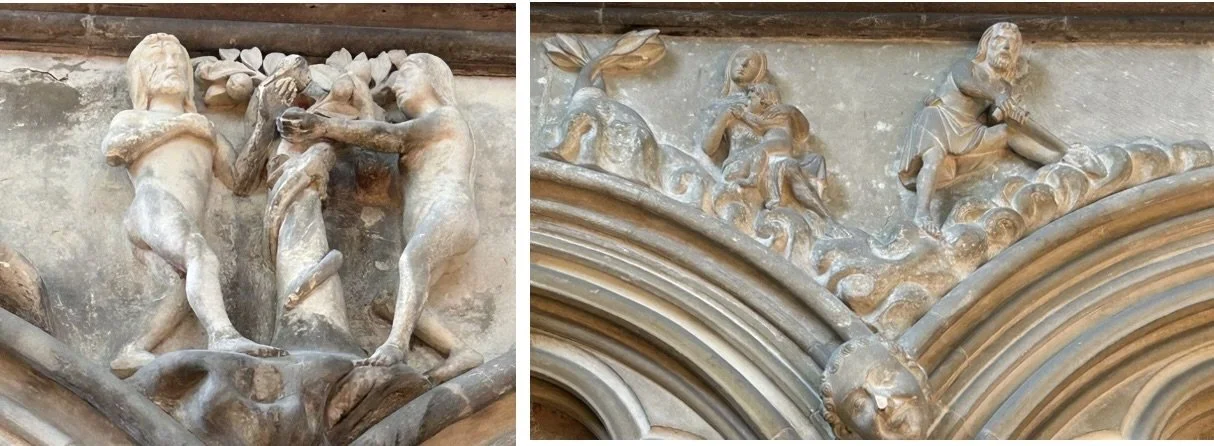
After the Creation (left) is the sculpture of Adam and Eve, naked under the tree of knowledge. After they have sinned and been expelled from the Garden of Eden, they are punished by God, (right) Eve to bear children in pain and be bound to nurture them and Adam to till the soil.
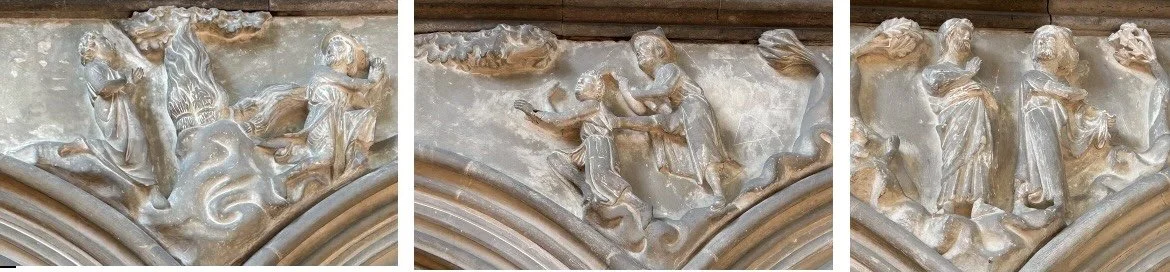
(left) Then is the image of Abel sacrificing a yearling lamb and Cain sacrificing his fruit of the soil; Cain’s sacrifice was not worthy in God’s eyes (centre). He became jealous of Abel and killed him; so God banished him to wander in the Land of Nod. (right) To ease Cain’s fear of being killed, God marked him with a sign to protect him.
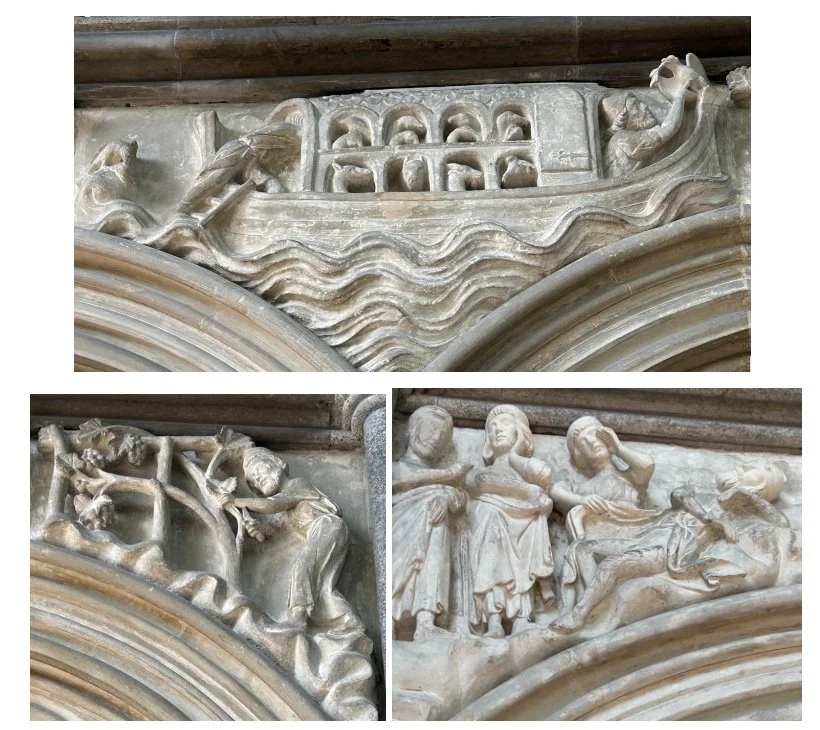
(top) Noah has built his ark and is releasing a dove to find dry land;
(left) AFter the flood, Noah cultivates a vineyard. (right) He becomes drunk and Ham sees him naked in his tent.. He calls Shem and Japheth to look but they cover their father. Thereafter, Ham must live out Noahs curse, that he be father of the Canaanites and forever a servant to his brothers who will be blessed by God.
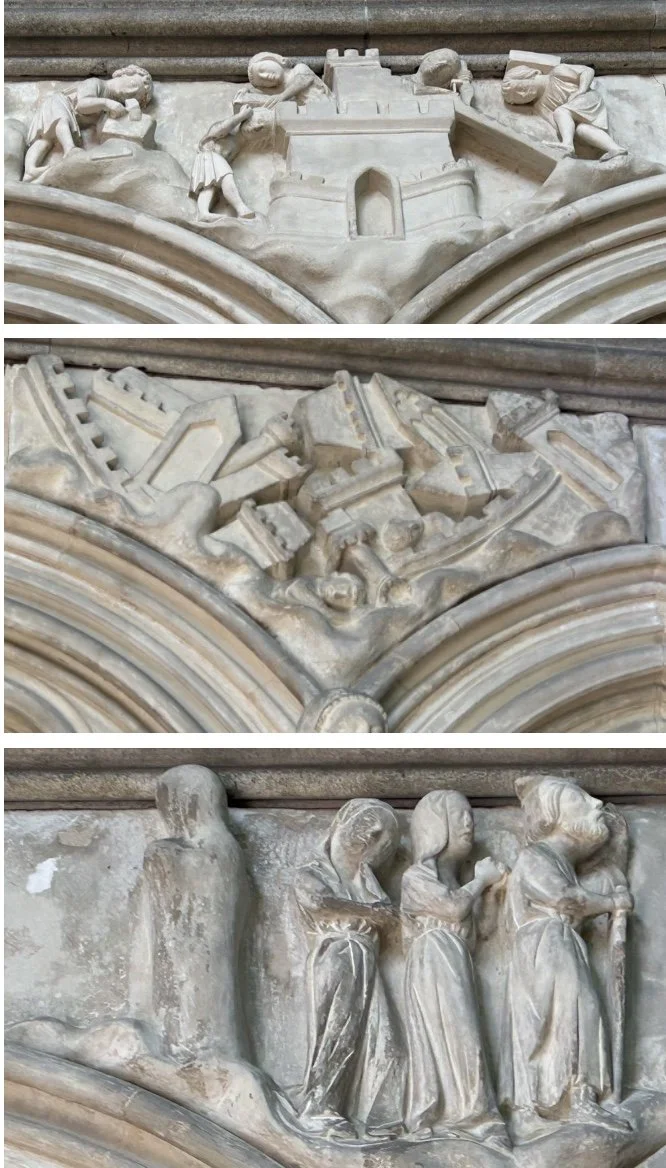
(top) Building the Tower of Babel
(centre and bottom) The destruction of Sodom and Gomorrah and Lot escaping with his daughters while his wife turns back and is turned into a pillar of salt.
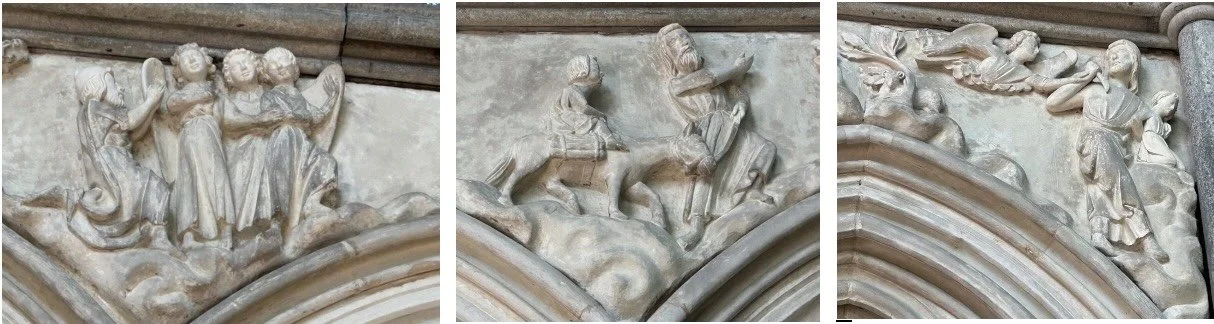
(left) abraham receiving three angels in the form of messengers, being told his aged wife will have a child. (centre) Abraham taking his son Isaac up the mountain to sacrifice him according to God’s will. (right) The Angel telling Abraham God is pleased with his loyalty and he need not slay his son. The angel points to a ram in the thicket that God will accept as an adequate sacrifice.
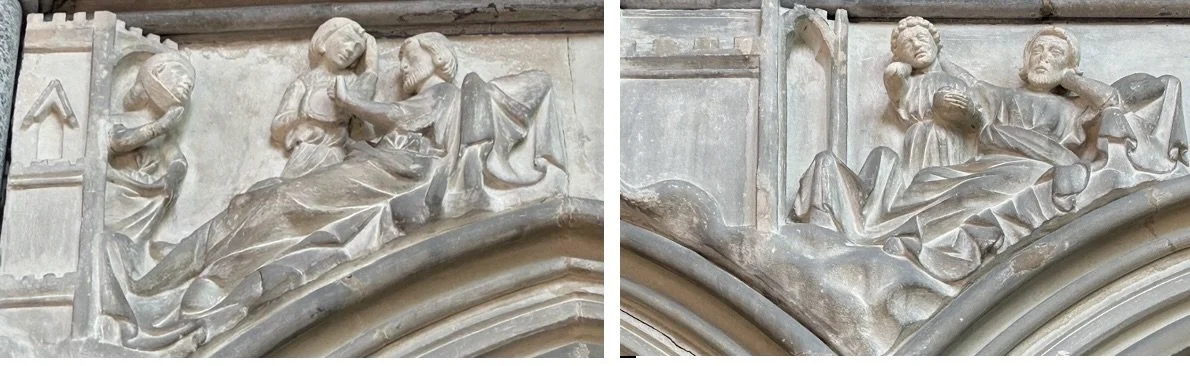
Isaac is old and blind. He and Rebecca have two sons, Esau and Jacob. (left) Isaac tells the hirsute Esau he will give him his blessing which means the inheritance of the lands. Rebecca overhears and because she favours Jacob, she deceives Isaac by covering Jacob with sheep’s wool and sending him to the father to receive the blessing instead of the elder Esau.
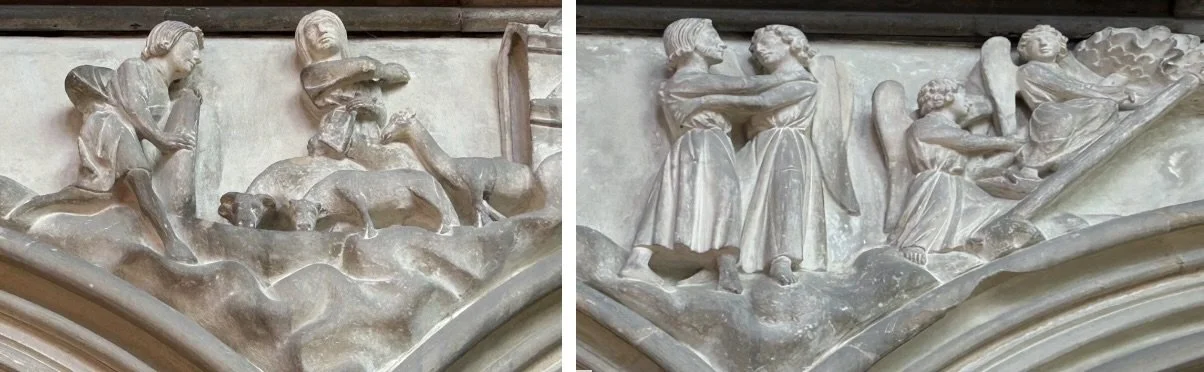
(left) Rebecca advises Jacob to run away to escape Esau’s fury. He goes to her brother Laban. On the way (right) he dreams he wrestles with an angel and see the ladder to heaven. From now, God names him Israel, the Father of the Israelite people.
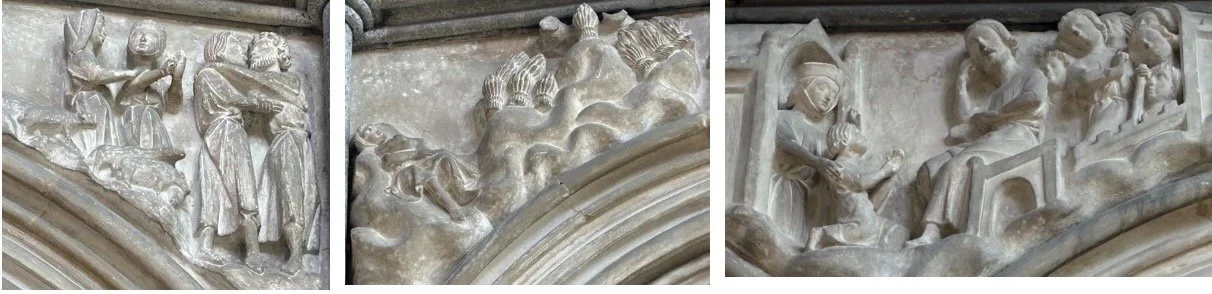
He works hard for Laban for seven years to earn his younger daughter Rachel. But first he must marry Leah, the elder and work another seven years before he is able to marry Rachel (left). Eventually, he returns to Esau’s land with his two wives, one daughter and eleven sons of Leah and two sons, of Rachel Joseph and Benjamin. (centre) Joseph dreams that eleven sheaves of corn bow down to one sheaf and the sun, moon and stars bow down to him. He tells the dreams to his father, interpreting them as a sign of his prowess over his brothers. They are angered and jealous.(right)
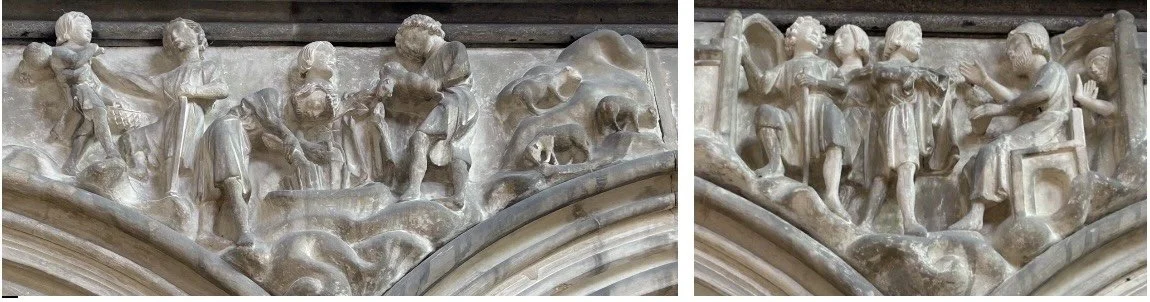
The brothers try to drown him in a cistern but Reuben urges them not to; they sell him to slave treaders going to Egypt. They soak Joseph’s coat of many colours in goat’s blood and (right) and show it to their father, telling him that Joseph is dead, killed by wild animals.
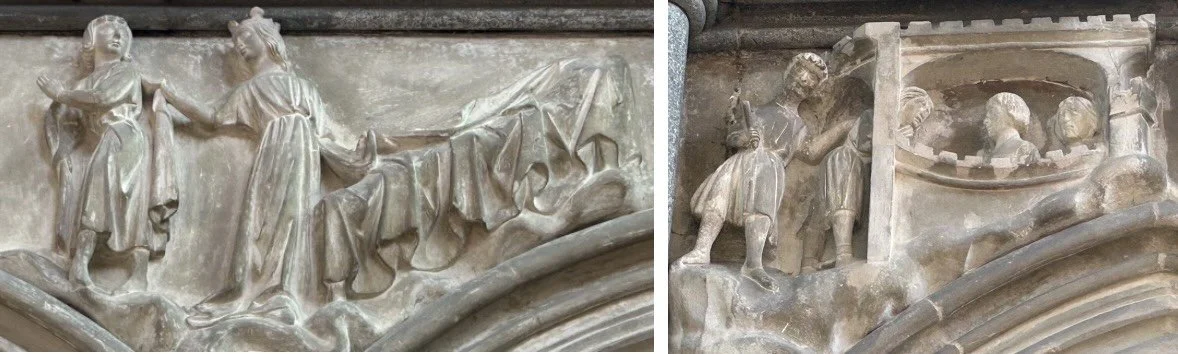
Joseph is bought by Potiphar, a general in Pharaoh’s army. He is granted a high position. (left) Potiphar’s wife tries to seduce him. When he rejects her, she accuses him of attempting to rape her and (right) he is imprisoned with the Pharaoh’s baker and cup bearer..
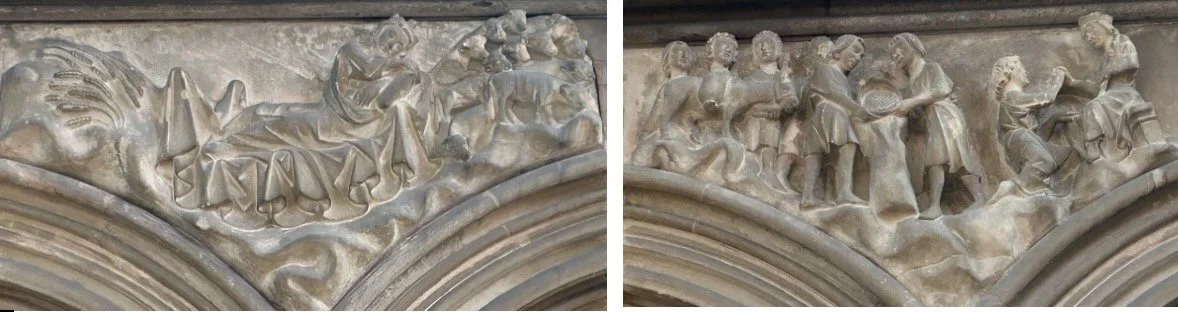
Pharaoh dreams of seven thin stalks of wheat devouring seven fat stalks; and seven thin sheep devouring seven fat sheep. Joseph interprets the dreams: seven years of plenty will be followed by seven years of famine. He is appointed as Pharaoh’s vizier to oversee the storage of grain in preparation for the famine. (left) Jacob sends Joseph’s brothers to Egypt after two years of famine to buy grain. Joseph recognises them though they do not know him. He accuses them of spying (right) When they plead innocence, he gives them grain and tells them to return to their father and return with their youngest brother as a sign of their veracity. This happened.
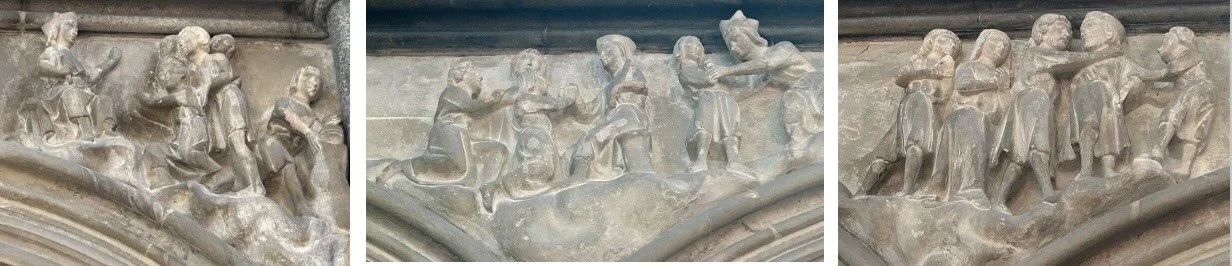
(left) As Joseph’s resentment persisted, he placed his silver cup in Benjamin’s sack of grain. It was discovered by guards and the brothers were again accused of treachery. Benjamin’s brother pleaded that he be imprisoned instead of Benjamin (centre) and Joseph was overcome with emotion and relented. He revealed himself and invited the brothers to live by the Nile; but first to go home and bring their families. (right) Joseph is reunited with his father. Over many generations the family of Jacob, the Israelites prospered but with political change, wars and less sympathetic pharaohs their favour declined and they became enslaved. Moses brought them out of the land of slavery.
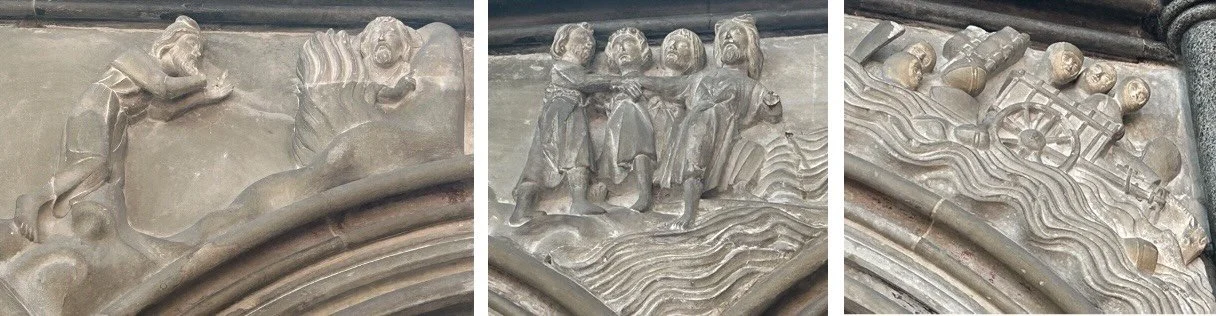
(left) God appeared to Moses in burning bush, telling him to save his people. (centre) The Red Sea parts and Moses leads the Israelites into Canaan. (right) the seas close and drown the Pharaoh’s army that is in pursuit.
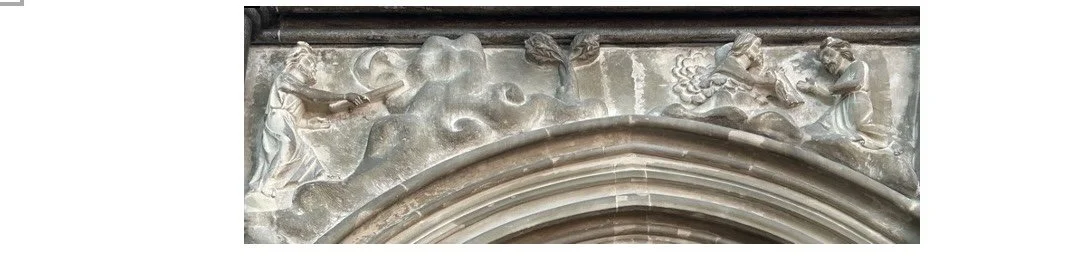
Wandering in the desert, Moses strikes a rock and water gushes forth. (left) On Mt. Sinai, God hands to Moses the Ten Commandments written on a stone tablet. And that is the end of the narrative.
Yet, it is for the eyes of the literate bishops, not the common people for whom cautionary tales are carved or painted in church aisles or pillars of the naves.
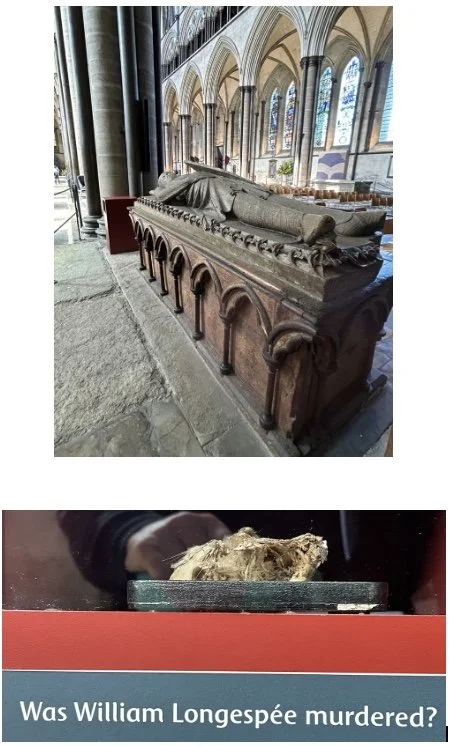
top ; william Longspée’s effigy.
The lower image is of a rat.
But before we leave, let us wonder about a murder. William Longspée, Earl of Salisbury, half brother of King John, was the first person to be entombed in the cathedral. In 1215, King John withdrew from the agreement, the first charter, which Longspée had signed, and waged a civil war against the barons. They pleaded with Louis, King of France to assist them and replace the king. Longspée deserted the king and joined the French cause. In October 1216, King John died, with most of England under the control of Louis and the rebels including the king of Scotland. John's few remaining supporters decided to make his nine-year-old son, Henry, king. King Henry III was knighted and then crowned on 28 October 1216. Following this, John's leading advisers sent out letters to all the rebels in the name of the new king, confirming Magna Carta and calling for their loyalty. Many of the barons, including Longspée, left Louis of France and gave their loyalty to the young King Henry.
For the remainder of Henry III's childhood, Magna Carta was repeatedly confirmed and reissued and became well-known across England, not just among the barons, but also in the counties. There was struggle for power between the aristocrats as the Regency drew to a close and it was thought Longspée was poisoned. The evidence lies in the rat that was discovered in his skull when his tomb was opened in 1791; it contained arsenic.