PAREIDOLIA
par·ei·do·lia ˌper-ˌī-ˈdō-lē-ə -ˈdōl-yə : the tendency to perceive a specific, often meaningful image in a random or ambiguous pattern. The human ability to see shapes or make pictures out of randomness. (Merriam Webster online) from para = beside and eidolia = shape
I am sitting at my kitchen table, listening to the last chapters of David Copperfield on Audible, having spent this Sunday trying to resurrect my hopeful herbaceous border. Its thousands of seeds have been stymied by snow, hail and wind. I do not see Spring’s regenerative power after a wintry sleep. I have given into mature plants from large pots bought at some expense from the nursery I have been patronising for fifty years. On the grassy slope of the park beyond the back fence, I can see a red-foliaged, unkempt prunus protecting its community of birds’ nests. From its extremity, a fox is watching me on very long legs which I must imagine as they are hidden behind the lilly pilly hedge on my boundary. The wind gives it a restlessness and the descending sun alters its colour from red gold to orange and brown on its shaded side. It has sharp ears and a long, curved neck connecting it to its body hidden in the thicket of the foliage. Its snout tosses and sniffs about; I imagine it is seeking Roland, the labrador.
I have the self-imposed luxury of writing with unconstrained pleasure because this morning I sent to the publisher the bibliography, acknowledgements and list of illustrations, with instructions about whether they be black and white or colour, pertaining to the book I have written about the stonemason who, legend says, carved the one hundred and eighty arch stones and six keystones on the Ross Bridge. The corrected proofs were sent two days ago. There were sixty-eight corrections which took two days to extract from the text I had edited any number of times before I had delivered it in the first place. I am sure there are acknowledgements which remain in space; I hope their wraiths smile upon my forgetfulness. I trust a graphic designer or editor will tidy the list of end notes and the bibliography because, for the life of me, I could not get the font consistent in size or blackness or the spacing an even 1.5 or the margin straight.
In the wake of their flight, I have gardened and now I am writing about an imaginary fox and pareidolia, a trait some regard as an affliction because seeing non-existent creatures in prunus trees could be madness. It has been a part of my mental make-up for as long as I can remember and seems to be perfectly normal. I am sure it has not caused me any suffering; on the contrary has filled many silent hours with stories filled with fanciful pictures. While I lie in the bath and the dark, night sky fills the window space, the light from the ceiling falls on the textured glass. Its pattern is ‘Cathedral’ though I cannot see or say why. Interlocking polyhedrons with raised, rounded margins are subdivided into hundreds of shapes, their edges refracting and reflecting into a menagerie. A human being shepherds beasts from the top right-hand corner; he is constant and gnomish, but the animals come and go, slinking in and out of my mind’s eye between nights and even during one bath-time. I shut one eye and then the other and watch them shape-shift.
I am practising defending my pareidolia as I prepare a PowerPoint presentation for a group of garden history enthusiasts meeting in Ross in a month. My chosen title is The Bisected Orchid. There is a carving of the cross section of two orchids, one upon the other, on the bridge. I am convinced this is not fanciful.

8th stone L west arch north face two orchids
They are neither lyres nor lilies, nor irises. There is no doubt they are orchids openly exhibiting similarities with women’s genitalia. I am not the only one who has realised the resemblance. Botanists acknowledge this similarity in their description of the bloom: the lower petals are called the labellum, which stems from the Latin labium (lips), the root for labia. The anther cap, meanwhile, bears a striking resemblance to the clitoral hood. But is it an immaculate womb or a vagina dentata? Watch a worker bee vanish into the throat of an orchid flower. In their beauty and delicacy, they can be a source of joy, but they can also inspire fear. Femininity, sex and death are themes pervading antiquity and the bridge’s sculptures.[1]
[1] https://medicalhealthhumanities.com/2018/02/05/stranger-things-maternal-body-horror/
A History of Orchids. A History of Discovery, Lust and Wealth. Scientific Papers. Series B Horticulture. Vol. LXIV No. 1 2020.
There was a long-standing belief that the tubers of orchids had stimulatory, generative and curative benefits, particularly for men because they look like testicles. The Greek philosopher, teacher, botanist and successor to Aristotle, Theophrastus, used the word orkhis to identify orchids, orkhis being Greek for testicle. In the first and second centuries AD, Dioscorides and Galen developed the idea that plant parts which looked like human parts were made for human use in the healing of ailments afflicting those organs or limbs. Paracelsus (1493-1541) of the inspiring name, Philippus Aureolus Theophrastus Von Hohenheim, called this philosophy The Doctrine of Signatures. Theologically, the notion was impressed upon the medieval gullible that God had designed things deliberately so.
The orchid was used for its healing properties in diseases of the male genitalia and its efficacy in the treatment of infertility, impotence, low libido or excessive passion[1]. In Gerard's Herbal (John Gerard, 1542-1612), published in 1597, orchids had been called "Satyrion Feminina" because they were considered satyrs' food that would enhance orgiastic fervour. Witches used orchid tubers in their philtres or love potions, the fresh, firmer tuber being given to promote true love, and the withered one to reduce passion. Thus, with the still-room maids and herbalists, the cunning women of late medieval Britain entrenched the value of their prescription. In the 17th century, the English botanist, herbalist, physician and astrologer Nicholas Culpeper (1616-1654) assumed the Doctrine of Signatures theory was common knowledge in his book the ‘Complete Herbal’ (1652-1653), so the ubiquitous belief in the magical and medicinal powers of orchids was perpetuated by the ladies of the houses who read the pharmacopoeias of the day.
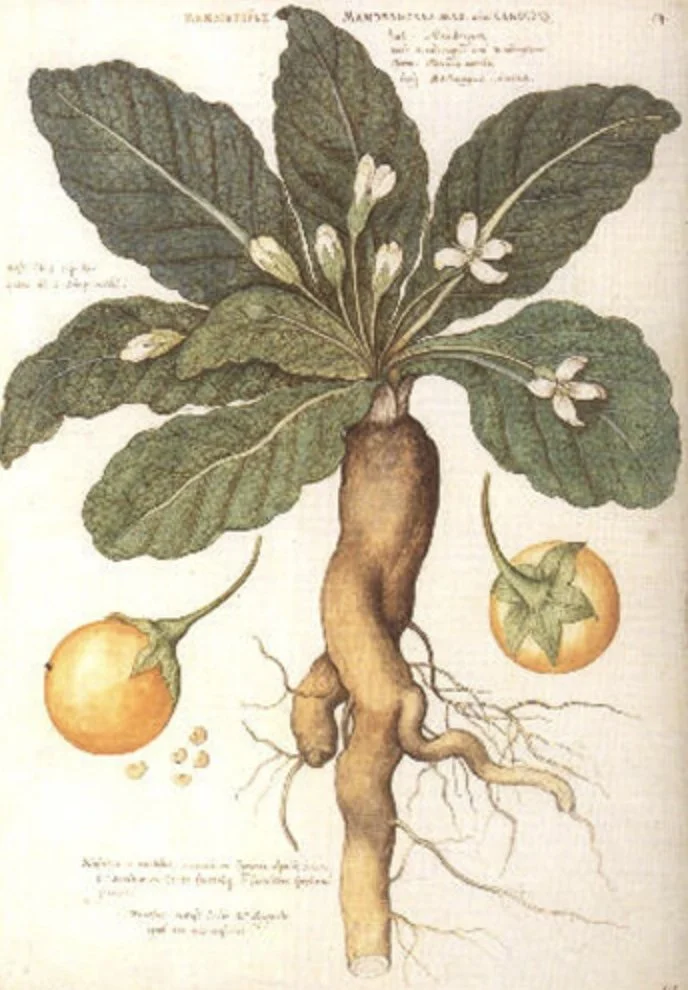
Some of the philosophers of the Middle Ages imagined that these plants grew from the drops of semen which fell to earth in places where animals or birds came together to breed, which is fascinating, for a similar notion applies to the Mandrake plant – that it grows under the gallows where the semen of a hanged man falls - and I think there is a mandrake on the bridge too. It is not pareidolia alone but in combination with reason that has led me to this conclusion.
The grotesque of the convicts’ nemesis, Lieutenant Governor Arthur, is carved as an anthropomorphic lion atop a mandrake plant, its leg-like roots astride an androgyne, or two-in-one, thus obscenely parodying an ancient symbol of unity. The juxtaposed death’s head is not a coincidence. During the twelve years of Arthur’s rule in the colony of Van Diemen’s Land, more than 260 people were hanged.
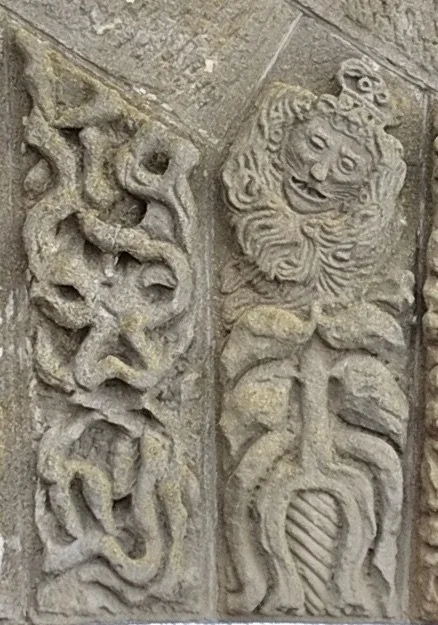
6th & 7th stones L eastern arch south face LIeutenant Governor Arthur juxtaposed to a death's head
The mandrake’s root is said to resemble the human form and according to the Doctrine of Signatures, can be a curative for any diseased part of the body that has a corresponding likeness to a part of a root. As was the orchid, it was considered an aphrodisiac with the attribute of increasing fertility but was also known as Abu’l-ruh, Old Arabic for “master of the life breath”, Satan’s apple, Manroot, Devil’s testicle and Circe’s plant, a poison since time immemorial.
When I was preparing my first lecture about the bridge’s carvings, I was warned not to talk about the ‘fairies’ that only I could see. It does puzzle me that not everyone is struck by their outlines. I regret that I shall be constrained by civility and be unable to explain to the audience of garden enthusiasts that the two vulval-like orchids are connected by a tongue. What else but women combined in cunnilingus? The bane of the colonial administration was the prevalence of ‘unnatural crimes’ in convicts of both sexes; that is, sexual congress between members of the same gender or with an animal. In the fight against transportation by the colonists, it was their most vivid and compelling argument to shock the people of Victorian England into hearing their plight. When the bridge carvings were in the making, however, Queen Victoria had not ascended the British throne and the age of properness had not yet emerged with the embryonic middle class. Poverty-stricken, beaten-down, vulgar, brutalised men and women, lewd in vernacular and licentious in their behaviour, were exiled to the antipodes for their crimes, their behaviours augmenting and entrenching in their isolation in Van Diemen’s Land..
“Let a man be what he will, when he comes from here, he is soon as bad as the rest – a man’s heart is taken from him – and there is given to him the heart of a beast,” said a convicted man from the dock; it is said he drew tears from the judge. [1]
The sculptures represent their defiance against harsh authority and well-mannered folk in cahoots with it. Understanding them in their awful conditions lessens the suspicion of pareidolia and replaces it with an inkling of the truth.
[1] Colonial Times Hobart Tuesday 25 December 1849 p2
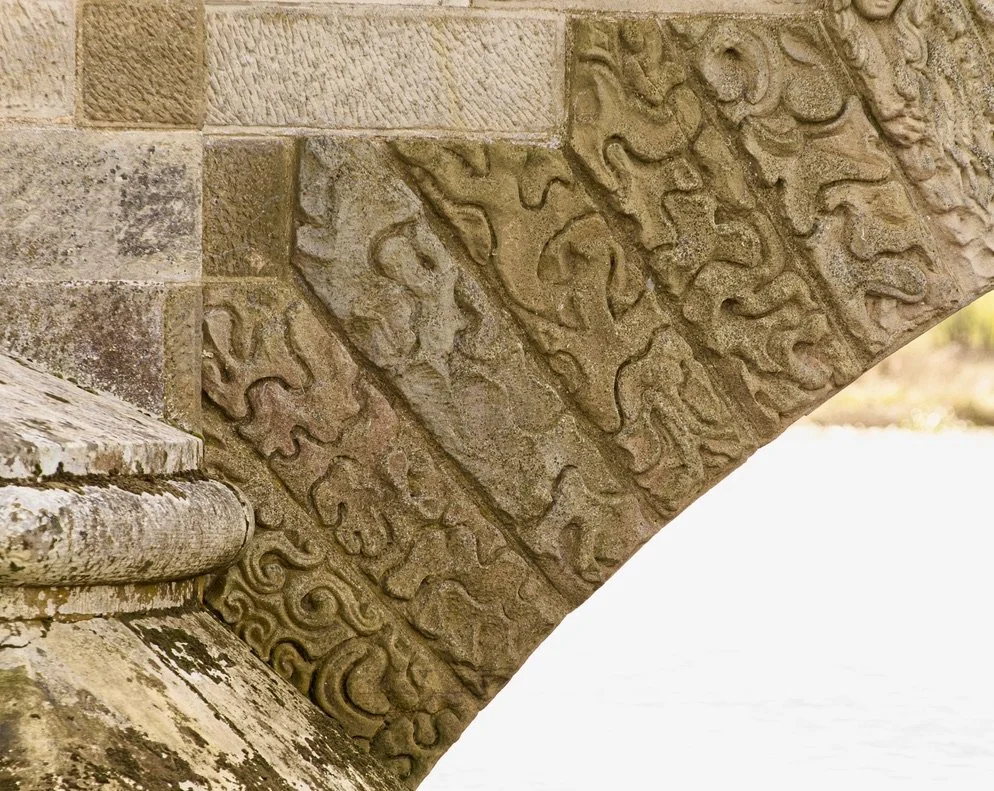
Western arch south face
The fairies of the warning are on the lower stones of the south facing west arch. They seem to me to be characters out of Melanie Warren’s book, Lancashire Folk. It is full of stories of fairies, ghosts and green men, monsters, mermaids, giants and boggarts. She did not agree with me that the two cats on the fourth stone were Dildrum and Doldrum. She wrote in an email: I think the Dildrum/Doldrum connection is a stretch, the ‘cats’ could just as easily be representations of witches’ familiars? Plus, the story does not mention the two cats being physically together. But without being a pareidolic interloper upon her domain, I can see a dead cat lying horizontally and the upright cat climbing up the chimney – which is as the story goes.
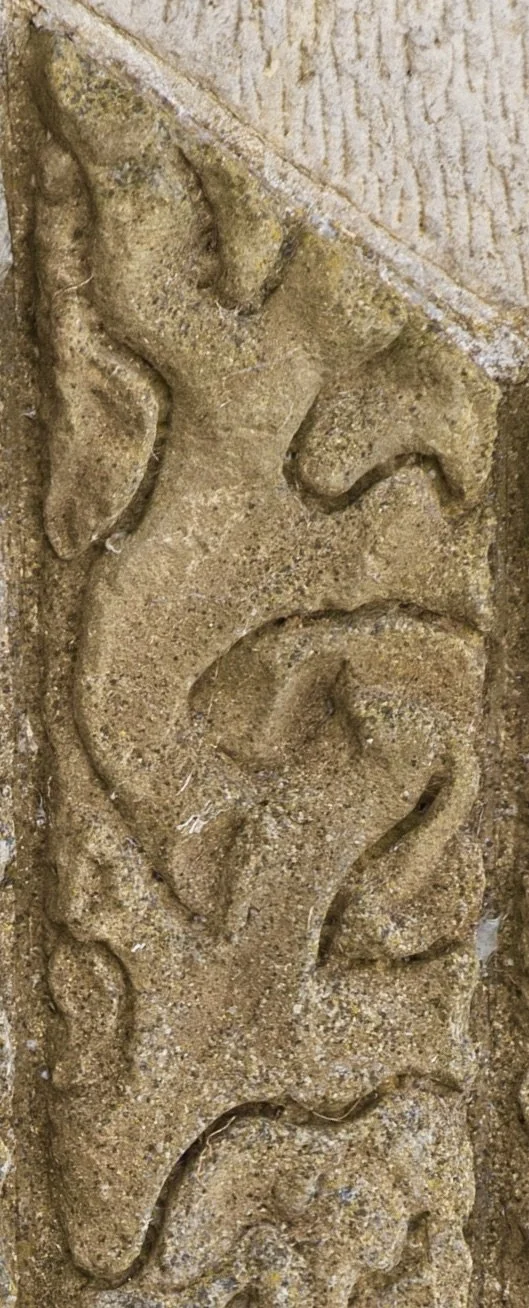
two cats: one dead, one upright.
As for the foliate face on stone 6, perhaps he benignly represents the verdant Spring’s regenerative power after a wintry death as genteel Victorians would have had us believe, but he has been about in England’s theatre and pageants since the 14th century as a wild man. In Edmund Spenser’s The Faerie Queene of 1596, in Book IV canto vii, the wild man lived all on ravin and on rape of men and beasts and fed on fleshly gore. Women in his thrall suffered most cruelly: He with his shamefull lust doth first deflower and afterwards themselves doth cruelly devoure … Spenser’s metaphor for lust is the bestial wodewose or Green Man. I have often pondered Dan Herbert’s education, wondering whether he was exposed to the English literary greats like Spenser. And then, how he absorbed and ornamented their characters as his degradation spiralled downwards.
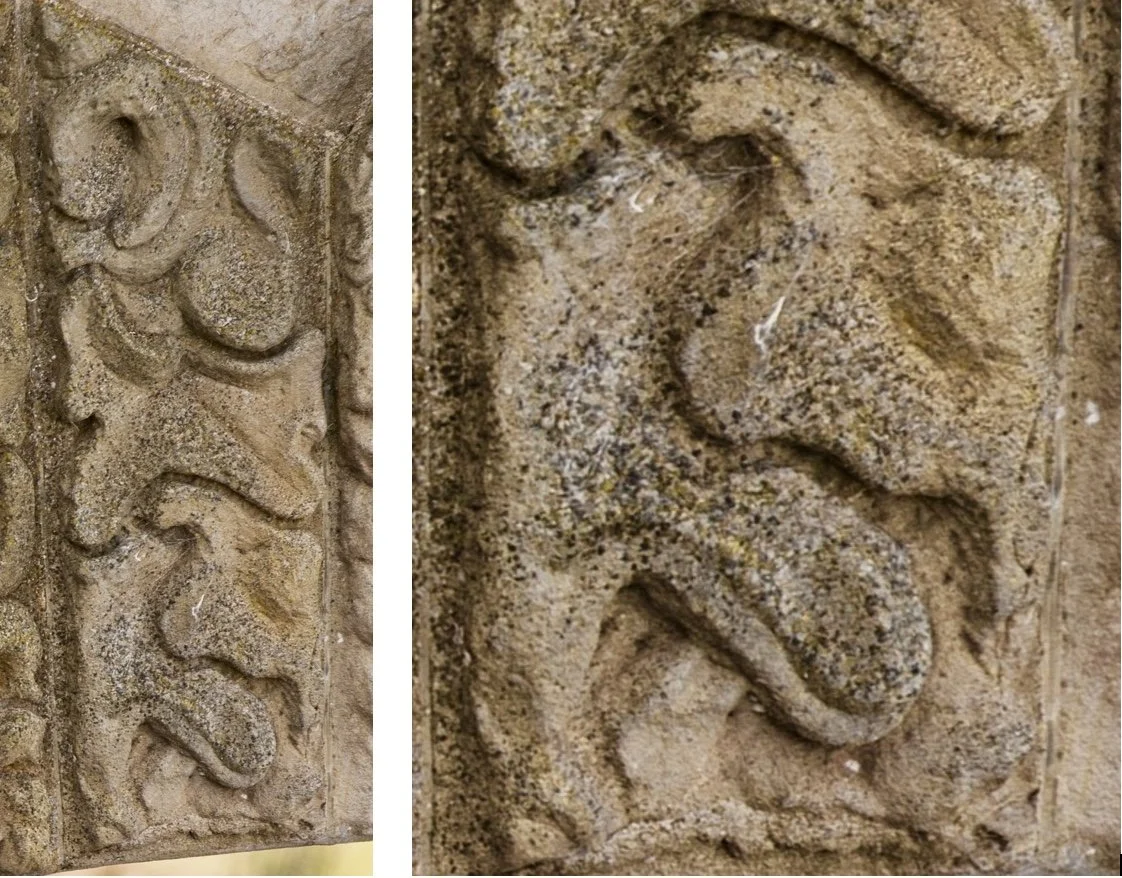
Foliate mask and rampant bull 6th stone western arch south face
Is it no accident that the wodewose oversees the seduction of a cow by a rampant bull with rising phallus.[1]
Pareidolia? I shrug and purse my lips and leave it up to you to see what you may, my audience and readers. Bring your binoculars.
[1] https://blogs.loc.gov/folklife/2023/10/green-man-connections-the-foliate-head.
Robert Hillis Goldsmith, The Wild Man on the English Stage The Modern Language Review Vol. 53, No. 4 (Oct., 1958), pp. 481-491