SEARCHING FOR THE ANGEL OF SARAH ANN ELLIS’S GRAVE at ROSS, TASMANIA, WHILE VISITING THE CHAPEL OF ST.LAURENCE BRADFORD ON AVON.
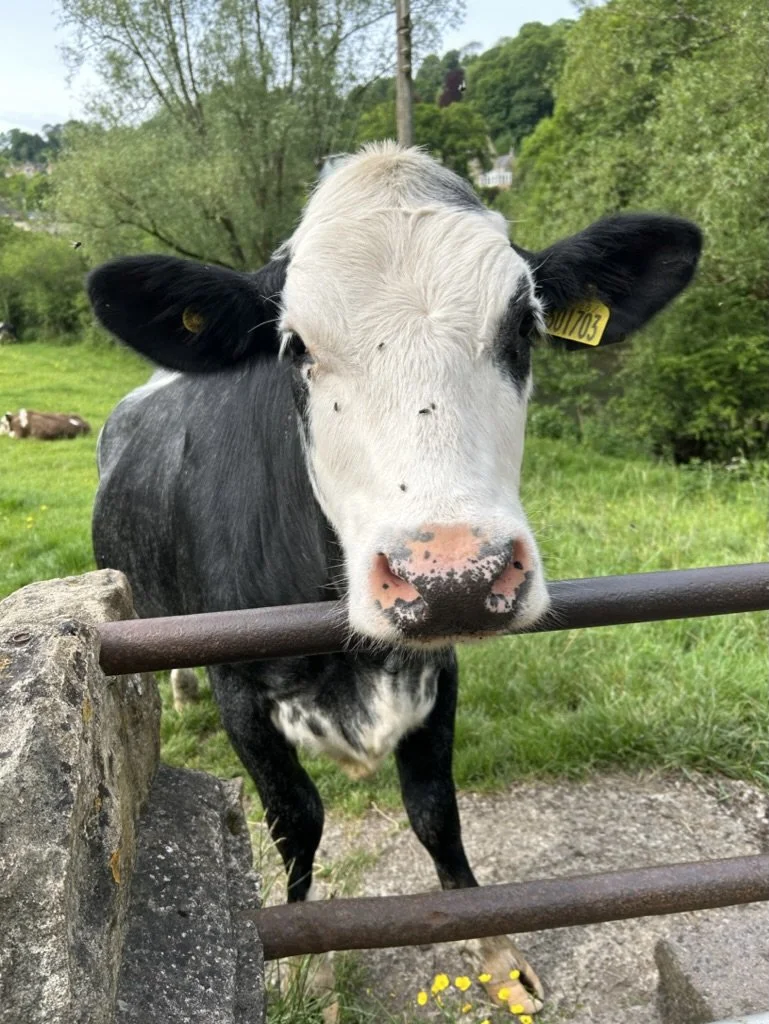
I met Jane Read just up the hill after I had asked the fly-irritated cow the way to Bradford upon Avon from Limpley Stoke. She was walking down towards the river path with her dog, Lucy and kindly offered to show me the way. She went beyond her intended stroll and we talked the whole way to Bradford and back around a loop through the villages of Turleigh and Winsley.
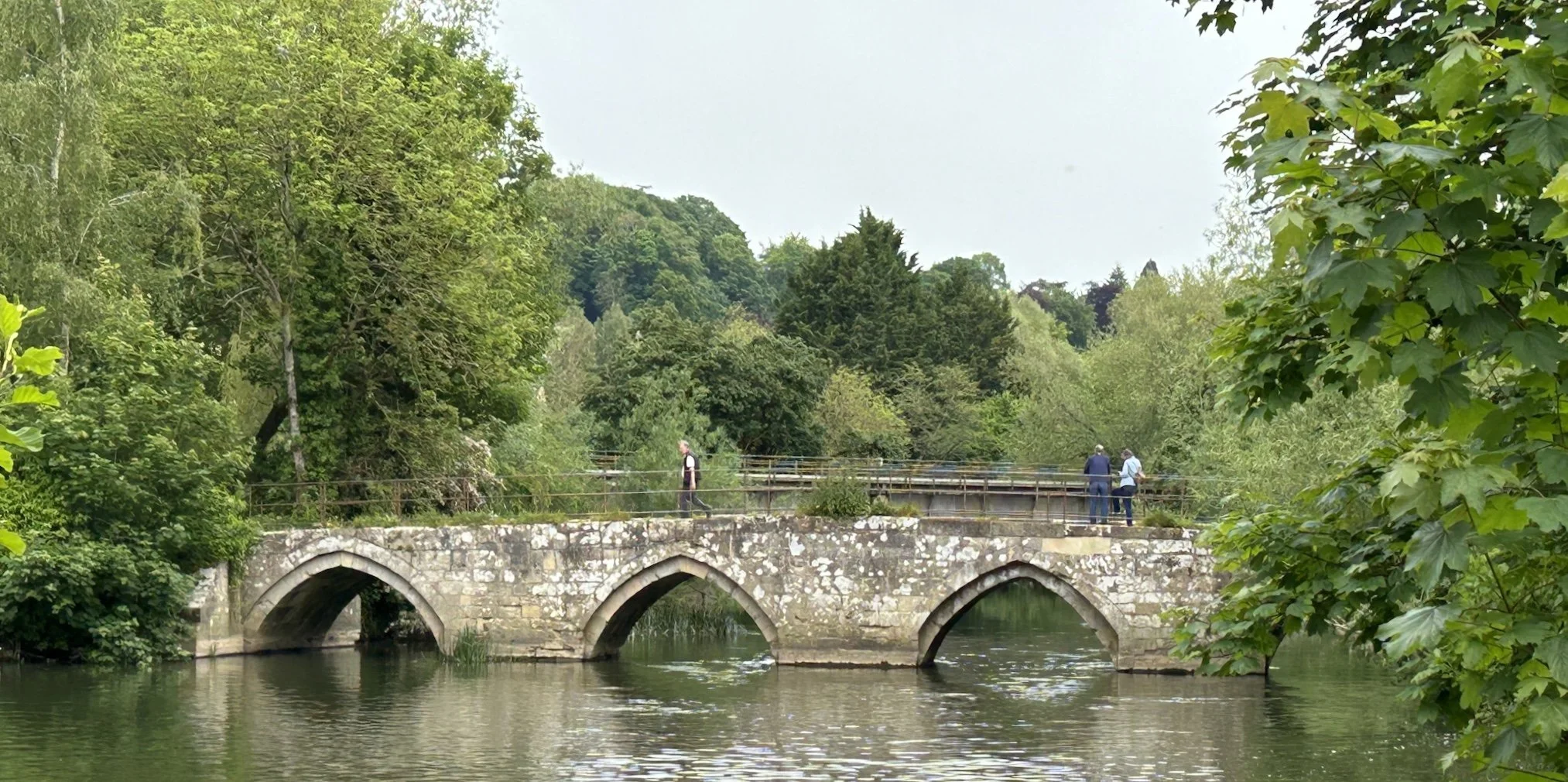
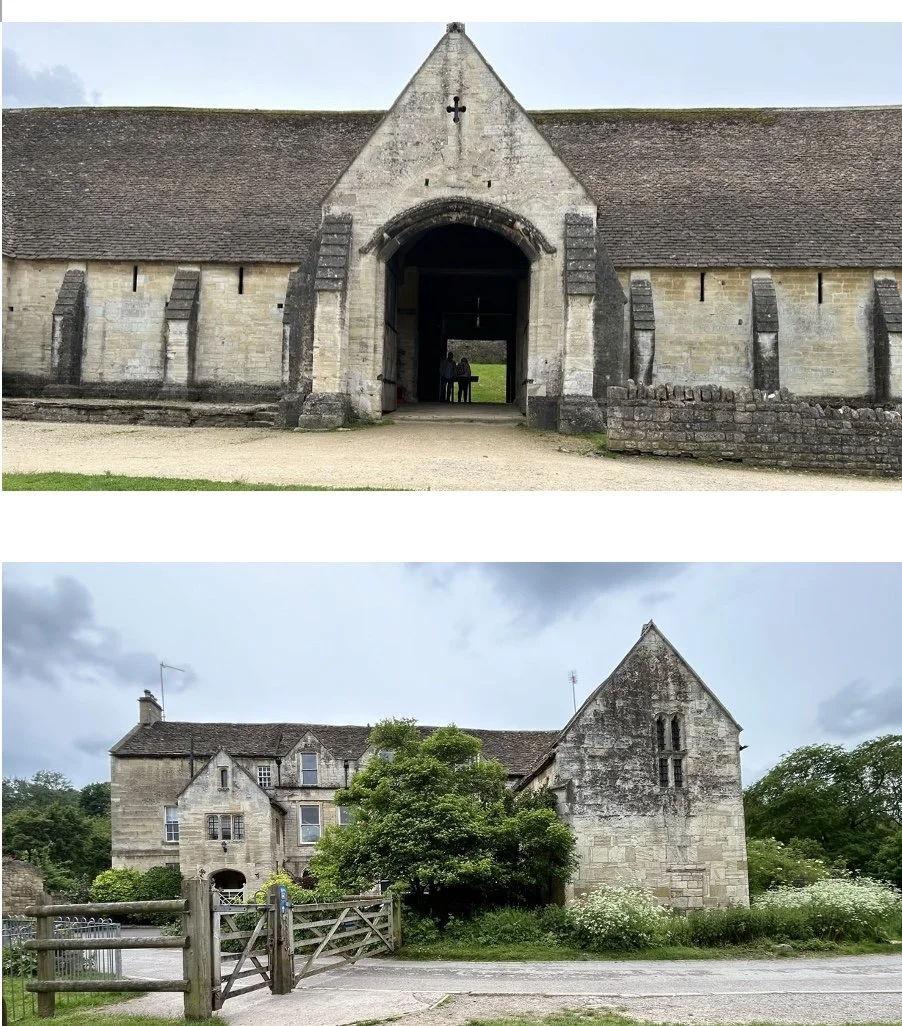
We breakfasted gazing at remarkable Tithe Barn, the middle image. Above is the medieval bridge at Bradford and below, the manor house.
The Tithe Barn has been standing solidly since since the 14th C, despite the depredations of the protestants in 1539. .It was built in the mid-14th century to serve Barton Grange, at the broad ford on the River Avon. The manor farm belonged to Shaftesbury Abbey in Dorset which was the richest nunnery in medieval England. But the barn was never vermin-proof and was probably used for cattle, not so much for storing the grain which was the tenant farmers’ tithe.
I have copied from the website of English Heritage:
https://www.english-heritage.org.uk/visit/places/bradford-on-avon-tithe-barn/history/
[Mention of] settlement had certainly appeared by 1001, when King Æthelred ‘the Unready’ (r.978–1016) granted the manor of Bradford, consisting of lands, the parish minster (religious community) and adjacent town, to the nuns of Shaftesbury Abbey, one of the richest religious houses in England. He made the gift in honour of his half-brother, King Edward ‘the Martyr’, who had been murdered in 978, probably by Æthelred’s mother’s retainers. Æthelred stipulated that Edward’s bones should be enshrined at Bradford, where they might be venerated, although there is no evidence that the martyred king’s remains were ever brought there, that is, to the Saxon Church of St. Laurence.
The manor of Bradford-on-Avon was very large […] There was land for 40 ploughs, 8 of which belonged to the manor farm, Barton Grange. The whole manor was worth £60 a year, making it an outstandingly valuable property.
Shaftesbury Abbey was closed as part of the Suppression of the Monasteries in 1539. The Hilary Mantel trilogy about Thomas Cromwell tells of the fate of the nunneries. In 1546, Henry VIII granted Bradford-on-Avon manor to Sir Edward Bellingham, a gentleman of the Privy Council. Upon Bellingham’s death in 1551 it reverted to the Crown.
Over the next 80 years, the manor passed through several hands, although it was never occupied as a principal residence. In 1635 it passed to William Paulet, Marquess of Winchester. The Paulets then held the manor and the barn until 1774, when they sold it to the neighbouring landlord, Paul Methuen of Corsham. In 1850 the manor was bought by Sir John Cam Hobhouse, Baronet, later 1st Lord Broughton. (While at Cambridge Broughton became good friends with Lord Byron. He was imprisoned in his own country in 1815 for writing a pamphlet supportive of Napoleon and damning of Bourbon royalty. He shared Byron's enthusiasm for the liberation of Greece; after the poet's death in 1824, Hobhouse proved his will, and superintended the arrangements for his funeral. )The lordship of the manor has remained in the Hobhouse family ever since.
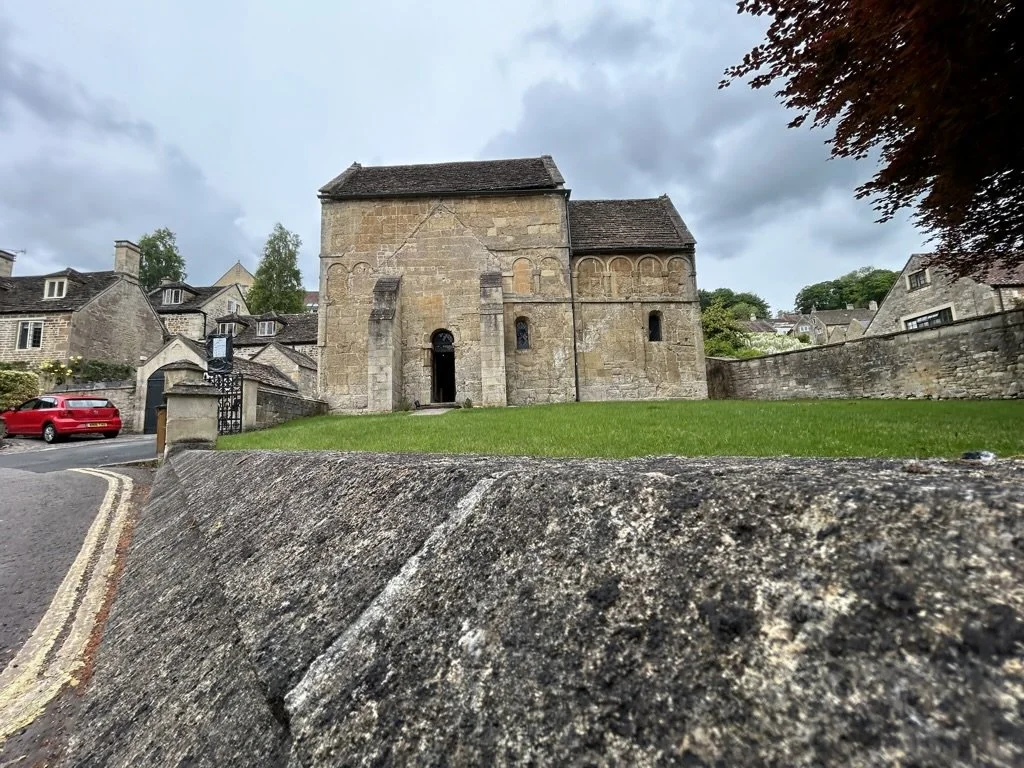
Saxon Church Bradford on Avon
And there, as we walked over the bridge and up a hill was the Saxon Chapel of St Laurence I had come to see. It has been described as being of ‘exceptional archaeological value’ and the building itself as ‘the most important remains of Anglo-Saxon architecture’ in England.
(A Discovery of Angels: How an Anglo-Saxon Chapel Gave up Its Secrets Wayne Perkins https://ritualprotectionmarks.com/2022/12/23/a-discovery-of-angels-how-an-anglo-saxon-chapel-gave-up-its-secrets)
In Tasmania there is a busy, skinny angel carved into the footstone of Sarah Ann Ellis’s grave at Ross, attributed to Daniel Herbert, convict stonecarver.
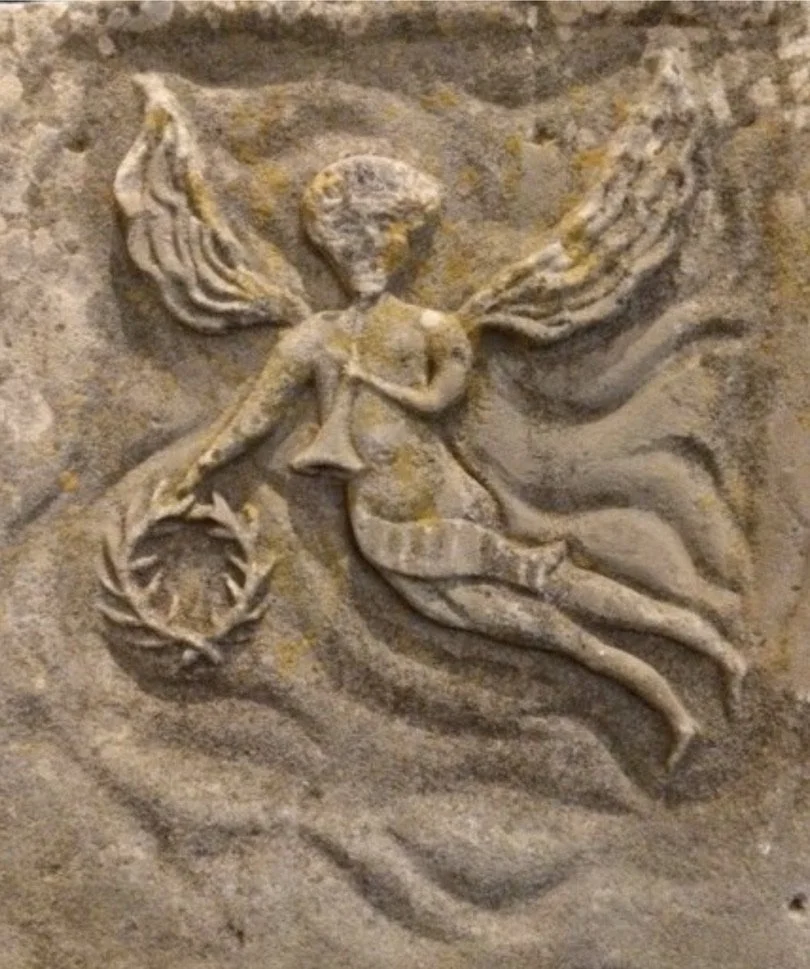
The footstone of Sarah Ann Ellis’s grave, Ross Tasmania
I knew that in this church in Wiltshire were skinny-ankled angels from a book I read by Andrew Ziminski, The Stonemason - A history of Building Britain. Ziminski wanted to know everything about the old stone constructions of Britain. He began to learn his trade from his father and stonemasons as a schoolboy, afterwards becoming a fixer mason - one who dares to fix the work of those who went before.
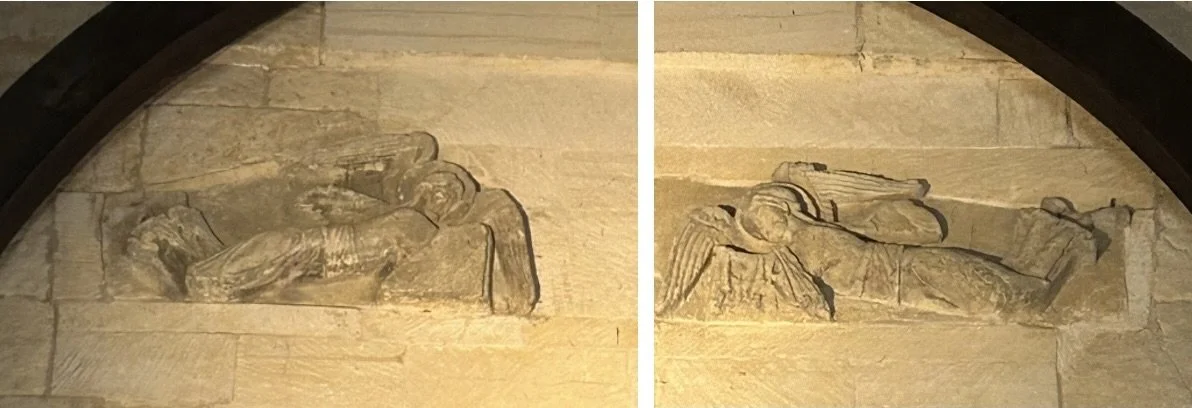
Angels in the Saxon Church of St Laurence Bradford on Avon Wiltshire UK
Jane took the photographs as I sat and gazed in wonder. I doubt that Dan Herbert ever saw these angels, but there are others elsewhere in England he may have been shown as an apprentice. He was born in Taunton, 65 miles to the south, but I think he was a baby when his family followed his father’s regiment to Birmingham, where the father died. There is always a suspicion that he did not carve Sarah’s angel but the more travelled and experienced mason, James Colbeck did. Perhaps they collaborated as both of them would have known John Ellis, blacksmith of Ross and his wife Mary, both transported convicts. James had not left Ross; he was building the church on the hill for the hapless architect Charles Atkinson.
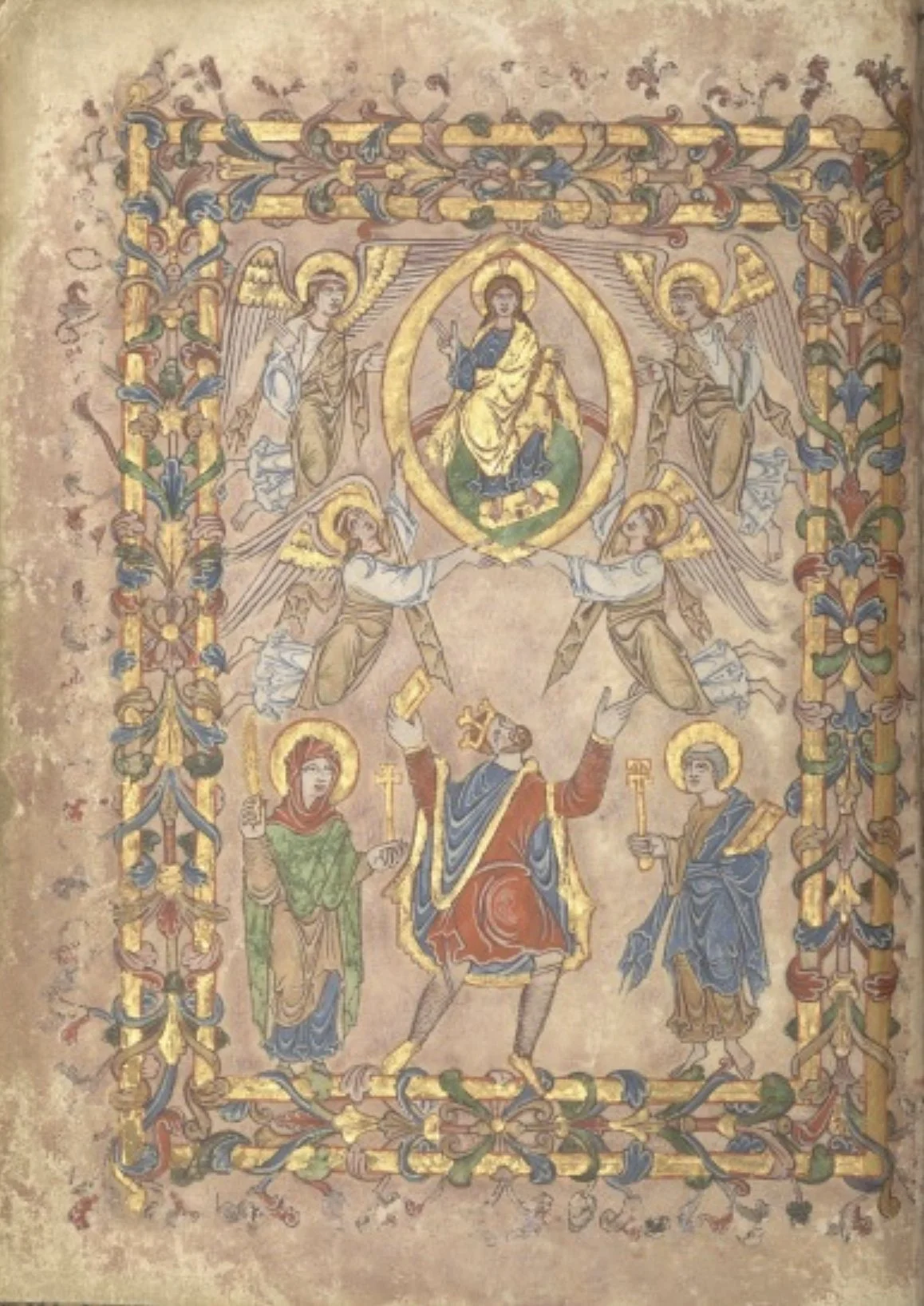
King Edgar with the Virgin Mary, St. Peter, Christ in Majesty and angels. New Minster Winchester https://britishlibrary.typepad.co.uk/digitisedmanuscripts/anglo-saxon/page/5/
Neither do I think either of them would have seen a Saxon illuminated manuscript, so where did the angel in Ross come from? Are skinny angels archetypal? Are the fat cherubs our graves are blessed with an affectation of Victorian times? Sarah died in 1836.
https://ritualprotectionmarks.com/2022/12/23/a-discovery-of-angels-how-an-anglo-saxon-chapel-gave-up-its-secrets/
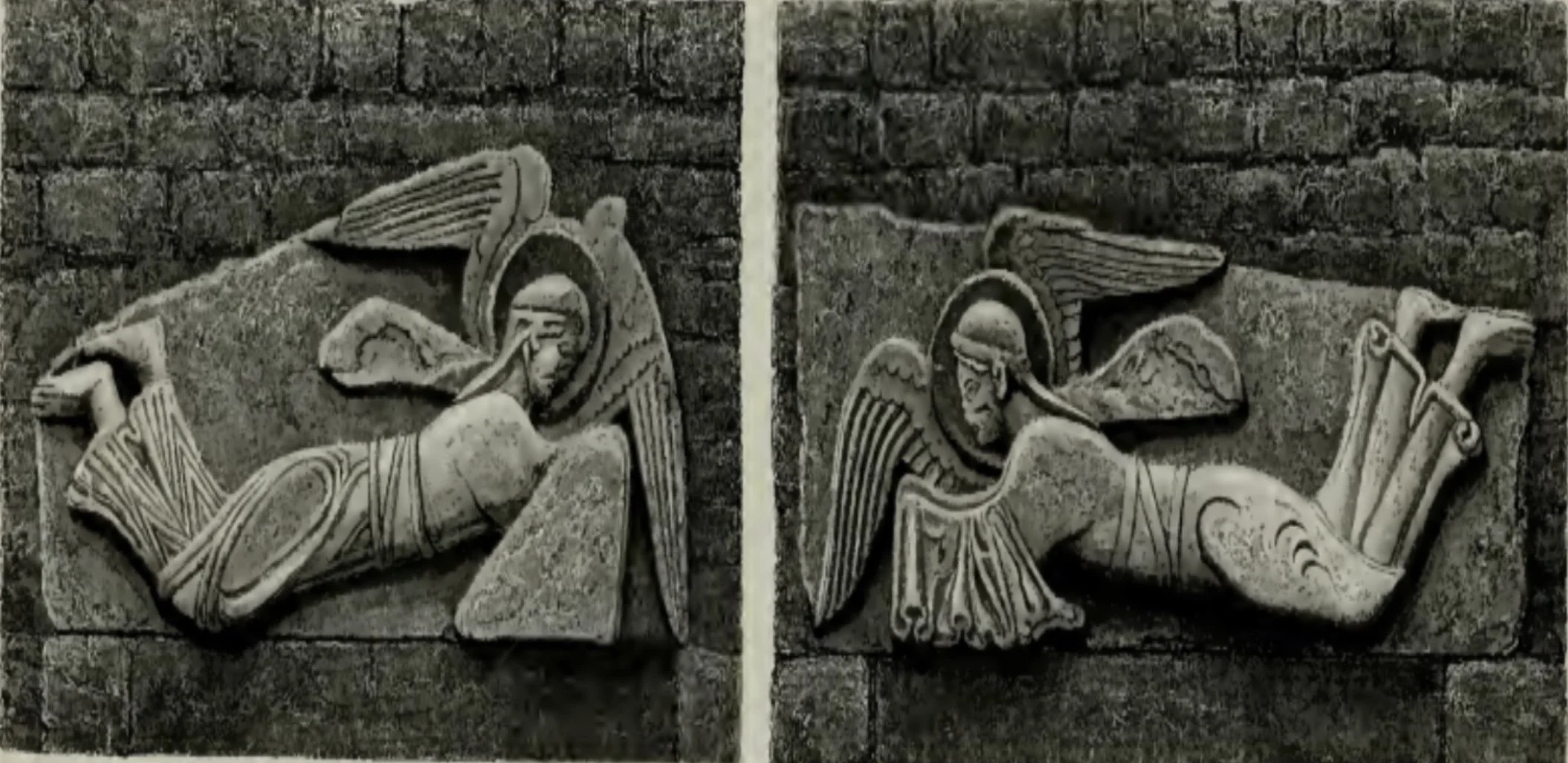
19th C engraving of the saxon angels (Wayne Perkins)
In 1857, Canon Jones, the Vicar of Holy Trinity church over the narrow street, became interested in the old building and he began to untangle its history. He recorded that the angels were embedded in the masonry high on the chancel arch, implying they were obscured. At some time, another floor was added to the chapel when it became a school. Whether the angels were made safe from school boys or protestants, I do not think anyone knows. They survived both. The scars on the chapel’s masonry indicate where the beams had been to support the upper floor; where the south porticus had been; where windows and a door had been cut through the ancient masonry of the north face to turn the chancel into a residence;
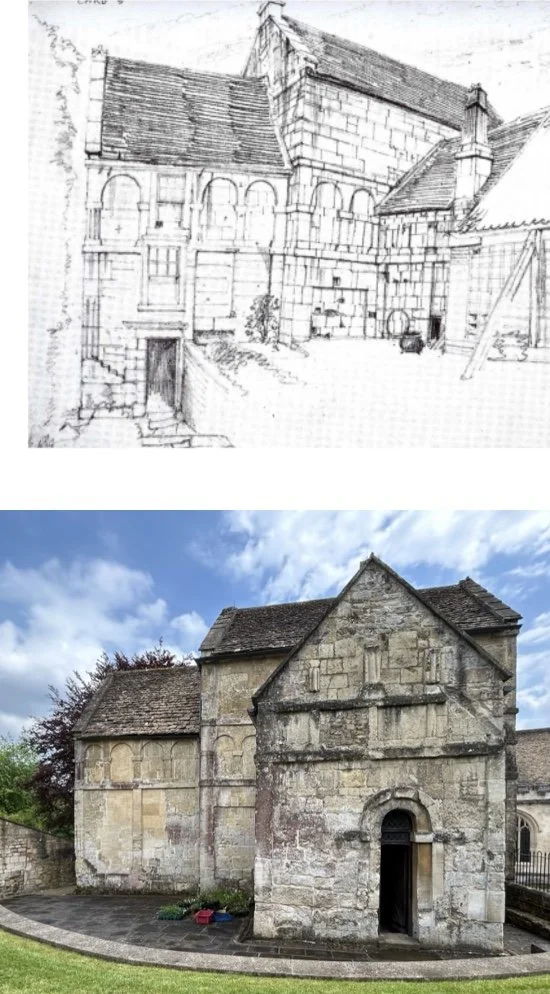
Under the chancel. to the left of the photograph, was a crypt, with a door to the outside, now covered with the paved area. What treasures are on the walls in there? Wayne Perkins has photographed compass inscribed circles, a five pointed star and rosettes which are called hexafoils now.
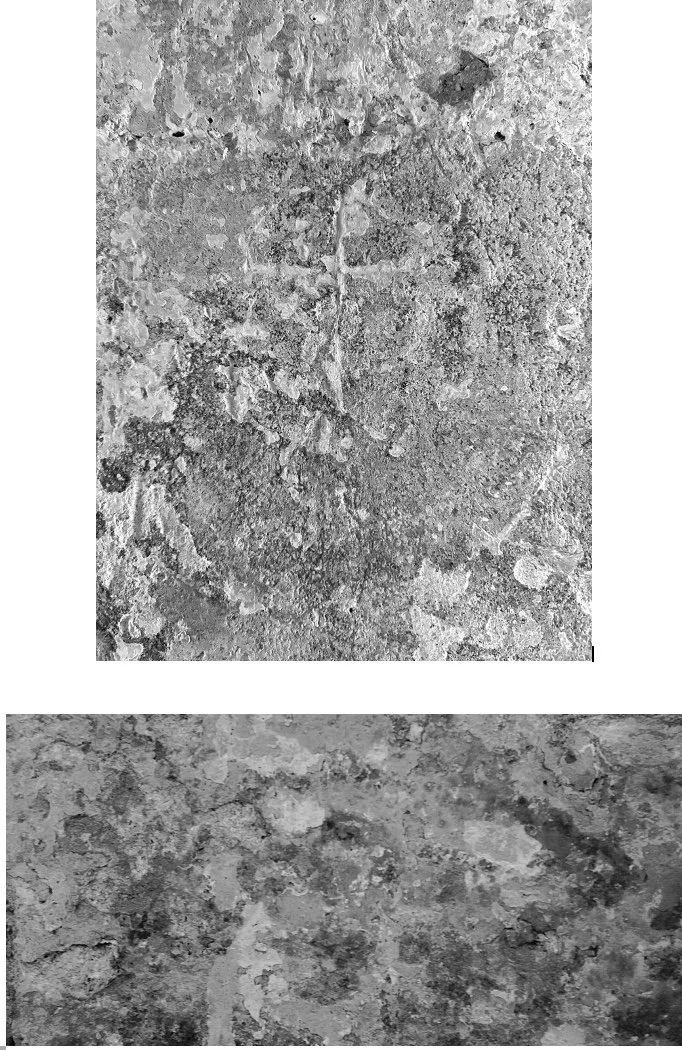
Top: a Christian cross, a crucifix, once within a circle, the centre of which seems to be the centre o the cross.
.Lower: a Christian symbol of a fish
The marvellous thing about graffiti like this is that the figures were masons’ marks likely inscribed in the tenth century.
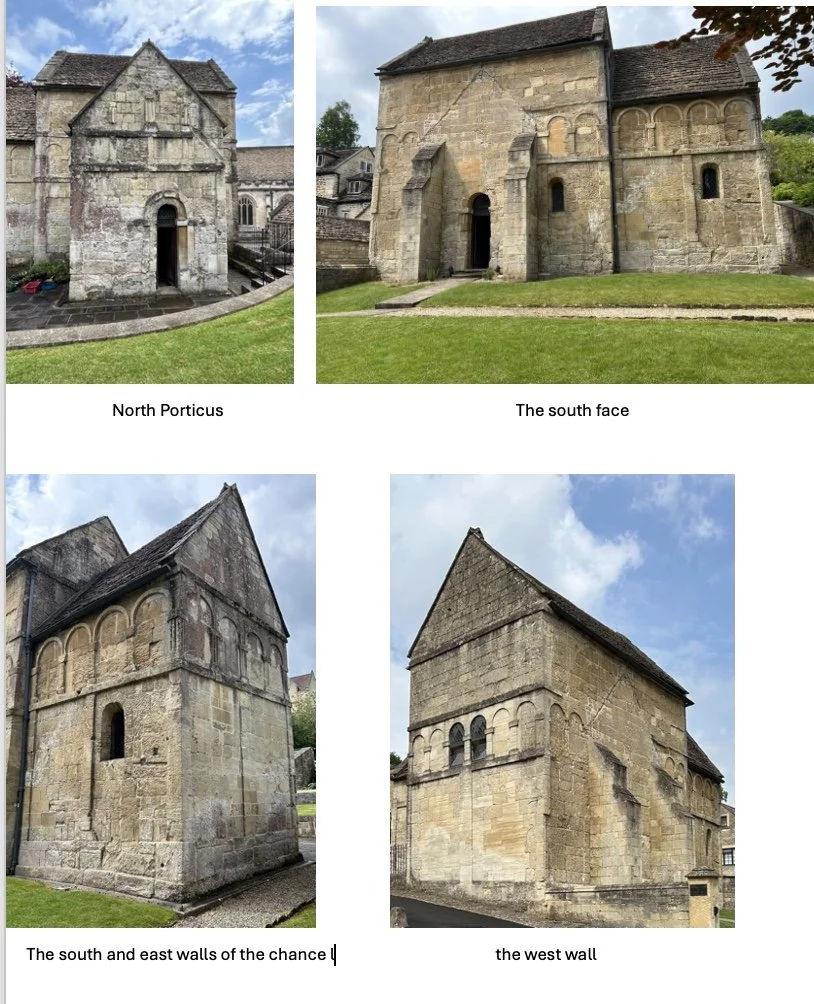
The Saxon Church of St Laurence, Bradford on Avon
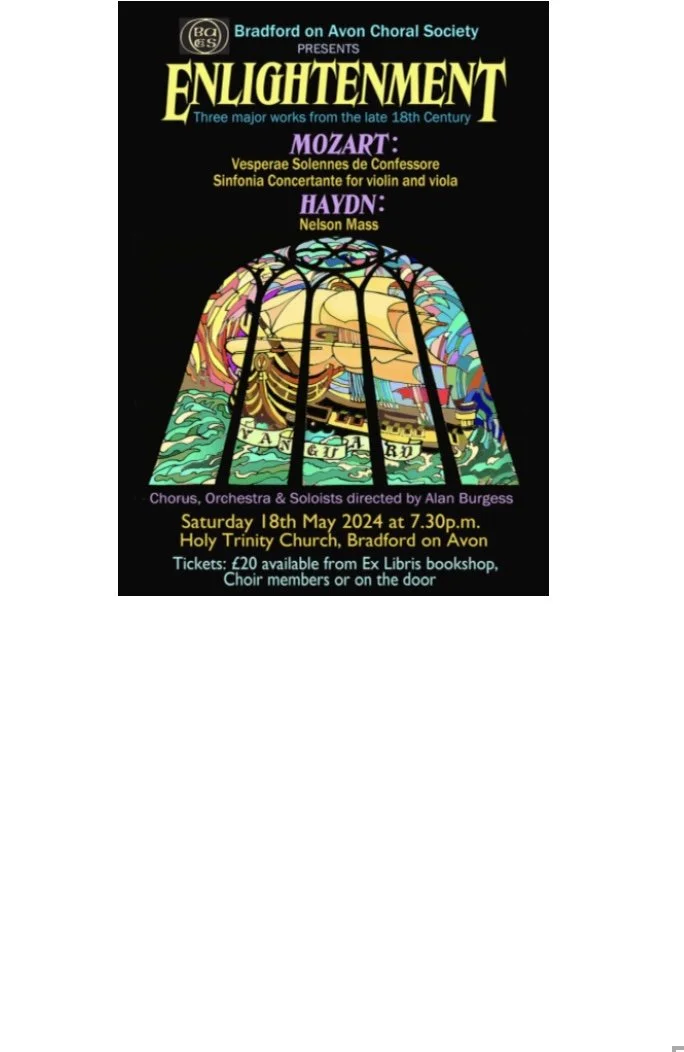
I left this chapel with heartfelt reluctance. I could have been visiting Bath but was perfectly content to have gone no further than here. By chance, there was a thunderstorm while I was in the chapel and the Bradford on Avon choral society was practising for a concert to be performed tonight in the Holy Trinity Church. The combination of sounds moved me almost to tears. I went into the church and was blessed to hear a Haydn Mass and a Mozart Concertante for violin and viola sung and played as beautifully as could ever be. Uplifted, I walked the four miles back to Limpley Stoke.